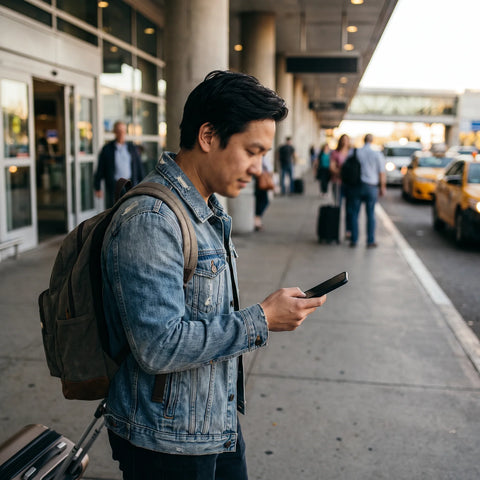
In short: an eSIM for solo female travelers is the fastest way to get mobile data as soon as you land, without relying on hotel WiFi or a physical card. It's installed before you leave home, works in Dual SIM mode alongside your Spanish line, and lets you share your location, use maps, and call via apps from minute one.
Traveling solo isn't inherently risky, but it does change how you prepare. When you travel with company, connectivity is shared: if you run out of data, you use the other person's phone. Alone, that safety net doesn't exist, and that's where an eSIM stops being a convenience and becomes part of your safety kit, on par with writing down the hotel's location in case your phone runs out of battery.

Why connectivity is a safety issue, not just a convenience
Think about the real-life situations where a solo trip gets complicated: your flight is delayed and the hostel reception is closed, the taxi from the station drops you on an unfamiliar street, or you simply need to confirm with someone at home that you've arrived safely before going to bed. In all these cases, the problem isn't a lack of bravery, it's a lack of data. Airport WiFi asks for a local phone number for SMS verification (one you won't receive without active roaming), and accommodation WiFi sometimes simply doesn't reach the street door.
The eSIM solves that specific gap: as soon as the plane lands and you activate airplane mode, you have your own data, without struggling with any router. You can open the map, order a car, text whoever is waiting for you, or simply check that the accommodation address is the one you had noted down.
What an eSIM is and why it's good for solo female travelers
An eSIM is a digital SIM card integrated into the phone itself: there's no plastic to insert or tray to open with a clip. It's activated by scanning a QR code or with a link, and in most modern phones (iPhone from XS, much of the Android range from 2021) it coexists with your physical line without replacing it. If you've never installed it, this step-by-step installation guide provides the complete process with screenshots.
The difference compared to roaming from your Spanish operator is mainly predictability: with roaming, the cost can skyrocket outside the European Union, and sometimes you don't know how much you'll pay until the bill arrives. With a data eSIM purchased before you leave, you know exactly what you've contracted and when it runs out. If you want to compare both options in more detail, we explain it in eSIM vs. roaming.
Set up Dual SIM in five minutes, before leaving home
This is the only thing that truly makes a difference in safety: traveling with two active lines at once. Your physical Spanish SIM remains reachable on your usual number (for family calls, banks, two-factor authentication for your apps), and the eSIM carries the destination's data. Install it at home, with your WiFi, not in an airport taxi or stuck to the hostel router on the first day:
- Before leaving home: buy and install the eSIM with your usual WiFi. The QR is scanned only once and is saved on your phone, ready to activate upon landing.
- Keep your Spanish SIM as the primary line for calls and SMS, and the eSIM as the data line. This way, you remain reachable on your usual number.
- Add an ICE (In Case of Emergency) contact to your phone's lock screen. On iPhone, this is done from the Health app; on Android, from Emergency medical information.
- Share your real-time location with a trusted person: Google Maps → profile picture → Location sharing, or Find My iPhone on iOS. There's no need to notify every hour, just leave it active for the duration of the trip.
- Save the contact for the Spanish embassy or consulate in the country you're landing in, and the local emergency number (not all countries use 112).
A detail that almost no one checks: activate "Data Roaming" for the eSIM in Settings, but leave the physical SIM on "Don't use data." It's easy for your phone, by default, to try to use both and charge you roaming without you realizing it until the bill.
Apps that solo female travelers actually use
There's no need to fill your phone with apps you won't open later. These are the ones that make real sense during your trip, and all depend on having data available at all times, not just when you find WiFi:
- Google Maps with offline map downloaded: download the area before leaving your accommodation each day. If the eSIM fails for a moment or you enter a subway tunnel, the map still works.
- Share location (Google Maps or Find My iPhone): the most useful function and the one least activated. It takes a minute to set up and provides real peace of mind to those at home.
- Translator with offline language pack downloaded: in rural areas or on the subway, offline voice translation saves more than one awkward situation.
- WhatsApp for embassy contact: several embassies and consulates handle non-urgent inquiries via WhatsApp, which uses much less data than a call.
- Country-specific transport apps (Uber, Grab, Bolt, Kakao T depending on the region): having the app installed and payment configured before landing avoids relying on finding a trustworthy taxi on the street.
All these apps are useless without available data: there's little point in having the app installed if, upon getting off the plane, your phone is "no service" until you find working WiFi.
Destinations popular with solo female travelers and what to expect from coverage
A destination's safety reputation and the quality of its mobile coverage don't always go hand in hand, and it's worth knowing this before booking. A country might be known as peaceful yet have rural areas with poor coverage, or vice versa.
| Destination | Reputation among solo female travelers | What to expect from coverage |
|---|---|---|
| South Korea (Seoul, Busan) | Highly valued for urban safety and night transport | Excellent mobile network in cities; you can delve deeper into our eSIM guide for South Korea |
| Australia and New Zealand | Very active travel community, infrastructure designed for tourism | Good on the coast and in cities, more irregular inland; details in this guide for Australia and New Zealand |
| Peru (Machu Picchu route) | Very busy route, with an established backpacking community | Cuts out in mountain sections and at Machu Picchu itself; it's advisable to plan ahead, we cover it in the complete eSIM route in Peru |
| Colombia (Medellín, Bogotá, Cartagena) | Tourist and co-working areas highly rated; it's advisable to check neighborhood by neighborhood | Good in the tourist areas of large cities |
No coverage table replaces checking official travel advisories before booking. The eSIM gives you connectivity, not judgment about the destination: that's still up to you.
Myths and what almost no one tells you
There's a lot of noise around eSIMs and safety for solo female travelers. Here are some things worth clarifying before you go:
"With an eSIM, I can call emergencies like my regular line." Not exactly: a data-only eSIM does not include a phone number for voice calls. To call 112 or the local equivalent in a real emergency, most phones allow dialing the emergency number with any active card, even without credit, but it's advisable to check in advance for the specific destination and not take it for granted in all countries.
"If I have an eSIM, I don't need to tell anyone my route." On the contrary: the eSIM makes it easier to share your location, but it doesn't replace the habit of telling someone where you'll be sleeping that night. Combine them: share your real-time location AND send a message when you change cities.
"All eSIMs in the world work the same in any country." No. Each destination or region has its own contracted coverage, so if your trip crosses several countries, it's advisable to check exactly what the plan you buy covers, and not assume that "international" means "the whole planet."
"It's enough to install the eSIM upon landing." This is the most common mistake: installing it requires WiFi, and often airport WiFi asks for an SMS verification that you won't receive if your Spanish line doesn't have active roaming yet. Install it at home, calmly, and activate it (which is a separate step, and you can do it at your destination) upon arrival.
"In countries with internet restrictions, the eSIM gives me free access anyway." That's not how it works. In destinations where the government blocks certain apps or websites, the eSIM gives you data, but the blocking still applies just as with any other connection. That's where a VPN comes in, which is a different layer than the eSIM: we explain it in detail in eSIM and VPN for private travel.
When you DON'T need to buy an eSIM
Being honest is also part of being well-prepared for travel. If your trip is within the European Union with your current Spanish plan, you probably already have data included without roaming charges: for a weekend in Lisbon or Paris, you don't need to buy anything, your own line covers you. It also doesn't make much sense if your accommodation has stable WiFi and your plan is not to leave the hotel except for organized excursions with a guide and transportation included: there, the margin for needing your own emergency data is much smaller. Where it does make a difference is for trips outside the EU, on routes where you're traveling alone independently, or for any plan where you depend on finding transportation or accommodation on the fly.
If you're still not sure which plan fits your route, these tricks for saving data on your trips provide guidelines to avoid running out or overpaying. And if your destination involves several European countries in a row, the Europe eSIM is usually more cost-effective than buying a plan country by country.
Frequently Asked Questions
Does an eSIM work for calling 112 or local emergencies?
It depends on the country and the type of eSIM. In many destinations, you can dial the local emergency number with any active card, even without credit, but it's not a universal rule. If you're traveling with Dual SIM, your Spanish line can usually make voice calls with roaming (at a cost), so keep it active as a backup for such calls.
Can I share my real-time location with my family using the eSIM?
Yes, and it's one of the most useful functions for solo travel. With Google Maps' Location Sharing or Find My iPhone, the person you choose can see you on the map in real-time as long as your eSIM has active data. Activate it on the first day and leave it running throughout the trip.
Is it safe to install an eSIM connected to hotel or airport WiFi?
The installation itself uses an encrypted connection, so technically there's no problem. Even so, it's most convenient to install it at home before you leave: this avoids relying on public WiFi precisely when you need it most for navigation.
Does an eSIM work in destinations with internet access restrictions?
An eSIM provides mobile data, but it doesn't bypass government blocks on specific apps or websites. If your destination has these types of restrictions, you'll need to combine it with a VPN, and even then, it's advisable to check beforehand: rules vary by country, and not all VPNs are legal everywhere.
What if my phone doesn't support eSIM?
Not all phones support it: generally, iPhones from the XS onwards and a good portion of high-end and mid-range Androids from 2021 include it. Before buying, check your phone's settings (or the manufacturer's website) to confirm that your specific model is compatible; if it's not, you'll need a physical SIM card.
Can I call the Spanish embassy with a data eSIM?
A data eSIM does not include a voice number, so you cannot call directly with it. To contact the embassy, use your Spanish line with roaming or check if they have a WhatsApp or email channel, which uses much less data and usually responds just as quickly for non-urgent inquiries.
Do I need to buy an eSIM for each country if I'm doing a multi-country route?
Not always. There are regional plans (for example, for several European countries) that cover the entire route with a single installation, avoiding the need to activate a different eSIM at each border. Check exactly which countries the plan covers before buying it, because "regional" doesn't always mean "all countries in the area."