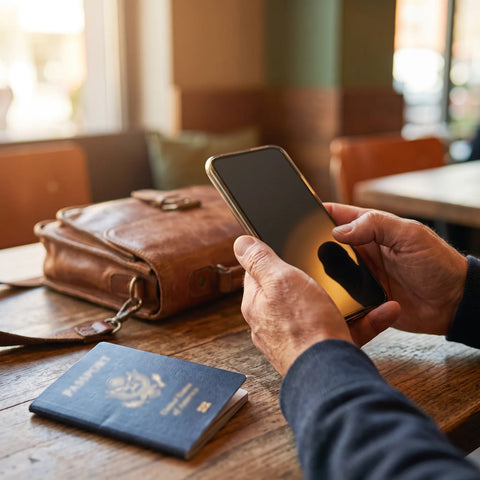
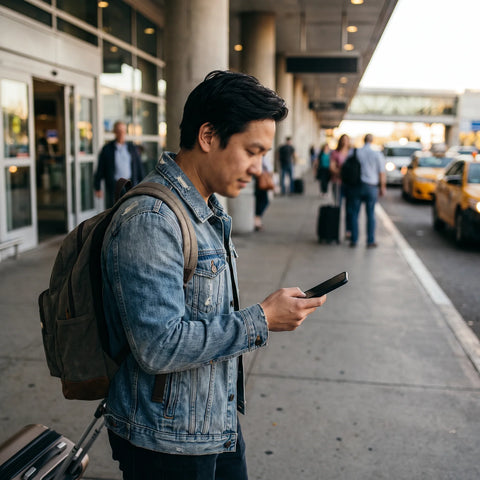
In short: To travel the Pan-American Highway with an eSIM, the most practical approach is to combine segment-based plans—North America, Central America, and South America—instead of a single, cheap global eSIM. You install each eSIM via QR code before crossing the border and activate data instantly, without roaming and without having to switch physical SIM cards.
What an eSIM is and why it's so suitable for this trip
An eSIM is a SIM card integrated into the mobile phone itself: instead of a physical chip that you insert and remove, you download an operator profile using a QR code. If you've never used one, you should first read what a virtual eSIM is before leaving home, because understanding the concept will save you doubts at a border crossing with poor Wi-Fi coverage.
On a months-long trip like the Pan-American Highway with an eSIM, this flexibility is invaluable: you carry several profiles installed at once—one per segment or country—and only activate the one you need, without touching anything physical on your phone or having to find a store when crossing a remote border post.
Long-haul travel hack: name each eSIM in your phone's settings ("USA-MX", "Central", "South") so you know at a glance which one to activate when crossing.

Is one eSIM enough for the entire Pan-American Highway?
No, at least not economically. The Pan-American Highway crosses fourteen countries with different operators, so it's realistic to combine regional packs instead of pursuing a single "all-inclusive" plan. A North America eSIM covers the USA, Canada, and Mexico; another multi-country eSIM covers a good part of South America; and Central America is handled country by country.
The big advantage over a physical SIM remains the same: you don't waste hours looking for a phone shop at each border. You install the eSIM for the next segment via QR code while waiting at immigration control, and when you cross, you already have data. Think of the route as three connectivity blocks: north, central, and south, each with its own plan and usage logic.
One nuance that many people overlook: not all phones support several active eSIMs at once (some allow one eSIM plus one physical SIM, or two eSIMs but only one with active data). Check your model's specifications before buying three or four plans for the trip.
North America segment: USA, Canada, and Mexico
The classic start of the Pan-American Highway (or its end, depending on the direction) combines three large countries with good urban coverage. In the United States, data relies on networks like AT&T and T-Mobile; in Canada, on Rogers, Bell, and Telus; and in Mexico, on Telcel, which has the widest coverage on the road. A regional North America eSIM saves you from activating three separate plans.
For this segment, you can rely on an eSIM for the United States if your journey is concentrated in North American territory, and supplement it as you enter or exit via Canada or Mexico. The Baja California strip and the Sonora Desert have areas without signal: download maps before you leave. This is where an eSIM that switches between several operators makes a difference, moving from one network to another without you having to do anything.
A detail that almost no one checks: near the border between the USA and Mexico, or between the USA and Canada, the phone sometimes temporarily "hooks" onto an antenna from the neighboring country. This is not an eSIM fault; it's signal geography, and it corrects itself as you move a few kilometers away from the border line.
Central America: from Guatemala to Panama
The Central American segment is the most fragmented: Guatemala, El Salvador, Honduras, Nicaragua, Costa Rica, and Panama—six countries in just a few days of driving if you go fast. Local operators (Claro, Tigo, Kolbi in Costa Rica) have decent coverage in capitals and on the coast, but it's spotty in mountains and jungles.
Our recommendation is to rely on short country packs for segments where you'll stop for several days, and handle quick crossings with whatever you have active from the previous segment. Be careful with the Darién Gap between Panama and Colombia: there's no road, so most people ship their car or fly, and you won't have coverage for hours there. It's a good time to have everything you need downloaded offline.
| Segment | Main Countries | Road Coverage | Recommended eSIM Strategy |
|---|---|---|---|
| North | USA, Canada, Mexico | High in cities, medium in desert | One regional eSIM for all three countries |
| Central | Guatemala to Panama | Medium, low in mountains and jungle | Short country packs for where you stop for several days |
| South | Colombia to Argentina | High on coast and in capitals, low in Andes/Patagonia | South American multi-country eSIM |

South America: Colombia, Peru, Chile, and Argentina
The southern block is where a multi-country eSIM truly shines: you can connect Colombia, Ecuador, Peru, Chile, and Argentina without changing your plan every few days. The main operators are Claro and Movistar, with Entel strong in Chile and Peru. Coverage is solid on the coast and in capitals, but drops off in the Andes and Patagonia, where you can spend entire stretches without a single bar.
If your route starts in Colombia, review the guide to eSIM in Medellín, Bogotá, and Cartagena first. And if your plan includes Machu Picchu or any Andean section, also check out the guide to eSIM for Peru and the route to Machu Picchu, because mountain coverage has its own peculiarities. On the Chilean Carretera Austral or Argentina's Route 40, assume you'll spend hours without a signal: download music, maps, and reservations in advance.
How many GB you need per segment
On a trip lasting weeks or months, data consumption skyrockets if you don't control video streaming and automatic photo uploads. As a general reference, a traveler who uses maps, messaging, some social media, and uploads photos uses about 1 GB every two or three days. If you work remotely or make frequent video calls, multiply that figure by three.
- Light use (maps + WhatsApp): 3-5 GB per month per segment.
- Medium use (social media + photos + some video): 8-12 GB per month.
- Digital nomad (work + video calls): 20 GB or more per month.
The advantage of an eSIM is that you can top up or change plans on the fly without having to find a physical store. If you run short in Peru, you can add more data from your phone and continue driving without interruptions. To make the most of each GB, especially in areas with weaker signals, check out these tips for saving data with an eSIM on a long trip: they can significantly change your actual consumption compared to what you estimate on paper.
How and when to activate each eSIM when crossing the border
If you've never installed an eSIM, practice with the first one before leaving home: the process is explained step-by-step in how to install an eSIM. Installation requires Wi-Fi (to download the profile via QR), but you can save the activation for when you actually plan to use it.
The sequence that works best on a long road trip is this:
- Before leaving Spain: install the eSIMs for the first segment at home, with good Wi-Fi.
- A few days before crossing: check that the plan for the next country is still installed and has available data; if not, buy it in advance.
- At the border control or upon landing: activate the new plan and deactivate (without deleting) the old one, so that the phone doesn't try to use two networks at once.
Many plans allow you to leave the profile installed and only "start" it when you arrive, without the validity beginning to run prematurely. Install calmly, but activate only when you need it.
Actual coverage on the road and in remote areas
The Pan-American Highway is not a continuous freeway: it alternates hyper-connected cities with stretches of desert, jungle, and high mountains where no network reaches. No eSIM (or physical SIM) provides coverage where there is no antenna, so the key is not the operator but preparing for signal gaps.
Before each long stage, download offline maps from Google Maps or Maps.me, save accommodation addresses, and inform your loved ones when you'll have coverage again. A good trick is to use your phone as a hotspot only in areas with signal, and activate data saving the rest of the time. This way, you stretch your GBs and avoid surprise downloads; if you're traveling in a group, a single eSIM shared via hotspot can cover everyone in sections with good network.
Regional eSIM vs. Global eSIM vs. Physical SIM: what's best for each segment
Not all options work equally well for such a long trip. Quick comparison to decide what to use in each block:
| Option | Main Advantage | Weakness | When to use it on the Pan-American Highway |
|---|---|---|---|
| Regional eSIM (per block) | More adjusted price per GB within that area | Must change plans when leaving the block | Bulk of the trip: North America, Central, and South separately |
| "All-in-one" Global eSIM | One plan, zero management at borders | Price per GB is usually more expensive compared to regional packs | Short segments with many consecutive borders or as a temporary safety net |
| Local Physical SIM | Local operator rates, sometimes very competitive | Must find a store, change the chip, and repeat in each country | Long stays in a single country where you will remain for weeks |
In practice, most people combine the first two: a regional eSIM as a base, and if a pack doesn't cover a certain country, an emergency global eSIM as a backup plan to avoid being cut off.
Common mistakes and myths on such a long journey
The number one mistake is leaving your Spanish card's automatic roaming activated as a "backup network": upon crossing into the USA or any country outside the EU, the bill can skyrocket with rates exceeding several euros a day, and often the user doesn't even realize it until the charge arrives. That free roaming only applies within the EU due to European regulations: outside Europe, the logic changes completely.
A widespread myth is thinking that a single "global" eSIM is always cheaper because it's "all-in-one." This is not the case: the price per GB is usually higher than for regional packs because you pay for the flexibility of working in dozens of countries you won't even visit. Before deciding, carefully compare eSIM versus traditional roaming for your specific situation.
Other common pitfalls: not checking that your phone is eSIM-compatible before leaving (some "unlocked" phones from specific markets have the feature factory-blocked), forgetting to activate the plan when crossing the border, and not having a second connectivity option for critical sections. With these controlled and maps downloaded, the trip is much smoother.
What almost no one tells you
Details you only learn by traveling the route or talking to those who have already done it:
- Hotel and gas station Wi-Fi in remote areas are the most common entry points for phishing attempts. If you connect to public networks to save data, consider using a VPN while traveling to avoid exposing passwords or banking details.
- An eSIM's validity usually starts counting from the first data connection, not from the purchase. Buy in advance to have the QR ready, but don't activate it until you're actually going to use it.
- In high-altitude Andean areas, the battery drains faster constantly searching for a signal. If you're going to spend hours with intermittent coverage, activate airplane mode and only check your phone during stops.
- Not all eSIMs allow hotspot. If you're traveling in a group and plan to share a connection, confirm this before buying the plan: some operators restrict it or charge separately.
- Save a screenshot of each eSIM's QR code, not just the confirmation email. If you lose Wi-Fi just when you need to reinstall a profile, having it in your gallery will save your day.
Frequently asked questions
Can I do the entire Pan-American Highway with a single eSIM?
In practice, not economically. The usual approach is to combine a regional eSIM for North America, country-specific packs in Central America, and a multi-country eSIM for South America, paying only for the coverage you use and avoiding the overprice of a single global plan.
Will I have coverage in mountain and jungle segments?
Partially no. In the Andes, Patagonia, the Sonora Desert, or near the Darién Gap, there will be hours without signal, and no eSIM can fix this because there are simply no antennas in those areas. Download offline maps before entering remote segments, regardless of the operator you use.
When do I activate the eSIM for each country?
Install it via QR in advance (you need Wi-Fi for the download) and activate it when you cross the border or land. Many eSIMs allow the plan to be installed without "starting" it, so you don't waste validity days prematurely.
How many GB do I need for several weeks on the road?
For medium use (maps, messaging, photos, and some video), estimate between 8 and 12 GB per month per segment. If you work remotely or make video calls, increase that to 20 GB or more. The good thing about an eSIM is that you can top up data from your phone if you run short.
Can I share the connection with my travel companions?
Yes, most plans allow data sharing via hotspot, though it's advisable to confirm when purchasing, as some operators limit it. One person carries the active plan, and the rest connect in areas with good coverage, monitoring usage because hotspot consumes data faster.
What if my phone doesn't support two eSIMs at once?
You can still have several eSIMs downloaded, but only one active at a time: when crossing a border, you go into settings and manually switch which one is active. It's not a real problem, just an extra step to consider.
Is it cheaper to use a local physical SIM than an eSIM on such a long trip?
It depends on the country and how many days you stay. For long stays within the same country, a local physical SIM can be competitive, but it involves finding a store and repeating the process at each border. For a fourteen-country journey over weeks or months, an eSIM usually pays off due to the time you save.
Conclusion
The Pan-American Highway is much more enjoyable when connectivity isn't a concern at every border. By combining regional packs, controlling your GBs, and downloading maps for areas without signal, you can travel from Alaska to Patagonia always reachable, without surprise roaming charges, and without wasting hours searching for a phone store. Choose your eSIM for each segment of the route and start your trip with your phone ready from the first kilometer. Explore all available plans in our eSIM catalog.