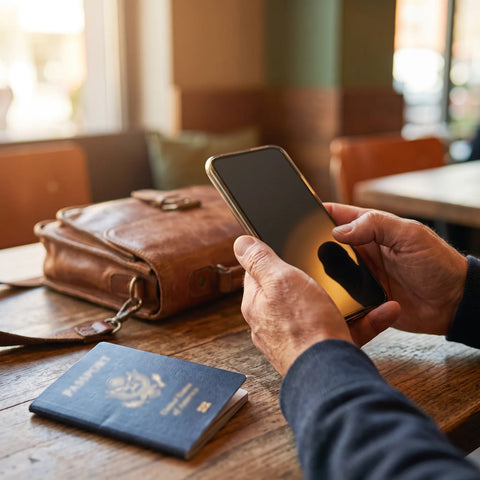
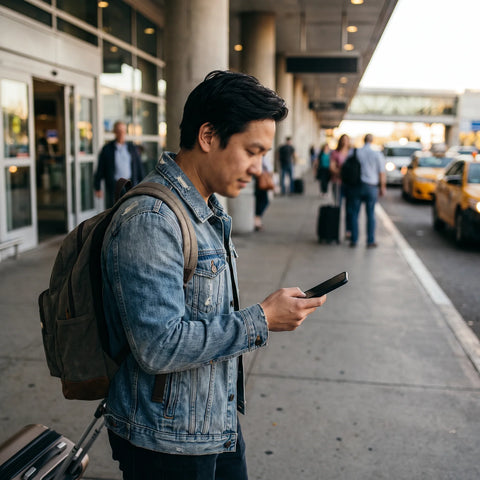
You land in the United States, take your phone off airplane mode, and... nothing. No data, no maps, no way to call an Uber or let anyone know you've landed. A USA eSIM solves precisely that: you connect to the network as soon as you touch down, without expensive roaming from your carrier and without searching for a SIM card store at the airport. In this practical guide, we'll tell you how a USA eSIM works, how much coverage you'll have, how many GB you'll need depending on your trip, how to activate it in a minute with a QR code, and what details to keep in mind (from ESTA to mobile-paid tips). If you're going to New York, Los Angeles, Miami, or Las Vegas, this is for you.
Why you need data in the United States
The United States is a huge country and very non-analog: almost everything is managed from your phone. You'll need active mobile data from the very first moment for tasks we take for granted at home, but which are essential there. Thinking you'll rely solely on free WiFi is a mistake: hotel WiFi is usually slow, cafe WiFi requires registration, and on the street, there simply isn't any.
- Maps and navigation: Google Maps or Apple Maps to get around immense cities and for driving if you rent a car.
- Transportation: apps like Uber, Lyft, or the New York subway operate in real-time and require a connection.
- Payments and reservations: many restaurants require reservations via app, and tips are calculated on the card terminal.
- Staying in touch: WhatsApp, internet calls, and sharing your trip with loved ones.
With PuraSIM, you keep your Spanish number and your usual WhatsApp while browsing with the eSIM, so you continue to receive messages and SMS verifications without paying a fortune. If you still have doubts about the technology, we explain it in what is an eSIM.
Coverage and networks: who you connect to
The great advantage of traveling to the United States is that it has three major carriers with very solid national coverage: AT&T, T-Mobile, and Verizon. A travel eSIM is not a new carrier: what it does is connect you as a guest to these local networks, just like an American SIM card would, but without a contract or an American number.
This means that the quality of your connection is the same as that of a resident: widespread 4G LTE and 5G in major cities and many suburban areas. In urban centers and main roads, coverage is excellent; in very remote national parks, mountainous areas, or deep deserts, there may be stretches without signal, which is also true for any local mobile phone.
A travel eSIM does not replace American networks: it gives you access to them. That's why you browse on the same AT&T, T-Mobile, or Verizon infrastructure that any American uses, without having to contract anything with them.
Another key difference from traditional roaming: with an eSIM, there are no surprises on your bill. You pay for a fixed plan before traveling and browse on those networks until you run out of data, with no per-minute surcharges or hidden fees. This is the same logic we apply to other destinations, such as our 30-day Europe eSIM.

How many GB you need depending on your trip
The million-dollar question: how many GB to buy. It depends on your travel style and the number of days you spend in the United States. Light use (maps, messaging, some searching) consumes little; if you're going to upload a lot of stories, make video calls, or stream, you'll need much more. This table gives you a realistic reference so you don't run out or pay too much.
| Trip type | Approx. daily usage | Recommended GB (10 days) |
|---|---|---|
| Light (maps, WhatsApp, email) | ~0.3 GB/day | 3 GB |
| Medium (social media, photos, navigation) | ~0.5 GB/day | 5 GB |
| Intense (videos, stories, constant maps) | ~1 GB/day | 10 GB |
| Heavy + hotspot (work, streaming, other devices) | ~2 GB/day | 20 GB |
As a practical rule: for a normal week of tourism, between 5 and 7 GB is usually more than enough if you connect to hotel WiFi at night. If you're going for two or three weeks, a more flexible plan or one with a top-up option is better. You have a more detailed guide in how much data do I need to travel.
How to choose your eSIM plan
Not all plans are created equal, so it's worth looking at some key details before buying. Choosing wisely avoids the classic scare of running out of data halfway through your trip or paying for gigabytes you won't use.
- Destination coverage: Make sure the plan covers the continental United States (and Hawaii or Alaska if you're going there).
- Data volume: Use the table above and add a 20% margin just in case.
- Validity: Check the duration of the plan; it should cover your entire trip.
- Hotspot included: If you want to share data with your laptop or tablet, confirm that it allows connection sharing.
- Support: It's better to have someone to contact if something goes wrong, ideally in your language.
With PuraSIM, all plans for the United States include hotspot for sharing your connection, you keep your number and WhatsApp, and you have 24/7 Spanish support in case any questions arise during your trip. Once you're clear, you can choose your eSIM for the USA in a couple of clicks.
How to activate the eSIM step by step
Activating an eSIM is much easier than it seems: there's no need to go to a store or change your phone's physical card. Everything is done with a QR code that you receive by email after purchase, and the entire process takes about 1 minute. Ideally, you should install it with WiFi at home before leaving and have it ready to activate upon arrival.
- Purchase your plan and receive the QR code by email.
- On your phone, go to Settings > Mobile Data (or Connections) > Add eSIM.
- Scan the QR with your camera when prompted.
- Assign the eSIM as your data line and leave your Spanish SIM for calls and SMS.
- Upon landing in the United States, activate the eSIM data and that's it: you're connected.
You need an eSIM-compatible phone (most iPhones since the XS and recent mid-to-high-end Androids) and it must be unlocked. If you install it before traveling, upon arrival you just need to activate the data switch. It's the same simple process you'll see in destinations like our 7-day Japan eSIM.
Top cities: NY, LA, Miami, and Las Vegas
Each major city in the United States has its own rhythm, and mobile data changes the experience in all of them. These are the four most visited and how to take advantage of the connection in each.
- New York: the subway is the fastest way to get around, but you need the app and maps to avoid getting lost between lines. 5G coverage in Manhattan is excellent.
- Los Angeles: a city of enormous distances; without Uber/Lyft and in-car navigation, it's practically impossible to get around. Here, data is mandatory.
- Miami: beaches, South Beach, and excursions to the Keys or the Everglades. Useful for booking tours and sharing your trip on social media.
- Las Vegas: the Strip is full of WiFi, but it's slow and saturated; with your eSIM, you can book shows, restaurants, and transfers without relying on it.
In all four, you'll have 5G in practically all tourist areas, so speed won't be an issue for maps, streaming, or video calls home.

Tips before traveling: ESTA and data
Before thinking about connectivity, there's one procedure you can't skip: to enter the United States as a tourist, most Europeans need the ESTA, an electronic travel authorization that is applied for online on the official U.S. government website. It's advisable to process it several days in advance (it's not always approved instantly) and be wary of intermediary websites that overcharge.
- ESTA: apply on the official website in advance; it's mandatory and valid for several years.
- Data from the airport: install the eSIM before leaving so you have maps and can request transportation as soon as you land.
- Tips: in restaurants, 15-20% is expected, and it's almost always added to the card terminal, so your phone helps you calculate it.
- Useful apps: have Uber/Lyft, Google Maps, and your bank's app downloaded before traveling.
Keeping your Spanish number active (with the SIM for SMS and the eSIM for data) is very practical for receiving verification codes from the bank or apps. If you combine the United States with other trips, the same approach works, for example, for an eSIM for Morocco.
Prices and what to expect
The good news is that a travel eSIM is radically cheaper than the classic roaming from your carrier, where a single day of data in the United States can cost as much as a complete eSIM plan for your entire stay. This is the comparison that matters.
| Option | Typical cost | Cost control |
|---|---|---|
| Carrier roaming | High, per day or per MB | Low: bill surprises |
| Local physical SIM | Medium, but you have to buy it there | Medium: you lose your number |
| PuraSIM travel eSIM | Low, fixed plan from $1.49 | Total: pay upfront and no surcharges |
With PuraSIM, plans for the United States start from $1.49, you know exactly how much you're paying before you travel, and there are no surcharges or roaming. You activate with the QR in 1 minute, share with hotspot, keep your number and WhatsApp, and have 24/7 Spanish support. Once you've decided, all that's left is to choose your eSIM for the USA and pack your bags.
Conclusion
For your trip to the United States, an eSIM gives you data as soon as you land, without expensive roaming from your carrier and without having to find a store. Remember to process your ESTA authorization before flying and get your connection ready: choose your eSIM for the USA and travel worry-free.
Frequently asked questions
Does the eSIM work throughout the United States?
Yes. The eSIM connects to the major national networks (AT&T, T-Mobile, or Verizon), so you'll have coverage in all cities, major highways, and most suburban areas. In very remote national parks or deep desert areas, there may be stretches without signal, just like any local mobile phone experiences.
How many GB do I need for 1 week?
For a normal week of tourism (maps, WhatsApp, social media, and some photos), between 5 and 7 GB is more than enough if you connect to hotel WiFi at night. If you make many video calls, stories, or stream, estimate about 1 GB per day and choose a plan accordingly.
Can I use the hotspot to share data?
Yes. All PuraSIM plans for the United States include a hotspot, so you can share your connection with your laptop, tablet, or your companion's phone. Keep in mind that sharing consumes more data, so adjust your plan volume if you plan to use the hotspot extensively.
Does the eSIM include calls and SMS?
The travel eSIM is a data plan. For calls and SMS, the most convenient option is to keep your Spanish SIM active in the background (so you continue to receive SMS verifications) and make internet calls with WhatsApp or FaceTime using the eSIM's data. You keep your usual number.
When should I activate the eSIM?
Ideally, you should install it with WiFi at home before traveling, by scanning the QR code you receive by email, and leave it ready. Then, upon landing in the United States, you just need to activate the eSIM data switch and you'll start browsing instantly.
Is my phone compatible with eSIM?
Most recent phones are: iPhones from the XS, Google Pixels from the 3, and many Samsung Galaxy and mid-to-high-end Androids. The phone must also be unlocked. If you have doubts, you can search for the "Add eSIM" option in Settings; if it appears, your phone is compatible.