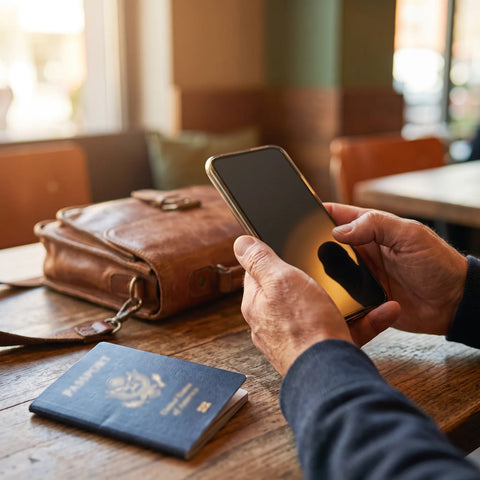
In short: an eSIM for the United Arab Emirates connects you to Etisalat or du networks as soon as you land in Dubai or Abu Dhabi, without expensive roaming or queues for a physical SIM card at the airport. Coverage is excellent in the city and becomes patchy in the deep desert. Watch out for one detail that surprises almost everyone: WhatsApp and FaceTime calls are restricted by local law, not by the card you use.
What is an eSIM and why is it the logical choice for the Emirates?
An eSIM is a SIM card that does not exist in physical form: it is a digital profile that is installed on your mobile phone by scanning a QR code. There is no need to pick it up, it does not occupy the SIM tray, and it coexists perfectly with your Spanish line, which remains active to receive SMS from the bank or calls while you browse with data from the Emirates. If you have never used one and want to fully understand the concept before buying, in what is a virtual eSIM we explain it from scratch.
The usual alternative, roaming from your Spanish operator, still works in the Emirates because the country has roaming agreements with European companies, but outside the European Union the cost skyrockets and many tariffs limit speed or charge per megabyte after a certain threshold. If you want to understand why roaming outside Europe is a different kettle of fish, we have a complete guide on what data roaming is and another directly comparing eSIM vs. roaming. For a week-long trip to Dubai, an eSIM is usually more cost-effective and gives you much clearer control over how much data you have left.
Real coverage in Dubai, Abu Dhabi and the rest of the Emirates
In urban areas, the signal is among the best in the world. You'll have 4G and, in much of Dubai and Abu Dhabi, 5G in the Burj Khalifa, Dubai Mall, the Marina, the Corniche, Yas Island, and virtually any three-star hotel and above. Dubai International Airport, one of the largest and busiest on the planet, has full coverage from the moment you get off the plane, so you can activate your eSIM at the boarding gate without waiting to reach the main terminal.
Outside the cities, things change. On a safari through the dunes of Al Marmoom or Al Awir, or on the road to Hatta and the Al Ain mountains, the signal becomes intermittent as soon as you move away from the main highway: there are stretches of several kilometers without coverage from any operator, not just yours. In organized Bedouin camps for tourists, many already have their own complimentary Wi-Fi in the tent area, but the 4x4 journey to get there usually goes without data. If your excursion includes an overnight stay in the desert, download offline maps of the area beforehand and notify anyone you need to that you will be without coverage for a few hours.
A detail that almost no one mentions: inside the Dubai Metro, which is largely elevated and partly underground, coverage is maintained even in the underground sections, which is appreciated if you are changing areas with your mobile as your only guide. However, in rooms with a lot of concrete and few windows, such as some galleries of the Louvre Abu Dhabi under the geometric dome, the signal drops a couple of bars; it's not an eSIM fault, it's the building.
If your route takes you to Sharjah, Ras al-Khaimah, or Fujairah, coverage remains solid in urban centers and on the beaches of the Gulf of Oman, and a bit more limited on the inland mountain roads, especially around Jebel Jais.

Etisalat and du: the operators that provide coverage for your eSIM
The Emirati market is dominated by two operators, and a good travel eSIM relies on their networks to give you the best available signal without you having to manually choose between one or the other.
| Operator | Strengths | Where it's most noticeable |
|---|---|---|
| Etisalat (e&) | Most extensive network in the country, good coverage also on intercity roads | Journeys between emirates, less central areas |
| du | Very strong in large cities, good speeds in dense areas | Dubai and Abu Dhabi, shopping malls, business districts |
Getting a physical SIM from either at the airport counter means passport registration, queuing, and tourist pricing for new arrivals. With an eSIM, you skip that process, and the connection is routed through the network that is working best in each area.
eSIM, physical SIM, or roaming: what suits your trip
Here's where it gets tricky, because the answer isn't always "buy an eSIM." If you're going to Dubai for a layover of less than four hours and won't leave the transit area, you'll probably be fine with the airport's free Wi-Fi and won't need to spend on data. If your Spanish plan already includes decent roaming in the United Arab Emirates (check the terms, as outside the EU it varies greatly from company to company) and you'll only be there for two or three days with light usage, it might be more worthwhile to use that plan than to buy something new.
Where an eSIM clearly wins is for stays of five days or more, when you use maps, social media, and some streaming daily, or when you want precise control over how many GB you've used without surprises on your bill when you return. Compared to buying a physical prepaid SIM at your destination, an eSIM also avoids losing your Spanish contact line, which is well explained in the comparison of international chip vs. eSIM.
How many GB do you need depending on your trip?
It depends on how you use your mobile, but for a typical week-long trip to Dubai with maps, social media, photos, and some streaming, a medium range is usually sufficient. These values are indicative, intended as a starting point.
| Travel Profile | Days | Approximate Data |
|---|---|---|
| Long layover or short city break | 1-3 | 1-3 GB |
| Tourist week in Dubai | 5-7 | 5-8 GB |
| Combined Dubai + Abu Dhabi trip | 10-14 | 10-15 GB |
| Intense use with streaming and hotspot | 7+ | Large or unlimited plan |
If you're going to share internet with your tablet or laptop, or upload a lot of vertical videos from the Dubai Mall or the Burj Al Arab, step up your data plan compared to what the table shows; hotspot consumes much faster than it seems.
How to activate your eSIM step-by-step
The process is quick and the same as any travel eSIM. The golden rule: install the profile with Wi-Fi before leaving home and save data activation for when you land in the Emirates.
- Buy the Emirates eSIM online and receive the QR code by email.
- Using Wi-Fi, scan the QR code from your phone's settings and install the profile.
- Do not activate data for that line yet; wait until you arrive.
- Upon landing in Dubai or Abu Dhabi, activate data and select the local network.
- Check that the signal appears, and you're browsing.
If you've never done it before or your phone gives you a strange warning during installation, in how to install an eSIM you have the detailed process with screenshots for the main systems. The activation itself takes a minute, and you don't need to remove your Spanish SIM.

Tips to avoid running out of data in the middle of the desert or at Global Village
A common mistake is activating mobile data as soon as you land and leaving it on throughout the trip without further control. In crowded places like Global Village during high season, with thousands of visitors connected simultaneously in the same venue, the network gets saturated and you'll notice it's slower even if your eSIM works well; it helps to download tickets or the venue map beforehand so you don't rely on the connection during peak times. Another easy saving: disable automatic app updates and automatic photo uploads to the cloud while you're away, as these consume the most GB without you realizing it. You can find more tips like these, applicable to any destination, in how to save data with your eSIM while traveling.
WhatsApp, FaceTime and video calls in the Emirates: what nobody tells you properly
This is the point that most confuses first-time travelers to the Emirates. Calls and video calls via WhatsApp, FaceTime, Skype, or Facebook Messenger are usually restricted by local country regulations, not by the card you carry. Text messages, photos, audio, and voice notes on WhatsApp work completely normally; what fails is specifically voice or video calls within those apps.
The data eSIM gives you perfect internet for browsing, using maps, and chatting, but this VoIP restriction is a regulatory decision of the country, and no eSIM on the market bypasses it on its own. Some travelers resort to a VPN to try to make video calls, and here it is important to be honest: it is not a guaranteed solution, the app may still block the call even if the VPN is active, and it is your responsibility to inform yourself of the current regulations before using it. If you are interested in understanding how a VPN works when traveling and when it makes sense to use it beyond this specific case, we cover it in eSIM, VPN, and privacy when traveling. For normal voice calls over the mobile network, there are no restrictions, so if you need to contact someone urgently, a traditional call always works.
Myths and common mistakes: what almost no one tells you
"Any data plan will be enough for my entire trip." This heavily depends on whether you share a hotspot or upload vertical videos daily; a couple sharing a connection from a single phone consumes two or three times more than a single person with their own data.
"In the desert, an eSIM is useless." That's not entirely true: on main routes and in organized camps, there's usually reasonable coverage; the problem arises in dune sections far from tracks, and there it's not your card failing, it's that there's no antenna in sight from any operator.
"With a VPN, I can definitely unblock video calls." There's no guarantee it will work, and it depends on the app and the moment. It's better to plan traditional voice calls or regular messaging as your primary plan, and see a VPN as something that may or may not help, never as a guaranteed solution.
"The more bars of signal, the faster it goes." Not always: in areas with many people connected simultaneously, such as a shopping mall on a weekend or an event at Global Village, you might see full coverage bars and still notice a slow connection due to network saturation, not lack of signal.
"If I have an eSIM, I don't need hotel Wi-Fi." It's a good idea to have both active. Hotel Wi-Fi serves as a backup if your mobile has problems with the eSIM, and some hotels in the Emirates have very good connections that can help you save mobile data when you're in your room.
If your trip continues beyond the Emirates
If you combine Dubai with a layover or a few days in Europe before or after, there's no need to buy anything new upon landing: you can have your eSIM for Europe ready in advance and switch profiles depending on the country you're in. And if you return to the area later, your Emirates eSIM profile remains installed on your mobile, ready to be reactivated on your next trip without having to install anything again.
Frequently asked questions
Does eSIM work the same in Dubai and Abu Dhabi?
Yes. It relies on local operators, who provide coverage in both cities and the rest of the emirates, with 4G and 5G in urban areas, hotels, and attractions. Only in the deep desert or on very remote routes might the signal fail.
Can I make WhatsApp video calls in the Emirates?
Video calls via WhatsApp, FaceTime, or Skype are usually restricted by local country regulations, not by the eSIM. Chats, audio, and photos work without any problem. Some travelers try using a VPN, but there's no guarantee it will unblock the call.
How many GB do I need for a week in Dubai?
For a week of tourism with maps, social media, photos, and some video, between 5 and 8 GB is usually sufficient. If you share internet with other devices or watch a lot of streaming, it's better to upgrade to a larger plan.
Do I have to remove my Spanish SIM to use the eSIM?
No. The eSIM coexists with your physical card, so you keep your Spanish number to receive bank SMS while browsing with the eSIM's data. You only activate the eSIM line's data upon landing.
When should I activate the eSIM, before traveling or upon arrival?
Install it with Wi-Fi before leaving home, but activate the data for that line upon landing in the Emirates. This way, you don't spend data or validity days during the flight and arrive connected from the airport itself.
Does the eSIM have good coverage on a desert safari?
On main routes and in organized tourist camps, there is usually reasonable signal. In dune sections far from tracks, there may be no coverage from any operator; download offline maps before heading out just in case.
Can I use the Emirates eSIM if I only have a layover at the airport?
You can, but if the layover is short and you won't leave the terminal, you'll probably be fine with the airport's free Wi-Fi and won't need to activate mobile data.
Conclusion
The United Arab Emirates is a destination with excellent connectivity in the city and somewhat less so in the desert, and an eSIM saves you queues, expensive roaming, and airport passport registration. Be aware of the local restriction on VoIP calls, download maps before heading into the dunes, and activate data just upon landing to avoid losing any days of validity. With that resolved, you arrive in Dubai or Abu Dhabi with internet from the first minute.