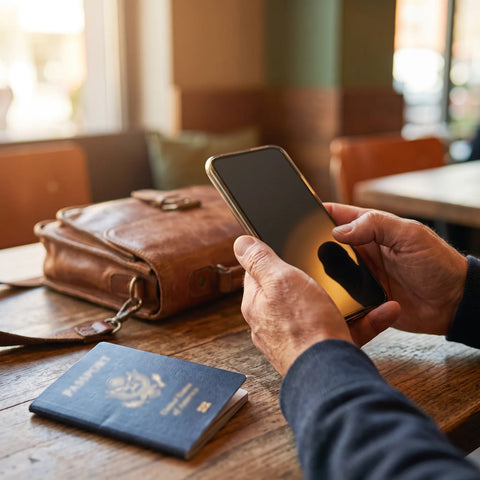
If you've already decided to buy data for your trip to the United Arab Emirates and the only thing left is to know how many GB to pack in your digital suitcase, this article is for you. Here, I won't rehash the comparison of connectivity options: I'll give you the well-reasoned figure, the why behind each number, and the specific characteristics of Dubai and Abu Dhabi that make your consumption there different from other destinations.
How many GB you need in the Emirates: the short answer
For 10 days in the Emirates, most people will be fine with 5 GB: about 400-500 MB per day for maps, WhatsApp, and social media. If you rely heavily on hotel and airport Wi-Fi, 3 GB will suffice; if you upload videos daily, expect to need 10 GB.
That's the figure I give to nine out of ten people who ask me. And I want to make that clear from the first paragraph, because it frustrates me to get to the end of an article and not find the number. The Emirates is, in fact, one of the destinations where you need to buy the least amount of data, and for three very specific reasons that we will see below: free Wi-Fi is excellent and ubiquitous, almost everyone speaks English (so you won't be glued to a camera translator), and tourist distances are short and very urban.
However, there's one detail that surprises many people and can increase your data usage: internet voice and video calls are restricted in the country. This is not a myth or a problem with your carrier. It changes how you communicate with home, and therefore, it changes how many gigabytes you consume. I'll dedicate the entire next section to it.
If you want the general framework for any destination, you can find it in my guide on how much data you need for travel. Here we're focusing on Dubai and its surroundings.
What changes the calculation: WhatsApp and FaceTime calls are restricted
This is the point that makes the Emirates different. In the United Arab Emirates, any application offering voice or video calls over the internet requires a license from the Telecommunications and Digital Government Regulatory Authority (TDRA), according to regulations starting with Federal Law-Decree No. 3 of 2003. The two carriers in the country, e& (formerly Etisalat) and du, are obligated to block traffic from apps that do not have this license. In practice: WhatsApp, FaceTime, and consumer Skype calls do not work, neither over mobile data nor most Wi-Fi networks.
The important thing for your calculation: WhatsApp messages, voice notes, photos, and files do work normally. What is blocked are live calls. And be aware, this does not depend on which SIM card you have: it's a network block within the country, so no data provider can promise you otherwise.
If your plan was "I'll call my mom from the hotel Wi-Fi," reconsider: the block also applies to most Wi-Fi networks. You'll have to talk to family via a licensed app or voice notes.
| App | Messages and photos | Voice/video calls | Call consumption |
|---|---|---|---|
| Yes | Restricted | — | |
| FaceTime | — | Restricted | — |
| Skype (consumer) | Yes | Restricted | — |
| Botim and other licensed apps | Yes | Yes | ~150-400 MB/hour |
| Zoom / Microsoft Teams | Yes | Usually yes | ~500-900 MB/hour |
| Normal phone call | — | Yes | 0 MB (uses minutes) |
Translated into gigabytes: if you're someone who video calls family daily, budget between 200 and 400 MB for each hour you talk using a licensed app, and add that to your base figure. If you manage with voice notes and photos, add almost nothing: a one-minute voice note is about half a megabyte. How to connect practically is detailed in the guide on internet in Dubai.
Dubai's free Wi-Fi is excellent (but it won't save you from everything)
I've been to destinations where public Wi-Fi is a pipe dream. The Emirates is not one of them. Dubai Airport (DXB) and Al Maktoum Airport (DWC) offer free, unlimited Wi-Fi, without a password or registration: you select "DXB Free WiFi" or "DWC Free WiFi" and you're connected. The usual speed is in a range that's more than enough for video, maps, and light work.
Outside the airport, things remain good: large shopping malls (Dubai Mall, Mall of the Emirates, Yas Mall in Abu Dhabi) have open Wi-Fi, hotels almost always include it, and many cafes and public areas do too. With this, an organized traveler can use Wi-Fi for 60-70% of their consumption without much effort: photo uploads, backups, streaming before bed, and work video calls.
But beware of two traps. The first, you already know: free Wi-Fi won't give you back WhatsApp calls. The second is that a country's public Wi-Fi is not your home network; for banking or work email, your own data is better. And a third practical point: the moment you need data most — getting off the plane, ordering a taxi, finding the hotel, announcing your arrival — is precisely when you don't yet have hotel Wi-Fi.
That's why the sensible plan is to buy a modest package and let Wi-Fi do the heavy lifting, not the other way around. If you're still unclear on how the technology works, I explain it in non-technical terms in what an eSIM is.
How much data each activity will consume
Here's the table that will really help you calculate your needs. These are average and real consumption figures per hour of active use, not per hour the phone is on. Adjust them to your pace: almost no one browses with Google Maps for eight hours straight, but many people do spend half an hour scrolling every night in their hotel bed.
| Activity | Approximate consumption | A typical day in Dubai |
|---|---|---|
| Maps and navigation (standard view) | ~5 MB/hour | 30-60 MB |
| Maps in satellite view | Up to 30 times more | Avoid it |
| WhatsApp: messages, voice notes, and photos | ~0.5 MB per 1 min voice note | 50-100 MB |
| Social media (Instagram, TikTok) | ~700 MB/hour | 200-350 MB |
| Uploading photos to the cloud or social media | 3-5 MB per photo | 60-150 MB |
| Uploading a 1-minute 4K video | ~300-400 MB | Only via Wi-Fi |
| Video call (licensed app) | ~150-400 MB/hour | Depends on usage |
| Streaming music (normal quality) | ~40 MB/hour | 80-150 MB |
| Streaming music (high quality) | ~150 MB/hour | Download beforehand |
| Streaming video 1080p | 1.5-3 GB/hour | Only via Wi-Fi |
| Taxi apps (Careem, Uber) and transport | ~10-20 MB/hour | 20-40 MB |
Add up the rows for maps, WhatsApp, social media, and taxis, and you get between 300 and 550 MB per day for a normal tourist. Multiply by your number of days, and you have your figure. If you want a detailed breakdown of these numbers, I have an expanded version in the mobile data usage statistics by activity. What you should never budget mobile data for is video streaming: save that for Wi-Fi.
Photos and videos: the real data drain in Dubai
Dubai is one of the most photogenic destinations there is, and that shows in data consumption. Between the Burj Khalifa, the view from At the Top, the Marina skyscrapers, the fountains, the desert at sunset, and the Sheikh Zayed Grand Mosque in Abu Dhabi, people return with hundreds of photos and dozens of videos. I myself shot more video in four days there than in two weeks in other places.
The problem isn't taking photos: that doesn't consume data. The problem is that your phone, by default, wants to upload everything to the cloud as soon as it detects a connection. A single minute of 4K video can be up to 350 MB. Ten such videos are 3.5 GB, more than most people buy for their entire trip. It's literally the most expensive mistake you can make.
The solution takes thirty seconds, and I always do it as soon as I land:
- Photo backup: Wi-Fi only. On iPhone, Settings > Photos. On Android, Google Photos > Backup settings.
- Google Drive, iCloud Drive, and Dropbox: Wi-Fi only. Everyone forgets these, and they upload huge documents in the background.
- Upload stories at night, from the hotel, instead of in the moment in the middle of Dubai Mall.
- Record in 4K if you want, but save the upload for when you're back at the airport, where there's unlimited Wi-Fi.
With these four adjustments, the data consumption for a photo-heavy trip is cut in half without giving up anything. This is the advice people appreciate the most.
How many GB based on your profile and length of stay
This is the table I stand by. It's calculated assuming reasonable use of free Wi-Fi (hotel at night, some shopping malls) and with backups already set to "Wi-Fi only." If you don't plan to connect to any Wi-Fi, go up one tier.
| Profile | 5 days | 10 days | 15 days | 30 days |
|---|---|---|---|---|
| Map and WhatsApp tourist | 1-2 GB | 3 GB | 5 GB | 10 GB |
| Photo and social media tourist | 3 GB | 5 GB | 10 GB | 20 GB |
| Content creator (lots of video) | 5 GB | 10 GB | 20 GB | Unlimited or 50 GB |
| Digital nomad / remote work | 5 GB | 10 GB | 20 GB | 50 GB |
| Family sharing one phone | 3 GB | 5 GB | 10 GB | 20 GB |
| Long layover (less than 24 h) | 1 GB is plenty | |||
A couple of honest nuances. The "map and WhatsApp tourist" with 3 GB for ten days is truly over-provisioned: I'm not selling you more just to make it look good. The remote work profile consumes the most, because Zoom or Teams meetings eat between 500 and 900 MB per hour, and in the Emirates, you'll use them more than expected, precisely due to the blocking of consumer apps.
And "family sharing" assumes you're tethering data from one phone to others. In that case, the person sharing bears all the cost, so expect kids to watch videos in the car. Details on coverage and carriers in the country are available in the eSIM guide for the United Arab Emirates.
"I only have an 8-hour layover in Dubai": a special case
Dubai and Abu Dhabi are two of the world's major connection hubs, so many people searching for this question aren't going to the Emirates: they're passing through the Emirates. And there, the answer changes completely, because you need very little. On a normal layover, without leaving the terminal, the free and unlimited airport Wi-Fi covers absolutely everything: messages, airport maps, streaming while you wait, and even a work meeting.
| Type of layover | What you'll do | Recommended data |
|---|---|---|
| Less than 4 h, no exit | Airport Wi-Fi is enough | None or minimal |
| 8 h without leaving the terminal | Wi-Fi, some messages when moving | 1 GB is plenty |
| 8-12 h with quick city visit | Taxi, maps, photos, metro | 1-2 GB |
| 24 h with hotel stay | All of the above plus social media | 2-3 GB |
If you leave to see the Burj Khalifa between flights — something many people do, and eight hours is plenty of time — then I do want you to have data: you'll be ordering a Careem or a taxi, looking up the metro, checking schedules, and taking photos. One gigabyte covers that excursion with plenty to spare and prevents the stress of being stranded without coverage in an unfamiliar country.
What I don't recommend is buying a 10 GB package "just in case" for a layover. It's a waste of money, and I'd rather tell you that even though we sell larger packages. Buy the minimum, rely on airport Wi-Fi, and save your budget for your final destination.
Desert, excursions, and road trips: where you won't spend data
The Emirates has some of the best mobile coverage in the world in cities and on highways: in Dubai, Abu Dhabi, Sharjah, and the E11 road that connects them, you'll have full signal all the time. The nuance is with desert excursions, which almost everyone does: in the dunes of Al Lahbab, Al Marmoom, or the Liwa desert, the signal becomes irregular as you move away from the main road.
For your gigabyte calculation, that's good news: the four or five hours of desert safari will barely consume any data, because you'll be semi-disconnected and occupied with something else. The same applies to excursions to Hatta or the Fujairah mountains. But it's worth preparing for:
- Download the offline map of Dubai, Abu Dhabi, and the desert area before you leave. In Google Maps: search for the area > menu > Download offline map.
- Save your booking and pickup point as a screenshot, not a link.
- Download your music and podcasts beforehand: highway journeys can be long and monotonous.
- Share your live location with someone before entering the desert, while you still have signal.
Another factor that plays in your favor and people don't often calculate: in Dubai, you'll be able to communicate in English in 99% of places. Here, you don't need a translator with the camera on all day like in Japan or China, and that saves you hundreds of megabytes without doing anything.
How to know your actual consumption before leaving home
All the above are averages, and you are not an average. The honest way to get your number right is to look at how much you actually spend in a normal month, and it's on your phone without installing anything:
- iPhone: Settings > Mobile Data. Scroll down to "Current Period" and you'll see the breakdown app by app. Reset the statistics on the 1st of a month to get a clean measurement.
- Android: Settings > Network & internet > SIMs > App data usage. You can set the monthly cycle and see the graph by day.
Take your 30-day consumption, divide it by 30, and you have your daily average. Now adjust it for your trip with two simple corrections. First: subtract what you do at home over Wi-Fi and will also do there over Wi-Fi (streaming, especially). Second: add 20-30% for maps, occasional translations, photos, and restaurant searches, which skyrocket when traveling.
A real, no-trick example: if you spend 4 GB per month at home, your average is about 133 MB per day. When traveling, with that correction, you'll be at 170-200 MB daily, plus maps and destination photos: about 350 MB. Ten days is 3.5 GB, so the 5 GB package gives you plenty of leeway.
Do it a couple of weeks before flying, not the night before. It's the only method that gives you your own number, not a generic estimate, and it takes two minutes.
How to stretch your GBs and what to do if you run out
If you're running low, there's plenty of room before you have to top up. These are the most effective adjustments for a trip to the Emirates, in order of impact:
- Data saving mode activated from day one. This alone will reduce background downloads.
- Autoplay video disabled on Instagram, TikTok, X, and Facebook. This is where the invisible money goes.
- Offline maps downloaded for Dubai and Abu Dhabi before flying.
- Music and series downloaded from home or hotel Wi-Fi.
- Video quality set to "data saver" on YouTube and Netflix when using mobile data.
- App updates only over Wi-Fi: a system update can wipe out 2 GB in one go.
I prefer you buy just enough and top up if needed, rather than paying in advance for gigabytes you won't use. Running short in the Emirates is not a disaster: there's free Wi-Fi on every corner to tide you over while you top up.
And if you run out, nothing serious happens. You connect to the hotel, mall, or cafe Wi-Fi, top up from there, and in a couple of minutes, you have data again. That's precisely why rounding down is the smart move in this destination and not others: here you always have a free network nearby to manage topping up. You can find more refined tricks in my guide on how to save data while traveling.
Frequently Asked Questions
How many GB do I need for 7 days in Dubai?
3 GB is good, and 5 GB is more than enough. Seven days of normal tourism (maps, WhatsApp, some social media and photos) averages around 350-450 MB daily, meaning between 2.5 and 3.2 GB. If you plan to upload a lot of video or work remotely, upgrade to 10 GB.
Can I make WhatsApp video calls in the Emirates?
No, WhatsApp voice and video calls are restricted nationwide. Apps without a TDRA license have this traffic blocked on e& and du networks. Messages, voice notes, and photos work completely normally; to speak live, you'll need to use a licensed app or a work platform like Zoom or Teams.
Does the hotel Wi-Fi work for calling home?
For WhatsApp or FaceTime calls, usually no. This is the most common confusion: the restriction is network-based and also applies to most Wi-Fi networks in the country, not just mobile data. Hotel Wi-Fi works for everything else—messages, uploading photos, streaming, email—but it won't restore blocked calls.
How many GB do I use if I only have a layover in Dubai?
Virtually none if you don't leave the airport. DXB and DWC have free and unlimited Wi-Fi without a password, so an 8-hour layover is completely covered by that. If you go into the city between flights, 1 GB is more than enough for taxis, maps, metro, and photos.
Do I need extra data for a translator?
No, almost no one uses a translator in the Emirates. English is the working language in hotels, restaurants, taxis, shopping malls, and tourist attractions. Unlike Asian destinations where you live with your translator camera open, here that expense simply doesn't exist, which significantly lowers your daily consumption.
Is there coverage in the desert?
On roads, yes; among the dunes, it's patchy. Coverage in the Emirates' cities and highways is excellent, but on a safari that goes deep into the dunes of Al Lahbab or Liwa, you might lose signal at times. Download offline maps and save your reservation as a screenshot before you go.
What happens if I run out of data halfway through my trip?
You top up from any free Wi-Fi and continue. You don't lose your number or settings: you simply buy more data, and it activates in minutes. That's why my advice is to buy just enough instead of too much: in the Emirates, you always have a free network nearby to manage topping up without stress.
Conclusion
To summarize straightforwardly: for a typical 10-day trip to the Emirates, 5 GB is the figure I recommend to almost everyone, and if you hardly look at your phone, 3 GB is more than enough. Only go up to 10 GB or more if you're going to telework or upload video daily. And if you're only on a layover, 1 GB will be more than sufficient.
Remember the two peculiarities of the destination: free Wi-Fi is excellent and saves you a lot, but it doesn't give you back WhatsApp or FaceTime calls, so if you want to talk to family, budget that time with a licensed app. With that, you have your number calculated intelligently and not by guesswork.
Once you're clear, choose your package for the eSIM for the United Arab Emirates and land in Dubai with data from the first minute.