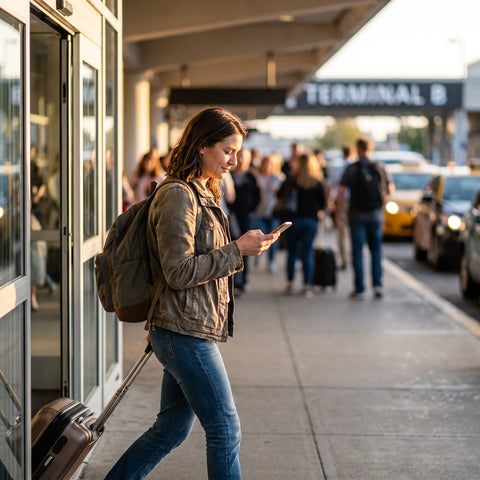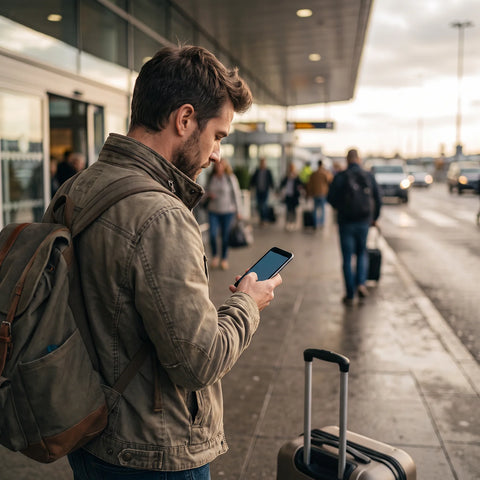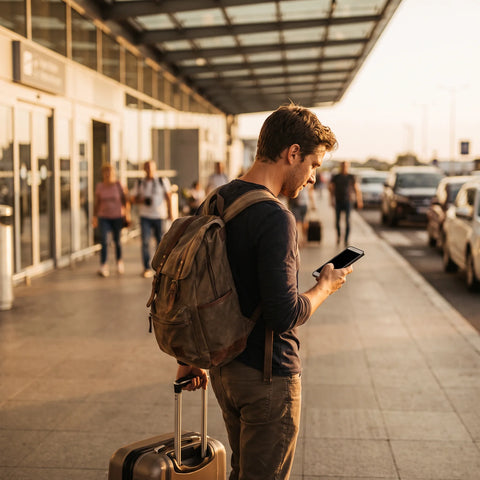
In short: A North America eSIM is a single data plan that works in the United States, Canada, and Mexico without changing cards when crossing borders. It's installed before you fly, connects automatically to each country's local network, and is more cost-effective than buying separate plans whenever your itinerary includes two or more of these three destinations.
If your trip mixes New York, a hop to Toronto, and a few days in Cancun, carrying three different SIM cards is an unnecessary hassle. With a North America eSIM that covers the United States, Canada, and Mexico all at once, you browse in all three countries with the same plan, without changing anything when crossing the border. In this guide, I'll explain how the regional pack works and when it's more beneficial than buying an eSIM for each country.
What a North America eSIM covers
A North America eSIM is a digital data plan that works in the United States, Canada, and Mexico with the same installation. It automatically connects to the local networks of each country, so you cross from one side to the other without buying new cards or touching settings. A single QR for the entire trip.
It's the natural choice for classic itineraries that combine the East Coast of the US with Canada, or US routes with a getaway to the Riviera Maya. Instead of managing three separate plans, you have one that follows you throughout the region. Your Spanish card stays inside your phone for calls and SMS, and the eSIM handles the data. If your trip is only to the United States, you might want to check out the eSIM for the United States: a plan tailored for a single country is usually cheaper than paying for coverage in all three.

Regional pack vs. one eSIM per country
The rule is simple: if you're visiting two or three countries on the continent, the regional pack is usually cheaper and more convenient than adding individual plans. If you're only visiting one country, a single eSIM for that destination might better suit your data needs. Here's a comparison.
| Travel scenario | Best option | Why |
|---|---|---|
| Only United States | USA eSIM | Plan tailored for a single country, without paying for coverage you won't use |
| USA + Canada | North America eSIM | One plan for both, no need to change when crossing the border |
| USA + Canada + Mexico | North America eSIM | A single QR for the entire route, fixed price |
| Long trip through many countries worldwide | Global or multi-country plan | Covers beyond the continent |
For routes combining many countries or mixing continents, before deciding, compare the regional pack with a traditional international physical chip: the difference in convenience and price is well-detailed in this comparison of international chip vs eSIM.
Useful tip: In North America, distances are deceiving. A "hop" from New York to Toronto or from Los Angeles to Tijuana crosses a border and changes networks. With the regional pack, you won't notice the change; with an eSIM per country, you'd have to activate another one.
When is the North America pack NOT advisable?
Be honest with yourself before paying for something you won't use. If your trip is a long weekend in New York and you don't leave the city, a standalone US eSIM is all you need: paying for coverage in Canada and Mexico that you'll never visit makes no sense. The same applies if your route starts in Madrid with a long layover in some European capital before crossing the Atlantic: for those preceding days, a separate Europe eSIM would be more beneficial, and you can activate the North America one just before your transatlantic flight, instead of forcing a plan that doesn't cover that initial leg well. And if you're going to be more connected to hotel or office Wi-Fi than walking around with mobile data, 5 GB from the smallest plan with Wi-Fi support will be more than enough.
Coverage and speed in USA, Canada, and Mexico
All three countries have strong 4G and 5G networks in cities and tourist areas, so the experience in New York, Toronto, Mexico City, or Cancun is smooth for maps, social media, and video calls. You might want to lower your expectations in remote roads, national parks, and rural areas, especially in the vast spaces of Canada and inland Mexico.
A quality regional eSIM connects to the main carriers in each country, not a minor network, so urban coverage is the same as a local would have. On a road trip along the west coast or the Riviera Maya, download offline maps before leaving the city to avoid being stranded in a section without signal. If you're weighing between an eSIM or paying for roaming with your Spanish operator, this comparison of eSIM vs roaming clarifies it with numbers.

Airport and hotel Wi-Fi: the trap no one tells you about
With your own data in your pocket, you no longer depend on public Wi-Fi, and that's not just convenience: open networks at airports like JFK, Toronto Pearson, or Mexico City's AICM are an easy target for anyone wanting to snoop on your traffic. If you still use shared Wi-Fi to save data at the hotel, consider an extra layer of privacy; this guide on eSIM, VPN, and travel privacy explains when it's worth combining them. Another detail many people miss: some Spanish banking apps block access or require extra verification if they detect you're connecting from an IP outside the European Union, so have your two-step verification method handy before you leave.
How much data to bring for a multi-country trip
A trip through North America uses a lot of data: maps for driving, reservations, translator, uploading photos, and looking up everything on the go. These approximate figures help you choose the right plan size without running out halfway through your trip.
- 5-8 GB: a week-long getaway to a single city, with hotel Wi-Fi.
- 10-15 GB: two weeks crossing the USA and Canada or USA and Mexico, with daily maps.
- 20 GB or more: a long three-week road trip through all three countries, with constant navigation and some video.
The big advantage of the regional pack is that you can recharge data from the app without changing cards if you run out midway through your trip. You don't depend on finding a phone store in a foreign country.
If you're tight on gigabytes, there's room before recharging: disable automatic app updates and photo backups to the cloud while using mobile data, and save them for when you have hotel Wi-Fi. Google Maps and Apple Maps let you download the area map in advance, so road navigation barely uses data if you prepare it the night before. These and other tricks to save data with an eSIM while traveling make the difference between arriving comfortably in Cancun or having to recharge halfway through your route.
How to activate it before leaving Spain
Prepare your eSIM at home, using your Wi-Fi, a few days before you fly. Installation takes about 1 minute, and you only need to scan a QR code that you receive by email when you purchase. This way, you land at your destination airport with data ready as soon as you turn on your phone.
- Purchase the North America eSIM and receive the QR instantly in your email.
- At home with Wi-Fi, go to Settings and add the eSIM by scanning the code.
- Keep your Spanish SIM as your primary line for calls and disable its data roaming.
- Activate eSIM data usage when you land at your first destination.
First, check that your phone supports eSIMs; most recent models do. The eSIM connects automatically to the network of the country you are in, without you having to manually select an operator.
If it's your first time installing one and you get stuck at any step, this step-by-step guide on how to install an eSIM covers common oversights: the QR that doesn't scan because the screen is too bright, the semi-unlocked phone that rejects the second line, or the mobile data setting that points to the wrong line. A detail many people miss: in the United States and Canada, if your Spanish operator doesn't support VoLTE or Wi-Fi calling while roaming, incoming calls may fail even if data works perfectly; this is not an eSIM issue, but rather how your main line handles voice outside Europe.
Expensive mistakes in North America
North America is expensive for traditional roaming, so a few oversights can inflate your bill or leave you without internet at the worst moment. These are the most common pitfalls and how to avoid them.
- Leaving data roaming on for your Spanish SIM: a roaming charge might slip through even if you're using the eSIM.
- Buying a USA-only eSIM when your trip includes Canada or Mexico: you'll lose data when crossing borders.
- Waiting to activate the eSIM at the airport without Wi-Fi: install it at home beforehand.
- Underestimating rural areas: download offline maps for road trips.
- Not checking your passport and visa (ESTA for the US, eTA for Canada): without these, you can't enter, and without entering, no eSIM will do any good.
With these points covered, your trip through the three countries will run smoothly, and connectivity will no longer be a concern.
Myths about eSIM in North America: what almost no one tells you
There are confusions that repeat trip after trip. Clarifying these will save you scares at the airport or extra charges on your bill.
- "Roaming and eSIM are the same, so it doesn't matter if I leave roaming activated." They are not. Data roaming is your Spanish operator's service for using your line outside Spain, and it bills separately from what the eSIM does. If you don't deactivate it, your phone might use both networks simultaneously without warning you, and physical SIM roaming is exactly what the eSIM saves you from paying.
- "With an eSIM, I no longer need a local phone number for anything." For almost everything, yes, but some US and Canadian services (restaurant reservations via SMS, verification codes for certain ride-sharing apps) require a real local number. If your route includes such procedures, a virtual SMS reception number can save you a bad time; for browsing and communicating via WhatsApp or calls, your usual Spanish line will suffice.
- "If my phone says 4G instead of 5G, the eSIM isn't working correctly." Not necessarily: in areas like the Arizona desert or rural British Columbia, stable 4G is better than a 5G that comes and goes. Real coverage is noticeable in whether it maintains the connection, not in the letter appearing at the top of the screen.
- "Once installed, nothing else needs to be touched." Almost: just remember to activate eSIM data usage when you land (it remains inactive until then by design, so it doesn't start consuming data while you're still on the plane or at your departure airport).
Frequently asked questions
Does a North America eSIM work in the United States, Canada, and Mexico simultaneously?
Yes. The regional pack covers all three countries with the same installation: when crossing from one to another, the eSIM automatically connects to the local network without you having to change anything. You use a single QR for the entire route, without buying new cards in each country.
Is the regional pack or an eSIM per country cheaper for me?
If you visit two or three countries, the North America pack is usually cheaper and more convenient than combining individual plans. If you're only going to one country, a single eSIM for that destination might better suit your data needs. It depends on your specific itinerary.
Can I still use WhatsApp with my Spanish number?
Yes. Your Spanish card remains installed for calls and SMS, and WhatsApp works with your usual number via the eSIM's data. You don't lose your line or have to re-register the app with another number.
Do I need a visa in addition to the eSIM?
Yes, and it is independent of connectivity. For the United States, you need ESTA authorization, and for Canada, eTA; Mexico requires a passport and in some cases a migratory form. The eSIM provides internet, but entry procedures are separate and should be completed before flying.
Does coverage extend to rural areas and national parks?
In cities and tourist areas, 4G/5G coverage is good in all three countries. In remote roads, national parks, and rural areas, the signal may fail, especially in inland Canada and Mexico. Download offline maps before entering sparsely populated areas.
What if I run out of data halfway through my trip?
You can recharge from the app on the spot, without looking for a store or changing physical cards. This is the advantage over an exhausted physical SIM: in a country that isn't yours, finding a phone store and explaining yourself in another language to buy more gigabytes is exactly what you want to avoid.
Is it better for me to buy the North America eSIM or wait and contract roaming with my Spanish operator upon arrival?
It's better to do it before you leave. Your operator's roaming in North America usually becomes very expensive outside the European Union, and activating it on the fly means being without data exactly when you need it most: upon landing, looking for your hotel or Uber. Installing the eSIM at home with Wi-Fi eliminates that wait.
Conclusion
For a trip that combines the United States, Canada, and Mexico, a regional pack saves you the hassle of three cards and the shock of continental roaming. One plan, one QR, and data that follows you as you cross each border. Install your North America eSIM before you fly and forget about connectivity throughout your entire trip.