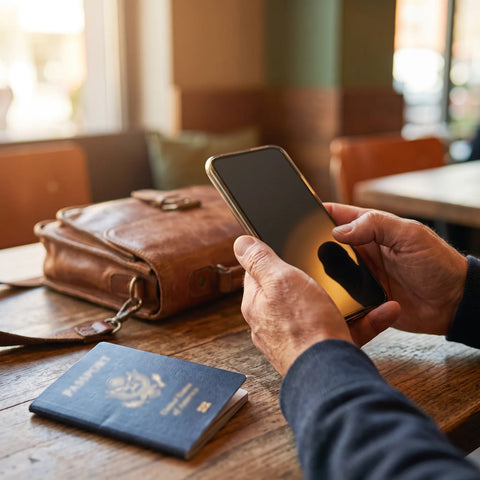
Jersey is one of those destinations that seems easy and then bites you on the bill. It's a stone's throw from France, they pay in pounds, they speak English, and many of us take it for "United Kingdom" without thinking. Well, no: looking for information about the internet in Jersey and sticking with the first answer is the best way to return home with a three-figure surprise on your phone bill. I'll tell you how connectivity works on the island, which operators are actually there, how much each option costs, and what I do when I go to a place like that.
Jersey is not the EU or the UK: the detail that costs you dearly
Jersey is not in the EU or the UK: it is a Crown dependency, so European roaming does not apply and many Spanish tariffs exclude it from their "UK" zone. The practical upshot: arrive with an activated eSIM, or buy a JT or Sure SIM in Saint Helier.
Let's get to the legal part, which is much more important here than it seems. Jersey is the Bailiwick of Jersey, a British Crown dependency: it has its own Government, its own parliament (the States of Jersey), its own tax laws and even its own pound, the Jersey pound, which is on par with sterling. The United Kingdom is responsible for its defense and international representation, but Jersey is not part of the United Kingdom as such.
And here's what's important for your phone: Jersey has never been in the European Union or the European Economic Area. Not even when the United Kingdom was a member. It had a special relationship for trade in goods, but services (and telecommunications are a service) were excluded. In other words: the famous Roam Like at Home, the regulation that lets you use your gigabytes in France or Portugal without paying extra, has never applied in Jersey and does not apply now.
The second blow is more subtle. Many Spanish tariffs include "United Kingdom" in their international bonus since Brexit, and travelers assume that Jersey is included in the package. The small print usually says the opposite: Jersey, Guernsey, and the Isle of Man are excluded and are billed in a separate zone, often the most expensive in the catalog. It's the perfect scenario for a surprise: the same language, the same currency, the same plug... and a completely different billing zone.
Who provides coverage in Jersey: JT, Sure and the operator that no longer exists
Jersey is an island of about 119 km² with just over a hundred thousand inhabitants, an international airport, and a powerful financial sector. This is reflected in the networks: mobile coverage is surprisingly good for its size, better than many towns in inland Spain.
Historically there were three networks: JT (Jersey Telecom, owned by the Government of Jersey), Sure and Airtel-Vodafone. Watch out here, because this has changed and there are still outdated guides on the internet: Sure acquired Airtel-Vodafone, the operation closed at the end of 2024 and during 2025 Airtel customers were migrated to the Sure network. The Airtel store closed. This means that today in Jersey there are two dominant networks: JT and Sure. As a counterbalance to this concentration, regulators imposed price commitments and the launch of a virtual operator with the local cooperative.
In practice, this hardly affects you as a tourist, but it saves you a headache: if you read a guide that tells you to look for an Airtel-Vodafone store in Saint Helier, that guide is old. What you will find are JT and Sure points of sale in the center of Saint Helier, as well as tobacconists and supermarkets with top-ups.
Regarding technology: 4G covers almost the entire island with good speed, including inland roads and coastal towns. 5G is being rolled out and you won't have it everywhere; count on it in Saint Helier and its surroundings, and don't take it for granted on the north coast or in the cliffs. For what a traveler does (maps, messaging, some video calls, uploading photos), the island's 4G is more than enough.

Your phone connects to France without warning
In Jersey, you don't decide which network to connect to: it's decided by the antenna with the strongest signal at that moment. And on the east coast, the strongest signal often comes from Normandy.
This is the detail that almost no one mentions and that is a classic in Jersey. The island is about 22 km from the coast of Normandy: on a clear day, France can be seen from Mont Orgueil castle. And French antennas don't understand borders. On the east and northeast coast, on the beach, on ferries and especially on boat trips to the islets, your phone can jump to a French network (Orange, SFR, Bouygues) without you doing anything.
Some travelers have discovered this the hard way: by their phone's clock changing time, or by seeing "F-Orange" in the status bar. The problem is twofold and goes in both directions:
- If you're traveling with your Spanish tariff and think you're in an expensive zone, connecting to France becomes cheap (France is in the EU). Lucky, but you can't control it.
- If you're traveling with a plan that only covers Jersey or the United Kingdom, connecting to France means losing data or paying separately.
- And vice versa: if you have a "Europe" plan and your phone stays on the Jersey network, you might not have service, because many European packs do not include the Channel Islands.
The solution is standard and takes thirty seconds: go to Settings → Connections → Mobile Networks, disable automatic network selection and manually choose JT or Sure. And occasionally check the operator name in the top bar, especially if you've taken a boat. It's the gesture that separates a normal bill from an absurd bill.
The four ways to connect, compared
For a destination like this, there are only four real paths, and it's worth looking at them together before deciding. I'll give them to you plainly, with the good and bad of each.
| Option | Estimated cost | Advantage | Disadvantage |
|---|---|---|---|
| Roaming with your Spanish tariff | From €0 if your plan includes it, up to several euros per MB or daily expensive zone bundles | You don't do anything, you keep your number | Jersey is usually outside the "United Kingdom" zone; real risk of surprise bill |
| Hotel and cafe Wi-Fi | Free | Enough for email and WhatsApp at night | Zero coverage on beaches, cliffs and routes; open and shared networks |
| Local SIM (JT or Sure) | From £5 top-up; 30-day bundles from £10 | Resident rate, abundant data, local calls | You have to go to the store, change card and number; not profitable for 3 days |
| Travel eSIM | A few euros for a few GB, depending on the plan | Activated before leaving home, no paperwork and no losing your number | Requires compatible phone and checking that Jersey is covered |
The fifth option, pocket Wi-Fi, I only mention to rule it out: on a small island where you'll be moving by bus, on foot, or by rental car, carrying a router, its battery, and its security deposit is not worth it. If you're curious about the numbers, I break it down in the comparison of eSIM versus pocket Wi-Fi. For Jersey, my order is clear: first your own mobile connection, and hotel Wi-Fi as support for heavy downloads and backups.
Roaming with your Spanish operator: what zone Jersey falls into
This is where you need to do your homework before flying. Zones change every season and each operator has its own map, but the recurring pattern is this.
| Operator | How it usually treats Jersey | What it means for you |
|---|---|---|
| Orange | The international bundle includes the United Kingdom except Jersey, Guernsey and Isle of Man, which fall into the "rest of the world" zone | High tariff per MB unless you contract a specific bundle |
| Movistar | "Jersey Island" appears as its own destination in its zone table, separate from the United Kingdom | Don't count on your Europe or UK bundle covering you |
| Vodafone | Some tariffs have included Jersey and Guernsey in their free roaming | It is the most likely option to come out well, but it needs to be confirmed |
| MVNOs and low cost | Many already charge extra even for mainland UK | Jersey almost always in the most expensive zone |
Two serious warnings. First: the automatic cut-off at €50 of data consumption is a guarantee of European regulations. Outside the EU, it depends on your operator's commercial policy, not on the law. Go into your app and manually activate a spending limit before you leave.
The second: MB tariffs in expensive zones are counted in euros, not cents. Updating your phone in the background one afternoon can cost you more than a boat trip. If you want the cold hard numbers of how much this costs on each continent, I compiled them in the guide on how much international roaming costs, and the direct comparison against a digital card is in eSIM versus roaming. My advice if you're going with your Spanish tariff: call your operator, ask for "Jersey" by name, and note down the answer with the date.
Hotel, cafe and museum Wi-Fi: how far it reaches
Jersey is a developed destination and Wi-Fi is everywhere... as long as you're indoors. In Saint Helier, the hotels on the waterfront and around Liberation Square offer decent Wi-Fi, as do the cafes in the center, and the airport and ferry terminal have their open networks. If your plan is to land, order a coffee, and plan your trip, that'll do for the first while.
The problem is that Jersey is not visited indoors. It is visited in Saint Ouen bay, on the northern cliffs, on the tidal path to Elizabeth Castle, in Gorey waiting for the castle to open. And there, Wi-Fi doesn't exist: either you have your own data, or you're flying blind. The three things I've missed most without connection in such places are always the same: bus schedules, tide tables, and a map to get back.
Two security notes that I repeat for all destinations with many open networks:
- On public Wi-Fi, don't access banking or enter card details without a VPN. Jersey is a financial center, not a lost village: there's traffic and interest.
- Disable automatic connection to known networks. Otherwise, your phone will jump to any "FreeWiFi" that resembles it and leave you stranded in the middle of browsing.
I use hotel Wi-Fi for heavy tasks (uploading the day's video, syncing photos, downloading offline maps) and my own data for everything else. It's the combination that has given me the fewest headaches and makes your data plan last twice as long.

Local SIM in Jersey: real prices from JT and Sure
If your trip is long, or if you're going to Jersey for work and need a local number, an island SIM makes sense. These are the reference prices in the market.
| Operator | Prepaid plan | Price | Approx. equivalent |
|---|---|---|---|
| JT (Jersey Telecom) | 5 GB, 30 days, unlimited local calls and SMS | £10 | approx. €12 |
| JT | 20 GB, 30 days, unlimited local calls and SMS | £15 | approx. €18 |
| JT | Unlimited data, 30 days | £20 | approx. €24 |
| Sure | Prepaid with top-ups and data and local minute rewards | Top-ups from £5 | from approx. €6 |
Practical details you'll appreciate knowing beforehand: JT's prepaid balance has a long validity, on the order of months, so it won't vanish between trips. There's no biometric registration or police station procedures like in India or Thailand; they ask for little more than a payment method. And be careful with money: in Jersey, Jersey pounds circulate alongside sterling; they are worth the same on the island, but Jersey banknotes are not legal tender in the United Kingdom. Spend them before you leave.
The downside? For a three or four-day getaway, you're burning half a morning of your vacation in a Saint Helier store, changing your card, and being without your Spanish number for the duration. If you're torn between this path and the digital one, in eSIM vs. local SIM I compare both calmly. My rule is simple: less than a week, don't even consider the store.
eSIM: what I use and why
An eSIM is a digital card downloaded to your phone: you buy it from home, install it with a QR code, and it activates upon arrival. You don't change physical cards, you don't lose your Spanish number (it remains active for calls and bank SMS), and you don't depend on finding an open store. If you've never used one, what an eSIM is explains it step-by-step, and the specific details for this island are in the eSIM for Jersey guide.
Before buying, two checks that are not optional in this destination:
- That Jersey is on the plan's country list. Many "Europe" packs cover the 27 EU countries but exclude the Channel Islands, precisely because they are not EU. If the plan doesn't name it, it doesn't cover it.
- That it includes France if you're going on a boat trip to the islets, a ferry to Saint-Malo, or a jump to Normandy. With both coverages, it doesn't matter which antenna you connect to.
How many gigabytes? It depends on the trip, not what the advertising says:
| Travel profile | Recommended data | What it covers |
|---|---|---|
| 2-3 day getaway | 1-3 GB | Maps, messaging, some photos, and finding a restaurant |
| Full week | 5 GB | Normal use with social media and daily browsing |
| Remote work or business trip | 10-20 GB | Video calls, heavy email, and sharing connection |
| Family sharing hotspot | 20 GB or more | Several devices pulling from the same phone |
Install it at home, using your home Wi-Fi, and leave the activation for when you land. It's the most boring and most profitable step in preparing your trip.
Tides, bunkers and beaches: where you lose signal
Jersey has one of the largest tidal ranges on the planet: the difference between high and low tide can be around 12 meters, and the island almost doubles its surface area when the sea recedes. This isn't just a brochure curiosity; it's a matter of safety. Walking to Elizabeth Castle, the causeway to La Corbière lighthouse, and treks across the tidal flats to Seymour Tower all depend on the tide clock. Checking the tide chart from the site, with data on your phone, is exactly the kind of thing that makes it worthwhile not to rely on hotel Wi-Fi.
Where you will lose signal, plain and simple:
- German War Tunnels (the underground complex excavated during the occupation): You're under tons of rock; there's no signal, and there won't be. Download anything you need before entering.
- Bunkers, coastal batteries, and towers of the Atlantic Wall scattered along the coast: concrete interiors, irregular signal.
- Islets and boat trips (Les Écréhous, Les Minquiers): You're closer to France than to Jersey, and the signal is whatever the sea dictates. This is where your phone will switch to French networks.
- Northern cliffs and hidden coves: uneven coverage depending on which side of the cliff you're on.
On the other hand, in Saint Helier, in Saint Ouen Bay (where the surf schools and 8 km of west coast sand are), in Gorey at the foot of Mont Orgueil, and on the inland roads, you won't have 4G problems. My routine for an island like this: downloaded offline map, tide chart saved in screenshots, and the power bank always in my backpack, because searching for a signal on a cliff consumes more battery than you think.
Frequently asked questions
Does EU roaming work in Jersey?
No. Jersey has never been part of the EU or the European Economic Area, even when the UK was a member, so the Roam Like at Home regulation does not apply. Your European data allowance won't work here, and consumption will be billed according to the international zone of your plan.
My plan includes the UK, does it cover Jersey?
Probably not, and it needs to be checked on a case-by-case basis. Operators like Orange expressly exclude Jersey, Guernsey, and the Isle of Man from their UK allowance and put them in the "rest of the world" zone; Movistar treats Jersey as its own destination. Vodafone has included it in some plans. Ask about Jersey by that exact name.
What operators are there in Jersey?
Currently, two networks operate: JT (Jersey Telecom) and Sure. Airtel-Vodafone was acquired by Sure, the deal closed at the end of 2024, and its customers were migrated to Sure's network during 2025. Any guide that directs you to an Airtel store is outdated.
How much does a local SIM cost in Jersey?
From £5 top-up, and 30-day data bundles start at £10. JT offers 5 GB for £10, 20 GB for £15, and unlimited data for £20, with local calls and texts included in their bundles. Sure works with top-ups from £5. This is approximately 12, 18, and 24 euros at the approximate exchange rate.
Why does my phone connect to a French network in Jersey?
Because France is about 22 km away, and its antennas reach the sea. On the east coast, on boats, and on the islets, it's common to end up on Orange, SFR, or Bouygues. Disable automatic network selection and manually choose JT or Sure to prevent your plan from no longer applying.
Is there good mobile coverage throughout the island?
4G covers virtually all of Jersey with good speed. 5G is being rolled out and doesn't reach everywhere. You'll lose signal in the underground war tunnels, inside bunkers, and in some coves on the north coast; in Saint Helier, Saint Ouen, and Gorey, you'll have no problems.
Do I need a passport to buy a SIM in Jersey?
There's no biometric registration or police process like in other destinations. Buying prepaid is simple and only requires a method of payment; carry your passport or ID card anyway, because Jersey has its own border control and is not in Schengen.
Will an "Europe" eSIM work for Jersey?
Only if Jersey appears in the plan's country list. Many European packs cover the 27 EU states and exclude the Channel Islands precisely because they are not EU territory. Check the coverage before paying, and if you're crossing by boat, make sure it also includes France.
Conclusion
To summarize the important points. Jersey looks like the UK, you pay in pounds, and English is spoken, but it is not the EU or the UK: it's a Crown Dependency, and European roaming does not apply. Many Spanish tariffs exclude it from their "UK" zone and charge it as an expensive destination, so the surprise comes in the following month's bill. On top of that, its proximity to Normandy means your phone often connects to French networks when it feels like it.
There are four options. Hotel Wi-Fi will save you for evening emails, but not for the tide chart on Elizabeth Castle causeway. A local JT or Sure SIM is genuinely competitive (20 GB for £15) and worthwhile if you're staying for weeks or for work. Roaming is a lottery that needs to be confirmed in writing with your operator. And an eSIM is what I use for getaways: it's installed from home, activated upon landing, keeps your Spanish number, and doesn't force you to waste a morning in a Saint Helier store.
If you're going to Jersey to surf in Saint Ouen, climb Mont Orgueil, and go down into the tunnels, sort out your mobile before leaving home: check out PuraSIM's eSIM for Jersey, choose the data amount according to your trip type, and forget about it. It's the least time-consuming task and the one that will save you the most headaches.