How does roaming work in Albania?
Roaming is an agreement between your operator and a local network that allows your cell phone to connect as soon as you land in another country, without changing your SIM card. In Albania, it works the same way, but with a key nuance: since it is not a member of the European Union, it falls outside the conditions that many operators reserve for European territory.
In practice, your cell phone automatically searches for a local network with which your operator has a roaming agreement. If such an agreement exists and is active, you can make calls, send messages, and use data as if you were at home, although almost always at a different cost than your usual plan. If there is no agreement, or your operator simply does not include Albania in its coverage, your cell phone may be without service or have blocked data until you manually activate an additional package.
Is Albania included in Vodafone's roaming?
The answer depends on which country you contracted your Vodafone line, because there isn't "one" single Vodafone: it's a group of independent national companies, each with its own roaming zones and conditions. Before traveling, the safest bet is to check directly in your operator's app or official website to see which zone Albania falls into for your specific plan, because these conditions change over time and vary depending on the country where you contracted your line.
Albania is not part of the European Union or the European Economic Area. This means that the roaming conditions designed for "like at home" use within the European bloc do not automatically apply there, regardless of which operator you use.
That's why it's common for travelers with a Vodafone line contracted in a European country to arrive in Tirana expecting the same coverage they had in Italy, Portugal, or Germany, only to find that Albania is charged under different conditions, almost always less generous. Confirming this before leaving home will save you surprises upon arrival. You can read more about how roaming generally works in this guide about roaming with Vodafone.
Which countries does Vodafone's roaming cover?
Vodafone group operators usually organize their international coverage into zones: one for the European Union and the European Economic Area, another for "extended Europe" (European countries that are not EU members, as is the case with Albania), and another for the rest of the world. Each zone has different usage conditions, speed, and cost, and which country falls into which zone depends on the national company with which you contracted your line.
This means there is no universal list valid for any Vodafone customer: two people with the same brand on their phone, but with lines contracted in different countries, may have different coverage in Albania. The only reliable way to know is to consult your specific plan before traveling, not assuming that "since it's Europe, it's already included."
Which countries does Vodafone cover worldwide?
Vodafone is one of the largest telecommunications groups in the world, with its own operating companies in several European countries (including Germany, Italy, Portugal, Ireland, the Czech Republic, Romania, and Greece, among others), a presence in the Middle East and Africa (such as Egypt and Qatar), and stakes and commercial agreements in Asia-Pacific markets. This scale is precisely what causes confusion: being such a recognized and widespread brand, many travelers take for granted that its coverage is identical in any country, when in reality each national subsidiary negotiates its own roaming agreements.
For a trip to Albania, what matters is not "if Vodafone exists there" (it does not have its own network in the country), but whether your home operator has a roaming agreement with an Albanian local network, and under what conditions.

A real-life example: arriving in Tirana and running out of data
Imagine a typical trip: you leave from Bogotá or Lima with a layover in Europe, and there you take the opportunity to buy a European line or data package thinking that it will cover your entire itinerary, including a three-day getaway to Albania. You use your cell phone without a problem in Rome or Athens: maps, messages, social networks, everything works as if you were at home.
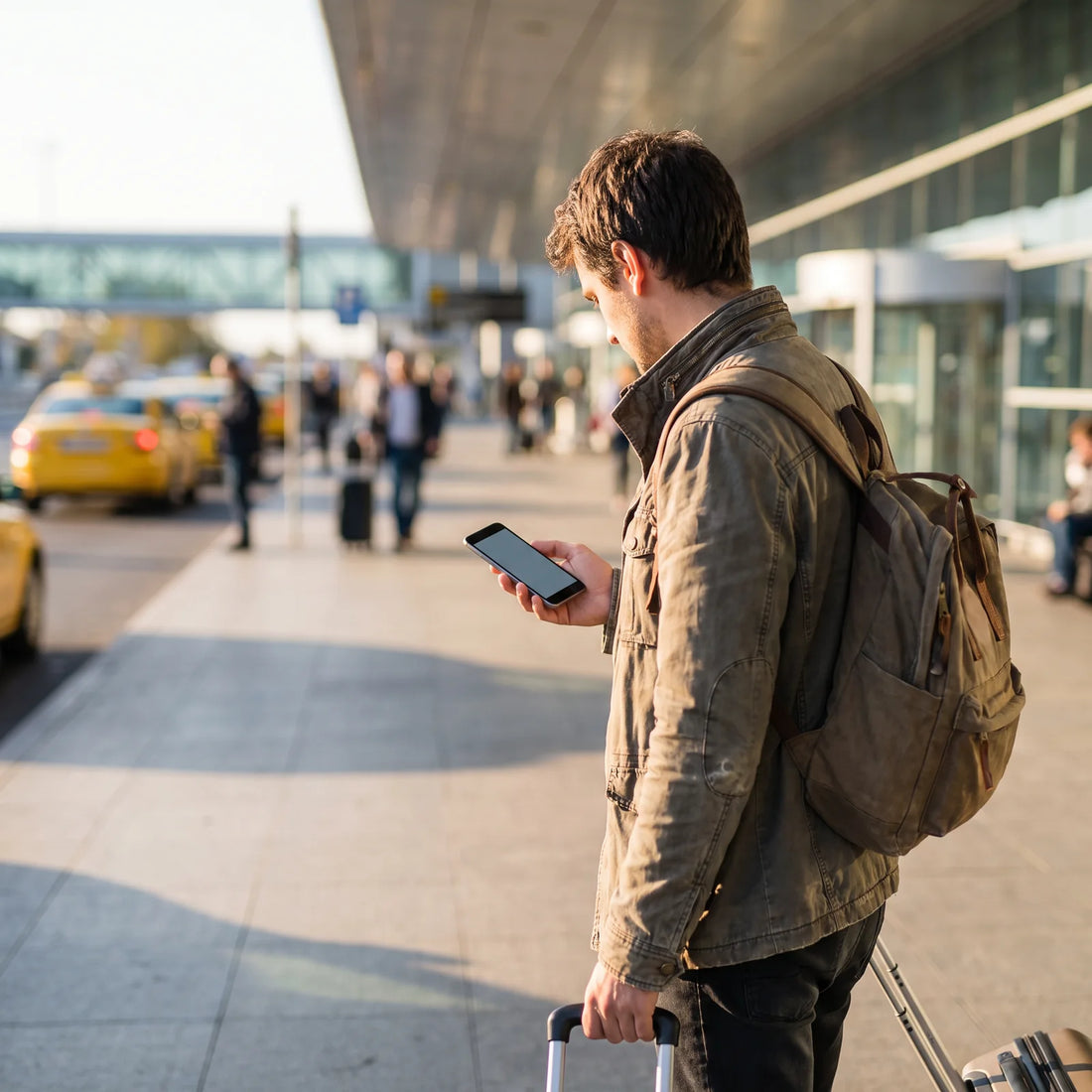
The problem appears when you land at Tirana airport. The cell phone still shows a signal, but the data doesn't load, or loads at such a slow speed that it is useless for locating a taxi or confirming the hotel address. The reason, almost always, is simple: the European package you bought was intended for European Union countries, and Albania is outside that zone. It is not a cell phone error or a local network error: it is that the contracted coverage never included that country.
Why is traditional roaming expensive outside the European Union?
Within the European Union, there is specific regulation that obliges operators to offer roaming at prices equivalent to local plan rates, without additional charges for the user. This rule does not apply in countries that, like Albania, are not members of the bloc. Outside this regulatory framework, each operator negotiates its own agreement with the local network of the visited country, and passes that cost on to the customer as best suits them: per day, per megabyte, or through optional packages that must be activated before traveling.
If you do not activate any additional package, it is common for the operator to apply a much higher default charge per megabyte, or to directly limit the speed to levels that are not very useful for browsing. This is the same logic that explains why, in general, roaming outside the European Union is usually more expensive than within it: it is not that "they charge more just because," it is that there is no longer a regulated ceiling on those prices.
The eSIM: the alternative that doesn't depend on your home operator
An eSIM is a digital SIM card integrated into the cell phone itself: instead of inserting a physical card, you download a profile (usually by scanning a QR code) and that profile connects to a data network in the destination country. It does not replace your main line unless you decide to: it works in parallel, as a second line dedicated only to data. You can review the concept in more detail in this explanation of what an eSIM is.
Here's the detail many travelers don't consider: most eSIM-enabled cell phones allow you to maintain two active profiles at the same time. This means you can keep your Vodafone line enabled only for calls and text messages (so you keep your number for people to reach you), while the travel eSIM exclusively handles data. You don't have to choose between "my number" or "internet": you can have both working simultaneously, without paying data roaming with your usual operator.
What do you need to activate an eSIM in Albania?
The process is shorter than it seems if you prepare it in an organized way. Before traveling, it is advisable to check three things: that your cell phone is compatible with eSIM, that you have Wi-Fi available to download the profile (installation requires an internet connection, and free Wi-Fi is not always available as soon as you land), and that you know how to activate it once you are at your destination.
| Step | What to do | Why it matters |
|---|---|---|
| 1. Check compatibility | Check your phone settings to see if the option to add an eSIM appears | Not all models, nor all software versions, support it |
| 2. Purchase in advance | Buy the eSIM before your trip, while you have stable Wi-Fi at home | Avoid relying on airport or hotel Wi-Fi |
| 3. Download the profile | Scan the QR code and install the profile, even from your home country | The download itself requires internet; data activation does not |
| 4. Activate upon arrival | Turn on the eSIM's mobile data when you land in Albania | This way you arrive with the profile ready and just need to turn it on |
If you want the detailed step-by-step with screenshots, this eSIM installation guide covers it for the main operating systems. And if you're not sure if your model is compatible, it's worth checking first on this list of eSIM-compatible phones before buying any plan.

Vodafone Roaming vs. Travel eSIM for Albania
Neither option is "bad": they simply address different needs. Roaming with your usual line has the advantage that you don't change your number or settings, but in a country outside the European Union like Albania, this can mean relying on conditions you don't control and sometimes don't even know precisely until you see the charge. You can compare both approaches in more depth in this comparison between eSIM and roaming.
| Aspect | Roaming with your Vodafone line | Travel eSIM for Albania |
|---|---|---|
| Activation | Depends on your home operator; sometimes requires manual package activation | You activate it yourself, in minutes, before or upon arrival |
| Coverage in Albania | Variable: depends on the country where you contracted your line and if Albania is in your zone | Specifically designed for the destination, without relying on your usual operator |
| Cost control | May include daily or per-megabyte charges outside the European Union | You know what you've contracted in advance, with no surprises when you check your bill |
| Your primary number | Maintained, but mixed with travel data consumption | Maintained separately for calls and SMS; data goes through the eSIM |
| Physical card | No need to change it | Neither: it's downloaded as a digital profile |
How long does it last and when should you activate your eSIM for Albania?
One of the most common questions is whether to buy the eSIM just before traveling. It's not necessary: when you buy an eSIM for Albania from PuraSIM, you have 180 days from purchase to activate it, so you can buy it weeks in advance, while planning the rest of your trip, without any date pressure. Activation itself takes approximately 1 minute once you decide to turn it on.
This is especially useful if your itinerary is not yet fully finalized: you buy the eSIM when you confirm your flight, leave it installed and on standby, and only activate the data on the day you actually land in Tirana or any other entry point to Albania.
Frequently asked questions
Do I need to buy the eSIM before arriving in Albania or can I do it once I'm there?
You can buy it from your home country, while you have stable Wi-Fi, or even after landing if the airport offers free Wi-Fi. Buying it beforehand is more convenient because it avoids relying on an unknown connection right when you arrive.
How do I know if my phone is compatible with eSIM?
Most mid-range and high-end models from recent years are, but it varies by brand and software version. Checking your phone's settings, or a list of compatible models, is more reliable than assuming.
Does the eSIM replace my Vodafone number for calls and messages?
No, unless you decide so. You can keep your Vodafone line active only for calls and SMS while the travel eSIM exclusively handles data, as most modern cell phones allow two active profiles at the same time.
What happens if I change my flight date after purchasing the eSIM?
No problem: you have 180 days from purchase to activate it, so a date change within that margin does not affect your data plan for Albania.
Do I need Wi-Fi to use the eSIM once I'm in Albania?
No. Wi-Fi is only necessary to download the profile the first time. Once installed and activated, the eSIM uses mobile data like any normal line, without relying on a Wi-Fi network.
Can I use the same eSIM if I visit neighboring countries in addition to Albania?
It depends on the specific plan you have contracted: some cover only one country and others cover several destinations in the region. Check the coverage details of the plan before purchasing it if your itinerary includes more than one country.
What happens if I run out of data before the end of my trip?
You can check your usage from your phone and, if necessary, contract an additional plan to cover the remaining days. It's simpler to resolve it this way than to rely on an automatic charge from your usual operator.
Is it necessary to notify Vodafone that I will be using another eSIM for data?
It is not mandatory: the travel eSIM works in parallel with your line, as a second connection. The only thing you should check before leaving is that your operator does not block the use of additional eSIMs in your specific plan, which is rare but worth confirming.
Conclusion
If you're going to Albania and your main line is Vodafone, the practical recommendation is simple: don't assume your European plan covers you there, because Albania is outside the European Union and conditions change depending on the country where you contracted your line. Confirm directly with your operator before traveling, and have an alternative plan ready just in case.
An eSIM for Albania resolves this point without complications: you buy it in advance, leave it installed, and only activate it upon landing, while your Vodafone line remains available for calls and messages. It's compatible with coverage in more than 200 destinations if your next trip continues to other countries, activates in approximately 1 minute, and you have 24/7 support in all languages via email and WhatsApp if something doesn't go as expected. If it's your first time using this type of digital card, this definitive guide to eSIM for travel is a good starting point before buying.