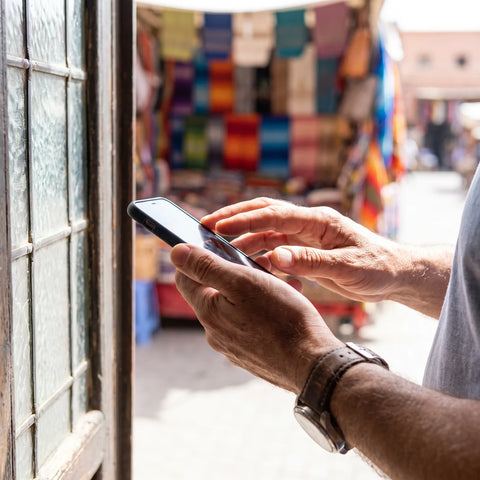
What options do you have for mobile data when traveling to Europe
You have three options: activate your local operator's international roaming, buy a physical SIM upon arrival in a European country, or install an eSIM before leaving home. All three provide internet, but they differ in cost, preparation time, and whether they serve a single country or the entire continent.
If you've never heard of an eSIM, you're not alone: many people still think the only way to get data in another country is to buy a physical card at the airport or pay whatever their company charges for roaming. There is a third option that solves the problem at its root, and in this guide, we explain how it works, what it's really for, and when it makes sense to use it on a trip to Europe. For a more general overview of the topic, you can check this guide on how to get internet when traveling.
What is an eSIM and how does it work
An eSIM is a digital SIM card: instead of inserting a physical chip into your phone, you download a profile (similar to scanning a QR code) and your phone gets an active data line, without opening the SIM tray or touching anything inside.
The practical difference from a traditional SIM is that you don't have to find a physical store, wait in line, or wait for a salesperson to configure your chip in a language you don't understand. You install the profile from your home Wi-Fi, the airport, or the hotel, and when the plane lands in Europe, you already have data available. You can see the full details of its operation in this explanation of what an eSIM is.
When traveling through several European countries, this matters more than it seems: an eSIM designed for the region covers different countries under the same plan, so you cross from France to Spain or from Italy to Portugal without having to look for a new store or change your chip at each border.
What is the best SIM for traveling to Europe
There is no single "best SIM" universally, because it depends on your itinerary: if you visit only one country, a local plan might be enough; if you cross several borders on the same trip, what you need is a plan that covers the entire region without having to reconfigure anything when changing countries.
For multi-country itineraries, a regional eSIM for Europe is usually the most practical option compared to buying physical SIMs country by country: you activate it only once, the plan covers you in the different destinations you visit within its coverage, and you don't depend on finding an open store on the day you arrive. You can check the coverage details of the eSIM for Europe before planning your itinerary.
The right question is not "which is the cheapest SIM?", but "which SIM allows me to keep traveling without losing internet when I cross a border?". That second question is what really saves you time on your trip.
Which SIM can I use throughout Europe without changing it in each country
To avoid changing SIMs in each country, you need to specifically look for a "regional" or "multi-country" plan, not a local plan for a single nation. The difference lies in the coverage declared by the plan, not in the brand of the SIM.
Here is a simple comparison of the three ways to solve this:
| Option | Coverage | What happens when crossing borders | Preparation needed |
|---|---|---|---|
| Local physical SIM (one country) | Only the country where you bought it | Loses useful signal, you have to buy another | Find a physical store upon arrival |
| Roaming from your local operator | Depends on the plan you have at home | May or may not continue to work, depending on the contract | None, but you need to check the plan beforehand |
| Regional eSIM for Europe | Several countries under the same plan | Continues to work without reconfiguring anything | Install the profile before leaving, with Wi-Fi |
If your route includes more than one country, the middle row is usually the one that causes the most headaches, because international roaming varies greatly depending on the operator and the plan you have contracted in your country of origin. It's advisable to check directly with your operator before deciding, and compare that condition with what an eSIM offers compared to traditional roaming.

Which SIM works for all of Europe: physical or eSIM
Both work for data in Europe, but they don't work the same way for a multi-country trip: a physical SIM is tied to the operator and the country where you bought it, while a regional eSIM is designed precisely for moving between borders without changes.
The following table summarizes their similarities and differences:
| Criterion | Physical SIM | eSIM |
|---|---|---|
| How it's obtained | Physical store, airport, or kiosk | Download of a digital profile, with Wi-Fi |
| Risk of losing or damaging it | Yes, it's a small physical object | No, it lives inside the phone |
| Space in the phone | Occupies the physical SIM tray | Does not use a tray; you can keep your normal line active at the same time, if your phone supports two lines |
| Multi-country coverage | Depends on whether the local operator offers it | There are plans designed to cover several countries at once |
| When it can be activated | Normally upon purchase, on the spot | You can install it in advance and activate the data when you decide |
If you want to delve deeper into this comparison with more technical detail, we have a dedicated guide on eSIM versus physical SIM.
How much does a SIM for Europe cost
The cost depends on several factors: how many gigabytes you need, how many days you will be traveling, and how many countries you will visit within that same plan. There isn't a single price because each plan is structured differently according to these three variables, so the most reliable way is to check the updated price directly on the page of the plan you're interested in before buying, rather than relying on a figure that might become outdated quickly.
What you can objectively compare, without needing to look at a particular price, is what each option includes: if the local physical SIM only covers one country and your operator's roaming depends on a contract you don't control, a regional eSIM gives you a simpler basis for comparison, because the same plan covers several destinations. This makes it easier to decide whether it's better to pay for several local plans or for a single regional plan, although the final number depends on your specific itinerary.
Practical example: touring Spain, France, and Italy on the same trip
Imagine you're planning a two-week trip that starts in Madrid, continues to Paris, and ends in Rome. With a physical SIM, you'd have to buy one upon arrival in Spain, look for another store when crossing into France, and repeat the process a third time in Italy. Each stop takes away from your actual travel time to resolve an administrative task.
With a regional eSIM for Europe, the process changes: you install the profile before leaving home, while you still have reliable Wi-Fi, and activate the data when you land in Madrid. When you move to Paris and then to Rome, the same plan continues to work without you having to look for anything new or reconfigure your phone in each city.
This difference is most noticeable when the trip includes several cities in a short time: it's not just about saving money, but about not losing the first few hours in each destination sorting out connectivity instead of exploring the place.
How to activate your eSIM before traveling
The process has three general steps, and it's best to do it before leaving home, with Wi-Fi:
- Install the profile. This is done by scanning a QR code or with a direct installation link, depending on your phone.
- Leave it installed, without activating the data yet. Installing the profile and activating the plan are two different moments: you can install it weeks in advance and activate it just when you want it to start counting.
- Activate the data line when you arrive at your destination. The activation itself takes about a minute once you decide to turn it on.
If your itinerary isn't completely finalized, there's no rush to activate the plan the same day you buy it: when you buy an eSIM, you usually have several months (180 days from purchase, in PuraSIM's case) to install and activate it when you truly need it. This allows you to buy it calmly, without waiting until the last day before the flight and without risking the airport Wi-Fi failing just when you need it most.
You can follow the complete process, with screenshots by operating system, in this guide on how to install an eSIM step-by-step.

How to check if your phone supports eSIM
Not all phones have this feature, so it's a good idea to confirm it before buying. Most mid-range and high-end models launched in recent years include it, but it varies by brand, specific model, and sometimes even by the country where you bought the phone.
The most reliable way to confirm is to check your phone's settings menu, in the mobile data or network section, and look for the option to "add eSIM" or "add plan." If that option exists, your phone is compatible. We have a more detailed list by brand and model in this guide on eSIM compatible phones.
If your phone is older or doesn't support it, the alternative is still a local physical SIM or your operator's roaming, although with the multi-country coverage limitations we've already discussed.
Common mistakes when choosing a SIM for traveling to Europe
The most frequent one is leaving everything until the last minute: arriving at the departure airport without having checked if the phone accepts eSIM, or waiting until you're already in Europe, without reliable Wi-Fi, to try to install the profile for the first time. Installation requires an internet connection, so doing it at the destination airport, with unstable public Wi-Fi, is the worst possible circumstance for something that takes a minute if you do it calmly from home.
Another common mistake is assuming that "roaming" and "eSIM" solve exactly the same problem. Roaming depends on the contract you have with your home operator and the agreements that operator has with European companies, while you buy an eSIM directly, without depending on any prior contract. You can see more specific cases in this guide on common eSIM problems and how to avoid them.
A third mistake is not checking which specific countries the plan covers before buying it. "Europe" as a tourist destination and "Europe" as a data plan coverage area don't always mean exactly the same thing, so it's worth confirming the list of covered countries against your actual itinerary before paying.
Frequently Asked Questions
Do I need Wi-Fi to activate the eSIM?
You need Wi-Fi (or data) to install the profile the first time. Once installed, you can activate the data line whenever you want, even without Wi-Fi, because the profile is already saved on your phone.
Can I use the eSIM and keep my local line active at the same time?
In most eSIM-compatible phones, yes: you can keep your usual line for calls and messages, and use the eSIM only for mobile data while traveling.
Does the eSIM work for calls and text messages, or just for data?
It depends on the specific plan. Most travel plans are designed for mobile data, which is what you need to use maps, messaging apps, and social media from your phone.
What if my phone doesn't support eSIM?
You can opt for a local physical SIM in each country or your home operator's roaming, although neither offers the same multi-country coverage convenience without changes as a regional eSIM.
How far in advance should I buy an eSIM for a trip to Europe?
You can buy and install it weeks in advance without problems, because installing the profile and activating the data plan are two separate steps. Just avoid leaving it until the last minute at the airport.
Can I share the eSIM connection with another device (hotspot)?
Most phones allow data sharing via hotspot regardless of whether the line is physical or eSIM, although it's advisable to check the terms of the specific plan you choose.
What if I have a problem during the trip?
PuraSIM offers 24/7 support in all languages via email and WhatsApp, so you can write directly if something doesn't work as expected, no matter which European country you are in.
Conclusion
If your trip to Europe includes more than one country, the most convenient SIM for you is one that doesn't force you to sort out connectivity every time you cross a border. A regional eSIM covers that specific need: you install it only once, before leaving home, and it keeps working as you move from city to city.
To get started, you can check the coverage and available plans for PuraSIM's eSIM for Europe, which covers more than 200 destinations in total within its catalog and gives you 180 days from purchase to activate the plan when you truly need it, without rushing to do it on the same day. If it's your first time using an eSIM, you don't have to figure it out alone: support is available 24/7 via email and WhatsApp, in all languages, in case anything is unclear during installation or even during your trip.