In short: an eSIM for cruises gives you quality 4G internet in every port of call, without roaming or bill surprises. There's no mobile coverage at sea, so the winning move is to combine the ship's WiFi for basic needs and the eSIM for going ashore and moving around with fast, cheap data.
Cruises have a peculiarity that confuses many people: you sail for days surrounded by water, without a single cell tower nearby, but every morning you wake up in a new city with its own mobile network waiting for you. Understanding this difference is key to avoiding overpaying or being out of touch. In this guide, we explain, straightforwardly, how connectivity works on a cruise, when each option is best, and how to prepare your eSIM according to your itinerary so you can land in each port with internet, without roaming, and without stress.

Why connectivity on a cruise is different from any other trip
On a normal trip, you land in a country, activate your eSIM, and have internet for your entire stay. On a cruise, the scenario changes every few hours. While the ship is sailing in international waters, you are out of reach of any terrestrial antenna: your mobile phone completely loses 4G or 5G signal. The only way to connect is through the satellite WiFi offered by the cruise line, a connection that travels via satellite to the ship and, by its very nature, is slow and expensive.
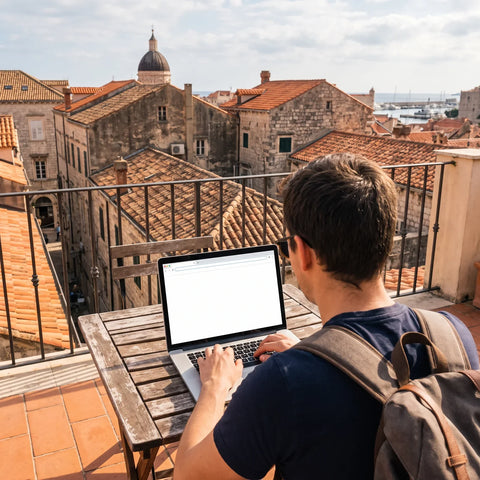
But as soon as the cruise docks at a port, everything changes. That port belongs to a country with its own mobile network like any other. Naples, Dubrovnik, Punta Cana, or Bergen have perfectly normal 4G coverage. This is where the eSIM for cruises comes into play: when you go ashore, your eSIM connects to the local network of the country of call, and you browse at land speed, without paying the exorbitant roaming charges of your Spanish operator or relying on the ship's WiFi.
In other words: a cruise is a succession of mini-trips to different countries, with no-coverage journeys in between. Your connectivity plan must consider these two realities separately.
Connectivity options on a cruise
These are the four real ways to connect during a cruise, with their pros and cons. Prices are indicative ranges: always check the current rate with your cruise line or operator before boarding.
| Option | Estimated cost | Speed | Where it works |
|---|---|---|---|
| Cruise ship satellite WiFi | Packages per day or per cruise; usually expensive | Slow (a few Mbps) | At sea and in port |
| Spanish operator roaming in ports | Outside the EU can skyrocket per MB | Normal 4G | Only in ports |
| eSIM per country or region of call | Economical regional plan for the entire itinerary | 4G/5G depending on country | Only ashore, in port |
| Café and port establishment WiFi | Free or with purchase | Variable, often saturated | Only ashore, occasionally |
The most balanced combination for almost everyone is simple: ship's WiFi only for essentials when sailing, and an eSIM that turns on automatically at each stop. This minimizes satellite spending and gives you real speed where you'll actually use it, which is exploring cities. If you want to get even more out of your data, check out our tips for saving data with your eSIM.
eSIM vs. Ship's WiFi: when to use each
It's not a "one or the other" duel, but rather knowing when to use each tool. At sea, there's no debate; on land, the eSIM almost always wins.
| Situation | Ship's WiFi | eSIM |
|---|---|---|
| Sailing on the high seas | Only option | No coverage |
| Urgent messages at sea | Yes, but for a fee | Not available |
| Sailing near the coast | Works | May pick up coastal signal |
| In port during a stopover | Slow and limited | Local 4G, much better |
| Exploring the city ashore | Does not reach the ship | Essential |
Satellite WiFi is your safety net for the sea: send a "doing well" message home, check email, or consult the next day's itinerary. The eSIM is your exploration tool: Google Maps for navigating streets, last-minute reservations, instant photo uploads, and uninterrupted video calls. If you come from the physical SIM world, it might help to first understand the differences between eSIM and roaming before deciding your strategy.
eSIM in ports: the big advantage
This is where the eSIM truly shines. As soon as you step onto the dock and your phone connects to the local network, the ship's limitations are gone. Here's what you gain at each stop:
- Smooth navigation with Google Maps to find your way around the city without relying solely on downloaded maps, with real-time traffic and updated public transport.
- Photos and videos uploaded instantly to Instagram or WhatsApp, at normal speed and not at a satellite drip.
- Last-minute bookings for restaurants, museums, or local excursions, almost always cheaper than those sold by the cruise line on board.
- Free WhatsApp calls or video calls to show the port to family live.
- Translator, reviews, and schedules instantly so you don't waste time when the stopover only lasts a few hours.
And there's a detail that many overlook: in some ports, when the ship is docked or very close to the coast, the eSIM can connect to the terrestrial network even from the deck. It's not guaranteed and depends on the distance to the antennas, but when it happens, you save on turning on the ship's WiFi while waiting to disembark.
eSIM planning according to your itinerary
The key to avoiding complications is to choose the plan that best covers the countries you visit. If all stops are within the same region, a regional plan covers your entire cruise without changing eSIMs. If the itinerary mixes zones, combine a regional plan with specific plans for countries outside that region. Here's a quick guide:
| Cruise itinerary | Common stopover countries | Recommended eSIM plan |
|---|---|---|
| Mediterranean (7-10 days) | Italy, France, Spain, Greece, Turkey | Europe plan + Turkey plan |
| Caribbean (7 days) | Dominican Republic, Jamaica, Aruba, etc. | Caribbean / regional plan |
| Northern Europe / fjords (7-10 days) | Norway, Denmark, Estonia, Finland | European regional plan |
| Transatlantic South America | Brazil, Uruguay, Argentina, Chile | South America regional plan |
For a classic Mediterranean cruise, an eSIM plan for Europe covers most stops without any changes; you'll only need to add a plan for Turkey if the ship calls at Istanbul or Kusadasi, as it falls outside the European zone. For a Caribbean cruise, a Caribbean regional plan saves you from buying an eSIM for each island. If you're unsure whether to get a country-specific plan or a regional one, we clarify it in our comparison between regional eSIM and country-specific eSIM.
A practical tip: install and activate your eSIM before boarding, using your home or hotel WiFi. The eSIM can be stored and ready without the plan starting to count until you connect in the first port. If it's your first time, follow our guide on how to install an eSIM step-by-step to arrive at the ship with everything configured.
How much data do you need on a cruise?
This is where many people make mistakes by overestimating. Since there's no coverage at sea, your actual consumption is concentrated only during the hours you spend on land, which greatly reduces your needs. A reasonable estimate for normal use (maps, messaging, social media, and some photos) would be:
| Traveler profile | Typical land use | Estimated data (7 days, 5 stops) |
|---|---|---|
| Light | Maps and occasional WhatsApp | 3-5 GB |
| Medium | Maps, social media, photos | 5-8 GB |
| Heavy | Videos, video calls, constant uploads | 8-12 GB |
The reason you need less data than you think is simple: you spend much of the cruise sailing, dining on board, or sleeping, moments when the eSIM isn't even active due to lack of network. Download city maps for your itinerary before leaving, and your consumption will drop even further.
What almost no one tells you about cruise connectivity
Beyond the obvious, there are details that make the difference between a connected cruise and a surprise bill. These are the mistakes and tricks that rarely appear in brochures:
- "Onboard" roaming is an expensive trap. Many cruise ships have an antenna on board that broadcasts a mobile network via satellite (you'll see names like "Cellular at Sea" or "MPS"). Your mobile can connect to it without you realizing it and charge you very high rates per MB. Keep roaming data disabled on your Spanish SIM and use the eSIM only on land. We explain this in depth in the guide on roaming on planes and ships.
- Activate the eSIM before boarding the ship. If you wait until you're at sea to install it, you might not have enough internet to complete the activation via QR. Get it ready at home.
- Port WiFi isn't always your friend. Many cruise terminals offer free WiFi, but it's often saturated when thousands of passengers disembark simultaneously. The eSIM gives you autonomy without queues or passwords.
- Beware of automatic app updates. Configure them to update and back up only over WiFi. A photo backup triggered by data in port can eat up your plan in minutes.
- Have a backup plan for stops outside your region. A Mediterranean cruise that touches Egypt or Turkey leaves those countries outside a European plan. Review the itinerary country by country before purchasing.
- Download entertainment before boarding. Shows, music, and books for long journeys. The eSIM doesn't work at sea, and satellite WiFi isn't for Netflix marathons.
If several people are traveling, you don't need an eSIM for everyone: you can share a mobile connection via hotspot on land and split the cost among yourselves.
Essential apps for a connected cruise
With a well-organized strategy, these apps will help you out at sea and on land:
- Official cruise line app: Royal Caribbean, MSC, Costa, or NCL apps usually work offline to check schedules, menus, activities, and onboard reservations. Download it before boarding.
- Google Maps offline: download each port city while you have WiFi. It will guide you even if you lose data.
- GetYourGuide or Viator: local excursions that are usually cheaper than the cruise line's official ones.
- WhatsApp and Google Translate: to talk to family and understand yourself in every port.
Before your plan starts counting, it's important to understand what roaming is and why the eSIM avoids it: understanding this concept is precisely what helps you save money at each stop instead of accumulating surprises on your bill.
Frequently asked questions about eSIMs on cruises
Does the eSIM work while the ship is at sea?
No. In international waters, there are no cell towers nearby, so neither the eSIM nor your physical SIM has 4G or 5G coverage. The eSIM only connects when the ship is in port or close enough to the coast to catch the terrestrial network. At sea, your only internet option is the cruise line's satellite WiFi.
How many GB do I need for a 7-day cruise with 5 stops?
For normal use focused on land, 5 to 8 GB is usually more than enough. Since you only consume data during stopover hours and not while sailing, you spend much less than on an equivalent land trip. Download offline maps and save your eSIM for Maps, messaging, and photos.
Should I buy an eSIM for each country or a regional one?
It depends on the itinerary. If all stops fall within the same region (for example, a Western Mediterranean cruise or a Norwegian fjords cruise), a regional plan covers your entire trip without any changes. If the itinerary mixes zones (Europe plus Turkey or Egypt), the most convenient option is a regional plan for the bulk of the itinerary and individual plans for countries outside that region.
Can I use the eSIM to download shows on board when there's no WiFi?
No, because there's no terrestrial signal at sea. Do large downloads on land with the eSIM or before boarding with home WiFi. Have shows, music, and books already saved on your phone for long journeys.
How do I avoid being charged for expensive ship roaming?
Disable roaming data on your Spanish SIM, and if you want to be extra sure, keep it in airplane mode during the journey. This prevents your phone from accidentally connecting to the ship's satellite antenna, which charges very high rates per MB. Use the eSIM only when you are on land.
Does the cruise line app work without internet?
Most major cruise line apps have features that operate without data: itinerary, menus, restaurant reservations, and daily activities. Download and log in before boarding, while you still have WiFi, to have it ready throughout the cruise.
When should I activate the eSIM, before or during the cruise?
Install and activate it before boarding, using your home or hotel WiFi. The eSIM is stored and does not start consuming the plan until you connect in the first port. Having everything ready on solid ground avoids activation problems when you no longer have a stable connection.