In summary: an eSIM for Turks and Caicos gives you data as soon as you land in Providenciales, without expensive roaming or looking for a store with your luggage in tow. It's activated from Spain before flying, covers Grace Bay with 4G/5G from Flow and Digicel, and with 3-10 GB, you'll have more than enough for a week of beach and excursions.
What is an eSIM and why you need it in Turks and Caicos
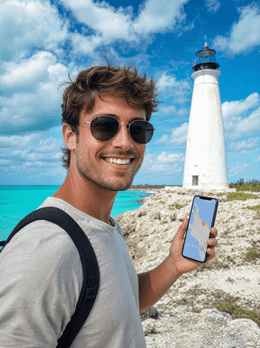
The Turks and Caicos Islands are one of those destinations everyone shows in photos but few explain well: almost white sand beaches, the reef surrounding Providenciales, and a tranquil luxury atmosphere, without the crowds of other Caribbean spots. What usually doesn't appear in photos is roaming. It's a British Overseas Territory, outside the European Union, so your Spanish plan doesn't cover data like in France or Italy: here, international roaming comes into play, which is one of the most expensive on the map.
An eSIM is, in essence, a digital SIM card installed via software instead of being physically inserted into your phone. If your device is compatible, you buy the plan online, receive a QR code, and scan it from home. There's no need to wait until you land, or search for a phone store in Providenciales with your luggage still in hand. If you don't know if your phone supports this technology, first check what a virtual eSIM is and how it works before buying anything.
The basic idea is simple: you land with internet, no roaming, no stress. You keep your Spanish number active for calls and WhatsApp (with data roaming turned off) and use the eSIM only for browsing. This way, you don't change your number, you don't depend on the resort's Wi-Fi for everything, and you control your spending from day one.

Real coverage in Providenciales, Grace Bay, and the rest of the islands
The mobile market in Turks and Caicos is split between two operators you'll know if you've traveled to the Caribbean before: Flow (from the Cable & Wireless / Liberty Latin America group) and Digicel. Between them, they provide 4G LTE coverage in inhabited islands, with 5G already present in the tourist areas of Providenciales. A travel eSIM doesn't force you to choose an operator manually: it connects automatically to the available network with the best signal at any given moment.
In Providenciales (Provo), where Grace Bay, most resorts, and the international airport (PLS) are located, coverage is solid throughout virtually the entire tourist hub. In Grand Turk, the capital island of Cockburn Town, the signal is also stable. The nuance lies in the less populated islands, such as North Caicos, Middle Caicos, or Salt Cay: there, coverage exists but is more intermittent, sufficient for messaging and maps, but not always for fluid video calls.
| Area | Typical Coverage | What to Expect |
|---|---|---|
| Providenciales / Grace Bay | 4G LTE and 5G in tourist areas | Stable signal in resorts, restaurants, and on the beach |
| Grand Turk (Cockburn Town) | 4G LTE | Reliable coverage in the urban core |
| North and Middle Caicos | 4G LTE, more limited | Sufficient for maps and WhatsApp, not always for streaming |
| Salt Cay and remote cays | Intermittent | Signal may disappear in stretches, normal in a dispersed archipelago |
| Open water diving/snorkeling excursions | No coverage | Download what you need before leaving the harbor |
Contextual fact: Grace Bay has been ranked among the world's best beaches for years in travel rankings. It is also, due to its concentration of resorts and tourism, the area of the archipelago with the best mobile coverage: your eSIM will perform at its best there.
How many GB to get depending on your trip type
Most trips to Turks and Caicos are all-inclusive resorts with Wi-Fi in the room, so the real question isn't "how much data do I use in total" but "how much data do I need outside the hotel." This is key to avoid buying a 20 GB plan you won't use, or running out one day on an excursion.
As a general reference, for a week with normal use of maps, messaging, and social media, relying on the resort's Wi-Fi for heavy use, 3 GB is usually sufficient. If you plan daily excursions, snorkeling, boat tours, or will share data via hotspot with others, increase to 5-10 GB. And if your mobile is also your remote work tool, it's better to have too much.
| Travel Profile | Duration | Recommended Data |
|---|---|---|
| All-inclusive, little use outside resort | 1 week | 3 GB |
| Daily excursions, snorkeling or diving | 1 week | 5 GB |
| Active honeymoon, lots of photos and videos | 10 days | 10 GB |
| Remote work or hotspot for multiple devices | 2 weeks | 15 GB or more |
A recurring but effective tip: reserve the resort's Wi-Fi for heavy downloads (uploading high-quality video, updating apps) and use mobile data for getting around Grace Bay, Chalk Sound, or excursions to other islands. If you've been comparing plans for other destinations, in how to save data with an eSIM while traveling you'll find tricks that apply here too. And if your route to the Caribbean passes through the United States, check the eSIM for the United States beforehand, useful if you have a long layover in Miami.

How to activate your eSIM step-by-step
The entire process is done before boarding the plane, comfortably from your couch at home. There's no need to wait for Wi-Fi at Providenciales airport or fill out forms upon arrival.
- Purchase the plan and receive the QR code by email, usually instantly.
- On your phone, go to Settings > Mobile Data (or Cellular) > Add eSIM and scan the QR.
- Name the new line, for example "Turks and Caicos", so you don't confuse it with your main line.
- Keep your Spanish line active for calls and WhatsApp, but with data roaming deactivated.
- Upon landing in Providenciales, activate data and roaming only on the eSIM line.
If you prefer to see it with screenshots, the guide on how to install an eSIM details it with images for iOS and Android. And if the term data roaming sounds like gibberish to you, it's worth understanding what it means and why you deactivate it just as you land. Spanish support is available if something gets stuck during installation, before or during your trip.
eSIM, physical SIM, or roaming: what suits you best
In Turks and Caicos, you theoretically have three ways to get data: activating roaming with your Spanish operator, buying a physical SIM upon arrival, or installing an eSIM before flying. In practice, for most travelers, the decision is quite clear.
| Option | Approximate Cost | Main Drawback |
|---|---|---|
| Roaming with your Spanish operator | Can exceed several €/day; without a plan, usually billed per MB | Risk of surprise bill, especially when uploading photos and videos |
| Local physical SIM (Flow or Digicel) | Local market price, check in-store | Need to find a store, wait in line, and temporarily change your number |
| Travel eSIM | Fixed price, known before flying | Requires eSIM-compatible phone |
Roaming outside the European Union, as is the case in Turks and Caicos, is among the most expensive available: it can exceed several euros a day with a plan, and without a plan, megabyte rates quickly skyrocket with just a couple of videos uploaded to social media from Grace Bay. With a local eSIM, you know in advance how much you'll spend, without surprises upon returning to Spain. To better understand the technical difference, you have the comparison of eSIM vs. roaming and also physical international chip vs. eSIM, if you're unsure between the two options.
Billing avoidance tip: as soon as you land, go to Settings and confirm that your Spanish line has data roaming deactivated and that only the eSIM has it active. This way, your home operator won't charge you a single cent for data.
If, in addition to Turks and Caicos, your itinerary continues through Europe on the way back, or you combine the trip with a layover, also check the eSIM for Europe: you can have different plans for each leg without number confusion.
Common mistakes almost no one tells you about
Beyond the obvious, there are details that you only learn after making a mistake once (or by reading someone who already did).
- Relying on resort Wi-Fi for everything: many hotels in Turks and Caicos have decent Wi-Fi in common areas but weak signals in rooms far from the reception, especially in villas or bungalows scattered across the property. The eSIM is your safety net there.
- Not checking your main line's roaming settings: this is the most expensive and easiest mistake to avoid. If you leave roaming activated "just in case" on your Spanish SIM, it can rack up charges even if you barely use it.
- Buying more data than you need "just in case": if your resort is all-inclusive with reasonable Wi-Fi, 10-15 GB is usually excessive. Adjust to your actual travel profile, not the worst-case scenario.
- Not thinking about hotel Wi-Fi network privacy: shared hotel Wi-Fi networks are not always secure for online banking or personal transactions. If you're doing sensitive tasks, it's better to use your eSIM's mobile data, and if you also use a VPN, here's how to combine eSIM and VPN on your travels.
- Forgetting that Turks and Caicos is not an EU zone: it's sometimes confused with European destinations due to being a British Overseas Territory. No European roaming regulations apply here, so your home plan doesn't protect you here like in France or Portugal.
- Not downloading offline maps before leaving the hotel: on secondary roads in Providenciales or on boat trips to other islands, the signal can cut out. Having it downloaded beforehand prevents losing time (or getting lost).
Tips for your trip to Grace Bay
Turks and Caicos is primarily a destination for beaches, diving, and relaxation, but being connected greatly facilitates daily logistics: last-minute bookings, inter-island transfers, or finding the least crowded cove.
- Download offline maps of Providenciales and any other island you plan to visit, in case the boat or rental car loses signal.
- Book excursions in advance: during high season, snorkeling tours and trips to the cays near Grace Bay fill up quickly.
- Use your eSIM's hotspot if you travel with a laptop or tablet and combine beach time with some work.
- Save the resort's phone number: in remote cays or long excursions, coverage may disappear for a while, and it's useful to have a direct contact.
- Check if you're traveling during high-demand dates, such as Easter or Christmas, when flights and Caribbean resorts fill up faster and it's advisable to book excursions with more lead time.
If you keep exploring destinations and want to compare how connectivity works in other parts of the world, our blog has guides with specific coverage and operator data for different countries, so you don't arrive anywhere blindly.
Frequently asked questions
What is the capital of Turks and Caicos and where is the best coverage?
The capital is Cockburn Town, on Grand Turk, but the tourist hub and best-connected area is Providenciales (Provo), where Grace Bay and most resorts are located. There, your eSIM works with 4G LTE and 5G in the most touristy areas.
To which country do the Turks and Caicos Islands belong?
They are a British Overseas Territory in the Caribbean, with their own self-governance. They are not part of the European Union, so your Spanish plan incurs expensive international roaming, and it's advisable to carry a local eSIM for data at a fixed, known price in advance.
If my resort has Wi-Fi, do I still need an eSIM?
It's highly recommended. The resort's Wi-Fi serves you within the property, but outside (in Grace Bay, on excursions, transfers, or at restaurants) you'll be without connection. With an eSIM, you can browse at all times and don't depend on finding an open network or waiting to return to your room.
Can I use the eSIM in North Caicos or Salt Cay?
Yes, there is 4G coverage in the inhabited islands, although it is more limited than in Providenciales. It's sufficient for maps and messaging. In uninhabited cays or remote diving excursions, you might lose signal, so download maps before leaving the port.
How many GB do I need for an all-inclusive week?
If you rely on the resort's Wi-Fi for heavy usage, a 3 GB plan is usually enough for use outside the hotel. If you go on daily excursions, upload a lot of photos, or use a hotspot to share with more people, aim for 5-10 GB to be comfortable all week.
Does the eSIM work at Providenciales airport as soon as I land?
Yes. Since you install it before flying, you just need to activate data and roaming on the eSIM line upon landing at Providenciales International Airport (PLS). You don't need airport Wi-Fi or to look for an operator's counter.
What if my phone is not eSIM compatible?
Then the alternative is a local physical SIM from Flow or Digicel, which you can buy in Providenciales, or activate roaming with your operator, accepting that the cost will be higher. Before deciding, check your device's compatibility: most recent models do support eSIM.
Conclusion
The Turks and Caicos Islands are one of those destinations where you don't want to waste a minute of beach time searching for coverage, and where roaming, being outside the European Union, can be very expensive even with an all-inclusive resort. With a local eSIM, you land with internet in Providenciales from the first minute, control your spending from start to finish, and enjoy Grace Bay without depending on hotel Wi-Fi. Buy your eSIM for the Turks and Caicos Islands before you fly and activate data when you get off the plane, with Spanish support if you need it.