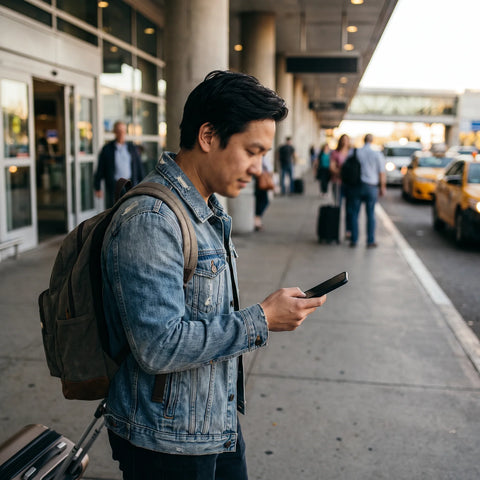
In short: To travel from Mexico to the United States, an eSIM provides you with local data from the moment you land without relying on Telcel, AT&T Mexico, or Movistar roaming, which becomes very expensive as soon as you leave the country. It is installed before you leave, activated upon arrival, and your Mexican number continues to receive calls and SMS on your physical SIM. If your plan already includes free roaming in the U.S., you don't need it.
If you're traveling from Mexico to the United States—whether it's a flight to Los Angeles or a car crossing through Tijuana—your Mexican carrier's roaming is one of the first things you need to sort out. Not because it's impossible to use, but because it's almost never the most reasonable option: it charges per megabyte or per activated day, speeds are often capped, and if you forget to deactivate it when you return to Mexican territory, you'll get a surprise on your next bill. An eSIM for Mexicans traveling to the USA solves this differently: you buy local U.S. data, activate it when you land, and your Mexican line remains intact for calls and WhatsApp.
This guide covers what you really need to decide: when an eSIM is worth it and when it's not, how many GB you need depending on your type of trip (plane, road trip, border crossing), how to install it before leaving home, and what you're sure to forget if it's your first time using one.
Roaming from Mexico to the United States: why the cost skyrockets
Mexican carriers—Telcel, AT&T Mexico, Movistar—treat the United States as an international destination in most of their plans, and international roaming is charged separately from domestic consumption. The usual result: per-day or per-MB rates much higher than what you would pay for the same data within Mexico, and once you accumulate several days of travel using maps, social media, and data calls, the bill will be noticeable.
There is one real exception worth checking before buying anything: some Mexican carriers, such as Telcel with its "Sin Frontera" benefit in certain plans, allow the use of minutes, SMS, and data in the United States and Canada just like in Mexico, within a reasonable usage range. If you have one of those plans and your trip is short, you may not need to buy an eSIM: check your carrier's app or call customer service before spending money on something you might already have included.
Where roaming does fall short is in three specific areas: speed often drops to 3G or less once you exceed a certain daily consumption, the "free" data cap for included roaming is usually low (a few hundred MB per day), and if your plan is prepaid or one of the basic packages, you probably don't have roaming included at all and will need to activate a specific package before leaving, which you pay for whether you use it all or not.
| Factor | Mexican carrier roaming | Local eSIM for the U.S. |
|---|---|---|
| Cost | Variable depending on the plan; skyrockets if you don't have roaming included | You pay once for the GB of the chosen plan |
| Speed | Often limited to 3G after certain consumption | Local 4G/5G network of the U.S. carrier |
| Activation | Automatic or via a pre-purchased package from your carrier | Install the QR before leaving, activate upon landing |
| Your Mexican number | Remains active (it's the same SIM) | Remains active on the physical SIM; the eSIM only carries data |
| Ideal for | Day trips or plans with roaming already included | Stays of several days with normal data usage |
What is an eSIM and how it works for a trip to the United States
An eSIM is a digital SIM integrated into the phone itself: there is no physical card to order, pick up, or lose. It is installed by scanning a QR code, and the profile is saved on the device. If you've never used one, we explain it in detail in what is a virtual eSIM and in how to install an eSIM step by step.
The important thing for a trip from Mexico to the United States is that your phone can have two active profiles at once: your physical SIM from Telcel, AT&T, or Movistar (for calls and SMS with your usual number) and the data eSIM for the United States. The actual process is this:
- Buy the plan for the United States at purasim.com before leaving home.
- Receive the QR by email and install the profile using WiFi, from Mexico, at your leisure.
- Configure the eSIM for mobile data and leave calls and SMS on your Mexican line.
- Upon landing (or crossing the border if you're driving), activate the eSIM and have data immediately.
If you're torn between an eSIM and a physical prepaid chip that you buy upon arrival, in international chip vs. eSIM we compare both options in more detail; for most travelers from Mexico, avoiding the phone store queue at the airport already tips the scales.

If you cross by land: Tijuana, Ciudad Juárez, and other border crossings
This is something that most generic eSIM guides don't cover and that affects Mexicans crossing by car or on foot: at the busiest border crossings—San Ysidro/Tijuana, El Paso/Ciudad Juárez, Nogales—the signal gets saturated during peak morning hours, just when most people are using the CBP One app or checking real-time wait times. If your eSIM is already active before arriving at the border gate, you avoid relying on the public WiFi in the waiting area, which is usually very slow due to the number of people connected at once.
Another detail that is often missed by first-time crossers: your Mexican carrier's signal can still "leak" several meters into U.S. territory and vice versa, especially in twin cities like Tijuana-San Diego. This means your phone might try to connect to the wrong network during the crossing; if you have the U.S. eSIM already manually selected in Settings → Mobile Data, you save yourself that small hassle of automatic network selection precisely when you're in a hurry.
For short shopping trips (a day in Otay or a weekend in El Paso), the same applies: if your Mexican plan already includes roaming in the United States, that will probably be enough, and you won't need to buy additional data. The eSIM makes more sense when the stay extends to several days or when your current plan does not include roaming.
How many GB you need based on your type of trip
A three-day business trip to Houston is not the same as a two-week road trip through California or a family visit to relatives in Chicago. The amount of GB depends mainly on how much you use Google Maps with active navigation (which consumes the most data) and if you make video calls.
| Activity | Approximate consumption per hour of use |
|---|---|
| Active GPS navigation (Google Maps/Waze) | One of the biggest consumers of the trip |
| WhatsApp with family in Mexico (text and photos) | Low consumption, even with frequent use |
| Social media without continuous video playback | Moderate consumption |
| Video call (FaceTime, WhatsApp video) | High consumption; monitor it if your plan is limited |
| Music or podcast streaming | Moderate consumption if you don't download offline |
With that as a reference: for a short trip of 3-5 days with normal use (maps, WhatsApp, some photos on social media), a small plan is usually enough. For 7-10 days with constant GPS navigation on the road—very typical if you're driving from the border into the U.S. interior—a more generous plan is advisable, because GPS in the background during hours of driving is what drains data fastest. If you work remotely during your trip or make daily video calls, upgrade to a higher tier. And if you run out, you can always top up without having to reinstall anything: you can view the available plans for the United States and choose according to the actual duration of your trip.
How to activate it before your flight (or before leaving by car)
The advantage of doing this from Mexico is that you can do it calmly, with your home WiFi, without relying on the airport signal or the border gate:
- Check that your phone is compatible: iPhone XS and later, most Samsung Galaxy S20 and later, and Google Pixel 3 and later support eSIM. If your phone was bought unlocked from a Mexican store, also check that the eSIM is not blocked (this sometimes happens with devices bought in installments).
- Buy the U.S. plan at purasim.com, choosing the GB according to the table above.
- Install the profile from home: open the email with the QR, go to Settings → Mobile Data → Add eSIM, and scan. It takes about five minutes.
- Give it a recognizable name ("PuraSIM USA") and configure it for data only, leaving calls and SMS defaulted to your Mexican line.
- Activate it upon landing or crossing: you can have it installed and inactive during the flight or car journey, and activate it just as you enter U.S. coverage.
If you get confused at any point with the phone settings, the guide on how to install an eSIM has step-by-step screenshots for iPhone and Android.
What almost no one tells you about eSIMs for the United States
"I need WiFi to activate it when I arrive in the United States": partially false. You need WiFi (or data) to install the profile, but you do that before leaving Mexico. Activation, once the profile is installed, is just a switch in Settings: it doesn't require downloading anything again.
"If I activate the eSIM, I lose my Mexican number": no. Your number remains on your physical SIM, receiving calls and SMS normally. The confusion comes from phones configured for "eSIM as primary line," so during installation, it's important to ensure calls remain assigned to your Mexican line.
"All U.S. eSIMs offer the same coverage": not exactly. In large cities (Los Angeles, Houston, New York, Chicago), coverage is solid on practically any network. Where you do notice a difference is in sparsely populated road areas—the desert between Arizona and New Mexico, long stretches of I-10 or inland Texas—where the signal can weaken regardless of the carrier you use. If your route crosses these sections, download the offline Google Maps before you lose coverage.
"Buying an eSIM is more expensive than my carrier's roaming": it completely depends on your current plan. As mentioned earlier, if your Mexican plan already includes free roaming in the United States, buying an additional eSIM makes no sense for a short trip. First, check what you already pay for.
"Support is only available if you purchased recently": PuraSIM provides 24/7 support by email and WhatsApp in all languages for the entire duration of your plan, not just the first day. If your connection fails on the third day of your trip, you can still write.

Specific tips for Mexican travelers
- Notify your bank before you leave: Mexican banks often block cards for charges in the United States if the trip is not reported. Do it with the app or by calling, don't leave it for the airport.
- Download essentials offline: maps of the cities you're visiting, your boarding pass or itinerary, and some music or video for the flight itself, where you won't have data.
- Have the CBP One app or your visa documents downloaded as PDFs, not just in the cloud: if your coverage fails just before the border gate, you'll want to be able to open them offline.
- WhatsApp will remain your primary way of contacting Mexico: with the active data eSIM, WhatsApp calls and video calls with family in Mexico work the same as at home, with no long-distance charges.
- Review privacy on public WiFi networks at airports and hotels while your eSIM is activating; if you're going to use a lot of open WiFi before you have your own data, it's worth checking eSIM and travel privacy before connecting to any free network.
- If your trip continues after the United States to another destination, you don't need to buy a new eSIM from scratch every time: first, review how to save data on a trip with an eSIM to stretch your existing plan.
And when an eSIM is NOT advisable: if you're crossing to a border city like El Paso or San Diego for a few hours to shop and returning to Mexico the same day, it probably doesn't pay to buy a full data plan. Use the store's WiFi or manage with limited data; the savings from an eSIM are noticeable on stays of several days, not on excursions of a few hours.
Frequently Asked Questions
Can I continue using my Mexican number while the eSIM is active in the United States?
Yes. The eSIM occupies a digital slot independent of your physical Mexican SIM. You will continue to receive calls and SMS on your usual number; the eSIM only handles data. To call Mexico without long-distance charges, use WhatsApp or FaceTime through the eSIM's data.
Do I need to deactivate my Mexican carrier's roaming if I have an eSIM?
It's a good idea to deactivate mobile data on your Mexican line (leaving calls and SMS active) to prevent your phone from automatically switching networks and consuming roaming without you realizing it. The exact setting is in Settings → Mobile Data, selecting which line uses data.
How long does the eSIM last, and when does it start counting?
PuraSIM plans have a fixed duration in days (e.g., 7, 10, 15, or 30). The countdown starts with the first use of data in the United States, not with the profile installation, so you can install it in advance without fear of wasting validity days.
Can I buy the eSIM when I'm already in the United States if I forgot before leaving?
Yes, as long as you have access to WiFi (airport, hotel, cafe). However, it's more convenient to sort it out before leaving Mexico, calmly, instead of relying on finding an open network right after landing.
Does the U.S. eSIM include calls and SMS?
PuraSIM plans are data-only. For calls, both local in the United States and international to Mexico, use apps like WhatsApp, Telegram, or FaceTime, which work through the eSIM's data without additional cost.
What if my phone from Mexico has the eSIM locked by the carrier?
Some devices purchased in installments with Telcel or AT&T Mexico come with the eSIM function restricted until the contract is paid off. Before buying your plan, check in Settings → Mobile Data if the "Add eSIM" option appears; if it doesn't, contact your carrier to confirm if the device is unlocked for eSIM.
What do I do if the eSIM doesn't connect when I arrive in the United States?
First, check that network selection is set to automatic in Settings → Mobile Data → Network and restart your phone, which usually resolves most cases. If it still doesn't connect, PuraSIM support is available 24/7 by email and WhatsApp in all languages; have your order number handy for faster assistance.