What "new number" means on an eSIM
When you buy a data eSIM for travel, the system automatically assigns you a new phone number, different from your usual mobile number. That number lives within the eSIM profile and serves to connect you to the data network of the country you are visiting: it does not replace your main line or erase your contacts.
It's the number one confusion for anyone who has never used an eSIM: upon reading "new number," many people imagine they will lose their usual line, have to notify their entire directory, or that their phone will have two conflicting identities. None of that happens. The new number is, in practice, a technical label that the network uses to identify your data connection while you are abroad. You will rarely see it, and almost never need it for anything.
What does change, and this is the useful part, is that this new number gives you internet access as soon as you land: maps, ride-sharing apps, messaging, home security cameras, whatever relies on mobile data. Your original number—the one your family, bank, and apps use—remains the same at all times.
Why your eSIM doesn't use your usual number
Think of the eSIM as a local internet access key, not a phone line for people to call you. When you travel, your phone needs to "present itself" to the network of the country you're in so that network can provide it with data. For this, the local or international operator issuing the eSIM assigns it a temporary identifier: that's where the new number comes from.
This identifier is almost always intended for data only, not for traditional calls or SMS. That's why you can buy and install an eSIM without having to cancel your physical SIM card or change the number that appears on your business card. Both numbers—your usual one and the new eSIM number—coexist on the same phone, each doing a different job: one identifies you to people, the other identifies you to the data network of the country you're visiting.
Travel example: how it works in practice
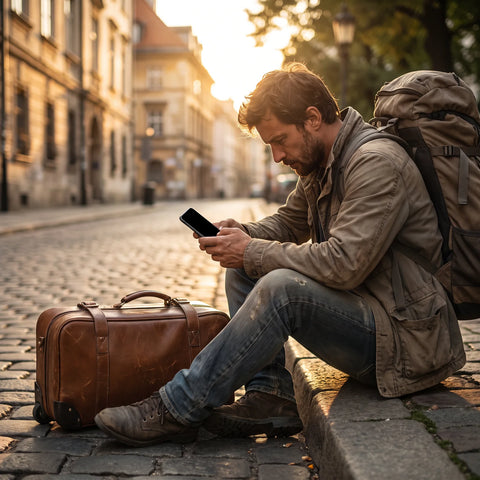
Imagine you're traveling from Mexico City to Bogotá for five days, for work. Before leaving, you buy a data eSIM for Colombia online and receive a QR code via email. Still at the airport, using the lounge's Wi-Fi, you install the profile on your phone in a couple of minutes: at that moment, the system generates the new number that the data connection will use, but you don't see it or need to write it down anywhere.
You land in Bogotá, activate the data line from your phone settings and, without looking for a SIM counter at the airport or waiting in line, you already have internet: you order your ride, locate the hotel on the map, and respond to messages from your usual WhatsApp, because that app is still linked to your original number. Your mom calls you on your old Mexico number and finds you just the same, even though your phone is technically using, for data, that new Colombian number you never even saw displayed on any screen.
If you ever wondered "so, will people still be able to call me even if I have another number?", the short answer is yes: regular calls and text messages still go through your usual line. The eSIM, almost always, only handles data.
Upon returning to Mexico, the new number on that eSIM simply stops being used. You don't have to cancel it, port it, or explain anything to anyone: it was a five-day tool, not a permanent commitment.

How to get a new number using an eSIM
The complete process has fewer steps than it seems at first glance. In general terms, this is how a phone ends up with a new data number ready for use at its destination:
| Step | What you do | What happens behind the scenes |
|---|---|---|
| 1 | Choose your travel destination or region | The system searches for available local networks in that country |
| 2 | Confirm the online purchase | A unique eSIM profile is generated for your phone |
| 3 | Receive the QR code or manual details via email | That code contains the information to download the profile |
| 4 | Install the profile from your phone settings | The operator assigns the new data number to that profile |
| 5 | Activate the data line upon arrival at the destination | The phone starts using the new number to connect |
None of these steps require going to a store, showing ID at a counter, or waiting for a physical chip by mail. If you want to see the technical details of each step, there's a complete guide on how to install an eSIM that covers iPhone and Android separately.
How to order an eSIM before traveling
Before buying, it's good to answer two simple questions: whether your phone is compatible and how far in advance you should buy. Regarding the first, most mid-range and high-end phones from recent years come with eSIM, but it's a good idea to check your device settings before paying; there's a detailed list of eSIM-compatible phones to clear up any doubts in a minute.
Regarding the second, there's no need to buy on the same day as your flight. At PuraSIM, for example, you have 180 days from purchase to activate the eSIM, so you can buy it weeks in advance while organizing the rest of your trip, without losing the plan's validity. The new number isn't generated until you install the profile, so buying early doesn't "waste" anything.
One detail that is often overlooked: if your trip crosses several countries, you don't need an eSIM for each border. Many international plans cover entire regions, and the new number assigned to you usually remains valid as you move within that coverage, without you having to reinstall anything when crossing from one country to the next.
How to activate the eSIM and its new number
Activation itself is the fastest part of the entire process: once the profile is installed, turning it on usually takes about a minute. The phone connects to the available network at the destination, and the new number becomes operational for data almost immediately.
Here's where a practical tip that almost no one mentions comes in handy: on most phones, after installing the eSIM, the phone continues to use your existing physical line as the "main" line for data, unless you go into the settings and manually change which of the two lines handles the internet connection. If you skip this step, you might land with the eSIM installed and active, and still unknowingly use data from your Mexican plan while roaming, because the phone never switched lines by default. Checking this setting—usually in the "Mobile Data" or "Cellular" section—is quick and avoids bill shock.
It's worth repeating something we already discussed: the new number associated with the eSIM is for the network to recognize your data connection, not for people to call you on that number. You don't need to memorize it, share it, or configure it in any app.
A new number every time you buy an eSIM?
Yes. Each eSIM you purchase for a different destination comes with its own new data number, independent of previous ones. If you traveled to Peru last month with an eSIM and are now going to Argentina, the eSIM for Argentina will generate another new number, unrelated to the one you used in Peru.
This is not a problem because, as we saw, that number is almost never something you actively use: you don't share it, you don't save it, you don't create a list of "my eSIM numbers." It's information that lives between your phone and the network, and that changes from trip to trip without affecting your contacts, your apps, or your identity to others. If you're interested in understanding the difference between this model and your usual operator's traditional roaming, there's a complete comparison in eSIM vs. roaming.
The only situation where you might need to pay attention to the new number is when a service asks to verify your location via the network, which is rare and usually resolved simply by having active data.

WhatsApp, contacts, and bank SMS codes
This is, in practice, the concern that needs the most reassurance: nothing in your digital life depends on the eSIM's new number, because that number almost never handles calls or SMS, only data. The following table summarizes what happens with the most common services:
| Service | Does it still work the same with the new number installed? |
|---|---|
| Yes. It remains registered with your original number and works via the internet, regardless of which data line you use. | |
| Contacts and address book | Yes. They are not modified or duplicated when installing the eSIM profile. |
| Normal calls and SMS | Yes, they still arrive via your usual physical line, not the eSIM number. |
| Bank verification codes via SMS | Yes, as long as your physical line remains active; they arrive at your usual number, not the data number. |
| Social networks and email | Yes, they work via the internet as soon as the eSIM provides data, without depending on the new number. |
In other words: the eSIM's new number is almost invisible for everything you use daily. It works in the background, connecting your phone to the internet, while your real number remains the contact point for people and for services that verify via SMS.
eSIM vs. physical SIM: what changes in the number
It's worth directly comparing the two classic ways to get data while traveling, because that's where you better understand why the eSIM's new number isn't a problem but rather part of how the system is designed:
| Aspect | Roaming with your usual physical SIM | Data eSIM for travel |
|---|---|---|
| Number you use for calls and SMS | The same as always, no changes | The same as always, no changes |
| Number that handles data abroad | Your usual number, under operator roaming | A new number, specific to the eSIM and destination |
| Do you need to remove your physical SIM? | No, it stays where it is | No, the eSIM is installed as an additional profile |
| Risk of unexpected roaming bills | Depends on the plan contracted with your operator | Lower, because the data plan is purchased before the trip |
If you also have doubts about how the experience compares to a traditional physical SIM card bought at the destination, there is a guide that delves into the topic: eSIM vs. physical SIM. And if you've never installed one and want to start from scratch, it's best to begin with what an eSIM is.
Frequently asked questions
Will I have a new phone number when I buy an eSIM for travel?
Yes, a new number associated with the eSIM's data profile is generated, but it's intended for the network to identify you, not for people to call you on it. Your usual number continues to function normally for calls and messages.
Can I choose the number assigned to me by the eSIM?
No. The number is automatically assigned by the network of the country or coverage region at the time of profile activation, just as with any prepaid SIM purchased at the destination.
Do I lose my WhatsApp number if I install an eSIM?
No. WhatsApp remains registered with your original number and works via the internet, so it continues to operate normally as soon as you have active data, regardless of whether it comes from your physical SIM or the eSIM.
Can I receive bank verification SMS with the new eSIM number?
Bank SMS codes arrive at your usual physical number, not the eSIM's data number. As long as your original line is active, those messages will still reach you just as they do at home.
What happens to the new number when my trip ends?
It simply stops being used. There's no need to cancel it or port it anywhere: it was a temporary number for the duration of your data plan.
Do I need a special phone to get a new number with an eSIM?
You need a phone with eSIM support, which is increasingly common in mid-range and high-end devices from recent years. It's a good idea to check your settings before purchasing.
Can I use my usual number and the new eSIM number at the same time?
Yes, that's precisely the idea of having two active lines on the same phone: one maintains your usual calls and messages, the other gives you data with the new destination number.
How long does it take for the new eSIM number to activate?
Activation usually takes about a minute once you install the profile and reach an area with coverage from the associated network.
Conclusion
The "new number" that an eSIM provides is not a second identity or pending paperwork: it is, simply, how your phone connects to the internet in the country you are visiting, while your usual number remains intact for calls, messages, and all the apps you already use. Understanding this difference is all it takes to travel with data from the moment you land, without surprises or complicated configurations.
If it's your first time, the best starting point is to review the available destinations in the international eSIM collection for the country you're going to. You can also read what other travelers are saying about the topic in opinions on eSIM numbers, or resolve specific doubts in the guide to common eSIM problems before you travel.