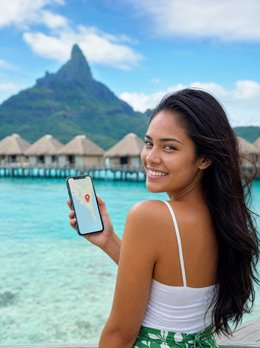
In short: an eSIM for French Polynesia gives you 4G data in Tahiti, Bora Bora, Moorea, and the rest of the Society Islands from the moment you land in Faa'a, without roaming or a physical SIM. It's activated before you fly, covers all islands with a single plan, and avoids expensive international roaming, as this territory is outside European roaming despite being French.

French Polynesia is one of those once-in-a-lifetime destinations, if you're lucky. The overwater bungalows of Bora Bora, the lagoons of Moorea, the atmosphere of Papeete, and the almost virgin Marquesas Islands are reason enough to keep your phone ready: to capture every sunset, let loved ones know you've arrived after an eternal flight, or book a last-minute excursion. With a French Polynesia eSIM, you land with internet, no roaming, and no airport queues.
What is an eSIM and how does it work here?
An eSIM is a digital SIM card installed via software on your mobile, without a tray or plastic. You purchase the data plan from home, receive a QR code by email, and calmly scan it from your phone's settings before packing your suitcase. If you've never used one, the guide what is a virtual eSIM clarifies the concept in five minutes.
The good thing about French Polynesia is that, although it's more than twenty hours of flight from Europe, including layovers, it has a modern mobile network on the tourist islands. As soon as the plane touches down at Faa'a airport in Tahiti, you activate your eSIM data and you have internet: no need to look for a phone counter late at night with jet lag. The installation itself is identical for any destination; if you want the general step-by-step before getting here, you have the guide on how to install an eSIM.
Coverage island by island
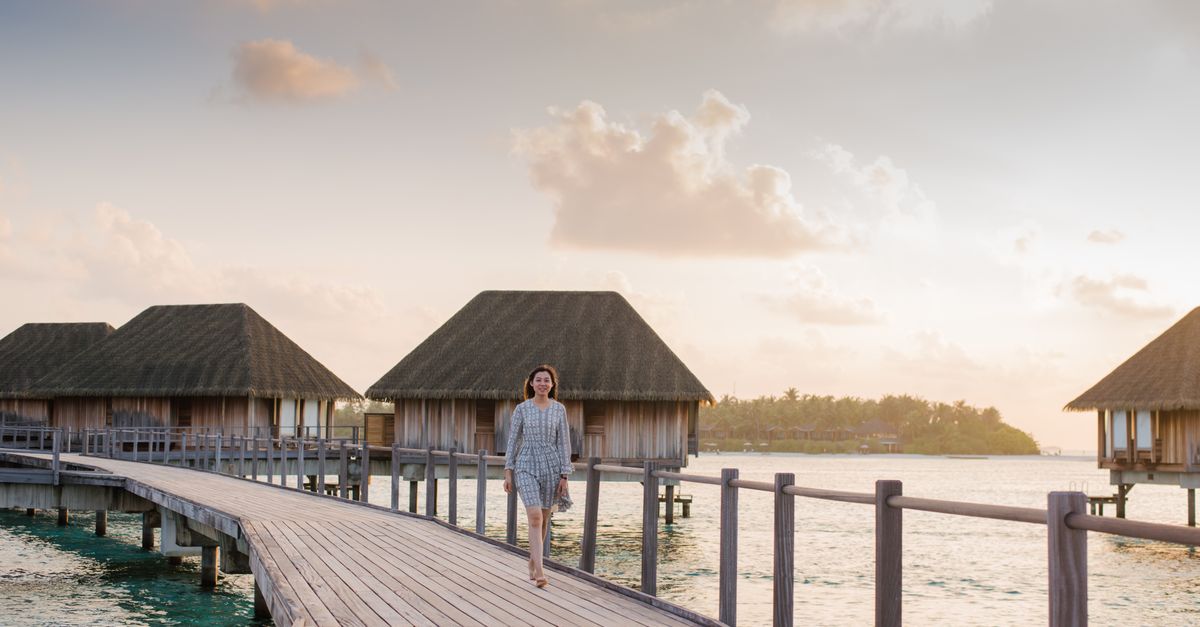
Coverage is not uniform, and it's good to know this before planning your route. In the Society Islands —Tahiti, Moorea, Bora Bora, Huahine, Raiatea, and Taha'a— the 4G network reaches population centers and resort areas without a problem, which is where you'll spend most of your time. Outside this circle, in the remote atolls of the Tuamotus or the Marquesas, the signal becomes more irregular and depends heavily on the specific village where you stay.
| Island / archipelago | Typical coverage | What to expect |
|---|---|---|
| Tahiti (Papeete) | Very good 4G LTE | Remote work, streaming, seamless maps |
| Bora Bora and Moorea | Good 4G in resorts and villages | Photos, reservations, video calls |
| Huahine, Raiatea, Taha'a | Stable 4G in population centers | Browsing and messaging without issues |
| Tuamotu (atolls) | Variable, depending on atoll | Confirm coverage with your accommodation |
| Marquesas | Irregular, by village | Download offline maps and content |
If your itinerary includes any of these more isolated areas, don't leave it to chance: ask the hotel or guesthouse directly before booking. An archipelago as scattered as this rewards those who plan well in advance.
Local operator and real speed
The main operator in French Polynesia is Vini (OPT), which supports most of the territory's mobile network, alongside Vodafone Polynésie and Ora as alternatives. A PuraSim eSIM relies on this local infrastructure to give you 4G LTE in the main islands, with more than enough speed for video calls, uploading photos in real-time, or checking the map while driving around Tahiti.
In the famous overwater bungalows of Bora Bora, you'll have mobile coverage in addition to the hotel's WiFi, which is often slow precisely because of the remote location: the signal has to travel a long way. That's where the eSIM becomes your real backup network. When the entire resort shares the same WiFi as evening falls and the connection crawls, your eSIM's mobile data is what saves that video call with family or the last-minute reservation to swim with rays in the lagoon.
How many GB to get
On a trip to French Polynesia, data consumption usually skyrockets compared to other beach destinations, simply because it's a place that makes you want to photograph and record everything constantly. If you also make video calls to show the paradise live, calculate generously from the start; running out halfway through the trip is a pain.
- One-week getaway: between 5 and 8 GB is usually enough for maps, messaging, and moderate photos.
- Two-week honeymoon hopping between islands: it's advisable to go for 8-12 GB.
- Content creators or daily video on social media: a 15 GB plan or a rechargeable one is better, because streaming live video can consume in one hour what normal browsing uses in several days.
Also consider the typical activities of the destination: snorkel tours with blacktip sharks, 4x4 excursions through the volcanic interior of Tahiti, or catamaran trips between islands generate a flood of photos and videos that you'll want to share the same day. To fine-tune the calculation according to your travel style, the guide on how to save data on an eSIM trip has tricks that apply perfectly here, such as scheduling photo backups for when you are connected to the resort's WiFi.
eSIM vs. roaming in French territory
Here's the nuance that most travelers overlook: French Polynesia is a French territory, but it is not part of the European Union for roaming purposes. Your "roaming like at home" rate does not apply, so if you leave unprepared and use data with your Spanish line, you directly enter international roaming, which can cost several tens of euros a day depending on your original operator. This is one of the most common mistakes precisely because it sounds like "it's France, nothing will happen" and that's not the case. If you want to understand what data roaming is and why it varies so much from one destination to another, you can find the complete explanation in what is data roaming.
With a travel eSIM, you pay a fixed price for your GB before leaving home, with no surprises on your bill when you return. On a two-week honeymoon, the difference compared to roaming can be considerable. If you want to see it in more detail, the comparison of eSIM vs. roaming explains why it almost always pays to plan your data in advance instead of leaving it to your usual operator.
How to activate it step by step
Activating your eSIM for French Polynesia is quick, and you can get it done days before your flight, without last-minute rush:
- Check that your mobile supports eSIM (iPhone XS or later, most recent Androids).
- Purchase the plan online and receive the QR code by email instantly.
- Scan it from your phone's settings with WiFi at home, and don't delete it afterwards.
- Keep the eSIM data turned off during the flight and layovers.
- Upon landing in Tahiti, activate the data and you're good to go: internet in your pocket.
A detail that is appreciated when you arrive exhausted from such a long flight: you don't have to look for a phone counter or change physical cards with clumsy hands due to fatigue. Everything is already installed before you leave home.
Layover: Los Angeles and other connections
Almost no flight to Tahiti is direct from Europe. It's common to layover in Los Angeles, somewhere in North America, or, depending on the route, in Auckland or Sydney before continuing to the South Pacific. If your layover requires you to spend several hours at the airport or even stay overnight in the United States, don't rely solely on airport WiFi: an eSIM for the United States solves those waiting hours without depending on public networks.
And if your round-the-world trip through the Pacific continues after Polynesia, towards Australia or New Zealand, it's advisable to check the guide on eSIM for Australia and New Zealand beforehand, because each leg of that type of route usually needs its own data plan.
Mistakes and tricks almost no one tells you about
Beyond the obvious, there are details that make the difference between a connected trip without stress and one with last-minute scares.
Thinking that "it's France, I'll have European roaming"
We've already said it, but it's worth repeating because it's the number one mistake: French Polynesia is an overseas French territory, not a European Union territory for telecommunications purposes. It doesn't matter if your SIM card is French or Spanish, European roaming stays in Europe.
Not noting down the APN before leaving
Some mobiles need you to manually confirm the Access Point Name (APN) of the data profile the first time you connect to a new network. It usually configures itself, but if you land and see that you have coverage but no internet, check that setting in the operator settings before assuming the eSIM is failing.
Not downloading offline maps for the Marquesas and Tuamotus
If your route includes these more remote archipelagos, download offline Google Maps or Maps.me before leaving Tahiti. The irregular coverage in these areas is not a flaw of the eSIM, it's the geographical reality of islands very far apart.
Using public WiFi in hotels and restaurants without protection
In tourist areas, it's tempting to connect to the first open WiFi that appears, especially to save data. The problem is that these networks shared by dozens of guests are a weak point for your passwords and bank details. If you're going to use them, do so with an extra layer of protection: the guide on eSIM and VPN to protect your privacy while traveling explains how to combine them without complicating things.
Not leaving margin for unexpected GB usage
A delayed flight, a last-minute change of plan, having to rebook online because the boat to another island is canceled due to bad weather: in such a scattered archipelago, logistical unforeseen events are more frequent than on a trip over land. Always leave a buffer of a couple of GB above what you estimate you'll need.
Frequently asked questions
Does French Polynesia fall under European roaming because it is French territory?
No. Although it is a French territory, French Polynesia is outside the European Union's roaming zone. Your "roaming like at home" rate does not apply here, and using data with your usual line would expose you to expensive international roaming. This is why a travel eSIM is so recommended for this destination.
Will I have internet in the overwater bungalow in Bora Bora?
Yes. Bora Bora has 4G coverage in the resort area, in addition to the hotel's WiFi. Since that WiFi can be slow due to the remote location, the eSIM gives you a reliable backup connection for video calls and uploading photos without solely relying on the hotel's network.
Does the eSIM work in the Marquesas Islands and the Tuamotu atolls?
In the Marquesas and the Tuamotu atolls, coverage is irregular and depends on the specific village or resort. For these more remote areas, it is advisable to download offline maps in advance and confirm with your accommodation if they have signal before assuming you'll have connectivity.
Can I use the same eSIM when island hopping?
Yes. The plan covers all of French Polynesia, so the eSIM continues to work when you fly from Tahiti to Bora Bora, Moorea, or Huahine. You don't need to buy or activate a different plan for each island you visit.
When should I activate the eSIM if I have a layover in another country?
Install the profile before leaving home, but do not activate its data until you land in Tahiti. If you have a layover in the United States or another country en route, keep this eSIM's data turned off to avoid using the plan outside Polynesia; for those layover hours, consider a specific eSIM for that country.
Do I need to book the eSIM far in advance?
There's no need to book it weeks in advance, as purchasing and activation are online and immediate. Still, it's a good idea to install it a few days before your trip, calmly and with WiFi, instead of leaving it for the airport just before boarding.
What happens if I run out of GB halfway through my trip?
It depends on the plan you've chosen: some allow you to top up additional GB from the app itself without having to buy a new plan from scratch. Therefore, if your trip is long or you're going to share a lot of content on social media, it's worth considering a rechargeable plan from the start rather than just barely covering your needs.
Conclusion
French Polynesia is a once-in-a-lifetime destination, and it deserves to be experienced without the worry of a skyrocketing roaming bill or the uncertainty of not knowing if you'll have coverage upon arrival. A French Polynesia eSIM gives you data in Tahiti, Bora Bora, Moorea, and the rest of the main islands from the first minute, with a fixed price and no paperwork at your destination. Install it calmly before your long flight, estimate your GB needs considering all the photos and videos you'll want to share, and enjoy a connection that lives up to paradise.