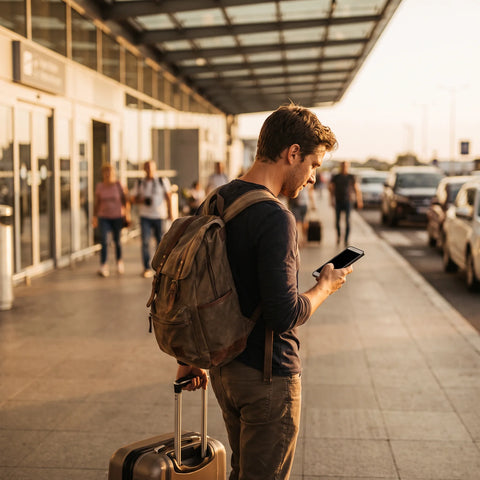
In short: for a 2-week eSIM in Thailand, estimate between 15 and 20 GB if your itinerary combines Bangkok, Chiang Mai, and the Southern islands, and install the profile before leaving home to activate it as soon as you land. Coverage is solid in cities and tourist areas, and drops on ferries, in the jungle, and on some mountain road sections.
Traveling to Thailand is an incredible experience, but arriving without data can ruin the first moments: no Google Maps to get out of the airport, no way to find your hotel, no way to contact whoever is waiting for you. The solution is simple and has been the standard among experienced travelers for years: an eSIM for Thailand.
In this guide, we tell you everything you need to know before traveling to Thailand: what coverage you can expect in Bangkok, Chiang Mai, Koh Samui, and Krabi, how many GB you really need, how to activate the eSIM, and the best connectivity tips from those who have already traveled there.
Spoiler: with PuraSim, you have local data from the moment the plane lands, no contracts, no physical SIM, and no surprises on your bill.

Your 2-week itinerary: from Bangkok to the Southern islands
Two weeks is just enough for the classic trip: a few days in Bangkok, a jump to Chiang Mai, and the rest split between Koh Samui, Koh Phangan, or Krabi. Each leg has its own connectivity logic, and that's where you'll notice if your eSIM is properly configured or not.
In Bangkok, you'll hardly miss data: the BTS Skytrain and MRT have good signal on the platforms, and most cafes and shopping centers have decent Wi-Fi. The real use of the eSIM here is for Grab (the local equivalent of Uber) and Google Maps to get around Sukhumvit, the Grand Palace, and Chatuchak. If you fly or take the night train to Chiang Mai, beware: within the Old City, some guesthouses with thick walls have weak Wi-Fi, and there, the eSIM with mobile data usually works better than the accommodation's router.
The leg that truly tests your data plan is the islands. Domestic flights between Bangkok and Koh Samui are fast and cheap if booked in advance; keep your eSIM active to compare prices in real-time before deciding on a date. Once in the archipelago, ferries between Koh Samui, Koh Phangan, and Koh Tao often lose signal halfway, and if you coincide with the Full Moon Party in Haad Rin, the local network gets saturated with so many tourists connected at once: it's not that your eSIM fails, it's that the nearest tower is at its limit. In Krabi and Railay, something similar happens on beaches only accessible by boat: good coverage on the main shore, and intermittent in the more isolated coves.
To get a quick idea of what to expect on each leg of the route:
| Route segment | Typical coverage | Where it might fail | Practical tip |
|---|---|---|---|
| Bangkok (city) | Very stable 4G/5G | Mall basements | Use eSIM mostly for Grab and maps |
| Chiang Mai and Old City | Stable 4G on the street | Guesthouses with thick walls | Prioritize mobile data over accommodation Wi-Fi |
| Night train Bangkok-Chiang Mai | Variable | Rural sections of track | Download maps and offline content before boarding |
| Koh Samui / Koh Phangan | Good in towns and main beaches | Ferries between islands and Full Moon Party nights | Don't rely on your phone for exact dates on that day |
| Krabi / Railay | Good on the main beach | Coves only accessible by boat | Tell your group the meeting point before losing coverage |
If your 2-week itinerary feels too short and you decide to cross into Malaysia or Singapore, your Thailand eSIM won't work on the other side of the border: in that case, it's better to look for a plan that covers Singapore, Malaysia, and Thailand in a single profile, instead of buying a new eSIM in each country.
Why do you need an eSIM for Thailand?
International roaming from European and Latin American operators is usually much more expensive than a local eSIM in Thailand, and many plans also limit speed or daily data volume. A local eSIM gives you data at local prices, without absurd daily limits and with 4G or 5G speeds where the network allows.
The difference between going with roaming and a PuraSim eSIM is huge:
- Traditional Roaming: fixed daily rate even if you barely use data, speed often limited to 3G, surprise bills when you return.
- PuraSim eSIM for Thailand: you only pay for what you contract, full local data at maximum available speed, activation in 5 minutes from anywhere.
Additionally, with an eSIM, you can keep your original phone number active to receive calls and SMS, as the eSIM operates in a separate virtual slot. You don't have to choose between local connectivity and your usual number.
For Thailand, where you'll be stringing together city, jungle, and islands in little over two weeks, having stable data is especially important. Coverage in Bangkok, Chiang Mai, Koh Samui, and Krabi is generally good, but there are areas where, without a well-configured local eSIM, you'd be in the dark.
Data coverage in Thailand: what to expect
Coverage in Thailand varies considerably by area. In major urban and tourist areas (Bangkok, Chiang Mai, Koh Samui, and Krabi), you'll find 4G and in some cases 5G networks. The experience is comparable to what you would have at home.
However, as in any destination, there are areas where the signal is more limited:
- Main cities: Stable 4G/5G, perfect for streaming, browsing, and video calls.
- Rural areas and nature: Coverage may drop to 3G or even lose signal in remote spots.
- Transport: Trains, ferries, and intercity buses have variable coverage; generally good in cities.
Key tip: if your route includes long overnight bus journeys or jungle areas in the north, download the maps and content you need before you leave, because you can go hours without stable coverage.
To maximize coverage in Thailand, PuraSim uses the local networks with the best available infrastructure through local roaming agreements. This means your eSIM automatically connects to the network with the best signal at all times.

How many GB do you need for traveling in Thailand?
This is the million-dollar question. The short answer: 15-20 GB for 14 days. The long answer depends on how you use your phone during the trip.
Here's a guide to real consumption by type of daily use:
- Basic use (maps, messages, occasional queries): 300-500 MB/day
- Moderate use (social media, photos, continuous browsing): 800 MB-1.5 GB/day
- Intensive use (remote work, streaming, video calls): 2-4 GB/day
For a 14-day trip to Thailand, our recommendation is to contract 15-20 GB for 14 days. This is enough for most travelers with normal use: Google Maps constantly running, Instagram, WhatsApp, and occasional searches.
If you're going to work remotely or plan to make frequent video calls, upgrade to the next plan. PuraSim plans allow you to top up data if you run out, so it's not a problem if you fall short: you won't suddenly lose coverage.
PuraSim offers specific plans for Thailand with different data and duration options. Check out the complete collection in our plans for Thailand.
How to activate your eSIM for Thailand step-by-step
Activating a PuraSim eSIM is as simple as scanning a QR code. There's no need to go to a store, no need to wait for any shipment. The entire process takes less than 5 minutes:
- Purchase your plan at purasim.com for Thailand. You will receive an email with the QR code.
- Install the eSIM: go to Settings → Cellular → Add Data Plan (on iPhone) or Settings → Connections → SIM Manager (on Android).
- Scan the QR code or manually enter the activation data.
- Configure mobile data: make sure to select the PuraSim eSIM as the default data line.
- Activate data roaming in the PuraSim eSIM settings (necessary for it to work on local networks).
You can install the eSIM before leaving home and configure it to activate automatically when you arrive in Thailand, or activate it manually when you land.
Important: verify that your phone is eSIM compatible before purchasing. Most iPhones from XS, Samsung Galaxy from S20, and Google Pixel from 3 are compatible. Check the complete list on purasim.com.

Local connectivity tips for Thailand
Beyond getting the right eSIM, there are a few tricks that make all the difference to stay connected throughout your trip to Thailand:
- Download offline maps before you leave. Google Maps and Maps.me allow you to download maps of all of Thailand or specific cities. This way you can navigate without using data when you are in areas with weak signal.
- Use airplane mode strategically. On long flights, trains, or ferries, activating airplane mode saves battery and data. Connect to available WiFi if there is any.
- WhatsApp and Telegram over data. Calls through these apps consume much less data than an international call. Configure them for high-quality calls only when you are on WiFi.
- Share connection carefully. Hotspot consumes data quickly, especially if there are other devices connected (laptop, tablet). Use it only when necessary.
And the most important tip: check app data usage from your phone settings halfway through your trip, so you know if you're going to run out before reaching the last leg of the route.
With these tricks and a good PuraSim data plan, your trip to Thailand will have the connectivity you need without unnecessary expenses.
What almost no one tells you before a 2-week trip through Thailand
There are quite a few ideas that are repeated in traveler forums and which, in practice, cause more than one upset. Some are direct myths, others are half-truths.
- "In Thailand, there's always free Wi-Fi everywhere." In cafes and hotels in cities, yes. But in a tuk-tuk, on a songthaew in Chiang Mai, or walking through a night market, there's no Wi-Fi to be found: that's where the eSIM makes a difference compared to traditional roaming, because you have constant data without relying on finding an open network.
- "It's cheaper to buy a physical SIM when you arrive." The price might be similar, but at Suvarnabhumi, the queues at SIM counters during peak hours are long, and if your flight lands in the early hours, some stalls aren't even open. With an eSIM, you install the profile from home and only activate it when you land; if you've never done the process, this step-by-step guide to installing an eSIM will save you surprises.
- "On the islands, you don't need data because everything is close by." On Koh Phangan, the beaches are further apart than they appear on the map, and Grab barely has driver coverage outside Bangkok and some large cities. Without data to order a moto-taxi or confirm the address of the bungalow complex, you could end up walking under the sun more than you bargained for.
- When NOT to buy a Thailand eSIM: if you're only stopping over in Bangkok for 24-48 hours and not leaving the airport or hotel, you probably have enough with the available Wi-Fi. Spending an entire plan for that isn't worth it; save it for the part of the trip where you're really moving around freely.
- "With eSIM, my consumption will skyrocket without me realizing it." It's the opposite if you know where to look: most smartphones show app consumption in real time, and there are simple tricks to stretch data on a long trip, like those we've included in this guide on how to save eSIM data on a trip.
If you're also concerned about privacy when connecting to public networks in markets or stations, it's worth reviewing how to combine eSIM with a VPN during your trip, especially if you're going to check your bank or work from your phone.
Frequently asked questions
When should I activate the eSIM for Thailand?
You can install it on your phone before leaving home. Most PuraSim eSIMs for Thailand can be set up days in advance and automatically activated upon arrival at your destination, or manually when you want to start using them.
Is my phone compatible with the eSIM for Thailand?
Most smartphones manufactured from 2018-2019 are compatible: iPhone XS onwards, Samsung Galaxy S20 onwards, Google Pixel 3 onwards, and many more. Check in Settings → General → About that your device lists 'eSIM' among its options.
Can I keep my usual phone number while using the eSIM in Thailand?
Yes. The eSIM works in a separate slot from your physical SIM. You can configure your local SIM for calls and the PuraSim eSIM for data. You will still receive calls and SMS on your usual number.
What happens if I run out of data in Thailand?
You won't suddenly run out of coverage. You can purchase a data top-up directly from the PuraSim app or client panel. The top-up is applied within minutes, and you don't need to change your plan or buy a new eSIM.
Does the PuraSim eSIM work all over Thailand?
The eSIM works through the local networks available in Thailand. In major cities and tourist areas, coverage is excellent (4G/5G). In rural or remote areas, such as parts of the northern jungle or hard-to-reach coves in the south, the signal may be more limited. We recommend downloading offline maps for those areas.
Do I need a different eSIM for each city or island on my itinerary?
No. A single eSIM plan for Thailand covers Bangkok, Chiang Mai, Koh Samui, Koh Phangan, and Krabi, provided you purchase a nationwide coverage plan and not one limited to a single area. Check the plan description to ensure it includes the entire country before purchasing.
My 2-week trip includes a getaway to Cambodia or Laos, will the same eSIM work for me?
No, a Thailand eSIM stops working as soon as you cross the border. If your route leaves the country, you need another local eSIM for Cambodia or Laos, or a regional plan that covers several Southeast Asian countries at once.
Activate your eSIM before you leave and arrive connected from the very first moment.
View eSIM plans →