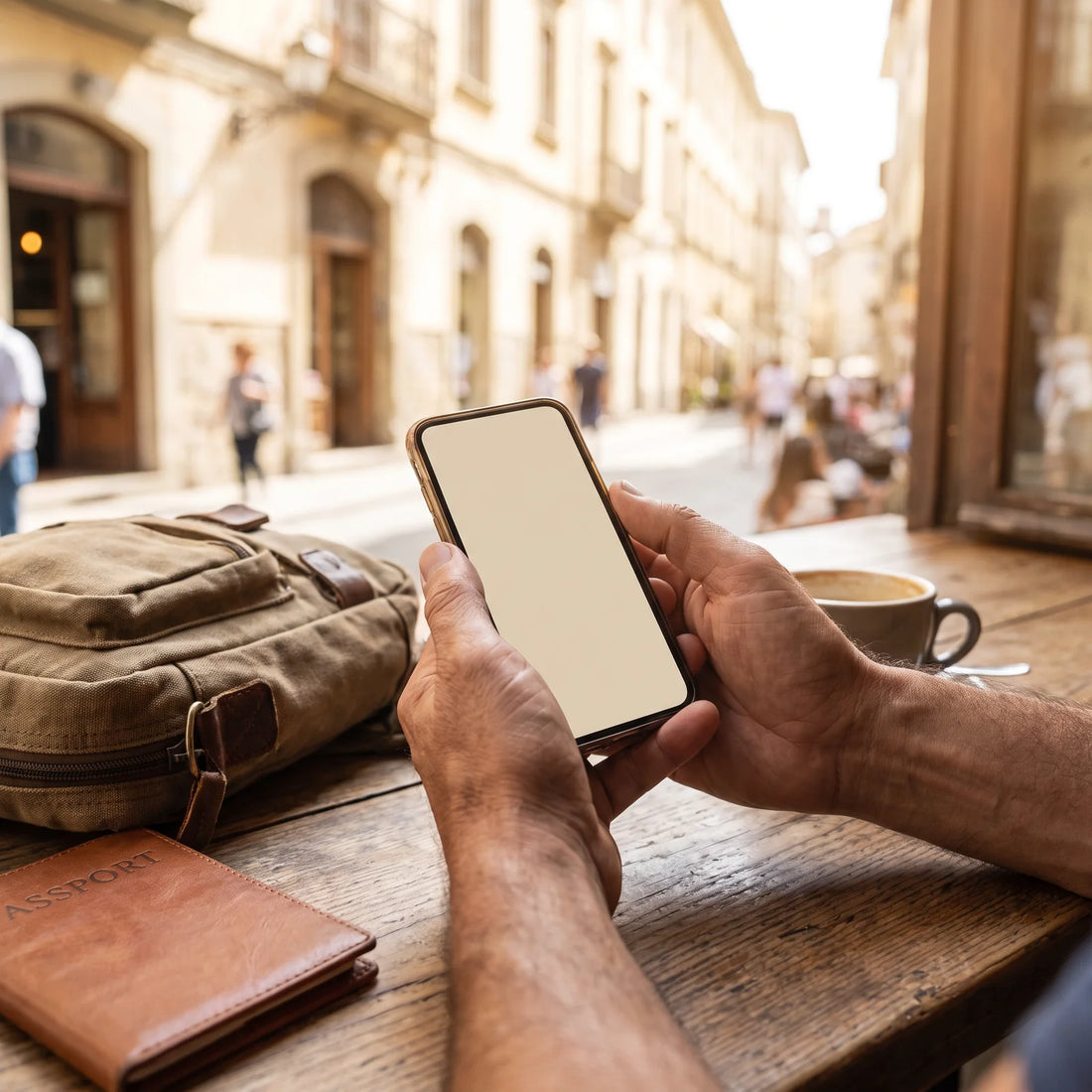
What is a world eSIM?
A world eSIM is a digital chip, integrated into your phone, that stores a mobile data plan valid for use in many countries without needing to change physical SIM cards. Instead of buying a new SIM at each airport, you activate a profile online before your trip, and your phone automatically connects to the local network in each destination.
The word "world" does not describe a brand or a company: it describes the type of plan. There are eSIMs for a single country (e.g., only Peru) and world eSIMs, designed for those who visit more than one destination on the same trip or make several different trips throughout the year without wanting to buy a new chip each time. The chip itself doesn't change: what changes is the data profile loaded onto it, and that profile can have coverage in dozens of countries at once.
For someone who has never used one, the simplest way to understand it is this: it's the same as what the physical plastic SIM card did, but without plastic, without a tray, without losing it at the bottom of your backpack, and without depending on finding an open store upon arrival. If you want the technical details of how this digital chip is manufactured and activated, the guide on what an eSIM is explains it from scratch.
How does a world eSIM work in multiple countries at once?
A world eSIM does not connect "to the world" in general: it connects, country by country, to local networks with which the eSIM provider has an agreement. When your phone detects you are in Mexico, it automatically searches for the network associated with that country within your plan; when you cross into Colombia, it does the same with the Colombian network. For you, the process is invisible: you don't have to activate anything different when entering each country, as long as that country is included in the plan you purchased.
This is different from traditional roaming, where your home operator lends its network to a foreign operator and charges you for that loan, almost always per megabyte or per day, with amounts that are only known much later: when the bill arrives. With a world eSIM, you purchase the data plan in advance, you know exactly how many gigabytes you have and in which destinations they work, and you do not depend on your main line's operator for anything related to international data. You can delve deeper into this comparison in the eSIM vs. roaming guide.
One point that confuses those new to the term: a world eSIM is almost always only for mobile data, not for traditional calls or SMS messages. Calls are handled with WhatsApp, FaceTime, or any video call app using that same data, which is how most people already travel anyway.
Real-life example: A trip through three countries with a single eSIM
Imagine a three-week itinerary: ten days in Mexico, six in Colombia, and the rest in Peru. With the traditional method, that means finding a phone store at each airport or city, waiting in line, showing your passport, paying in cash or with a local card, waiting for the chip to activate, and repeating the process three times, each in a different administrative language and with different rules about what documents are required.
With a world eSIM, that same trip is handled just once, before leaving home: you buy the plan that covers the three countries, install it with your phone connected to your home Wi-Fi, and leave it there. Upon landing in Mexico City, you activate your data, and your phone connects automatically. Arriving in Bogotá six days later, there's nothing additional to do: the same profile recognizes the Colombian network. The same happens when entering Lima. The purchase confirmation email, the downloaded map, and the chat with the person meeting you all continue to work on the same WhatsApp number throughout the journey, because you never changed chips or settings.
What changes with a world eSIM is not the chip inside your phone: it's that you no longer have to think of mobile data as a separate procedure at each border.
That is, in essence, the problem the concept solves: it doesn't necessarily save money on each leg when compared one-on-one with the cheapest local SIM in each country, but it saves time, hassle, and the uncertainty of arriving in a new country not knowing if you'll be able to order a car or send a message as soon as you get off the plane.
How to use a World eSIM? Step-by-step guide
The process is the same regardless of the specific destination and does not require technical knowledge:
- Confirm your phone supports eSIM. Most mid-range and high-end models from recent years have it, but it's worth checking before buying (we explain how below).
- Choose the plan according to your actual itinerary, not based on the country where you live: what matters is where you're going, for how many days, and how many countries you will visit.
- Install the profile using Wi-Fi, ideally before you travel. This is done by scanning a QR code or, on newer phones, with automatic installation from a link.
- Activate it upon arrival at your first destination, or even before, to test that it's correctly installed while you still have Wi-Fi backup.
- Activate data roaming for that specific eSIM line within your phone's settings; it's a toggle switch, not a procedure with any operator.
None of these steps require moving a physical card or restarting your phone in most cases. The step-by-step installation guide includes screenshots for iOS and Android if you prefer to follow it with images.
World eSIM vs. local eSIM vs. operator roaming
All three options solve the same problem—having mobile data outside your home country—but with different approaches. None is objectively better in all cases: it depends on how many countries you visit and how much you plan ahead.
| Feature | World eSIM | Local eSIM (single country) | Home operator roaming |
|---|---|---|---|
| Coverage | Multiple countries with the same profile | Only the country where purchased | Depends on your operator's agreements |
| When to contract | Before departure, online | Before departure or upon arrival, online | Already active on your original line |
| Known cost upfront | Yes, fixed price for the chosen plan | Yes, fixed price for the chosen plan | Often no, until the bill arrives |
| Procedure when crossing borders | None, network changes automatically | Must buy another plan per country | None, but cost may vary per country |
| Ideal for | Multi-country itineraries or frequent travel | A single long stay in one country | Very short trips with low data usage |
If your trip is to a single country, a local eSIM might be more tailored to actual use. If you cross borders within the same trip, a world eSIM avoids buying and configuring a new plan each time. The complete comparison, with more specific cases, is in eSIM vs. physical SIM.
Which is the best company for an eSIM?
There isn't a single answer for all travelers, because "best" depends on each person's itinerary. What you can do is review the same objective criteria before choosing any provider, instead of just focusing on the cheapest plan that appears first.
| Criterion | What to check | Why it matters |
|---|---|---|
| Actual coverage | Whether the exact country of your itinerary is on the destination list, not just "global coverage" as a generic phrase | A world plan that doesn't cover your specific destination is useless, no matter how many other countries it includes |
| Activation window | How many days you have from purchase to activate the plan | If you buy weeks in advance, you need enough time so you don't lose the plan before your trip |
| Available support | Through which channels you can ask for help and during what hours | A connection problem on arrival day can't wait for business hours |
| Plan clarity | If the gigabytes, days, and included countries are explained without fine print | Avoid coverage surprises mid-trip |
| Declared compatibility | If the provider confirms which phone models work with their eSIM | Installing a profile on an incompatible phone often leads to an avoidable claim |
PuraSIM, for example, covers more than 200 destinations under this model and provides 24/7 support in all languages via email and WhatsApp, which are precisely two of the criteria on this list. But the recommendation remains the same: check these points with any provider you consider, not just this one.
What are the disadvantages of a world eSIM?
The most real limitation, and the least mentioned, is compatibility: not all phones accept eSIMs, and some unlocked models or those bought outside their country's official market may have this function factory-blocked even if the hardware supports it. Buying the plan before confirming this is the most costly mistake, because the problem isn't discovered until you've already arrived at your destination.
The second limitation is that, since it's almost always a data plan, it doesn't replace a local number with traditional voice minutes, nor does it always allow receiving SMS verification from banks or apps that require a number from the country you are in. If your trip specifically requires that, it's worth checking before relying solely on the eSIM.
The third is less technical and more about habit: installing the profile requires an internet connection at the time of installation, so it's not something that can be done for the first time without Wi-Fi or data, unlike a physical SIM which can be inserted without needing a network. That's why the step of installing it before leaving home, mentioned above, is not optional: it's what prevents you from being unable to install it upon arrival.
Which is the best eSIM for Mexico?
If the trip starts or ends in Mexico but includes other countries on the same itinerary, the relevant question isn't "which eSIM is best for Mexico" but "which plan covers Mexico along with the rest of my route under a single profile." That's where a world eSIM with broad coverage—one that includes more than 200 destinations in the same catalog—solves something that an eSIM designed only for Mexico cannot: continuing to work seamlessly when crossing into Central America, South America, or any other destination on the itinerary.
If, on the other hand, the trip is exclusively within Mexico, without leaving the country, the most efficient option is usually a local plan designed only for that destination, adjusted to the exact days of the stay. The world eSIM makes sense when the "world" in the title is actually used: more than one country on the same trip.
Is your phone compatible with eSIM?
Before buying any plan, there's a quick check that avoids the most common problem described in the previous section. On iPhone, check in Settings > Cellular: if you see the option "Add eSIM" or "Convert to eSIM," your device supports it. On Android, the path varies by brand, but it's usually in Settings > Connections > SIM card manager, looking for the "Add eSIM" or "Download SIM" option.
It also matters if the phone is unlocked. A device purchased under contract with an operator, and still tied to it, may have the eSIM function blocked even if the model supports it by default. The complete list of compatible models, updated by brand and year, is in the eSIM compatible phones guide.
Common mistakes when buying a world eSIM
The first was already mentioned: buying without checking phone compatibility. The second is buying the plan on the day of the flight, without enough time to calmly install the profile and confirm it's correctly configured before leaving home.
The third relates to the timing of purchase versus the timing of travel, and this is where it's worth looking at the fine print of any provider: buying the plan is not the same as activating it. Most providers, including PuraSIM, allow up to 180 days from purchase to activate the eSIM, and the plan's usage day counter doesn't start until then. This means that taking advantage of a convenient date to buy—for example, weeks before the trip, when there's time to check everything calmly—doesn't reduce the plan's data days by even one, because the actual countdown begins when you first connect at the destination, not when you pay.
The fourth mistake is assuming that "world" automatically means "all countries on the planet." It's always advisable to confirm that your specific destination is on the list before paying, not afterward. And the fifth is not keeping the provider's support channel handy: if something goes wrong upon arrival, it's better to have already identified whether it can be resolved by email or WhatsApp before needing it, rather than searching for it with a phone without data in hand. The complete list of typical failures and how to resolve them without wasting travel time is in the common eSIM problems guide.
Frequently Asked Questions
Does a world eSIM completely replace my main line?
Not necessarily. Most travelers use it as a second line, dedicated only to mobile data abroad, while leaving their main line in airplane mode or for Wi-Fi only. The phone can have both lines active at the same time if it is dual SIM.
Do I need Wi-Fi to install the world eSIM?
Yes, to install it. Once installed, activating and using it at the destination does not require Wi-Fi: it works with the local data network included in the plan.
Can I use the same world eSIM on more than one trip?
It depends on the plan: some are single-use for the contracted duration and gigabytes, and others allow recharging the same profile for a later trip. It's advisable to check the plan description before buying.
Does the world eSIM work the same for calls as for data?
Generally, these plans are for mobile data, not traditional calls or SMS. Calls are handled by apps like WhatsApp or FaceTime using that same data.
What if my phone does not accept eSIM?
Then you need a physical SIM in each country, either local or purchased before the trip. The digital data world option only applies to devices with this feature enabled.
How long do I have to activate the world eSIM after purchasing it?
With PuraSIM, up to 180 days from the purchase date. The plan does not start to be consumed until you activate data at the destination.
Can I ask for help if something goes wrong during the trip?
Yes. PuraSIM provides 24/7 support in all languages via email and WhatsApp, without the need for a phone call.
Is the world eSIM useful for single-country trips?
It works, but it's not always the most tailored option. If the trip is to a single destination, comparing it against a local plan for that country might be more suitable than a plan designed for several countries.
Conclusion
A world eSIM makes sense when the trip truly crosses borders: with a single purchase made before leaving home, it solves something that would otherwise mean repeating the same process in each country. If your next itinerary includes more than one destination, the first step is to confirm that your phone is compatible and that the entire route is covered by the same plan.
To take the first step without getting lost in technical terms, the definitive eSIM guide for travel covers the entire process from start to finish, and the international plans collection allows you to check which destinations are covered before deciding which one fits your route.