In short: the best eSIM for Morocco provides stable coverage in Marrakech, Fez, and the desert, with data tailored to your travel days and activation before you land. Compare actual coverage, GB, and plan expiration before buying; avoid focusing solely on price or the most well-known brand.
Choosing the best eSIM for Morocco comes down to three things: real coverage in Marrakech, Fez, and the desert, enough data for your itinerary, and an honest price with no surprises when you get home. In this guide, we'll tell you what to look for before buying and how to avoid the mistake of relying solely on the most recognized logo.
Which is the best eSIM for Morocco
The best eSIM for Morocco is one that combines stable 4G/5G network in the cities you'll visit, a data plan adjusted to your travel days, and 1-minute activation with no local procedures. For a weekend getaway to Marrakech, a small plan is sufficient; for long routes through the south, it's advisable to choose one with more margin.
There isn't a single valid answer for everyone. A traveler who only uses Google Maps and WhatsApp spends much less data than someone who uploads stories from the souk every evening. That's why it's smart to start with your usage profile and not the most expensive plan "just in case." A PuraSim eSIM for Morocco relies on local networks, so the coverage is the same as a SIM card bought there, but without queues or passport hassle. If you're debating between brands, we've included an honest comparison below.

Coverage and operators in the country
In Morocco, the three main mobile networks are Maroc Telecom (IAM), Orange Morocco, and Inwi. Travel eSIMs connect to one or more of these networks, so the experience depends on which one your plan uses and where you are physically.
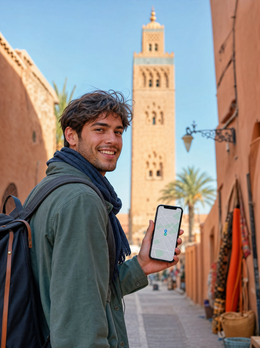
In urban areas like Marrakech, Casablanca, Rabat, Fez, or Tangier, 4G coverage is solid and sufficient for browsing, maps, and video calls. Things change when you venture further afield: in the Draa Valley, the Todra Gorges, or in the heart of the Merzouga desert, the signal becomes intermittent, sometimes drops to 3G, or disappears in stretches. No operator or eSIM will give you 5G surrounded by dunes, so be wary of anyone who promises it.
Practical tip: download offline maps of your route before leaving the city. In the desert, the best network is the one you already have saved on your phone.
If your trip combines Morocco with a layover in Europe, consider a plan that covers both areas so you don't have to switch eSIMs at each border: there's an eSIM for Europe and Morocco specifically designed for that.
Marrakech and the medinas: where the signal really fails
This is the question we get asked the most, and for good reason: the signal inside the Marrakech medina does not behave the same as in Guéliz, the modern part of the city. The adobe and pisé walls of the derbs (the narrow alleyways) attenuate the signal, so inside a riad, you might have one less bar than on the street next door. This is not a fault of your eSIM or your operator: it would happen with any line, local or travel, due to the building's construction.
In Fez el Bali, the country's largest and oldest medina, the pattern repeats: good coverage in open squares like Bab Boujloud, and occasional drops in the covered passages where tanneries and artisan workshops are clustered. If you plan to get lost in the souk - which is what you should do - have your route back to the riad saved offline before entering.
Something similar happens in Chefchaouen: in Uta el-Hammam square and the main streets, the connection is good, but when climbing to the higher blue alleys, where many people go just to take photos, the signal becomes irregular. And on day trips from Marrakech, such as the Ourika Valley or the village of Imlil in the Atlas, expect coverage to drop out in stretches of mountain road; save your itinerary or trekking route before leaving the city. If you want the complete picture of how internet works in the country, beyond this eSIM comparison, we have a separate guide on internet in Morocco.
How many GB do you need depending on your route
Consumption depends on what you do online. As a realistic reference for a typical trip to Morocco, this table helps you calculate without running out or overpaying. If you want to fine-tune it by day, calculate your route segment by segment instead of relying on a general average.
| Traveler profile | Daily usage | Days | Recommended data |
|---|---|---|---|
| Basic (maps + WhatsApp) | ~200 MB | 4-5 | 1-2 GB |
| Medium (social media + photos) | ~500 MB | 7-8 | 3-5 GB |
| Intensive (stories + video) | ~1 GB | 10+ | 8-10 GB |
| Long route through the south | variable | 10-14 | 10 GB or unlimited |
For a short trip to Marrakech of three or four days, 2-3 GB will be more than enough. If you do the complete imperial route or go to the desert for ten days, aim for 8-10 GB. Remember that you can upload many of your photos at night using the riad's Wi-Fi.

Comparison of options and prices
The eSIM market for Morocco is full of brands, and not all of them play by the same rules. These are the differences that truly matter when making a decision. If you're looking to save money, always compare several packages before settling on the seemingly cheapest one.
- Price per GB: the cost per GB varies quite a bit from one package to another. Always compare the total price divided by the actual GB included, not the sticker price.
- "Unlimited" data: often hides a reduced speed after exceeding a certain threshold. It's fine for chat, not so much for video.
- Expiration: some plans expire in 7, 15, or 30 days. Choose one that covers your entire trip.
- Support: having 24/7 Spanish-speaking assistance makes a difference if something goes wrong 3,000 km from home.
Compared to traditional roaming from your operator, which in non-EU destinations can cost between €10 and €20 per day, a travel eSIM is usually much cheaper. We'll look at this in detail in eSIM vs roaming.
eSIM or physical SIM card in Morocco?
If you were looking for a "Morocco SIM card," it's probably because you didn't know eSIM existed or weren't sure if your phone supports it. The practical difference is this: you buy a physical SIM at a Maroc Telecom, Orange, or Inwi kiosk inside the airport - or at a store in the city - with queues, a passport copy, and sometimes only in cash. You buy an eSIM online, install it before you fly, and don't need to visit any counter upon arrival.
There is one case where a physical SIM still makes sense: if you're staying for several months and need a real Moroccan number for procedures, banking, or home deliveries. For a tourist trip of a few days or a couple of weeks, an eSIM saves you the queue without any real disadvantage. If your underlying question is what exactly an eSIM is and how it differs from an international physical chip, we explain it in detail in international chip vs eSIM.
An important nuance: not all phones have eSIM. iPhones from XS onwards, most Samsung Galaxy mid-to-high-range phones from recent years, and Pixels from 3 onwards are usually compatible, but it's worth checking your settings before buying to avoid a disappointment at Marrakech-Menara or Casablanca airport.
How to install and activate it
The great advantage of an eSIM is that you buy and install it from home, before you fly, and activate it upon landing. There's no physical store, no SIM card to lose, and no paperwork with your ID at Marrakech-Menara airport.
The process is simple: after purchase, you receive a QR code by email, you scan it in your phone settings, and the profile is saved. When you arrive in Morocco, you activate the data for that line, and in less than a minute, you have internet. You can keep your Spanish SIM for calls and WhatsApp with your usual number. If it's your first time, follow our step-by-step guide on how to install an eSIM to avoid any adjustment mistakes.
A note: install the profile with Wi-Fi before leaving, but do not activate the data until you are in Morocco, or you could start consuming the plan prematurely.
Typical errors that ruin the connection
Most eSIM problems in Morocco don't come from the network, but from a misplaced setting. These are the most common failures and how to avoid them.
- Data roaming deactivated: the travel eSIM needs roaming ACTIVATED on that specific line to connect to the local network. This is how it works, it won't charge you extra.
- Mobile data assigned to the wrong SIM: check that the default data line is the eSIM and not your Spanish card.
- Manual network selection stuck: if it doesn't connect, set network selection to automatic or manually choose Maroc Telecom or Orange.
- Activating the plan too soon: as we said, wait until you are at your destination.
With these four points under control, you'll have internet as soon as you land. And if something resists, Spanish-speaking support is there for that.
Myths and what almost no one tells you about eSIM in Morocco
Here are the details that don't appear in the product description, but which make a real difference on the ground.
- "With eSIM, I can't call via WhatsApp": this isn't entirely a myth. Voice and video calls through apps like WhatsApp or FaceTime have experienced intermittent outages on Moroccan mobile networks at various times, regardless of your operator or card. Text messages and normal browsing are not affected. If a video call doesn't connect, first try using the Wi-Fi at your riad or cafe before assuming your line is faulty. And if you're also concerned about privacy on those public Wi-Fi networks, there are specific tricks in eSIM, VPN, and travel privacy.
- "I have to remove my physical SIM to install the eSIM": No. Your phone works with both simultaneously (dual SIM). Your Spanish line remains active for calls and SMS with your usual number; the eSIM only handles data in Morocco.
- "It doesn't matter when I buy, there's always availability": Easter is one of the periods with the most Spanish travelers to Morocco, so flights and riads fill up sooner than it seems. It pays to book well in advance, not just the eSIM but also accommodation.
- Save data before entering areas with no coverage: just before entering sections with poor signal, such as the journey to Zagora or Merzouga, deactivate automatic app updates and background refresh. It makes a much bigger difference than it seems to your actual plan consumption. More tricks on how to save data on your travel eSIM.
- "Roaming will charge me extra": the roaming you activate within your travel eSIM has nothing to do with the expensive roaming from your Spanish operator; it's simply the technical mechanism to connect to the local Moroccan network at no extra cost beyond what you've already paid for the plan.
Frequently asked questions
What is the best eSIM for Morocco if I'm traveling for only a few days?
For a three-to-five-day getaway to Marrakech or Fez, a 1 to 3 GB plan is more than enough if you primarily use maps and WhatsApp. Choose one with Spanish support and 1-minute activation, so you can resolve any questions upon landing without relying on hotel Wi-Fi.
Does eSIM work in the Merzouga or Zagora desert?
In cities and on main roads, yes, with good 4G coverage. In the middle of the desert, the signal is weak or non-existent for any operator. It is advisable to download offline maps and routes before leaving, and use the camp's Wi-Fi for anything you need to upload.
Can I keep my Spanish number with the eSIM?
Yes. The travel eSIM only handles data, while your Spanish SIM remains active for calls and SMS with your usual number. It's the ideal dual-SIM setup: you browse with the cheap eSIM and remain reachable on your regular line.
Do I need to register my data or passport?
No. When you buy a travel eSIM online, there's no document registration as sometimes happens when buying a local physical SIM. You receive the QR, scan it, and you're good to go. It's faster and more convenient, especially if you arrive tired after a long flight.
How much does it cost compared to my carrier's roaming?
Roaming outside the European Union, such as in Morocco, can cost around €10-20 per day with Spanish operators. A travel eSIM usually costs significantly less for the entire trip, with clear data and no surprise bills upon returning home.
Is an eSIM or a physical SIM card better in Morocco?
For a tourist stay, eSIM is the most convenient option: it saves you the airport queue, the passport paperwork, and the Moroccan dirhams cash you would need to buy a physical SIM at a kiosk. A physical card only pays off if you're staying for months and need a Moroccan number for local procedures.
Does eSIM work well in Marrakech and inside the medina?
Yes. In Marrakech and Guéliz, 4G coverage is good. Inside the medina and in riads with thick walls, it might drop a bit due to the building's structure, not the line; the same would happen with a local SIM. With the accommodation's Wi-Fi as a backup, you won't have any problems.
Conclusion
The best eSIM for Morocco is not the most expensive or the one from the most advertised brand: it's the one that fits your itinerary, your travel days, and how you use your mobile. With coverage in cities, well-calculated data, and 1-minute activation, you'll have internet from the moment you leave the airport. Choose your eSIM plan for Morocco before you fly and forget about local SIM cards and expensive roaming.