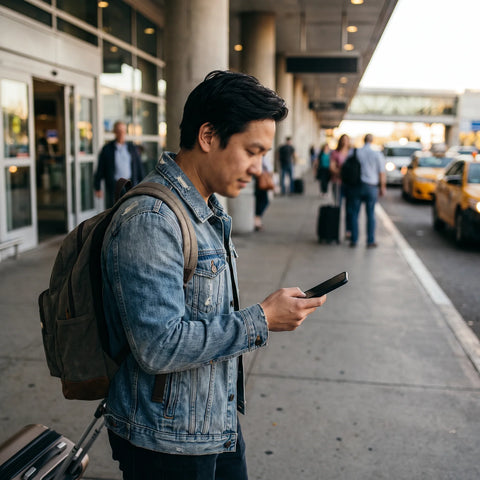
In short: 2025 closed with some 1.52 billion international tourist arrivals, up 4% compared to 2024, according to UN Tourism. At the same time, 80% of the world's mobile connections are already smartphones, with 5G expanding in regions like Latin America, according to GSMA Intelligence. The logical consequence, according to Juniper Research: the travel eSIM market will exceed $8.7 billion by 2030.
Every July, we are asked the same question: what has changed in the eSIM world this month? The truth is that this "monthly news" approach makes little sense in a sector that moves in cycles of years, not weeks. What does make sense — and what truly matters if you are traveling in the remainder of 2026 — is to understand where traveler connectivity is heading in the medium term. And for that, there are three data points, each with a verified source, that paint a clear picture.
A record 2025 sets the pace for connectivity in 2026
Let's start with the basics: how many people travel. According to UN Tourism, in 2025 there were approximately 1.52 billion international tourist arrivals worldwide, a 4% increase from 2024. This is a record figure, and it is not insignificant for the telecommunications sector: each of these arrivals is, potentially, a phone that needs to connect outside its country of origin from minute one.
For years, this need was resolved in two unsatisfactory ways: paying roaming fees to the usual operator (expensive, with bill surprises) or looking for a physical SIM card store upon landing (queues, paperwork, and sometimes no coverage until the next day). If you want to understand exactly what roaming is and why it generated so much mistrust for so long, we explain it in detail in our guide on what data roaming is.
The interesting thing is that this record mobility in 2025 is not an isolated peak: it fits into a trend of recovery and sustained growth in international tourism that has been consolidating since 2023. The more millions of people cross borders each year, the more pressure there is on any connectivity solution that doesn't scale well — and the more sense everything that follows in this article makes.
The smartphone is now the standard, and 5G is advancing in regions
The second piece of data comes from GSMA Intelligence, the research division of the association that brings together mobile operators worldwide: smartphones already account for 80% of global mobile connections. In other words, we are no longer talking about a market in transition to smartphones — that change, in global terms, is practically complete. The relevant conversation now is different: what type of smartphone, with what connection technology, and with what way to manage that connection when crossing a border.
And here enters the second element of the same data: 5G continues to expand in regions, with Latin America being one of the markets where GSMA Intelligence explicitly points out this advance. This has a very practical interpretation for travelers: the infrastructure that a few years ago only existed in a handful of large European or Asian cities is increasingly present in more countries, which expands the terrain where an eSIM can offer a fast and stable connection from landing.
Note that this does not mean that 5G is everywhere yet or that it is essential for good travel — for the vast majority of a traveler's uses (maps, messaging, social media, some video calls) 4G LTE still works perfectly. But it is a clear sign of where the underlying infrastructure supporting any travel eSIM is heading.
Why the travel eSIM will grow so much between now and 2030
The third piece of data connects the previous two and points to the future: according to Juniper Research, the travel eSIM market will exceed $8.7 billion by 2030. This is not a figure that appears out of nowhere — it is the almost direct consequence of more people traveling (UN Tourism) on a base of increasingly capable smartphones with better coverage (GSMA Intelligence).
The underlying trend that summarizes all this is simple to explain, even if the phenomenon behind it is complex: more and more travelers want to arrive with internet from the moment they land, without relying on their usual operator's roaming and without having to look for a physical store as soon as they leave the airport. eSIM technology — which allows a digital data profile to be installed even before boarding the plane — fits exactly this need. If you have never used one and want to understand the difference with a traditional physical SIM, we have a complete guide on what an eSIM is and how it works.
| Data point | Figure | Source / Year |
|---|---|---|
| International tourist arrivals in 2025 | ~1.52 billion (+4% vs. 2024) | UN Tourism, 2025 |
| Global mobile connections that are smartphones | 80% of total, with 5G expanding regionally (e.g., Latin America) | GSMA Intelligence |
| Projected size of the travel eSIM market in 2030 | Over $8.7 billion | Juniper Research |
Three different sources, three different angles (tourism, telecommunications, and technology market), and one single direction: more travelers, more capable smartphones, and more demand for a way to connect that doesn't depend on physical SIMs or expensive roaming. No need to invent any additional figures to see which way the wind is blowing.
What this means for you if you have a trip ahead
Beyond the numbers, what truly matters is what you do with this information before your next flight. Here are some concrete ideas:
Don't leave connectivity to the last minute
If the trend is clear — it's getting easier and easier to be connected from the moment you land — there's no point in leaving that topic for when you're already in line at passport control. You can install your eSIM from home, before you leave, and activate it just as you land. The process is simpler than it seems the first time; we explain it step by step in how to install an eSIM.
Compare eSIM and roaming with real numbers, not fear
For years, roaming had a reputation for being a "bill trap," and partly for good reason. But before deciding, it's worth understanding the real differences between both options, without dramatizing either: in eSIM vs. roaming we break down when each makes sense depending on the type of trip.
If you are going to the US or the EU, enter with a clear plan
The United States and the European Union continue to be two of the destinations with the most international arrivals in the world, so it's no coincidence that they are also where the travel eSIM offer has matured the most. If your next destination is one of the 27 countries of the European Union, remember that within the bloc, the roaming regulation without additional surcharges has been in force since 2017 for national operators — something different from what you need if you come from outside and want data from day one. You can check specific coverages in our eSIM for Europe or, if your trip is within Spain, in the eSIM for Spain. For the United States, the other major international tourism receiving market, the approach is the same: activate data before landing instead of looking for a physical SIM upon arrival.
Think about the security of your connection, not just the data
With more people connecting from public networks in airports, hotels, and cafes at their destination, the question of how to protect that connection becomes more important. Having your own mobile data is already a step forward compared to unencrypted public Wi-Fi, and if you also want an extra layer of privacy, in eSIM and VPN we explain how to combine both without complicating your life.
If you travel frequently, monitor how much you actually spend
Many travelers are still unclear about how much it really costs them to connect outside Spain each year, and how much of that expense is avoidable. If you're interested in the background context — how Spanish travelers behave regarding roaming and international data — you can review our analysis of roaming statistics for Spaniards abroad.
Not all destinations advance at the same pace
One of the most useful readings of GSMA Intelligence data on 5G expansion by regions is that the world does not move at a single speed. There are markets where mobile infrastructure is already very mature and others where it is still under construction, which translates into different connection experiences depending on where you go — from Latin America, where 5G is advancing strongly according to the same source, to destinations where 4G LTE will remain the standard for much longer. It's worth checking local coverage before you leave instead of assuming everything will work the same as at home.
Don't confuse "eSIM" with something complicated
There is still a lot of confusion about what it means for a phone to be "eSIM compatible," and that confusion causes some travelers to arrive at their destination without having activated anything for fear of not understanding the process. It's not magic or anything particularly technical: it's a chip integrated into the phone itself to which a data profile is loaded via a QR code or a link, usually in a couple of minutes and with the phone connected to any Wi-Fi before leaving home.
A note on figures and projections
It is worth stating this clearly: Juniper Research's $8.7 billion for 2030 is a projection, not an accomplished fact. Market projections are revised over time, up or down, depending on how actual device adoption, regional regulation, and competition among providers evolve. What is already a verified fact is UN Tourism's record tourist arrivals in 2025 and the current weight of smartphones noted by GSMA Intelligence. Both data points, combined, form the reasonable basis upon which this projection is built — but it should be treated as what it is: an industry estimate, not a mathematical certainty.
At PuraSIM, we do not have any proprietary market size figures to contribute here, and we prefer not to invent them. What we can tell you, because it is information about our own service, is that we cover more than 200 destinations and that if you have any questions before, during, or after your trip, you have 24/7 support by email and WhatsApp — something that makes more sense the more travelers depend on their data connection for everything, from maps to hotel reservations.
Frequently Asked Questions
How many international tourists were there in 2025?
According to UN Tourism, in 2025 there were approximately 1.52 billion international tourist arrivals worldwide, 4% more than in 2024. This is the highest figure recorded to date by this organization.
What percentage of the world's mobile connections are already smartphones?
According to GSMA Intelligence, 80% of global mobile connections are now smartphones, with 5G expanding in various regions, including Latin America.
How much will the travel eSIM market be worth in 2030?
Juniper Research projects that the travel eSIM market will exceed $8.7 billion by 2030. This is a market estimate, subject to revision, not a fixed figure.
Why is the demand for travel eSIMs growing so much?
Because several factors coincide: more people traveling each year (record tourist arrivals in 2025), an increasingly large base of capable smartphones, and a growing preference for having active data from landing instead of relying on the usual operator's roaming or looking for a physical SIM at the destination.
Is 5G essential for traveling with an eSIM?
No. 5G is expanding and improves the experience in cities with good coverage, but for a traveler's typical use — maps, messaging, social media, some video calls — 4G LTE is still more than sufficient in the vast majority of destinations.
Is eSIM the same as roaming?
No. Roaming is the service your usual operator offers you to use your line outside your country, usually with surcharges if you leave your usual coverage area. A travel eSIM is an independent data profile that you install for your destination, without relying on your originating operator. You can see the full comparison in our eSIM vs. roaming guide linked above.
Do I need to do anything special if I travel within the European Union?
If your line is from an operator in one of the 27 EU countries, since 2017 the roaming without additional surcharges (RLAH) regulation applies within the bloc. If, on the other hand, you are traveling to the EU from outside and need data from day one without relying on your originating operator, a travel eSIM is still the most direct option.