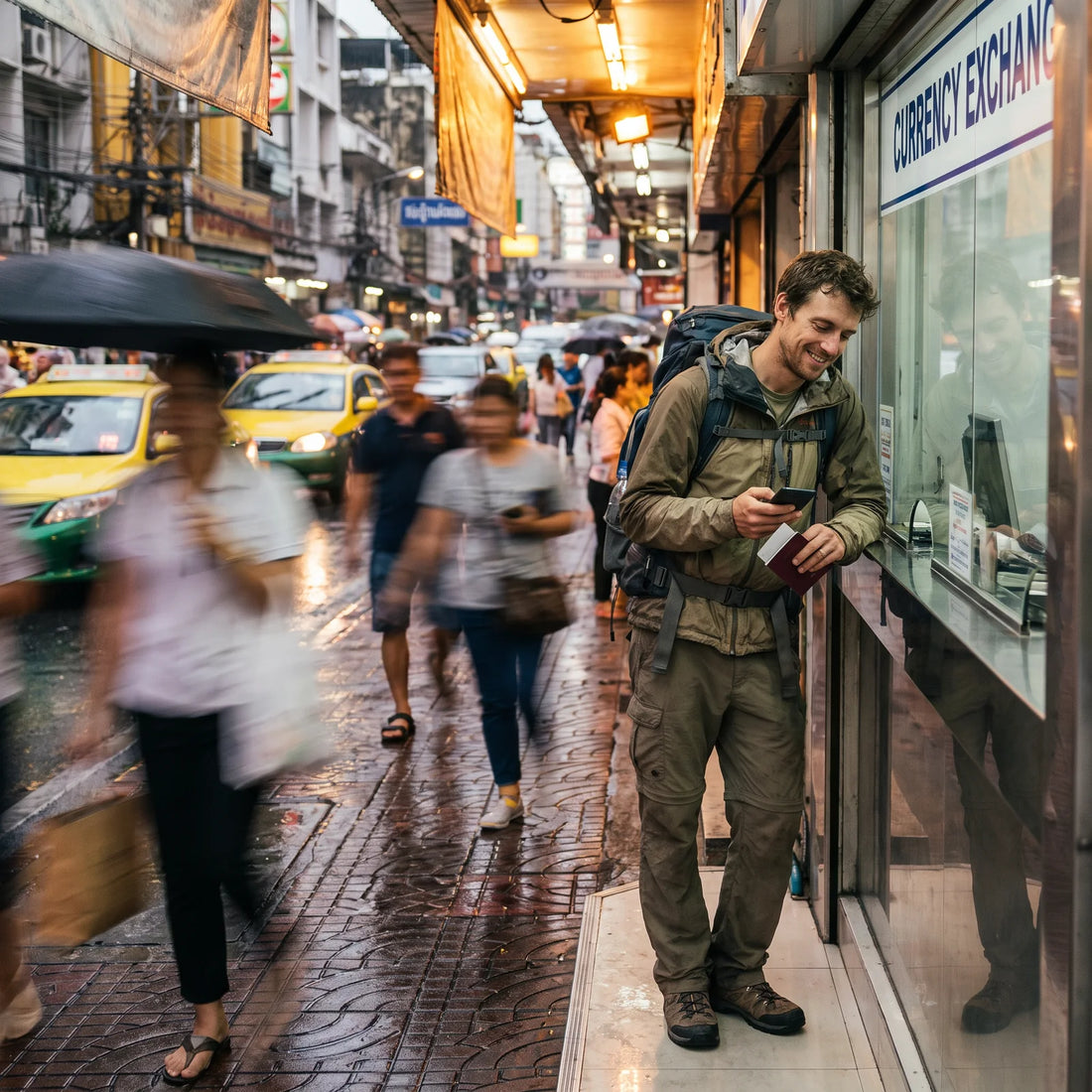
What is international roaming and how it works with a prepaid line
International roaming is the service that allows your cell phone to function outside your country using another operator's network, without changing your SIM card. With a prepaid line, usage is paid in advance: you activate a package or leave a balance available before traveling, instead of the consumption being added to a monthly bill.
The difference with a contract line is that, without a monthly plan behind it that "absorbs" out-of-plan consumption, if you don't activate anything before leaving your country, your cell phone may lose data signal as soon as you cross the border, or it may start consuming your balance at a much faster rate than usual. That's why most travelers who use prepaid lines prefer to resolve this issue before getting on the plane, not after.
It's worth clarifying something from the start: international roaming is not the only way to have mobile data when you travel. There are also alternatives such as buying a physical SIM in the destination or installing an eSIM, a digital SIM card that is activated without the need to insert anything physical into the cell phone. Later in this guide, you will see how these options compare to each other.
How to activate international roaming with Claro prepaid
The process for activating roaming on a prepaid line usually follows a similar pattern among operators, although the exact steps and available options depend on the current conditions of each company in your country. In general terms, the usual path is this:
- Confirm with your operator that your prepaid line has roaming service enabled. Not all prepaid lines have it active by default, and some require requesting it from the app, using a dialing code, or through customer service.
- Check if there is a roaming package or add-on that you can purchase before traveling. These packages usually include a certain amount of data, minutes, or messages to use in one or several countries for a limited number of days.
- Verify that your cell phone is compatible with the network bands of the country you are going to. A cell phone can have roaming activated and still not pick up a signal if it does not support the frequencies used by the local operator in that destination.
- Activate data roaming in your cell phone settings, not just with the operator. This is a step that many people skip: even though the operator has already authorized roaming on your line, the cell phone has the "data roaming" switch deactivated by default, precisely to avoid accidental consumption. Without activating that switch in Settings, you will have signal for calls but you will not be able to browse.
- Confirm activation upon landing, checking that the local operator's name appears in the signal bar and testing navigation before relying on the cell phone for anything important.
Since conditions and exact steps can change depending on the country and the time, the safest thing is always to confirm the current procedure directly through your operator's official channels before traveling, instead of assuming that it works the same as the last time.
How much Claro charges for international roaming
The cost of international roaming varies depending on the country of origin, the destination country, the type of plan or package chosen, and when you check, because operators update their rates quite frequently. There is no single roaming rate: what you pay for using data in a neighboring country can be very different from what you pay in a more distant destination or one with fewer commercial agreements between operators.
For this reason, this guide does not include specific price figures: any number you see today could be outdated tomorrow, and the only reliable source is the current rate published by your own operator at the time you are traveling. What is important to be clear about is what to ask before contracting or activating a roaming package:
- Is the charge based on time (e.g., a number of days), data consumption, or a combination of both?
- What happens if you run out of the contracted package halfway through the trip: is the service cut off or is it still charged outside the package?
- Does the package cover a single country or a zone with several destinations?
- Does it include calls and messages, or only mobile data?
International roaming does not work the same in all operators or in all countries, and confirming the current conditions before getting on the plane avoids surprises on the bill or in the prepaid balance when you are already away from home.

What roaming packages does Claro Prepaid offer
Operators with a presence in several Latin American countries, such as Claro, usually offer different types of roaming packages designed for different traveler profiles. Although the exact catalog and its availability change depending on the country you contract from and are updated over time, in general, these types of packages are grouped into categories such as these:
| Package type | Intended for | What it usually includes |
|---|---|---|
| Single-country package | Short trips to a specific destination | Data, and sometimes minutes and messages, valid only in that country |
| Regional package | Trips crossing several countries in the same region | Data coverage in a group of countries under the same rate |
| Day package | Short and well-defined stays | A fixed number of days of use, with or without a data limit |
| Additional data add-on | Travelers who have already used up their initial package | Extra data to add to the package you already had active |
Before purchasing any of these options, confirm through your operator's official channels which ones are available for your line, your country of origin, and your specific destination, because not all packages are offered in all country combinations.
Can I use international roaming with a prepaid card
Yes, in general, prepaid lines can use international roaming, but with some peculiarities compared to a contract line. The most important one is that, since there is no monthly bill behind it, the operator usually requires roaming to be paid in advance, either by purchasing a specific package before traveling or by leaving enough balance for consumption to be deducted according to the current rate.
Another peculiarity is that some prepaid lines require a minimum age or a recent top-up amount to activate roaming, as a control measure by the operator. And in some countries, prepaid roaming is simply not available for certain destinations, even if it is for contract lines. That's why the first step is always to confirm directly with your operator if your specific line is eligible before assuming that you will be able to use it abroad.
If your prepaid line is not eligible for roaming, or if you prefer not to depend on that last-minute confirmation, there are independent alternatives to your country's local operator, such as buying a physical SIM in the destination or installing an eSIM before traveling. Both options are explained in more detail later in this guide.
Real example: a trip from Mexico to Bogotá using prepaid roaming
To make it clearer how all this comes together in practice, let's look at a concrete example. Imagine you live in Mexico City, have a prepaid line, and are traveling to Bogotá for five days for work.
Before leaving, you open your operator's app and confirm two things: that your line has roaming enabled for Colombia, and if there is any data package designed for that destination. If you find a day package that covers your stay, you activate it before traveling, not upon landing, because some packages take a while to confirm and you don't want to arrive without a signal.
Once in Bogotá, you check that data roaming is active in your phone's Settings, and you test it by opening the map or email before leaving the airport. During the trip, you monitor consumption from the same app so you don't run out of data halfway through a meeting. If the package runs out before five days, you have to decide whether to buy an add-on, reduce your data usage until your return flight, or switch to another solution, like a local eSIM, to finish the trip without relying on roaming.
This same example applies, with minor adjustments, to any other journey: an Argentine traveler going to Chile, a Peruvian one going to the United States, or a Colombian one going to Mexico. The pattern is the same: confirm eligibility, activate before leaving, check cell phone settings, and monitor consumption during the trip.
Roaming vs buying a local SIM at the destination
When your operator's roaming doesn't cover the destination, is expensive for your travel style, or you simply prefer to explore other options, the most well-known alternative is to buy a physical SIM card upon arrival. It has its advantages, but also its frictions, especially if your time at the destination is short.
| Aspect | Roaming with your prepaid line | Physical SIM purchased at destination |
|---|---|---|
| When it activates | Before traveling, from your country | Upon arrival, finding a point of sale |
| Your original number | Remains active throughout the trip | Becomes inactive while using the local SIM |
| Process | Done from the app or with the operator | Usually requires identification and sometimes in-person registration |
| Risk if the phone doesn't accept dual SIM | Does not apply, you continue with your usual SIM | Lose access to calls and messages from your original number |
There is a third option that solves several of these frictions at once: the data eSIM, which is explained in the next section.

The data eSIM: the alternative you might not have known
If you've never heard of this before, an eSIM is a digital SIM card that is already integrated into most cell phones manufactured in recent years. Instead of inserting a physical card, you activate a data profile by scanning a code or installing a file, without the need to go to any point of sale or touch your cell phone's physical slot.
For travel, this changes the order of things compared to traditional roaming or physical SIM: instead of relying on your original operator having roaming agreements with the country you are going to, or finding a point of sale as soon as you land, you buy the data plan for your destination before leaving home, activate it from your cell phone, and keep your usual prepaid line working for calls and messages in parallel, as long as your cell phone is eSIM-compatible.
At PuraSIM, for example, the international eSIM collection covers more than 200 destinations, with activation in approximately 1 minute once you arrive at the place where you will use it, and with a 180-day period from purchase to activate it, so you don't have to install it the same day you buy it. If you ever have a question during the process, support is available 24/7 in all languages via email and WhatsApp, without the need for phone calls.
This does not mean that the eSIM replaces roaming in all cases: if you travel infrequently and your operator already offers you a reasonable roaming package for your destination, it may be the simplest option. But if you travel often, visit several countries on the same trip, or want to avoid the uncertainty of how much you will end up paying, it is worth comparing both options before deciding. You can delve into this comparison in our guide on eSIM versus roaming.
Common mistakes when using prepaid roaming outside your country
Most problems with international roaming on prepaid lines do not come from technical failures, but from steps that are skipped before traveling. These are the most frequent:
| Common mistake | Why it happens | How to avoid it |
|---|---|---|
| Activating roaming already at the destination | Some packages take time to confirm and need a prior signal | Activate it before leaving your country, with plenty of time |
| Not checking data roaming in Settings | The cell phone has it deactivated by default | Confirm it manually upon landing, before needing data |
| Not verifying band compatibility | Not all cell phones capture the same frequencies in all countries | Consult the model's compatibility before traveling |
| Assuming prepaid balance covers roaming | Some operators treat roaming as a separate service from the normal balance | Confirm the billing mechanism with the operator before using it |
| Not having a plan B if roaming fails | It is assumed that the connection will work without testing it | Have an alternative ready, such as an already installed eSIM |
If you have already experienced any of these failures on a previous trip, you are not alone: these are common problems that also appear with other data solutions for travel, and almost all of them are solved by checking the settings before leaving home instead of improvising at the destination airport.
Frequently asked questions
Does international roaming work the same in all countries?
Not necessarily. Coverage, signal quality, and conditions depend on the agreements your operator has with the local networks in each country, so it's normal for the same roaming package to work differently in one destination than in another.
What happens if my roaming package runs out halfway through the trip?
It depends on the operator and the type of package: some cut off data service until you purchase an add-on, and others continue charging outside the package at a different rate. Confirm this point before activating any package.
Do I need to unlock my phone to use roaming?
For roaming with your own line, usually not, because you continue to use the same SIM card. Unlocking the phone only becomes relevant if you are going to insert a physical SIM from another operator at the destination.
It varies by package. Some roaming packages include data, minutes, and messages together, while others are exclusively data. Check the package details before contracting it to avoid assuming coverage it doesn't have.
Yes, if your phone supports dual active lines. You can keep your usual prepaid line for calls and messages, and use a data eSIM in parallel for browsing, without having to choose between one and the other.
Does international roaming work on airplanes or cruise ships?
Normal terrestrial roaming does not work during flights or at sea. Onboard connectivity uses independent satellite Wi-Fi services, which the airline or cruise ship offers separately and are not dependent on your mobile operator.
How do I know if my cell phone is compatible with eSIM?
Most mid-range and high-end cell phones manufactured in recent years are compatible. You can check this in your phone's settings, in the section related to mobile plans, or consult our list of eSIM-compatible phones before purchasing any plan.
Conclusion and what to do before your next trip
International roaming with a prepaid line can work well if you activate it in advance, confirm the current conditions with your operator, and check your cell phone settings before needing data at your destination. The most frequent error is not that roaming "doesn't work," but that it's activated late, without confirming phone compatibility, or without understanding how it's charged.
If you prefer not to rely on your home operator's roaming coverage, or simply want to have an alternative ready in case something goes wrong, installing an eSIM before traveling is a way to solve this from home, without paperwork at your destination. You can start by reviewing our getting started guide for installing an eSIM and, when you want to see the options available for your next destination, take a look at the international eSIM collection, which covers more than 200 destinations with activation in approximately 1 minute and 24/7 support by email and WhatsApp if you need it during your trip.