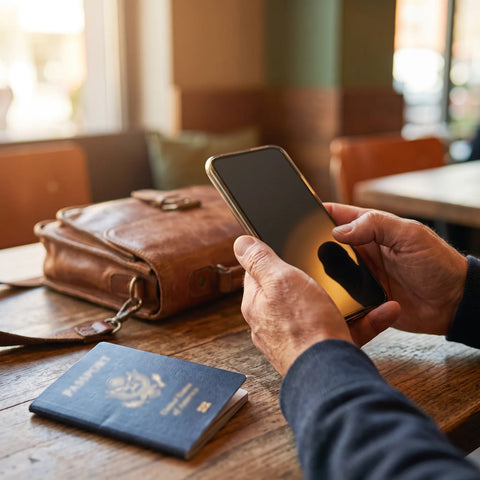
In short: deleting an eSIM profile from your phone permanently erases it in less than a minute, on both iPhone and Android. Only do this if the plan has already expired, you are selling the phone, or you are factory resetting it; if you still have an active plan, it's better to deactivate it instead of deleting it.
It's an action that takes three taps on the screen, but it's not always advisable. A deleted eSIM profile doesn't come back on its own: if the original QR has expired or the provider doesn't allow re-issuance, that plan is gone forever, along with any unused data. Before tapping "delete," it's worth distinguishing between two actions that your phone treats very differently: deactivating and deleting.
Delete or deactivate? They are not the same
iPhone and Android allow you to deactivate an eSIM profile without deleting it: the profile remains installed, stops consuming battery and trying to connect to the network, but it's there, ready to be reactivated with a tap when you need it again. Deleting is different: the profile disappears from the device and, in most cases, there's no going back without contacting the provider.
If you already know what an eSIM is and how it works as a digital profile, this will be intuitive: since there's no physical card to remove and store in a drawer, the operating system needs an equivalent, and that equivalent is "deactivate." Many people delete when they actually only wanted to turn off the profile for a while, for example, while using the physical SIM on a short trip and not wanting to confuse the phone with two active networks at the same time.
When deleting an eSIM makes sense
The short rule: delete when you will never use that profile again under any circumstances. If there's any chance you might need it—even a remote one—deactivate it and leave it dormant.
| Situation | Delete? | Why |
|---|---|---|
| The plan has already expired and there's no MB left | Yes | It's useless, it just takes up a profile slot |
| You bought a new plan from the same provider for the same trip | Yes, only the old one | The previous one has already fulfilled its purpose |
| The plan is active and you have balance or days left | No | You would lose what you haven't used; deactivate it |
| You're going to change phones soon | Not yet | First check if the provider allows transferring the profile to the new device |
| You are selling, gifting, or recycling your phone | Yes, all profiles | For your security and the buyer's |
| You are going to perform a factory reset | They delete themselves | A reset erases all profiles, no need to do it manually beforehand |

How to delete an eSIM profile on iPhone
In iOS, the process is integrated into Settings and does not require password confirmation unless you have restrictions enabled:
- Go to Settings → Cellular Data (or "Mobile Data" on some models) and select the eSIM profile you want to delete.
- Scroll to the bottom of that screen and tap "Remove eSIM Data Plan."
- Confirm the deletion when the system prompts you.
A detail that many people miss: if you have two profiles with similar names (for example, two "PuraSIM" from different trips), iOS doesn't distinguish them by date or destination on that screen, only by the name you gave it or the default one. Before deleting, enter each profile and check the "Data Plan Number" or the associated network operator to avoid accidentally deleting an active one.
How to delete an eSIM profile on Android
On Android, the path varies slightly depending on the manufacturer, but the pattern is repeated: look for SIM card management within the network settings.
On Samsung
- Settings → Connections → SIM Card Manager.
- Tap the eSIM profile you want to delete and select "Remove".
- Confirm the action.
On Pixel and other Android devices with "stock" interface
The usual path is Settings → Network & internet → SIMs (or "Network connections" depending on the version). Tap the gear icon next to the eSIM profile and look for the delete option within that menu.
On Xiaomi, Oppo, and other customized layers
The menu is usually called the same ("SIM cards and mobile networks"), but the delete option may be hidden behind a three-dot icon instead of being inside the profile itself. If you don't find it at first glance, it doesn't mean your phone doesn't allow it: look in the advanced settings on that same screen.
If what you're really looking for is to install a new eSIM and just wanted to make space, first check how many profiles your model supports: almost no midrange Android allows as many as an iPhone, so sometimes "I can't install another eSIM" is not a bug, it's that you've reached the device's limit.
What exactly happens after deleting
This is what people who search "delete an eSIM profile from their phone" really want to know: not the process, but whether there's a way back. The honest answer is "it depends on each element":
| What happens to... | Can it be recovered? |
|---|---|
| The profile installed on the phone | No, it has to be reinstalled from scratch if the provider allows it |
| The data or days you had left unused | Practically never; the plan was linked to that profile |
| The original QR you used to install | Depends on the provider: some QRs are for single use, others can be rescanned if they haven't expired |
| The charge already made | Not applicable: these are prepaid plans, deleting the profile does not generate or cancel any charges |
| The consumption history within that profile | Disappears from the phone; if the provider has a customer panel, it may still be visible there |
The practical conclusion: if you have any doubt about whether you'll need that profile again, deactivate it this week and decide calmly in a month. Deleting is the only action of the two that you cannot undo yourself from your phone.
Common errors and myths when deleting an eSIM
This is where most guides fall short, because they repeat the step-by-step but don't warn about what really confuses people:
"If I delete the eSIM, the subscription is canceled and I stop being charged." This only makes sense if your plan was a recurring subscription. Travel data plans like PuraSIM's are prepaid: you pay once, consume what you've purchased, and the economic relationship ends there. Deleting the profile doesn't cancel anything because there was nothing to cancel.
"I can rescan the same QR after deleting." Sometimes yes, sometimes no, and you won't know until you try. Many eSIM QRs are designed for a single activation for security reasons, so if you saved the code, don't assume it will work again. Also save the purchase confirmation or the provider's email: when roaming data, that proof is usually the first thing support asks for if you need reissuance.
"A factory reset is safer if I delete the eSIMs manually beforehand." It's an extra step. A factory reset completely erases all eSIM profiles from the device along with the rest of the data, so doing it manually beforehand doesn't add anything extra, just wasted time.
"All eSIMs are the same, so it doesn't matter if I delete the travel data one or my main operator's." It's not the same at all. If you use eSIM for both your regular line and to avoid data roaming on a trip, double-check the profile name and associated operator before deleting: deleting the wrong line will leave you unable to receive calls or verification SMS until you reinstall it, and some of those lines don't reinstall themselves.
"There's no need to disable data roaming if I uninstall the eSIM I use abroad." If you have data roaming activated on your physical line in addition to the travel eSIM profile, that roaming can continue to generate consumption on its own even if the eSIM is deleted. Review both things separately, especially if at some point you compared the international physical chip vs. eSIM and still have the physical one installed as a backup.

Before selling, gifting, or factory resetting your phone
Here, deleting is mandatory, without exception. An eSIM profile that remains installed on a phone that is no longer yours is, in practice, a line that another person could potentially use or see associated with the device. Before handing over the phone:
- Delete all eSIM profiles, not just the one you remember: check the complete list in Settings, because sometimes one from an old trip you no longer remembered remains.
- If you also have a VPN configured to protect your connection on public networks, log out and uninstall it; here you have more details on how to use eSIM and VPN together for greater privacy, also useful for knowing what to clean before getting rid of your phone.
- Perform the factory reset after deleting the eSIMs, not before: the order does not change the technical result, but it visually confirms that the profile list has been emptied.
And if what you're going to do is just the opposite—you're going on a trip next week and need to get the profile ready—don't delete anything yet. Install the new plan with plenty of time (for example, with an eSIM for Europe or an eSIM for Spain if it's your turn to receive visitors), test it with Wi-Fi before leaving home, and leave the old profile deactivated until you confirm that the new one works.
When it's NOT advisable to delete (and what to do instead)
It's worth saying clearly: if your plan still has days or data to consume, deleting the profile is throwing away money you've already paid. There's no scenario where deleting it prematurely benefits you. The only real reason to delete with an active plan is if you urgently need that profile slot and your phone has reached the limit of installable eSIMs—something that rarely happens on recent iPhones. If that's your case, first try to deactivate instead of deleting any old profile you no longer rely on; it almost always frees up the slot just the same.
Also, don't buy a new eSIM for every short trip if you already have an active one with enough data: check how much you have left first, and if you need to stretch it, there are simple tricks to save data with your eSIM while traveling that will extend a plan you already had purchased.
Frequently asked questions
Does a factory reset delete eSIMs from the phone?
Yes. A factory reset erases all eSIM profiles along with the rest of the device's content. There's no need to manually delete them before resetting.
If I delete the eSIM, will I still be charged?
No. Travel data plans are prepaid: you pay once and consume what you purchased. Deleting the profile does not generate any additional charges or activate any cancellation, because there is no subscription to cancel.
Can I recover an eSIM that I have already deleted?
It depends on the provider and whether the plan was still active. Some allow re-issuing the profile if it hadn't expired yet; others do not. Contact the provider's support as soon as possible and have your purchase confirmation email handy.
Should I delete the eSIM before selling the phone?
Yes, always. Delete all installed eSIM profiles before giving the device to another person, regardless of whether the plan was still active or not.
How many eSIM profiles can I have installed at once?
Up to 8 on most recent iPhones. On Android, it varies by manufacturer: on Samsung devices it usually ranges between 5 and 10, and other manufacturers set their own limits.
How do I delete an eSIM on Android if I can't find the option?
Look within "SIM cards and mobile networks" or "SIM Card Manager" in Settings → Connections (or Settings → Network & internet, depending on the manufacturer). If it doesn't appear directly when you tap the profile, check the three-dot menu or the advanced settings on that same screen.
Is deactivating the same as deleting an eSIM profile?
No. Deactivating turns off the profile without deleting it, so you can reactivate it whenever you want without reinstalling anything. Deleting erases it from the device permanently. If you have any doubt about whether you'll need it again, deactivate instead of deleting.