In short: an eSIM for Bosnia and Herzegovina gives you mobile data as soon as you land in Sarajevo, without the expensive roaming charges applied by your Spanish operator outside the European Union. It relies on the 4G networks of BH Telecom, m:tel, and HT Eronet, provides good coverage in Sarajevo, Mostar, and tourist routes, and activates in less than a minute before you fly.
An eSIM for Bosnia and Herzegovina gives you internet as soon as you land in Sarajevo, without having to look for stores or pay the extremely expensive roaming charges applied by a country outside the European Union. In this guide, you will see the actual coverage, which operators the network uses, and how many GB you need to travel between Sarajevo, Mostar, and the Kravice waterfalls.
Does an eSIM work well in Bosnia?
Yes. An eSIM works perfectly in Bosnia and Herzegovina: it connects to local 4G networks in major cities and tourist corridors, and is installed before you travel so you have data the moment you turn off airplane mode when you arrive at Sarajevo airport.
Bosnia is not part of the European Union, so "roaming like at home" rates do not apply here. This makes the eSIM the most practical and economical option: you buy a local data plan, activate it in a minute, and browse without changing your Spanish number or spending on a physical SIM from a kiosk. The country's mobile coverage is solid in Sarajevo, Mostar, Banja Luka, Tuzla, and on main routes; in mountainous areas or remote villages, the signal may drop to 3G, which is normal in a country with such marked terrain. If you visit several Balkan countries on the same trip, consider whether a regional eSIM is more worthwhile than a plan just for Bosnia; in the myths section below, you'll see when each option is convenient and when it's better to opt for an international chip versus an eSIM.

Coverage and local operators
The Bosnian mobile market is divided among three main operators, and a good eSIM relies on their networks to give you the best signal available in each area:
| Operator | Strong coverage | Technology |
|---|---|---|
| BH Telecom | Sarajevo, Zenica, central part of the country | 4G / LTE |
| m:tel | Banja Luka and Republika Srpska | 4G / LTE |
| HT Eronet | Mostar and Herzegovina | 4G / LTE |
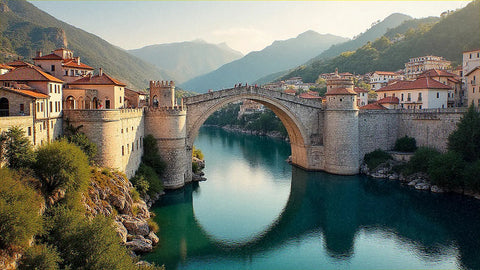
Between the three, they cover almost all the areas a traveler would visit: the old town of Sarajevo (Baščaršija), the Stari Most bridge in Mostar, the Međugorje complex, and the roads to Croatia and Montenegro. A data eSIM connects to the network with the best signal at each point, so you don't have to worry about which company to choose. The capital, Sarajevo, and tourist hubs have stable 4G; in remote valleys like Sutjeska, the signal may drop to 3G, which is normal for a country with such varied terrain.
How many GB you need depending on your trip
Consumption depends on your usage, but Bosnia is a destination where you'll mainly use maps, messaging, and some social media. This table gives you a realistic reference:
| Trip profile | Duration | Estimated GB |
|---|---|---|
| Sarajevo getaway | 3-4 days | 1-3 GB |
| Sarajevo + Mostar route | 1 week | 3-5 GB |
| Long trip through the Balkans | 2 weeks | 5-10 GB |
If you only use Google Maps, WhatsApp, and occasional searches, a small amount is more than enough. If you share many videos or use your hotspot for a laptop, upgrade your plan. To calculate more precisely according to your habits and avoid running out of data halfway through your trip, check out how to save data with an eSIM on a trip. Remember that Wi-Fi in hotels and cafes in Sarajevo is usually good, so you can save your mobile data for when you're on the go.
Tip: download offline maps of Sarajevo and Mostar before you leave. You'll save data and have navigation even if you enter a mountainous area with no coverage.

Roaming vs eSIM: why it matters outside the EU
This is the key to the whole trip. Since Bosnia is not a member of the EU, your Spanish operator applies international roaming charges, which can skyrocket to several euros per megabyte or charge you expensive daily packages. A local eSIM completely avoids this cost: you pay a small flat rate for your GB and browse worry-free.
The practical difference is huge. With classic roaming, checking the map and answering messages for a week can cost you more than a night's accommodation. With a data eSIM, you know what you're paying in advance and there are no surprises on your bill when you return home. Plus, you keep your Spanish number active to receive bank SMS or important calls while data runs on the eSIM. If you're coming from other destinations in the area like Croatia, keep in mind that European roaming "like at home" does apply there, and the rules change; you can review how data roaming works to avoid confusion when crossing the border.
How to activate your eSIM step by step
Activating the eSIM is quick and should be done before flying, with Wi-Fi at home. This way, you arrive in Sarajevo with everything ready:
- Purchase your plan for Bosnia and receive the QR code by email.
- Go to Settings → Mobile Data → Add eSIM and scan the QR.
- Label the profile as "Bosnia" to easily locate it.
- Upon landing, activate the eSIM's data line and deactivate roaming for your home SIM.
- Turn on mobile data and check that coverage appears.
The entire process takes no more than a minute and requires no technical knowledge. If this is your first time installing such a profile, you can find a detailed guide on how to install an eSIM. The advantage of doing it before you leave is that you don't have to rely on finding Wi-Fi at the airport or struggling with the connection as soon as you arrive tired from your flight.
Tips for connecting in Sarajevo and Mostar
Bosnia is a charming destination with a mobile network that works well in the places you'll visit. These tips will help you make the most of it:
- Sarajevo has stable 4G throughout the historic center; upload photos from Baščaršija without issue.
- Mostar and its famous bridge are well covered, ideal for live sharing the divers' jump.
- In mountain routes like Sutjeska or Jahorina, the signal drops: download maps and music before heading up.
- The currency is the convertible mark (BAM), pegged to the euro; many shops accept cards, but carry some cash for villages.
- Use the eSIM to book taxis or translate menus; 24/7 Spanish support will help you with any issues.
With your connection sorted, you can focus on what's important: Bosnian coffee in the old city, the Kravice waterfalls, and the route to Herzegovina. If your plan includes hopping to neighboring countries, consider regional coverage; for travel through several European countries, you have the eSIM for Europe as a broader alternative that avoids buying a different plan at each border.
Myths and what almost no one tells you about eSIM in Bosnia
There are several ideas circulating about eSIMs that, in a country like Bosnia, can cause you trouble if you don't know them beforehand.
Myth: "I need dual SIM mode activated for it to work." Not so. The eSIM works independently of your physical SIM; you only need dual SIM if you want to have both lines active at the same time (for example, receiving calls on your Spanish number and using data via the eSIM simultaneously). If you're going to completely turn off your Spanish line during the trip, a single active data line is more than enough.
Myth: "any mobile phone from recent years has an eSIM." Not all. You need an iPhone XS or later, or a mid-to-high-end Android manufactured from around 2019 (Pixel from 3, Samsung Galaxy S20 onwards, among others). If your phone is a few years old, check in Settings if the "Add eSIM" option appears before buying; if it doesn't, you'll have to opt for a traditional physical SIM. And if you've never used an eSIM, it's worth reviewing what an eSIM is exactly first.
What almost no one tells you: the road from Sarajevo to Mostar (the M17, via Konjic) crosses gorges and some tunnels where the signal disappears for a few minutes. This is not an eSIM fault, it's the terrain. Download your playlist and the map for that route before leaving and don't worry if WhatsApp takes a while to deliver messages during that stretch: as soon as you leave the valley, it recovers on its own.
Another detail that surprises those driving towards the coast: Neum, Bosnia's only access to the sea, is a narrow strip surrounded by Croatian territory on both sides. It's normal for your phone to pick up a Croatian network for a few seconds when passing through; with automatic network selection, you won't notice anything strange, and as soon as you leave the strip, it will reconnect to the Bosnian network without you having to do anything.
When NOT to buy extra data: if your trip is limited to two or three nights in the center of Sarajevo and your hotel has good Wi-Fi, a small plan for moving around the city is more than enough; you don't need to load extra GB "just in case." And if you're constantly crossing into Croatia because your route is more Croatian than Bosnian, first compare how much your European roaming already covers you: sometimes those sections are already sorted, and you don't need anything additional.
What to do if the eSIM doesn't connect immediately upon landing?
It happens rarely, but it does happen: you land, activate data, and it doesn't browse. Before panicking, check these things in order: first, that the eSIM's data line is marked as the primary data line in Settings (and not the physical one); second, that data roaming is activated within the eSIM's own profile, even if it's a local plan, because the operating system manages it internally as roaming; third, restart your phone, which resolves most of these temporary blocks. If you still have no signal inside Sarajevo airport terminal, try going out to the baggage claim area: sometimes the building structure itself interferes, and outside, it recovers instantly.
Frequently asked questions
Do I need an eSIM if I'm going to Bosnia from Spain?
Highly recommended. Bosnia is not in the European Union, so your Spanish plan charges international roaming, which is usually expensive. With a local data eSIM, you browse at a fixed price, with no surprises on your bill, and keep your Spanish number for calls and SMS.
Is there good data coverage in Sarajevo and Mostar?
Yes. Sarajevo and Mostar have stable 4G in their centers and tourist areas, supported by operators like BH Telecom and HT Eronet. In mountain valleys or remote villages, the signal may drop to 3G, which is common due to the country's terrain; for those routes, it's advisable to download offline maps.
How many GB do I need for a week in Bosnia?
For a one-week trip between Sarajevo and Mostar, with maps, messaging, and social media, 3 to 5 GB is usually enough. If you share many videos or use your hotspot for a laptop, choose a larger plan. Hotel and cafe Wi-Fi helps you conserve data.
Can I also use the eSIM in Croatia or Montenegro?
The plan for Bosnia covers Bosnia. If your trip includes Croatia, Montenegro, or Serbia, a regional Balkan eSIM that covers several countries with a single profile is more convenient. This way, you avoid buying separate plans and changing eSIMs every time you cross a border.
When should I activate the Bosnia eSIM?
Install it before flying, with Wi-Fi at home, and activate the data line upon landing in Sarajevo. Installing the profile takes a minute and doesn't consume anything until you turn it on. Preparing it beforehand avoids relying on finding Wi-Fi at the airport as soon as you arrive.
Does the connection cut out when passing through Neum, the Bosnian coastal strip surrounded by Croatia?
Not problematically. It's normal for the phone to pick up a Croatian network for a few seconds when crossing that coastal strip, but with automatic network selection, the eSIM will re-engage with the Bosnian network on its own as soon as you leave the area. You don't need to do anything manually.
Do I need to manually select a Bosnian operator on my mobile?
No, and it's not recommended. Leave network selection on automatic: the phone will connect to the operator with the best signal in each area, whether it's BH Telecom, m:tel, or HT Eronet. Manually choosing only makes sense if you notice that the automatic network isn't connecting well in a very specific spot.
Conclusion
Bosnia and Herzegovina is a beautiful destination where classic roaming is expensive because it's outside the EU, so a local eSIM is the smart way to have internet in Sarajevo, Mostar, and the mountain routes. With 4G coverage in key areas and activation in a minute, you'll be connected from the first step. Prepare your eSIM for Bosnia and Herzegovina before takeoff and don't worry about the bill.