What is carrier activation on an eSIM?
Carrier activation is the moment when your phone, with the eSIM profile already installed, connects to the operator's network: signal appears, and you get data access. This is a distinct step from installing the eSIM, and confusing the two is why many believe it "doesn't work" when only this step is missing.
Installation means scanning a QR code or tapping a link: this copies the profile to your phone, but it doesn't activate anything yet. Carrier activation happens afterward, when the phone searches for the network of the operator corresponding to the plan you purchased and registers on it. For a travel eSIM, this registration usually completes automatically, without calls or paperwork, as soon as the phone detects an antenna from the operator associated with the installed profile.
The confusion is understandable because, with the traditional physical SIM, the concept barely exists: you insert the card, and if the chip was activated by the manufacturer or seller, you're all set. With an eSIM, however, installation and activation are intentionally separate, and this separation is precisely what allows you to buy it and keep it ready for when you need it, without anything starting to run yet.
How to activate an eSIM step-by-step
In practice, the process has three stages: receiving the profile, installing it, and letting the network activate it. None of the three requires going to a store or speaking to anyone on the phone.
- Receive the profile. After purchase, a QR code arrives, and almost always, a direct installation link to open from the same phone.
- Install the profile with Wi-Fi. In Settings > Mobile Data (or Mobile Network) > Add eSIM, scan the code or tap the link. Your phone downloads the profile in seconds.
- Activate the data line. Within the settings for this new line, enable "Mobile Data" for the newly installed profile. This is the step many people skip.
- Turn on data roaming for that specific line, if the plan requires it outside your home country.
- Wait for a signal to appear. Your phone searches for the operator's network, and as soon as it finds it, carrier activation is complete: you'll see the network name at the top of the screen.
The entire process, when the phone is compatible and already unlocked, takes about a minute from start to finish once there is coverage from the corresponding network. If you have questions about the installation step itself, the guide on how to install an eSIM covers it with screenshots by operating system.
Can I activate the eSIM myself, without going to a store?
Yes. Unlike a physical SIM, which in some countries still requires activation at a store or with the operator's customer service, a travel eSIM is fully activated from your phone's own settings. There's no form to fill out or identity to verify at a counter: the profile is already associated with your purchase.
All you need is a Wi-Fi network (or data from another line) to download the profile the first time, because the installation process itself uses some data. After installation, activation with the carrier no longer depends on the internet: it depends on your phone finding the antenna of the corresponding operator, which usually happens upon landing or entering the plan's coverage area.
If at any point activation doesn't complete automatically, it's usually enough to turn off airplane mode, restart your phone, or check that the correct data line is selected as active for browsing; none of this requires in-person support.

Can I activate my eSIM before arriving at the destination country?
You can install the eSIM profile before traveling, even from home, days or weeks in advance. What typically doesn't happen before you arrive is the actual carrier activation: the destination network only appears when your phone is physically within its coverage area, so that last step usually completes upon landing or, at some airports, as soon as the plane touches down and exits airplane mode.
This is precisely what makes it useful to buy the eSIM ahead of time: you install the profile and it's ready, without the plan starting yet, and on the day of travel, all you have to do is turn on mobile data and roaming for that line. At PuraSIM, that window is 180 days to activate the eSIM from purchase, so installing it in advance doesn't cost you any usage time.
What does "unlocking" the carrier mean and when is it necessary?
"Unlocking the carrier" is different from activating the carrier, even though the names sound similar. A locked phone is one that an operator sold tied to its own network: even if you install the eSIM without a problem, the phone refuses to register on any operator other than its own, and in that case, activation never completes.
A factory-locked phone can install the eSIM profile without any visible error, but it will never fully activate with the carrier: the locked network simply rejects any operator other than its own, without saying why.
To find out if yours is locked, the most direct way is to insert (if the model has a tray) a physical SIM from an operator different from the one who sold it to you: if it doesn't recognize that line, it's locked. Phones purchased without a contract, factory unlocked, or already used with more than one operator are almost always free. Unlocking, when necessary, is requested once from the original operator; after that, it's resolved for any eSIM you install, not just for PuraSIM.
eSIM vs physical SIM: the activation process
The difference between these two technologies isn't so much about which is "better," but rather when and how each step occurs. The following table summarizes it for the specific case of travel.
| Process step | Travel eSIM | Travel physical SIM |
|---|---|---|
| Where to get it | Purchased online, arrives as a QR code via email | Must be picked up at a counter, kiosk, or physical location |
| When it can be installed | Days or weeks before travel, from anywhere with Wi-Fi | Only upon arrival at the point of sale, with the phone in hand |
| What activates the network | The phone registers automatically when it detects operator coverage | Sometimes requires manual activation at the counter or via chat |
| Risk of losing the line | No physical card to drop, bend, or lose | The card can be lost, bent, or damaged when changing it |
| Compatibility | Requires a phone with eSIM function (most recent mid-range and high-end models) | Works on virtually any phone with a tray |
For those still undecided between the two, a complete comparison is available in eSIM vs physical SIM, and if the comparison point is specifically against your home operator's roaming, it's worth checking eSIM vs international roaming.
What does your phone need before activating the carrier?
Before attempting to activate any eSIM, it's advisable to confirm two separate things, because a phone might meet one requirement but not the other.
| Requirement | What to check | Why it fails if not met |
|---|---|---|
| eSIM compatibility | That the model and operating system version support eSIM profiles | Without this function, the "Add eSIM" setting won't even appear |
| Unlocked phone | That it's not contractually tied to a single original operator | The profile installs, but the locked network never activates it |
| Phone purchase region | Some models purchased in certain regions have eSIM disabled | The setting might not be available even if the model supports it |
The detailed list of models and regional exceptions is in eSIM compatible phones. If yours isn't listed there or you're unsure if it's unlocked, it's better to confirm before buying the plan than after trying unsuccessfully to activate it.

Real example: activating the plan on the way to the airport
Consider someone leaving Bogotá for Cancun on a Thursday morning. The night before, still at home and connected to Wi-Fi, they buy the eSIM for Mexico, scan the QR code, and install it; their phone now has two lines, their usual one and the new one, but the Mexico line still has no data because roaming for that line is off.
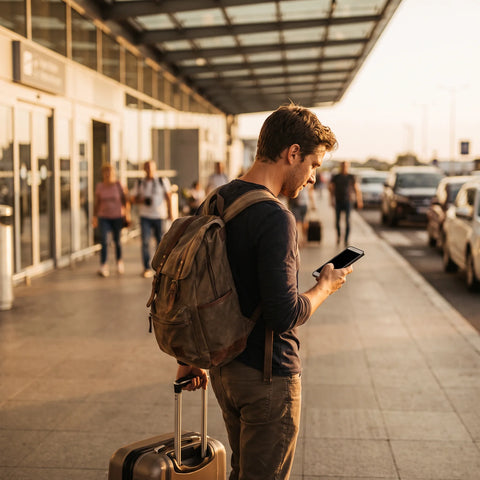
At the airport, while waiting for the flight, they do nothing else: the Mexico line doesn't need to activate yet because there's no coverage from that operator in Colombia. Only when the plane lands in Cancun and exits airplane mode, do they go to Settings, activate mobile data and roaming for the eSIM line, and in less than a minute, the Mexican operator's signal appears on the screen: carrier activation is completed automatically, without needing to find airport Wi-Fi or queue at any counter.
This order — install with Wi-Fi before leaving, activate data upon arrival — is what prevents being without a connection right after getting off the plane, which is when you most need it to request a ride, locate your hotel, or announce your arrival.
Common errors when activating the carrier profile
Most activation problems are not profile failures, but rather skipped steps or the order in which they were performed. The most frequent are:
- Activating roaming before the profile is properly installed, which sometimes confuses the phone about which line to use for data.
- Leaving the wrong line as the primary for data, so even if the eSIM is active, the phone keeps trying to browse via the original line.
- Not waiting for actual coverage: trying to activate in airplane mode, in a basement, or in an area without the corresponding operator's antenna.
- Confusing "no signal" with "broken eSIM" when in reality the phone is still locked by the original operator.
- Deleting the profile to "try again": in most cases, the profile cannot be downloaded a second time, so before deleting it, it's advisable to calmly review the roaming and data line settings.
If, after checking these points, the signal still doesn't appear, the list of causes and solutions is expanded in common eSIM problems, and for those who are just about to buy their first travel eSIM, it's advisable to start with what is an eSIM before delving into activation details.
Frequently asked questions
What exactly is carrier activation on an eSIM?
It's the moment when the phone, after having the eSIM profile installed, connects to the corresponding operator's network and starts showing signal and data. It's a distinct — and subsequent — step to installation.
Does carrier activation consume data from the plan?
No. Searching for and registering on the network does not deduct data from the contracted plan; the count begins when you actually browse or use the connection, not just by having a signal.
Can I activate the eSIM without a Wi-Fi connection?
The profile installation does require internet (Wi-Fi or data from another line) because it needs to be downloaded. Carrier activation, however, doesn't depend on Wi-Fi: it depends on the phone finding the destination operator's antenna.
What happens if I don't activate the eSIM as soon as I buy it?
Nothing immediate happens: at PuraSIM, you have 180 days from purchase to activate it. You can install the profile immediately and leave it waiting, or install it only on the day of travel; both options are valid.
Does carrier activation work the same on iPhone and Android?
The concept is the same on both: install the profile and then let the phone register on the network. The exact menu names change (Settings > Mobile Data on iPhone, Settings > Network & Internet on most Android), but the steps are equivalent.
Can I have the eSIM activated and my physical SIM active at the same time?
Yes, most eSIM-compatible phones allow two active lines at once, one physical and one eSIM (or two eSIMs on several recent models). You can choose which one uses data and which one is only for calls or messages from your usual number.
What do I do if carrier activation fails upon arrival at my destination?
Check, in this order, that airplane mode is off, that the correct data line is selected, that roaming for that line is on, and that you have restarted your phone once you are in the country. If there is still no signal after that, our 24/7 email and WhatsApp support team can review it with you.
In summary
Carrier activation isn't a separate process or something that depends on a store: it's simply the moment your phone, with the profile already installed, finds the operator's network and starts showing a signal. Install the eSIM in advance with Wi-Fi, leave roaming off until you arrive, and activate everything only when you are in the destination country: this order prevents most first-day travel headaches.
If you still don't have a plan for your next destination, the international eSIM collection covers over 200 destinations with activation in approximately one minute once there's coverage, and 24/7 email and WhatsApp support is available in all languages if something doesn't go as expected. To get everything ready before leaving home, the ultimate guide to traveling with eSIM reviews the rest of the preparation, from buying the right plan to what to check on the day of your flight.