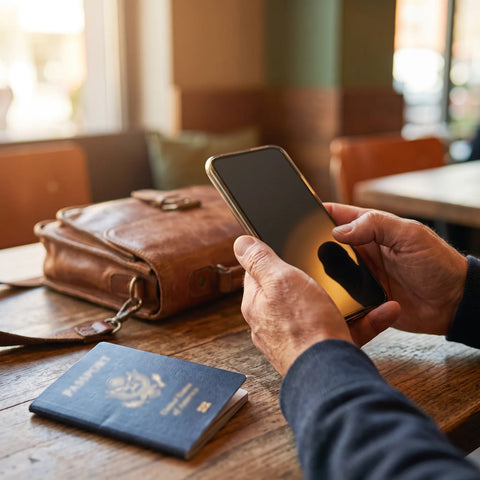
In short: an eSIM for Cyprus gives you mobile data as soon as you land in Larnaca or Paphos, without expensive roaming or queues for a physical SIM. For a week, 3-5 GB is usually more than enough, coverage in the south is very good, and there's only one serious warning: if you cross to the north of the island, your plan might stop working.
What an eSIM is and why it's useful in Cyprus
An eSIM is a digital SIM card: it's installed with a QR code, it doesn't take up your phone's tray, and it coexists with your home line in Dual SIM mode. For Cyprus, this matters more than it seems, because the island isn't always included in the free roaming you take for granted in the rest of the EU, and many home tariffs treat it with fine print. With a Cyprus eSIM, you buy local data at a fixed price, install it from home, and activate the connection when you land, without relying on hotel Wi-Fi or an operator counter at the airport.
If you've never stopped to understand what roaming technically consists of and why you're charged what you're charged, it's worth reading what data roaming is before continuing. The philosophy is simple: you land with internet, no roaming, no stress. You open Google Maps as soon as you leave the terminal, confirm your rental car reservation, and send your location to whoever is waiting for you, all with data you already knew you were going to pay for. If you're used to planning other Mediterranean destinations, the logic is the same as we explain in eSIM vs. roaming, also applicable to Cyprus.

Coverage in Cyprus, city by city
The south of the island, the Republic of Cyprus, has a mature mobile network: 4G in practically all inhabited areas and 5G that already covers Nicosia, Limassol, and Larnaca well. An eSIM connects to the local network with the best signal at each point, so in practice, you browse like a resident, not like a tourist with second-rate roaming. This is what you'll find depending on where you go.
| Area | Coverage | What you need to know |
|---|---|---|
| Larnaca (city and airport) | Excellent 4G/5G | Ideal for activating the eSIM as soon as you collect your luggage |
| Limassol | Excellent 4G/5G | Coastal and business area with the best signal on the island |
| Nicosia (south) | Very good 4G/5G | The signal changes noticeably if you cross on foot to the north via Ledra Street |
| Paphos | Very good 4G | Occasional drops between the stone columns of the archaeological park |
| Ayia Napa / Protaras | Good 4G | In August, the network gets saturated due to tourist influx in the entertainment strip |
| Troodos Mountains | Variable 4G | Drops in mountain bends and in villages like Kakopetria; download the offline map |
If you rent a car to go up to Troodos, especially if you're looking for snow in winter or hiking trails in spring, have the map downloaded before leaving the coast. The signal on those winding roads isn't bad, but it is intermittent, and losing your GPS on a foggy mountain descent is not ideal.
How many GB you need depending on your trip
Short answer: for a week in Cyprus, most travelers will be fine with 3 to 5 GB. With maps, WhatsApp, social media, and a restaurant reservation, consumption is moderate; it only skyrockets if you stream video on the beach or upload heavy content daily.
- Weekend getaway (3-4 days): 1-2 GB is plenty if you use the accommodation's Wi-Fi at night for updates and photo backups.
- Beach week and island tours: 3-5 GB is the sweet spot for almost everyone, including navigating between Paphos, Limassol, and Larnaca without worries.
- Two weeks, remote work, or heavy streaming: it's better to go for 10 GB or a plan with higher data, especially if you're going to make work video calls from the balcony.
Real tip: activate your hotel's Wi-Fi for automatic photo backups and background mobile updates. These silent downloads are what consume the most GB without you noticing, and reserving your eSIM data for when you're out allows you to stretch the plan much further than expected.
If you're not sure about your usual consumption, take a look at our guide on how to save data on a trip with an eSIM, with tips that work just as well in Cyprus as in any other destination.

eSIM vs. Cypriot physical SIM
You can buy a physical SIM from a local operator, like Cyta or Epic, as soon as you land. But that means queuing at the airport, handing over your passport to register it (it's mandatory in Cyprus) and losing your home number while you use it, unless you switch cards every time you want to receive a call. The eSIM skips all that: it comes pre-installed from home and coexists with your main line thanks to Dual SIM, so you continue to receive calls and SMS from home while browsing with Cypriot data.
Compared to roaming from your home operator, the cost can skyrocket if your tariff doesn't include Cyprus under the same conditions as other EU destinations; it's worth checking the fine print with your operator before leaving. To compare prices and conditions without falling for constantly changing figures, our guide on eSIM vs. roaming will help, and if you're still not clear on what a virtual eSIM is exactly, start with what a virtual eSIM is.
That said, be honest with yourself about the length of your trip: if you're going to Cyprus for a 24-hour layover on your way to another destination, you probably don't need a local SIM or eSIM, just the hotel and airport Wi-Fi. An eSIM makes sense when you're going to be moving around the island for several days, not for a transit night.
Northern Cyprus: the border that changes your network
This is the most important thing in the whole article and almost no one explains it well. Cyprus has been divided since 1974: the south is the Republic of Cyprus, an EU member, and the north is the self-proclaimed Turkish Republic of Northern Cyprus, recognized only by Turkey. They have different mobile networks, from different operators, and your eSIM contracted for the south is designed for that network.
If you cross the Green Line to the north, either on foot via Ledra Street in Nicosia or by car towards Kyrenia (Girne) or Famagusta (Gazimağusa), your southern eSIM may stop providing data or enter roaming with a Turkish operator, with the associated cost. The change is almost immediate: the phone searches for a new network and sometimes takes a few seconds to connect.
If your travel plan includes crossing to the north, even if it's a day trip to see Kyrenia Castle or the Selimiye Mosque in Famagusta, buy a plan designed for that or consider contracting coverage for Turkey, given that the north operates with a Turkish network. Our guide on international chip vs. eSIM explains the differences well if you end up needing a mixed solution for several countries on the same trip. And if your route continues through other EU countries afterward, it's more worthwhile to directly look for an Europe eSIM with coverage in several destinations rather than buying a different plan at each border.
How to activate it before flying
The beauty of an eSIM is getting everything ready from the comfort of your home. No special connection or trip to a store is needed: you buy the plan, receive a QR code, scan it with your home Wi-Fi, and activate the data when you land in Larnaca or Paphos. The complete process, with step-by-step screenshots, is in how to install an eSIM.
- Check that your phone supports eSIM and Dual SIM (most models from recent years do).
- Buy your plan for Cyprus and scan the QR with your home Wi-Fi, no rush.
- Leave the eSIM installed but with data paused until the day of your flight.
- Upon landing, activate the eSIM data and deactivate only the mobile data of your home line, without completely turning off that line.
That last nuance is important: if you completely deactivate your home line, you stop receiving the two-factor bank verification SMS that many banks still send via that channel. Simply turn off mobile data for that SIM and leave calls and SMS active.
Errors and myths almost no one tells you about
There are several misconceptions about eSIMs in Cyprus that need to be dispelled before they complicate your trip.
Myth 1: "all the EU has free roaming equally." Not exactly. Cyprus is in the EU, but some home tariffs apply data limits or specific exclusions for the island that don't apply in France or Italy. Check your contract before assuming you're covered as usual.
Myth 2: "physical SIM gives better coverage than eSIM." False: both connect to the same antennas of the same local operator. The difference is in logistics, not in the signal.
Myth 3: "my southern eSIM also works in the north." As we've seen, it's not certain. Check before crossing the Green Line if you plan to do so.
Myth 4: "it's more practical to buy it at the airport when you arrive." You can do that, but you add queuing, saturated airport Wi-Fi just when you need it most, and you depend on having battery and patience after a long flight. Installing it calmly from home avoids that first fifteen minutes of stress in Larnaca.
Myth 5: "if I turn off my home operator's roaming, I lose everything." No, you only lose data if you deactivate the entire line. Turning off mobile data and leaving calls/SMS active is enough to continue receiving bank codes and important calls.
And a critical piece of advice, because it's not all about selling: if your trip to Cyprus is a short layover of less than a day, or you'll be staying in a resort with decent Wi-Fi and don't need to move around, you probably don't need an eSIM or a local SIM. Save the expense for trips where you'll actually be moving around the island.
Frequently Asked Questions
Does the eSIM work throughout Cyprus?
In the south, the Republic of Cyprus, it works with good coverage in Larnaca, Limassol, Paphos, Nicosia, and beach areas like Ayia Napa. In Turkish Cypriot north, it may not work or may enter roaming with a Turkish operator. If you plan to cross the Green Line, confirm beforehand or carry a plan that covers that area.
How many GB do I need for a week in Cyprus?
For seven days, 3 to 5 GB covers most travelers: maps, messaging, social media, and some reservations. If you do a lot of streaming or upload video daily, go up to 8-10 GB. Using hotel Wi-Fi for photo backups and downloads allows you to stretch your data quite a bit.
Is Cyprus part of the EU's free roaming?
The Republic of Cyprus is in the EU, but it's worth checking your tariff: not all Spanish companies include the island in free roaming under the same conditions as other destinations, and there may be data limits. A local eSIM prevents you from relying on your operator's fine print.
Can I still use WhatsApp with my Spanish number?
Yes. The eSIM only provides data; your WhatsApp remains linked to your usual number because the Spanish SIM remains in the phone in Dual SIM mode. You continue to receive messages and calls on your number while browsing with the Cypriot eSIM.
When does the data plan start counting, upon purchase or upon arrival?
You install it before flying with your home Wi-Fi, but the data plan starts counting when you activate the eSIM and it connects to the Cypriot network, usually upon landing. This way, you don't use up plan days while still in Spain.
Do I need a passport or registration to activate an eSIM in Cyprus?
No. Unlike a local physical SIM, which requires registering your passport at the point of sale, the eSIM is purchased and activated online, without in-person procedures or paperwork upon arrival.
What if my phone doesn't support eSIM?
You'll need another alternative, such as a local physical SIM or a pocket Wi-Fi router. Most mid-range and high-end phones from recent years do support it, but it's worth checking your phone's settings before purchasing any plan.
Conclusion
Cyprus is a convenient destination for connectivity if you avoid expensive roaming and keep in mind the island's division. With an eSIM, you arrive with data right from Larnaca or Paphos airport, browse the entire southern coast without hitches, and forget about the bill when you get home. Prepare your eSIM for Cyprus from home and activate the internet as soon as you step onto the island.