In short: the best way to get internet in Curaçao is an eSIM for Curaçao that you install before leaving home and that activates automatically when you land at Hato Airport. It covers practically the entire island thanks to local operators Flow and Digicel, avoids expensive roaming outside the European Union, and doesn't require changing your physical SIM card.
What an eSIM is and why it's convenient in Curaçao
An eSIM is a SIM card that is already integrated into your mobile phone, so instead of looking for a counter at Hato Airport or asking for a SIM card at a gas station in Willemstad, you install it by scanning a QR code from home. If you want the technical details of how it works, you can find the guide on what a virtual eSIM is. For Curaçao, it makes particular sense because it's a destination where you usually arrive tired from a long flight (direct from Amsterdam or with a layover) and the last thing you want to do is waste the first hour of your vacation battling with a closed mobile store or a long queue.
The island is small, about 60 kilometers from end to end, so with a single data line, you'll have almost your entire route covered: the historic center of Punda and Otrobanda in Willemstad, western beaches like Cas Abao or Kenepa, the southern diving area, and a good part of the interior. PuraSIM's Curaçao eSIM relies on local operators with roaming agreements, so your phone will automatically connect to the best available signal without you having to touch any settings.

Flow and Digicel coverage island by island
In Curaçao, the two mobile operators with their own network are Flow (formerly known as UTS or Chippie, the name many locals still use) and Digicel. Together, they cover practically the entire inhabited island with 4G/LTE, which is the network you'll use for maps, WhatsApp, restaurant reservations, and uploading photos.
Willemstad and the south of the island
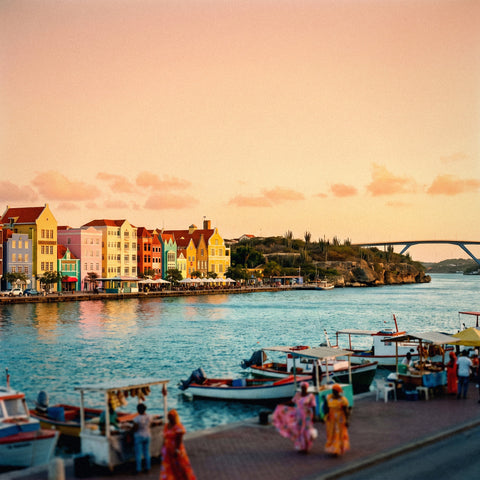
This is where the signal is most consistent: Punda, Otrobanda, the Queen Emma Bridge, Pietermaai, and the entire strip towards Jan Thiel and Mambo Beach. If your plan is to move between restaurants, the historic center, and the beaches near the capital, you'll barely notice any difference from having Wi-Fi.
Western beaches: Cas Abao, Kenepa and surroundings
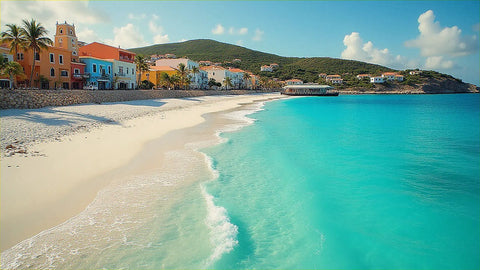
Coverage reaches the most visited western beaches well, which are also the best connected by road. This is the area where you'll need data the most, precisely because these are the beaches where people take more photos and share more locations with those who stayed at the hotel.
Northern and inland areas
In the drier interior, on the way to Christoffelpark, and in the more secluded coves in the north like Playa Kalki or Watamula, the signal may weaken in some stretches, especially if the terrain is uneven or there's little population around. This is not exclusive to Curaçao: it happens on any Caribbean island when you move away from populated areas. 5G is already appearing in specific points of the capital, but don't count on it for the entire trip: local 4G performs more than adequately for everything a traveler needs, and it's what you'll have available across most of the island.
Traveler's tip: if you're going to Playa Kalki or Shete Boka to see the caves and blowholes, download an offline map of that area before leaving your hotel. The eSIM will give you signal for most of the journey, but it's best not to depend on it for the last stretch of dirt road.
How many GB you need depending on your trip
It depends on how many days you're staying and how much you use your phone. For a typical beach and city trip with maps, messaging, social media, and a few video calls home, this is a reasonable reference:
- 3-4 day getaway: 1-3 GB will be plenty if you connect to the hotel or apartment Wi-Fi at night.
- One week: 3-5 GB is the most balanced option so you don't have to keep checking how much you have left.
- Ten days or more: 5-10 GB or more if you upload a lot of content to social media or share your connection with someone in your group.
- Remote work from the island: better to get a large or rechargeable plan if you're going to make work video calls, especially because the Wi-Fi in some beachfront accommodations isn't as stable as in a city hotel.
What really drives up consumption are long video calls and uploading videos instead of photos. If you tend to run out or prefer to play it safe, you'll find practical tips in the guide on how to save data with an eSIM while traveling.

eSIM vs. roaming in Curaçao
Curaçao is not part of the European Union, so the "roaming like home" rates included in your Spanish contract do not apply here. Outside the EU, most operators charge roaming for data blocks, calls, and SMS at international rates, which usually skyrocket compared to what you pay in Spain. If you want to understand what this means and why it happens, the guide on what data roaming is explains it without technical jargon.
| Option | How it works | Ideal for |
|---|---|---|
| Local eSIM (Curaçao) | Data on local Flow/Digicel network, fixed plan by GB and days | Most travelers to the island |
| Roaming from Spanish operator | International rate outside the EU, cost skyrockets by blocks | Only if you absolutely need to keep your number active for calls |
| Physical local SIM | Must be bought and activated on the island, in a physical store | Very long stays if you prefer a physical card to an eSIM |
| Accommodation Wi-Fi only | No mobile data, dependent on Wi-Fi coverage at each location | Very relaxed trips, no plans to move around much |
The practical difference is predictability: with an eSIM, you know beforehand what you'll pay for your travel days, with no hidden charges for connecting to the wrong network or surprises when you get home. If your operator charges by segments outside the EU, a couple of maps or a missed call can inflate your bill without you even realizing it. With a fixed data plan, you control your spending from day one. However, if your trip to Curaçao is just a very short weekend and you already have guaranteed Wi-Fi at your hotel and at the places you'll visit, it might not even be worth buying anything: evaluate it before spending more than you need to.
For more examples and specific cases, the comparison of eSIM vs. roaming reviews several travel scenarios.
How to activate your eSIM step by step
Activating your Curaçao eSIM takes just a couple of minutes and you can get it sorted from home before you fly:
- Purchase your Curaçao eSIM and you'll receive a QR code by email instantly.
- At home, with Wi-Fi, go to Settings > Mobile Data > Add eSIM and scan the QR.
- Set this line as the one to use for mobile data and leave your physical SIM for calls and SMS.
- Upon landing in Curaçao, the eSIM will automatically connect to Flow or Digicel. If it takes a while, just restart your phone once.
If you've never installed an eSIM and want to see it step-by-step with screenshots, the guide on how to install an eSIM covers iPhone and Android separately.
Myths and what almost no one tells you
There are quite a few common misconceptions about eSIMs in destinations like Curaçao. It's worth clarifying them before they complicate your trip:
- "If my phone is from another country, it's not compatible." This is not true: what matters is the model and that it's unlocked, not where you bought it. An iPhone bought in the Netherlands or a Samsung bought in the United States works the same if it's a compatible model and not locked to a carrier.
- "I need Wi-Fi in Curaçao to install the eSIM." On the contrary: you install it in Spain before you fly. When you land, it's already ready; it just needs to connect to the local network, which it does automatically.
- "If I have an eSIM, I lose my Spanish number." You don't lose it. The eSIM is added as a second data line; your number remains on your physical SIM, available for bank SMS or calls if you need them.
- "All eSIMs provide the same coverage." Not exactly: it depends on which local operators each provider has an agreement with. That's why it's advisable to buy an eSIM specifically designed for Curaçao and not a generic "Caribbean" one without further detail, because the agreement with Flow or Digicel is what gives you real coverage on the island.
- "The more GB, the better, always buy extra." It's not that simple: if you end up using half, that money goes unused. It's better to calculate based on your actual days and usage, and if you run short, recharging takes a minute.
Tips for getting around the island
Curaçao is calm and easy to navigate, but a few practical details will make your trip even smoother:
- Language and currency: Papiamento, Dutch, Spanish, and English are spoken depending on who you talk to, and the official currency is the Antillean guilder, although many tourist businesses accept dollars without a problem.
- Rental car: This is the most practical way to reach the western beaches and Christoffelpark. This is where you'll most appreciate having the map always at hand, because road signs are not always as clear as in Spain.
- Plugs: Curaçao uses the same type of plug as the United States (type A/B), so you'll need an adapter if you're coming from Spain. A charged phone is your connection insurance all day long.
- Before landing: leave the eSIM installed from Spain to leave Hato airport already connected, without having to look for Wi-Fi in the terminal.
- Diving and snorkeling: if you're going to spend the day underwater at some point in the Curaçao Underwater Marine Park, keep in mind that there is obviously no signal there; save the location of your exit point before getting into the water.
With this, your only job will be to enjoy Willemstad and the beaches, not to struggle with the connection. The eSIM takes care of the rest in the background.
If your route continues outside Curaçao
Many flights to Curaçao from Spain have a layover, either in Amsterdam (due to the historical connection with the Netherlands) or, depending on the season, in a US hub like Miami. If you're going to have hours of layover and want to stay connected during that leg as well, the Curaçao eSIM won't work: you'll need a different line for that country. For a long layover in Europe before or after your flight, check out the Europe eSIM; if your route passes through US territory, the USA eSIM covers that leg without relying on airport Wi-Fi.
Frequently Asked Questions
Does the eSIM work throughout the island of Curaçao?
Yes, in practically all inhabited areas of the island. The eSIM relies on local operators Flow and Digicel, which provide 4G coverage in the capital Willemstad, the western beaches, and a good part of the interior. In very remote coves in the north, such as Playa Kalki or Watamula, the signal may weaken in some stretches, which is common in sparsely populated areas of any Caribbean island.
Is my phone compatible with the Curaçao eSIM?
If you have an iPhone XS or later, a Samsung Galaxy S20 or newer, a Pixel from recent years, or most high-end Android phones, it is very likely. You can check in your phone settings by searching for "eSIM" or "Add data plan." The phone, however, must be unlocked from any carrier.
When does the plan start counting, upon purchase or upon arrival in Curaçao?
You install the eSIM as soon as you buy it from home using Wi-Fi, but data consumption begins when the line activates at the destination, according to the plan's conditions. Ideally, you should install it before flying and activate data roaming for that line immediately upon landing in Curaçao.
Can I use WhatsApp and make video calls with the eSIM in Curaçao?
Yes, without restrictions. The eSIM provides you with a data connection, so WhatsApp, video calls, Instagram, and maps all work normally. Additionally, you retain your Spanish number on your physical SIM to receive bank SMS, although for talking to those back home, using data is always the cheapest option.
What happens if I run out of GB while already on the island?
You can top up the plan from your phone without changing anything, or purchase a new eSIM if the plan you chose was not rechargeable. Since installation is almost immediate, you'll be connected again in minutes without needing to find a physical store in Willemstad.
Do I also need to bring a spare physical SIM card to Curaçao?
It's not necessary if your phone supports eSIM. You can use the eSIM for data and keep your usual physical SIM for calls and bank SMS. If your phone is old and doesn't support eSIM, then you would need to buy a local physical SIM upon arrival.
Can the same Curaçao eSIM be used if I take a day trip to Bonaire or Aruba?
No: each destination's eSIM works with the operator agreements of that specific country, so the Curaçao eSIM will not provide coverage on another island. If your itinerary includes more than one Dutch Caribbean island, consider purchasing the appropriate plan for each destination where you'll spend several days.
Conclusion
Curaçao is much more enjoyable with your phone connected from the moment you land: maps to get to the western beaches, instant reservations in Willemstad, and photos that upload without waiting for accommodation Wi-Fi. With Flow and Digicel covering almost the entire island and activation taking just a couple of minutes from home, there's no reason to risk expensive roaming outside the European Union. Buy your Curaçao eSIM and leave Hato airport already connected.