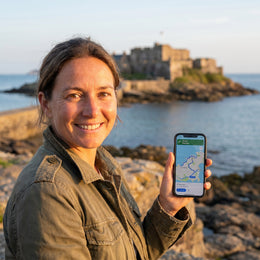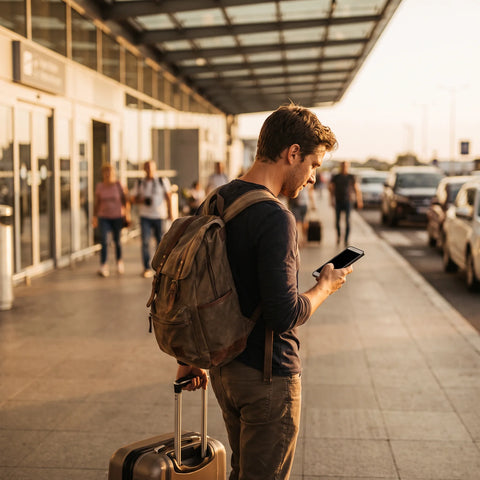

In short: Guernsey belongs neither to the United Kingdom nor the European Union for mobile purposes, so neither "roam like home" nor many UK tariffs cover you here. A Guernsey eSIM installed before leaving home gives you stable data on the island from day one, with a fixed cost and without relying on the Wi-Fi of every cafe.
Why Guernsey catches your tariff off guard
Guernsey is one of those confusing destinations geographically: it's less than an hour from the French coast and very close to the United Kingdom, with short flights from several Spanish airports via London or Southampton. But it's neither France nor technically the UK for mobile purposes. It's a British Crown dependency with its own regime, and that becomes apparent as soon as your phone searches for a network upon landing.
The island is tiny — barely 65 km² — and extraordinarily walkable: a port area in Saint Peter Port, cliff paths in the south, sandy beaches in the west. You'll be using Google Maps to avoid getting lost in the cobblestone streets of the center, you'll want to upload photos of the cliffs, and you'll need to check ferry schedules to Herm or Sark. All of that consumes data, and constantly searching for Wi-Fi ruins the pace of a short trip.
The good thing is that activating an eSIM doesn't force you to give up your Spanish line: your physical SIM still receives bank SMS and calls while the eSIM handles only data. It's the combination that works best for a weekend getaway or a longer stay.
Guernsey is neither the UK nor the EU
Here's the trap most people overlook. Spain is in the EU, and within the EU/EEA, your operator applies free roaming as per regulations. Guernsey, however, is not part of the European Union or the European Economic Area, so that protection does not exist. Your operator may treat it as an international destination and apply roaming rates that skyrocket with very little consumption.
The important nuance: it is also not the United Kingdom in all respects, although it shares the sterling pound (with its own version, the Guernsey pound) and the British dialing code. Some Spanish operator tariffs that do include "United Kingdom" in their roaming explicitly exclude the Channel Islands, because legally they are a separate territory with their own roaming agreements. It's advisable to check your tariff conditions before assuming you are covered, because the name "United Kingdom" in the brochure does not always include Guernsey.
With a data eSIM, you forget about that small print hassle: you contract coverage for the specific island and know exactly what you're getting before boarding the plane. If you want to understand exactly what roaming is and why some destinations include it and others don't, it's a good idea to read what data roaming is first.

Operators and real coverage on the island
Guernsey relies on two local operators: Sure and Airtel-Vodafone, both with established 4G networks throughout the inhabited area. A travel eSIM automatically connects to the network with the best available signal at each point, so you don't have to choose an operator or adjust settings.
In Saint Peter Port, the harbor, the High Street shopping area, and the tourist routes in the east, coverage is solid and stable, with practically no interruptions. Where you will notice drops is on the southern cliff paths —between Icart Point and Pleinmont, for example— and in some enclosed sections of the west coast, where the terrain itself blocks the signal. This is to be expected in rugged terrain and should not be a concern for normal traveler use.
A detail that surprises those who don't know: ferries between Guernsey, Jersey, and Saint-Malo completely lose coverage at sea, it doesn't just slow down, it disappears. Download your movie, podcast, or offline map of your next stop before setting sail, because during the crossing you won't have a single bar.
If your itinerary includes other islands in the archipelago, each requires its own solution: check what options we have to learn more about eSIM versus traditional roaming before deciding how to cover each leg of the trip, especially if you're island hopping in a few days.
How many GB to take according to your trip
Guernsey is usually a short getaway, so there's no need to sign up for disproportionate plans. For a long weekend with maps, messaging, some social media, and shared photos on the go, 3-5 GB will be more than enough. If you're staying a full week or are one of those who constantly uploads videos, bump it up to 8-10 GB to avoid running out on the last day.
Since the island has reasonably widespread Wi-Fi in hotels, restaurants, and many B&Bs, you can reserve mobile data for when you're out exploring — which is when you really need it — and save consumption while dining or sleeping connected to the accommodation's network.
- Weekend (2-3 days): 3 GB covers the essentials without stress.
- Week on the island: 8 GB provides plenty of room for browsing and photos.
- Work or long stay: better 15 GB or a plan with a top-up option.
If you're going to share your connection with your travel companions, your phone's hotspot solves the problem without buying a second eSIM. Before you go, review some tips for saving data while traveling and stretch the GB you buy, especially if you're on a tight data budget.
Indicative plans
The final cost depends on the GB and the days you choose, and varies depending on when you buy, so the most useful thing here is not a fixed price but rather guidance on what combination to order based on the type of trip you have in mind:
| Type of trip | Indicative data | Suggested validity | Intended for |
|---|---|---|---|
| Weekend getaway | 3 GB | 7 days | Maps, chat, occasional photos |
| Full week | 8 GB | 15 days | Social media, daily browsing |
| Extended stay or work | 15 GB | 30 days | Video calls, intensive use |
Always check the current price before buying, because these data and day figures are indicative, not a fixed catalog. What you can be sure of is that a fixed plan saves you the uncertainty of a roaming bill that you won't control until the end of the month.
Install and activate your eSIM before flying
The process is done from the comfort of your home and takes no more than a couple of minutes. You buy the plan, receive a QR code by email, scan it from your phone's settings, and the profile is installed. The key is to have it ready but not activated until you land, so as not to start consuming validity days while you are still checking in your luggage.
- Purchase your Guernsey eSIM and receive the QR code by email, usually within minutes.
- Go to Settings > Mobile Data (or Connections) > Add eSIM and scan the code.
- Give the line a name to distinguish it from your Spanish SIM and leave it installed but inactive.
- Upon landing in Guernsey, activate the data for that line and data roaming within its settings.
- Check that your main Spanish line is still active for calls and SMS, and deactivate data roaming on it to avoid duplicate charges.
If it's your first time installing one, the step-by-step guide on how to install an eSIM will resolve any questions you have about the process, and if you're still unclear about exactly what this technology is compared to a physical SIM, it's a good idea to first read what a virtual eSIM is before buying.
What almost no one tells you
There are details about Guernsey that you only discover by stepping foot on the island, and it's good to know them before they catch you by surprise.
Sark, the car-free island, also has almost no mobile coverage. If you take the day trip from Saint Peter Port —highly recommended, by the way—, don't count on data there beyond a few sporadic spots near the harbor. It's one of the few islands in Europe where you truly disconnect, so download your offline map before boarding the boat.
Herm, the smallest and closest island, has patchy coverage. Twenty minutes by ferry from the harbor, it's perfect for an afternoon at the beach, but the signal comes and goes depending on where you are on the island. It's not a problem if you're going to disconnect for a while, but don't rely on it for urgent matters.
Sure and Airtel-Vodafone don't always cover the same corners equally well. A travel eSIM that doesn't tie you to a specific operator is a real advantage here, because it connects to the network with the best signal in each area instead of leaving you stuck with a single operator that might be weak exactly where you are.
The airport (GCI) is small and the arrival process is quick, so if you activate the eSIM as soon as you land, you'll have data even before collecting your luggage, which is useful for ordering a taxi or confirming your accommodation address without searching for Wi-Fi in the terminal.
Online banking with SMS verification works perfectly with dual SIM. Since your Spanish line remains active in the background, bank one-time codes reach you just like at home; the common mistake is to completely deactivate the physical SIM thinking that "you no longer need it" and then be unable to confirm a payment.
Free Wi-Fi in cafes and accommodations is not always secure for checking your bank. If you're going to do sensitive transactions connected to a public network, it's good to know how to protect yourself; we explain it in the guide on eSIM, VPN, and travel privacy.
When you DON'T need an eSIM here
It's worth being honest: if you're only going to Guernsey as a cruise stopover, with a few hours in Saint Peter Port before re-boarding, you'll probably manage with the ship's Wi-Fi and the port's Wi-Fi without spending anything on data. And if you're staying in a hotel with good Wi-Fi and your plan is not to move much from the urban center, the real need for mobile data decreases significantly.
It also doesn't make much sense if your Spanish tariff already expressly includes Guernsey or the Channel Islands within its roaming — this happens with some premium tariffs; in that case, check the exact conditions before spending on something you already have covered. The eSIM makes sense primarily when you're going to move around the island, rely on your mobile for navigation or to share your trip in real time, or when your operator doesn't cover this destination and you prefer not to risk a surprise bill.
Frequently asked questions
Does my UK eSIM work in Guernsey?
Not always. Guernsey is a Crown dependency with its own status, and many eSIM plans designed for the UK do not expressly include it. Check that the plan mentions Guernsey or the Channel Islands before purchasing; if not, a specific eSIM for the island is better.
Do I have free roaming in Guernsey with my Spanish or European tariff?
No. As it does not belong to the EU or the European Economic Area, "roam like home" does not apply here. Your operator may bill you as an international destination, so it's advisable to check your tariff conditions or carry a data eSIM with a fixed price.
Can I use the same eSIM in Jersey or Sark?
It depends on the plan. Some eSIMs cover several Channel Islands and others are limited to Guernsey. If your route includes Jersey, check the plan's coverage before purchasing. For Sark, however, don't count on mobile data almost anywhere on the island, whether your eSIM has coverage or not.
Do I need a special phone to use an eSIM in Guernsey?
You only need an eSIM-compatible phone, which is common in almost all mid-range and high-end models since 2019. There are no island-specific requirements: the same phone you use in Spain will work without any further adjustments.
Does the eSIM work as soon as I land at Guernsey Airport?
Yes. The airport (GCI) has good coverage, so if you activate the profile when you turn on your phone after the flight, you'll have data immediately to order transportation or announce your arrival, without needing to look for Wi-Fi in the terminal.
What happens to my Spanish number while using the eSIM in Guernsey?
It continues to function normally for calls and SMS, including bank codes. The eSIM only handles data, so you don't lose your usual line or have to notify anyone of a number change during your trip.
How many days in advance should I buy the eSIM for Guernsey?
There's no rush: you can buy it and install the profile days before flying, as leaving it installed doesn't consume data or activate its validity. Activate it only when you land to make the most of every day of your plan.
Conclusion
Guernsey hides a connectivity trap behind its Channel Island charm: it's not in the EU, it's not always covered by your UK roaming, and your Spanish tariff might treat it as an expensive destination without you realizing it until the bill. The solution doesn't require complications: install the Guernsey eSIM before leaving home, activate it upon landing, and dedicate your trip to exploring cliffs and harbors instead of chasing Wi-Fi in every café. If your route continues to the continent afterwards, also check the Europe eSIM so you don't have to resolve connectivity country by country.