If you're looking for internet in the Isle of Man assuming it's "like the UK" or that your European data plan will work, stop for a moment: this island in the middle of the Irish Sea is a British Crown dependency, with its own parliament, its own currency, and its own telecommunications rules. Neither the UK nor the European Union. And that, on your phone bill, makes a difference. In this guide, I'll tell you how I would connect, what operators are available, how much a local SIM really costs, and why TT Race Week changes everything.
The Isle of Man is not the UK (or EU): what that means
European roaming does not work in the Isle of Man: it is neither the UK nor the European Union, but a Crown dependency. You have four options: activate roaming with your Spanish operator, rely on Wi-Fi, buy a local SIM from Manx Telecom or Sure, or use an eSIM activated from home.
Let's get to the boring but crucial part. The Isle of Man is a Crown Dependency: the British Crown is responsible for its defense and foreign relations, but the island has its own government and the Tynwald, one of the oldest continuously operating parliaments in the world. It is not part of the United Kingdom, nor is it part of the European Union, and it was never a member state.
The practical consequence is simple: the European "Roam Like at Home" regulation, which allows you to use your data in France or Italy as if you were at home, does not apply here. Nor does the "UK data plan" that many Spanish tariffs incorporated after Brexit automatically apply, because each operator decides country by country what to include in each zone, and several exclude the Isle of Man.
There are more clues that you are in a different place: the currency is the Manx pound, on par with sterling, and although British pounds are accepted without problem, Manx banknotes are not accepted in Liverpool. The telephone prefix is +44, with area code 01624, which confuses many people and some billing systems. The entire island is a UNESCO Biosphere Reserve, the only one in the world that covers an entire territory.
Translated to mobile: it doesn't matter what your plan says about Europe. Here, you have to check it case by case before taking off.
Your Spanish plan: how to check if it covers you
This is the first thing I would do, and it takes five minutes. Go to your operator's website, look for the list of countries by roaming zone, and find "Isla de Man" or "Isle of Man" using the browser's search function. Don't trust "Reino Unido" (United Kingdom) appearing: they are distinct entries.
What I found when reviewing it: Movistar classifies the Isle of Man outside its European Zone 1, meaning it's not included in the bundle; it's billed as an international destination with separate rates. Vodafone Spain has been including it in its zone along with the UK, Jersey, Guernsey, and Gibraltar in several of its plans, which is good news. Orange does not list it among the destinations included without extra cost. And low-cost operators (Yoigo, Pepephone, Digi, Finetwork, and co.) each do their own thing and frequently change conditions.
I insist on "frequently change": these lists are reviewed every season, and what was valid last year may not be valid today. The only reliable source is your operator's website the month of your trip, or a call to 1004, 22123, or the corresponding number. If they tell you "it's included," ask for written confirmation in the chat. Save that screenshot, because claims are lengthy afterwards.
A lifesaver that does work: by European regulations, your Spanish operator will by default cut off data once you reach about €50 (excluding VAT) of roaming consumption outside the EU, and will notify you via SMS beforehand. It's not a plan, it's an airbag. If you want to understand the numbers well, I have the breakdown in the guide on how much international roaming costs.
The four ways to connect, compared
To summarize, in the Isle of Man you have exactly four options. None is entirely bad; they simply serve different purposes. This table is what I show to people who ask me on WhatsApp the week before flying.
| Option | Estimated Cost | What's good about it | What's bad about it |
|---|---|---|---|
| Roaming with your Spanish operator | Free if your zone includes it; if not, international rate per MB | No changes needed, keep your number | Many plans exclude it; costly surprise if you don't check |
| Hotel, pub, and cafe Wi-Fi | Included | Enough for uploading photos at night | Useless on the road, in the glens, and on the ferry |
| Local SIM (Manx Telecom or Sure) | From £5 for SIM + top-ups of £5-20 | Lots of data for little money, native local network | Must buy in person, most shops are in Douglas |
| Travel eSIM | Fixed price seen before payment | Activated from home, works upon landing, no shops or queues | Requires compatible and unlocked phone |
If you're going to Douglas for four days to visit the castles, any of the last three options will work. If you're going in June, with roads closed and half the world trying to upload motorcycle videos at the same time, the difference between being well-connected and not is called having your plan sorted before leaving home. And if you want a detailed analysis of each comparison, I've broken it down in eSIM vs local SIM.
Roaming: when it's good and when it's a shock
I'll be fair about roaming, because in some cases it's the right answer. If your plan expressly includes the Isle of Man in its zone at no additional cost—as is the case with several Vodafone Spain plans—activating it and forgetting about it is the most convenient thing in the world. You keep your number for bank SMS, you don't reconfigure anything, and you don't spend an extra euro.
The problem lies in the other two scenarios. The first: your plan doesn't include it, and you assume it does because "it's England, right?". There, you enter international billing, and the meter runs per megabyte, meaning a couple of autoplay videos on Instagram and a few background app updates can turn into an unpleasant bill. The second, more treacherous: maritime roaming. On the ferry from Liverpool or Heysham, as soon as you move away from the coast, your phone connects to a satellite network on the ship, and those networks are not included in any bundle, not even European ones. It's billed separately and is one of the most expensive things out there.
My rule on any crossing: mobile data OFF before the ship unties, and I don't touch it again until I see land. I've seen three-figure bills for a movie that synced itself in the middle of the Irish Sea.
If your operator does cover you, also check the details: sometimes they include data but charge for calls, or limit the bundle to a few gigabytes per month with "reasonable use." All of that is in the fine print and should be read. I elaborate on the full comparison between paying for roaming and having your own plan in eSIM vs roaming, with the numbers on the table and without bias.
Hotel, pub, and ferry Wi-Fi: how far it goes
The Isle of Man is well-cabled for its size. Douglas, Ramsey, Peel, Castletown, and Port Erin have fiber in many accommodations, and the hotels on Douglas promenade usually offer decent Wi-Fi for working in the morning or making a video call. Guest houses and family B&Bs do too, though often with a single shared router: if the building is full, speed drops.
The pubs and cafes in central Douglas, the House of Manannan in Peel, Ronaldsway Airport, and some public libraries offer free Wi-Fi. At the airport, you'll appreciate it for ordering a taxi upon arrival. The Isle of Man Steam Packet terminal in Douglas also has it, although things change onboard: the ship's Wi-Fi is satellite-based, barely works, and crawls on busy crossings.
Where does Wi-Fi fail? Everywhere else, which is exactly where you'll be. On the mountain road, on the trails of Raad ny Foillan (the coastal path around the island), in the glens of Dhoon or Glen Maye, on the climb to Snaefell, or waiting for the tram in the middle of the countryside, there's no Wi-Fi to latch onto. And that's when you need Google Maps, train schedules, or to call a taxi.
My usual conclusion: Wi-Fi is a great complement but a terrible primary plan. If you're from the portable router school, I've got an honest comparison in eSIM vs pocket Wi-Fi, detailing batteries, deposits, and returns, which is where things often go wrong.
Local SIM: Manx Telecom and Sure, real prices
Two companies operate their own networks on the island: Manx Telecom, the historical operator and the one that has pushed 5G deployment the most, and Sure, which also provides service in Guernsey and Jersey and works well with 4G in populated areas. Both sell pay-as-you-go (PAYG) in stores.
Manx Telecom's figures are public and quite generous for what one expects from a small island:
| Manx Telecom PAYG Top-up | Data on the island | Minutes and SMS | UK Roaming Data |
|---|---|---|---|
| £5 (approx. €6) | 5 GB for 7 days | 200, to island mobiles | Not included |
| £10 (approx. €12) | 10 GB for 14 days | 500, to island mobiles | 1 GB for 14 days |
| £20 (approx. €23) | 20 GB for 30 days | 10,000, to island mobiles | 2 GB for 30 days |
The SIM card costs an additional £5, and the balance expires after 90 days. Important detail: those included minutes are for calls to numbers on the island itself, not to Spain, so you'll still use WhatsApp to talk to home. And beware of the "UK roaming included" claim: it's only 1 or 2 GB, and it doesn't cover the EU.
The catch? All of this must be purchased in person. The main Manx Telecom store is in Douglas, there are sales points scattered throughout the villages, and top-ups can be done online once you have the SIM. If you land on a Sunday afternoon or arrive by ferry at night, you'll go to bed without data.
eSIM: why it's what I use
With this destination, the advantage of the Embedded SIM is particularly clear, and it's not about price: it's about logistics. The Isle of Man doesn't have a phone shop on every corner like Bangkok or Istanbul, and business hours are typical of a quiet British village. Arriving with your plan already purchased and activated, and having your phone connect to the network as the plane taxis down the Ronaldsway runway, saves you the entire first afternoon.
The mechanics are simple: you buy online, receive a QR or activation link by email, install it with Wi-Fi before leaving home, and activate the plan upon landing. Your Spanish line remains in your phone as the primary line, so you still receive calls, WhatsApp, and bank codes via SMS, while data runs on the new profile. If you've never done it, in what is an eSIM I explain it step by step and without jargon.
Requirements: compatible phone (practically all iPhones since the XR and most mid-to-high-end Androids from recent years) and unlocked. That's all. No need to show your passport at any counter, no deposit required, and no need to return any device, and if you leave the island for Liverpool or Dublin, you won't be stuck with a SIM that only works here.
For specific details on this destination—what network it uses, what plans are available, and what configuration is best—you can find the full information in the Isle of Man eSIM guide, which is where I update the information every season.
Actual coverage by area: Douglas, Peel, Snaefell, and the glens
Time to tell the truth, including the part that isn't appealing. Mobile coverage in the Isle of Man is good where people live and fair to poor where you go on excursions, which is exactly the pattern for any mountainous island.
- Douglas: The capital concentrates over a third of the population, and here the network is more than adequate, with fast 4G and Manx Telecom's 5G covering much of the urban area and promenade.
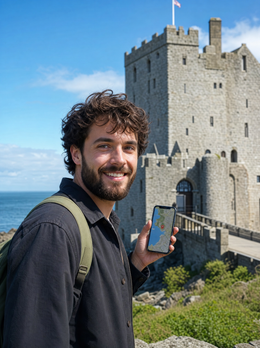
- Ramsey, Peel, Castletown, Port Erin, and Onchan: No problems for browsing, maps, and video calls. In Peel, the castle is on an islet, and the signal drops a bit there, but it works.
- Mountain Road and the ascent to Snaefell: Irregular. There are stretches with decent coverage and curves where you lose it completely. At the summit of Snaefell, at 621 meters, the signal comes and goes depending on the operator and the day.
- Glens and coastal path: In Dhoon Glen, Glen Maye, or the wilder sections of Raad ny Foillan, don't expect stable data. Download offline maps beforehand.
- Calf of Man: The islet at the southwest tip, a bird sanctuary, is practically disconnected. Go mentally prepared.
- On the ferry: Land-based coverage only near the coast; in the middle of the journey, nothing useful except paid satellite.
A tip you'll appreciate: if your plan allows manual network selection, try both. There are areas in the north and west where one of the two operators is clearly better than the other, and changing networks manually will get you out of trouble more than once.
TT Race Week: when the network suddenly fills up
If you're traveling in late May or early June, you're not going to the normal Isle of Man: you're going to the TT, the most famous and toughest motorcycle races in the world, held on the Mountain Course, a public road circuit of about 60.7 km that passes through villages, stone walls, and the mountain.
During those two weeks, the island receives tens of thousands of visitors, practically all with mobile phones, all recording videos, and all trying to upload them simultaneously from the same place. The network holds up, but it's noticeable: in the busiest spectator areas—the Grandstand straight in Douglas, Bray Hill, Ballaugh Bridge, Creg-ny-Baa—the speed plummets in the minutes after each pass of motorcycles. It's network physics: there are so many antennas and so many users.
Things that still work when things get saturated: text and WhatsApp messages still come through even if video doesn't load; uploading heavy content at night from your accommodation instead of at the circuit; and downloading the road closure map beforehand, because during the races entire parts of the island become inaccessible by land until they reopen, and you won't be able to check schedules on the fly if you run out of data.
Add another factor: during TT, accommodation is filled to the last sofa, and many sleep in campsites and private homes where Wi-Fi is minimal or non-existent. There, depending on the hotel router ceases to be an option, and your own connection becomes plan A.
Staying connected while on the move: steam trains, trams, and ferries
A large part of the island's charm lies in moving slowly, and there, connectivity matters more than it seems because schedules are seasonal and change.
The Isle of Man Steam Railway connects Douglas with Port Erin to the south with original 19th-century steam locomotives; the Manx Electric Railway runs along the east coast from Douglas to Ramsey in 1893 electric trams that are still in service; and the Snaefell Mountain Railway climbs to the summit, from where on a clear day you can see the so-called six kingdoms. In summer, the horse tram on Douglas promenade also operates, a beautiful rarity. All of this can be paid for with combined cards and passes that can be purchased or consulted online, and schedules vary by season.
During journeys, coverage is intermittent: good in towns, weak in between. On the tram to Ramsey, there are cliff sections where your phone will be left thinking. For the Steam Packet ferry from Liverpool, Heysham, Dublin, or Belfast, with crossings ranging from two and a half to four hours, as mentioned before: data off and content downloaded.
- Download the island map on Google Maps before leaving your accommodation.
- Save the day's schedules and local taxi numbers to your phone.
- Have your transport pass handy as an image, not just in the app.
With that, even if you lose signal in the middle of the countryside among sheep and a tailless Manx cat, you won't be stranded.
How much data do you need and how to make it last
Data plans are sold by the gigabyte, and hardly anyone knows how much they need. This is my estimate for an island where you'll be using maps a lot and streaming very little, because the scenery is meant to be seen with your eyes.
| Trip Profile | Typical Duration | Recommended Data | Primary Use |
|---|---|---|---|
| Short getaway (Douglas, Peel, castles) | 3-4 days | 3-5 GB | Maps, WhatsApp, some photos |
| Full week exploring the island | 7 days | 8-10 GB | Maps, schedules, social media |
| Hiking the Raad ny Foillan | 5-10 days | 10 GB and offline maps | GPS, tracks, weather alerts |
| TT Week filming video | 7-14 days | 20 GB or more | Video, live streams, heavy uploads |
Tricks I always use and that are doubly valuable here due to the changeable weather: disable automatic video playback on Instagram, TikTok, and X; set photo backups to "Wi-Fi only"; download music and podcasts before leaving; and download the area map on Google Maps or OsmAnd, which will be the only thing to guide you in the glens.
And a warning about the climate: Manx weather can change in twenty minutes, with fog swallowing the mountain without warning. Checking the forecast before climbing Snaefell isn't an obsession, it's common sense, and you need a signal for that. Leaving home with your plan sorted is what separates a nice outing from an uncomfortable afternoon.
Frequently Asked Questions
The most common questions I get about connectivity on this island, answered directly and without beating around the bush.
Does European roaming work on the Isle of Man?
No. The island does not belong to the European Union or the European Economic Area, so the Roam Like at Home regulation does not apply. Nor is it automatically included in the "UK" bundles of Spanish tariffs: each operator decides, and several exclude it.
Is the Isle of Man considered part of the UK for my plan?
It depends on your operator, and that's why you need to check. Geographically, it is a Crown dependency with its own government, not part of the United Kingdom. Some Vodafone Spain plans group it with the UK, Jersey, and Guernsey; Movistar places it outside its European zone, and Orange does not list it as included.
How much does a local SIM cost on the Isle of Man?
Around £5 for the card plus your chosen top-up. With Manx Telecom, £5 gets you 5 GB for a week, £10 gets you 10 GB for two weeks, and £20 gets you 20 GB for a month. The balance expires after 90 days, and included minutes are for calls to island numbers.
Do I need a passport to buy a prepaid SIM there?
There is no mandatory biometric registration like in some Asian countries. The real obstacle is logistical: SIMs are bought in person, most points of sale are in Douglas, and opening hours are typical of a quiet town. If you arrive outside business hours, you'll be without data until the next day.
Is 5G available on the Isle of Man?
Yes, in urban areas. Manx Telecom has deployed 5G in Douglas and other main towns, and 4G covers the rest of the populated areas well. In the mountains, glens, and coastal path, coverage is patchy, so download maps before you set off.
Does the internet work well during TT Week?
It works, but it gets congested at spectator points. With tens of thousands of visitors recording and uploading video from the same locations, speed drops after each pass of motorcycles. Messages still come through; leave heavy uploads for the evening from your accommodation.
Can I use my mobile on the ferry from Liverpool or Dublin?
You can, but it can be very expensive. On the high seas, your phone connects to the ship's satellite network, which is billed as maritime roaming and is not included in any bundle, European or otherwise. It's sensible to turn off mobile data before sailing and use the onboard Wi-Fi.
Which option do you recommend if I'm only staying for three days?
A data plan purchased and activated before leaving home. For a short break, spending the first evening looking for an open shop in Douglas isn't worth it, and roaming is only a good idea if you've confirmed in writing that your plan includes the island. 3-5 GB will be more than enough.
Conclusion
To summarize the important points: the Isle of Man is not part of the UK or the European Union, so the first thing to do is check with your operator whether it's included or not, and do so in writing. If it's not included, you have two good options: a local Manx Telecom SIM, cheap in terms of data but only purchasable in person and during shop hours, or to have your plan already activated from home. And whatever happens, turn off data on the ferry.
If you want the quick route, here's the eSIM for the Isle of Man: install it before you leave, activate it when you land in Ronaldsway, and forget about it so you can focus on what you came to do, which is look at the sea from Peel Castle and chase tailless cats.