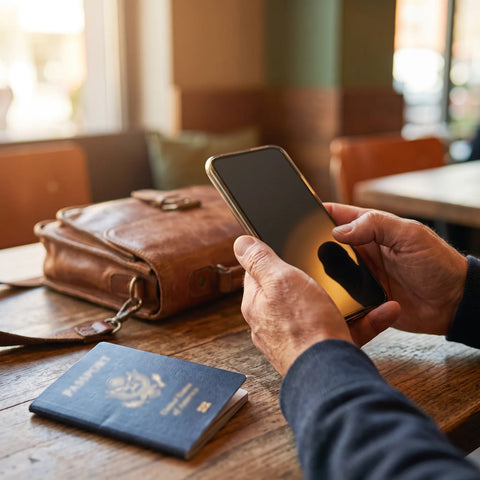

In short: an eSIM for the Isle of Man gives you mobile data as soon as you land in Ronaldsway or get off the ferry in Douglas, without relying on your Spanish operator's roaming. The island belongs neither to the EU nor to the UK, so "like at home" roaming does not apply here: install the profile before you leave and arrive connected, even in the middle of TT week.
The Isle of Man is a peculiar destination: small, green, and world-famous for the TT, the wildest motorcycle race on the planet. Whether you're going for the races or escaping to Douglas or Peel for a few days, you'll need data upon arrival. And here's a trap many travelers fall into: because it sounds "British," they assume their UK roaming will work. It won't, and it can be expensive to discover that with the bill in hand.
What exactly is the Isle of Man (and why doesn't roaming work the same)?
It's worth clarifying before booking anything: the Isle of Man is a British Crown dependency with its own government, currency (although the pound sterling circulates), and customs. It is not part of either the United Kingdom or the European Union. It is self-governing, has its own parliament (the Tynwald, one of the oldest in the world), and decides its own telecommunications regulations.
For roaming purposes, this matters a lot. The island is outside the European "roaming like at home" regulations that protect you in France, Italy, or Portugal. And since it's not technically the UK, some data plans designed for London or Edinburgh either don't cover it directly or bill it as a separate international destination. The result is the worst of both worlds: neither a European nor a guaranteed British rate, but the traditional international roaming, which can skyrocket without warning. If you want to understand why this happens, we explain it in detail in what data roaming is.
This legal loophole is precisely why a travel eSIM is so worthwhile here: you pay a fixed price for your GB before leaving home and forget the word "roaming" exists. If you want to compare the two options in depth, you have the complete comparison in eSIM vs roaming.
Does an eSIM work on the Isle of Man?
Yes, without any problems. The Isle of Man has a modern mobile network, and an eSIM works just like in any other destination: you install the digital profile before traveling, and upon arrival, your phone connects to the local operator to give you data. You only need an eSIM-compatible mobile (most mid-to-high-end phones from recent years are) and have it ready to have internet as soon as you set foot on the island, without looking for a physical SIM counter at Ronaldsway airport.
It's especially convenient here because the island gets crowded during the TT season, and buying a physical card can be a hassle with so many people and queues. With an eSIM, your data is already sorted: activate the line, load offline maps, and enjoy the races or the scenery. If you've never used an eSIM and are unsure how the system works internally, in what a virtual eSIM is we explain it from scratch, without technical jargon.

Data during the Isle of Man TT
The TT is when the island experiences its peak number of visitors, and also network saturation. Thousands of fans uploading videos and photos simultaneously from the circuit's hot spots (Ballaugh Bridge, Creg-ny-Baa, the Mountain) can slow down the connection just when you need it most: when the motorcycle passes.
Why the network saturates on the circuit
The Mountain Course is not a closed circuit with stadium infrastructure: it's normal public roads, with the normal network capacity of a rural road. When tens of thousands of people gather in a few kilometers and all stream live at the same time, the network suffers even if your operator has good basic coverage. It's not an eSIM failure; it's radiofrequency physics: too many devices requesting bandwidth in the same place.
With an eSIM, you have your own data without relying on saturated Wi-Fi from bars and public areas, but that doesn't free you from the congestion of the local tower itself. A real tip: if you're going to record a lot, calculate a generous plan, because high-quality videos use up GBs in minutes. And to avoid running out of battery or data during live streaming, apply the tricks of how to save data on your travel eSIM: upload heavy videos at night with accommodation Wi-Fi and use offline maps during race day.
TT Tip: Download the map of the Snaefell circuit (the famous Mountain Course) offline before leaving your accommodation. Between races, the network gets congested in the most popular viewing spots, and having the map offline saves you when moving from one section to another without relying on live GPS loading.
Another detail that almost no one anticipates: in massive observation points like Creg-ny-Baa, if you use free public Wi-Fi from a bar or sponsor tent to save data, be careful what you connect to on that open network shared by thousands of strangers. If you're going to check your bank or do any transactions, it's better to use your own eSIM data and, if possible, a VPN — we explain this in eSIM, VPN, and travel privacy.

Coverage in Douglas and the rest of the island
Douglas, the capital, has good 4G coverage, as do Peel, Ramsey, and Castletown. For browsing, checking maps, and messaging, you'll have no problem in inhabited areas or most of the circuit route, including Douglas's promenade itself, where much of the TT atmosphere outside of races is concentrated.
Signal weakens in the mountainous interior, enclosed valleys, and some sparsely populated coastal stretches, especially around Snaefell and certain sections of the Millennium Way. It's a small island—you can cross it from end to end in just over an hour by car—so you'll rarely be far from coverage, but if you're hiking inland or exploring remote corners of the west coast, expect stretches without data. Downloading the route map before leaving your accommodation is still, as in any destination with irregular terrain, the most cost-effective precaution you can take.
Local operators and recommended GB
The island's mobile network is supported by local operators, and a travel eSIM automatically connects to the one offering the best signal at each point, without you having to configure anything manually:
| Visit profile | Typical duration | Estimated data |
|---|---|---|
| Tourist getaway (Douglas, Peel, Castletown) | 2-4 days | 2-4 GB |
| TT week without much content recording | 1 week | 5-8 GB |
| TT recording and live video uploading | 1-2 weeks | 12-20 GB or renewable plan |
| Combined island + UK or Ireland route | 2-3 weeks | Per country plan or separate regional eSIM |
The main local operators are Manx Telecom and Sure, the island's two reference networks, with established coverage for years in populated areas. You don't have to choose which one to use: the data profile relies on the best available signal at each point of the route, just like your regular mobile does at home when moving between antennas.
If your trip doesn't stay just on the island and you're going on a longer route through the continent before or after —Dublin, Amsterdam, Berlin—, you don't need to buy a new eSIM at each stop: a single eSIM for Europe covers all those stretches, and you leave the Isle of Man eSIM only for the specific days you spend here, as the island is not included in European regional plans because it does not belong to the EU.
How to activate it step by step
It is installed before traveling, with Wi-Fi at home, in about 1 minute:
- Purchase the Isle of Man plan and receive the QR by email.
- Scan the code in Settings → Mobile Data → Add eSIM.
- Keep your regular SIM for calls and use the eSIM as your data line.
- Upon arrival on the island, activate mobile data and roaming in the eSIM profile.
If you've never used an eSIM and want to see the process with actual screenshots, the guide on how to install an eSIM will sort it out for you in no time, even before you pack your bags.
Errors and myths: what almost no one tells you
This is where most generic guides fall short, as they repeat the obvious without going into the real details for travelers:
"My UK eSIM will definitely work here"
This is the most common mistake, and the one that causes the most trouble. Many data plans labeled "United Kingdom" are built on the coverage of operators like EE, Vodafone, O2, or Three in British territory, and their small print does not always include the Isle of Man as a covered destination. Before assuming your British eSIM will work, explicitly check if the plan mentions the island; if it doesn't, don't assume it will work.
"Since it's small, there must be free Wi-Fi everywhere"
There is Wi-Fi in cafes and at your accommodation, yes, but during TT week, those networks get as saturated as mobile networks, and often worse, because the local bandwidth isn't designed for hundreds of customers simultaneously uploading videos. Don't plan your connection assuming you "will find Wi-Fi": always have your own backup data.
"The ferry from the UK will leave me with active roaming"
Not exactly. Some shipping companies offer Wi-Fi on board, but it's limited and shared among hundreds of passengers, so don't count on it for anything other than checking arrival times. As soon as you step ashore in Douglas, you need your own connection, not the ship's.
"The more GB, the better, just in case"
Not necessarily. Buying too much doesn't give you better coverage or speed, just data you probably won't use. If you're going on a weekend getaway without recording video, 2-4 GB is usually more than enough; save large plans for when you're truly going to upload live content during the TT.
When NOT worth buying an eSIM here
Not all reasons are for buying. If your plan is a few hours' stopover on the ferry to another destination and you're not going ashore, you don't need anything: the ship's Wi-Fi to check the schedule is enough. And if your Spanish operator or your UK operator's contract expressly includes the Isle of Man within its domestic coverage – some British plans do, although not all, so it's worth checking the specific conditions of your tariff before spending on something you already have – you also don't need to buy a separate eSIM for a short visit.
Where it almost always makes sense is in other cases: stays of more than a day, TT week, or any plan that involves recording and sharing content, because that's where roaming without a fixed plan runs up the highest costs without you realizing it until the bill arrives.
Frequently asked questions
Is a UK eSIM valid for the Isle of Man?
Not always. The Isle of Man is not part of the United Kingdom, so many British plans do not cover it or bill it separately as an international destination. The safest option is to contract a plan that expressly includes the Isle of Man to avoid running out of data as soon as you arrive.
Will I have coverage during the TT races?
In inhabited areas and much of the circuit, yes, although the network gets congested at peak times due to the influx of fans uploading content simultaneously from the same stretch of road. Having your own data with an eSIM helps, and downloading offline maps ensures you can get around even if the signal is slow.
Will I be charged expensive roaming with my Spanish operator?
It's likely. As it's not in the EU, the Isle of Man is outside regulated European roaming and is usually billed at international rates, sometimes higher than those for mainland UK. An eSIM with a fixed price before traveling completely avoids this risk.
How much data do I use if I'm going to record the TT?
Quite a lot. Recording and uploading high-quality videos can consume several GB in a short time. If that's your plan, contract a generous package (12-20 GB or renewable) and upload heavy content at night with your accommodation's Wi-Fi to stretch your mobile data during race day.
Does it work as soon as I land or arrive by ferry?
Yes, as long as you have installed it before leaving home. Whether you arrive at Ronaldsway airport or by ferry to Douglas, you just need to activate mobile data and roaming in the eSIM profile, and you'll connect to the local network in no time without looking for shops or counters.
Do I need a different eSIM if I combine the island with the UK or Ireland?
It depends on the duration of each leg. If you're going to spend several days in the UK or Ireland in addition to the island, it's usually more cost-effective to contract a specific plan for each destination than one that tries to cover everything, because the Isle of Man is not included in European regional plans, nor always in British ones.
What if my phone is not eSIM compatible?
Then you'll need a local physical SIM, which you can buy on the island itself, although during TT week, queues at shops and points of sale get quite long due to the influx of visitors. Checking your phone's compatibility before leaving home saves you that problem.
Conclusion
The Isle of Man is a unique destination, and its location outside the EU and the UK means that normal roaming can be expensive without prior warning. With solid coverage in Douglas and most of the circuit, two reliable local operators (Manx Telecom and Sure), and activation in just 1 minute, an eSIM is the smartest way to arrive connected to the TT or your peaceful getaway to Peel and Castletown. Prepare your eSIM for the Isle of Man before you travel and enjoy it without checking the bill when you return.