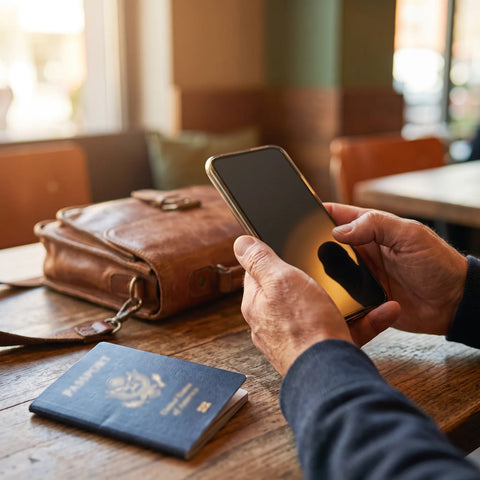
In short: for a trip to Lisbon, a Portugal-type eSIM for Lisbon with 1-3 GB is typical: it's installed at home before flying, automatically activates upon landing at Humberto Delgado Airport, and provides good signal in the city center, Alfama, and Belém. This way, you avoid roaming charges from your Spanish operator from the very first minute.
An eSIM for Lisbon gives you mobile internet from the moment you step onto the plane's jet bridge, without searching for Wi-Fi or paying unexpected roaming fees. For a weekend getaway, you don't need the same plan as you would to travel all over Portugal: a few well-calculated gigabytes will be more than enough to get around the city. Here's what you need and what you don't.
City, not country: why the plan changes
For a short getaway to Lisbon, a small plan (1-3 GB) is enough: you'll be moving within a limited radius, with Wi-Fi at your hotel and in many cafes, so actual consumption is low. A full country plan only pays off if you're going to explore the Algarve, Porto, or the interior. Less city, fewer gigabytes, less money wasted on data you won't use.
The key is that in a capital city like Lisbon, you constantly switch between mobile data and Wi-Fi. You check the map to get off at the right stop for tram 28, search for where to eat pastel de nata near Belém, and share a photo from the Santa Luzia viewpoint, but in between, you're sitting on a terrace with Wi-Fi. That's why a city eSIM is sized differently than one for a long trip. If you're unsure between plans, check out our comparison of eSIM vs. roaming and choose the lowest tier that gives you peace of mind.

How many GB for a Lisbon getaway
For a weekend (2-3 days) in Lisbon, 1-2 GB is usually enough if you use Wi-Fi at your accommodation; for 4-5 days with navigation, maps, and social media, estimate 3 GB. Only if you plan long video calls or upload many videos should you go up to 5 GB. Lisbon has Wi-Fi everywhere, so almost no one runs out.
| Travel profile | Days | Recommended GB |
|---|---|---|
| Express getaway with Wi-Fi | 2 days | 1 GB |
| Weekend sightseeing | 3 days | 2 GB |
| Long weekend, lots of maps | 4-5 days | 3 GB |
| Content creator | 3-5 days | 5 GB |
It's better to underestimate and recharge than to overpay for unused gigabytes. Almost all eSIMs allow you to add a new plan from the app in a matter of seconds, without reinstalling anything. If you frequently travel in Europe, also check out the Europe eSIM: if Lisbon is a stop on a longer route, a regional plan might be more cost-effective than a city-specific eSIM.
Coverage in the center and neighborhoods
Mobile coverage in Lisbon is among the best in Europe. The eSIM connects to the Portuguese network with the best signal at any given time, so you'll have stable 4G/5G in the center and in tourist neighborhoods. Here are the places where people are most concerned and how the network performs:
- Baixa and Chiado: excellent signal, 5G on most streets.
- Alfama and its alleys: good coverage despite the hills and thick walls.
- Belém and the Tower: 4G/5G without problems, ideal for using maps.
- Viewpoints (Graça, Senhora do Monte): strong signal, perfect for uploading photos instantly.
- Metro and funiculars: may fail inside the tunnel but recovers upon exiting.
A detail that is barely noticeable but helps: in open spaces like the Santa Justa Lift or the courtyard of the Carmo Convent, the signal remains strong, but inside covered rooms with thick stone walls—some areas of São Jorge Castle, for example—it loses some strength. This is not a problem for normal use (checking maps, answering messages), but if you are going to make a long video call from inside, it is better to find the outdoor patio before starting.
Tip: If you're going to the viewpoint or São Jorge Castle, download an offline map of the area beforehand. The signal is good, but this way you won't use data loading the entire map every time you open the app.

Internet at Humberto Delgado Airport
Lisbon Airport (Humberto Delgado, LIS) is right next to the city, ten minutes by metro from the center. With your eSIM already activated, you'll have internet as soon as you land: you can order a taxi or Bolt, check the metro schedule, and announce your arrival without relying on the terminal's slow Wi-Fi. That first moment with data is precisely when you need it most.
The classic mistake is installing the eSIM at the airport, in a hurry and without good Wi-Fi. Installation (scanning the QR and adding the profile) requires a connection; activation then happens automatically upon arrival at your destination. That's why it's best to get everything ready at home. If you want the complete step-by-step, we have a guide on how to install an eSIM, which covers both installing the profile and activating it upon landing.
How to activate it before traveling
Installing the eSIM before leaving saves you most of the hassle. The complete process from purchase to having internet in Lisbon is summarized as follows:
- Buy the Portugal eSIM online and receive the QR by email in 1 minute.
- At home, with Wi-Fi, scan the QR (Settings > Mobile Data > Add eSIM) and install the profile.
- Keep the eSIM stored but activate data roaming only for that profile.
- Upon landing in Lisbon, activate the eSIM data and you're good to go: it connects automatically.
Before buying, confirm that your phone supports eSIM: almost all iPhones since the XS and many recent Android phones have it. It's a thirty-second check that prevents you from buying something your phone can't use, and while you're at it, see how many simultaneous eSIMs your model supports: some mid-range Androids only allow one active at a time, so if you already have another installed from a previous trip, you'll have to replace it.
Another common question: if you're traveling with a laptop or tablet, you can share the eSIM's data as a Wi-Fi hotspot without installing anything else. Two things to keep in mind: a hotspot drains battery much faster, so bring your charger if you're going to work an afternoon from a café in Principe Real, and that data comes from the same plan you're using on your phone, it's not an extra. If you plan to work several hours a day connected to your laptop, go up a GB tier compared to what the table above indicates.
Tips to use less data in the city
With a well-sized city eSIM, you almost never run out, but these habits stretch your gigabytes and give you leeway for the last day:
- Offline maps: download all of Lisbon on Google Maps before leaving your hotel.
- Wi-Fi for heavy use: save downloads, updates, and photo backups for when you're at your accommodation.
- Video autoplay off: on Instagram and TikTok, autoplay video is what consumes the most data.
- Photos, not live streams: uploading photo stories consumes much less data than live streaming from a viewpoint.
Fact: half an hour of maps on your phone barely uses 5-10 MB. What skyrockets consumption is video on social media, not navigating from one point to another in Lisbon.
If this list has been helpful and you want to save even more gigabytes—especially useful if you're combining Lisbon with another city on the same route—we have a longer guide on tips to save data with eSIM on any trip, with specific settings by operating system and the apps that consume the most data without you realizing it.
Myths and what almost no one tells you about eSIM in Lisbon
Before buying, it's good to debunk a couple of circulating ideas that often lead to overspending or arriving in Lisbon unprepared.
"If I activate the eSIM, I lose my physical SIM." No. The phone works in dual SIM mode: the physical SIM remains inside, receiving calls and SMS from your Spanish operator, and the eSIM only handles data while you're in Portugal. This is precisely what frees you from the data roaming that your operator would charge you if you browsed outside Spain with your physical SIM.
"The more GB, the more at ease I'll be." This is the most expensive and common mistake. In Lisbon, there's Wi-Fi at the hotel, in almost any café, and in many museums; buying a large plan for a weekend is a waste of money. If you're debating between two tiers, buy the lowest one: extending from the app takes a minute and you only do it if you really run out.
"With mobile data, you no longer need to be careful about the connection." On the contrary: on any public network—including mobile—it's advisable to avoid online banking without an extra layer of protection. If you're going to check your balance or pay for something sensitive from a terrace in Chiado, a VPN on your phone adds security without cost or complication.
"An eSIM and a physical prepaid chip are the same, only the medium changes." They are similar in result but not in process: a physical chip requires queuing in a store or kiosk as soon as you land, while an eSIM is already active when you leave the plane. If you want a thorough comparison, we have an analysis of international chip vs. eSIM with the real differences, not just price.
The detail almost no one mentions: on tram 28, the most touristy and slowest one due to Alfama's hills, you're more focused on the window than your phone for almost the entire journey. This is one of the few moments of the trip where data consumption drops to zero without you doing anything—take advantage of it to not look at the screen and enjoy the ride.
Frequently asked questions
How many GB do I need for a weekend getaway to Lisbon?
For two or three days with Wi-Fi at the hotel, 1-2 GB is usually more than enough. If you'll be using a lot of maps and social media for four or five days, estimate 3 GB. Lisbon has Wi-Fi everywhere, so actual mobile data consumption is low.
Does the Portugal eSIM work for Lisbon, or do I need a city-specific one?
The Portugal eSIM covers Lisbon perfectly; there are no separate "Lisbon-only" eSIMs. What changes is the plan size: for the city, you choose the lowest gigabyte tier. The coverage is the same in Lisbon, Porto, or the Algarve.
Will I have internet at Lisbon airport as soon as I land?
Yes, provided you installed the eSIM before traveling. Upon landing at Humberto Delgado, activate the eSIM data, and it will automatically connect to the Portuguese network in seconds, ready for you to order a taxi or check the metro without relying on the terminal's Wi-Fi.
Can I buy the Lisbon eSIM on the same day of travel?
Yes. Delivery is immediate: you receive the QR by email in approximately one minute. However, it's ideal to install it at home with Wi-Fi the night before so you don't have to rely on a good connection at the airport and can travel with everything sorted.
Do I keep WhatsApp and my Spanish number with the eSIM?
Yes. The eSIM adds a new data line while your Spanish SIM remains in your phone. WhatsApp works with your usual number, and you receive bank SMS. You only browse via the eSIM to avoid roaming charges.
How much does roaming in Portugal cost if I don't have an eSIM?
It depends on your plan: within the EU, roaming is usually included in your regular data allowance, but if your allowance is small or your plan doesn't cover it, the cost of browsing outside Spain can quickly skyrocket. Before traveling, it's advisable to check the exact conditions with your operator; if your allowance is tight, an eSIM with its own GB usually works out cheaper and without surprise bills.
Conclusion
For Lisbon, you don't need a huge plan: with 1-3 GB, your eSIM installed at home, and a couple of data-saving tricks, your getaway is sorted with internet from the moment you land. Fewer gigabytes than you think, zero roaming, and everything ready before you board the plane. Choose your Portugal eSIM, install it tonight, and land in Lisbon already connected.