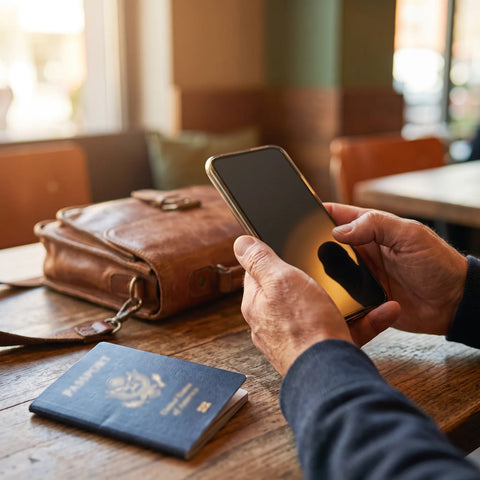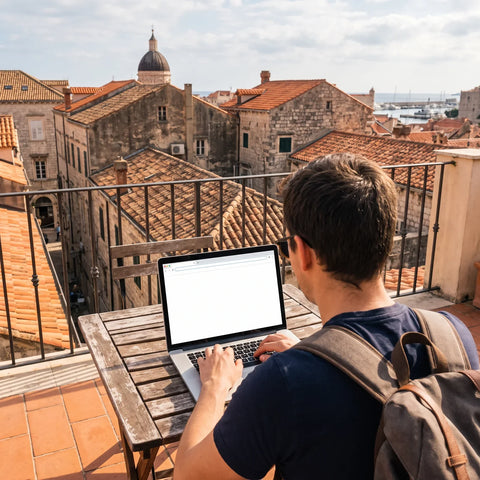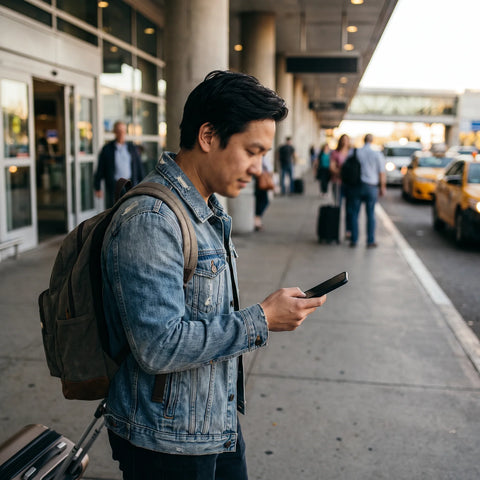
In short: an eSIM for Seville gives you mobile internet from the minute you land in San Pablo, without expensive roaming or searching for Wi-Fi. You install it before leaving home with your QR code, activate data upon arrival, and browse with 4G/5G throughout the city. For three or four days of tourism, 3 to 5 GB is enough.
You land, you want to hail a taxi, open the map to your downtown hotel, and let people know you've arrived safely. With an eSIM for Seville, you'll have internet instantly: no fumbling for the terminal's Wi-Fi or praying your carrier doesn't hit you with roaming charges. You land with internet, no roaming, no stress. In this guide, we'll tell you how to get connected as a tourist, what coverage you'll find, how much data you'll actually use between tapas, and the details almost no one tells you before traveling to the Andalusian capital.
What is an eSIM and why it's useful for Seville
An eSIM is a digital SIM that is already integrated into your phone. Instead of inserting a plastic card, you install a profile by scanning a QR code, and you're done. There's no need to go to a store, no waiting for deliveries, and you don't have to lose your home SIM card: modern phones work with dual SIMs, so you can keep your usual number and, at the same time, have Spanish data for your trip.
For a getaway to Seville, this means something very specific: you arrive with internet already working, and your usual number remains available on the main SIM for bank SMS or important calls. If you want to understand the technology in depth, we explain it in what an eSIM is and how it works. And if you have doubts about whether your phone supports it, the short answer is that most iPhones since the XS and a good number of recent mid-to-high-end Android phones are compatible.
How to get internet in Seville as soon as you land
The cleanest way is to install a Spanish eSIM before leaving home. You receive the QR by email, scan it while connected to your Wi-Fi, and leave the profile ready. Upon landing at San Pablo airport, you activate the data and connect to the Spanish mobile network in seconds. The entire installation process takes barely a minute and requires no fiddling with settings.
This is especially convenient if you are coming from outside the European Union, where your carrier's roaming charges can skyrocket. With an eSIM, you arrive connected and don't have to worry about the bill. If you are coming from another EU country, your plan already includes roaming in Spain without surcharge, although many travelers still prefer an eSIM so as not to use up their usual data allowance. Once you have the profile installed, you only have one step left on your travel day: turn on the eSIM's mobile data when you get off the plane.

eSIM coverage and speed in Seville
Seville has excellent mobile coverage. The eSIM relies on major Spanish operators—Movistar, Orange, and Vodafone—so in the historic center and tourist areas, you'll have plenty of 4G and much of 5G for maps, social media, and uninterrupted video calls. In practice, a tourist won't notice any difference from their home connection.
The signal is strong in the old town, Triana, the Cathedral, the Real Alcázar, and Plaza de España, as well as at the airport and Santa Justa station. Only in the basements of very thick monuments or in some stone courtyards might it falter for a moment, which is normal in any historic city. For the rest of your route through Andalusia—Granada, Cordoba, Cadiz—the same Spanish eSIM will work, as it covers the entire national territory. It's the same one you would use in Madrid or any other city if your trip continues through the country.
How much data does a tourist need in Seville?
This is the main question, and the good news is that urban tourism consumes less than people think. For a three or four-day getaway with normal tourist use —maps, photos, social media, looking for restaurants, a few video calls— 3 to 5 GB is more than enough. If you stream videos, broadcast on Instagram, or share your connection with a tablet, increase it to 8-10 GB to be safe.
Here's a realistic guide based on your type of trip around the city:
| Tourist Type | Typical Use | Data / 4 days |
|---|---|---|
| Light | Maps, WhatsApp, some photos | 2-3 GB |
| Medium | + Instagram, looking for plans, video calls | 4-6 GB |
| Intensive | + video, uploading content, hotspot | 8-10 GB |
What drives up consumption the most isn't maps or WhatsApp, but video: an hour of reels or stories consumes more data than a full day of normal browsing. If you run short halfway through your trip, there's no need to buy another eSIM: you can top up your eSIM without changing numbers. And if you want to fine-tune the calculation for your specific case, you have the travel data consumption guide, with tricks to extend any plan.
eSIM vs. roaming vs. hotel Wi-Fi: which is best?
You have three real ways to connect in Seville, and not all of them are equally cost-effective. eSIM wins in terms of freedom of movement; hotel Wi-Fi ties you to the lobby; roaming can be a shock on your bill if you're coming from outside the EU. This table summarizes the differences:
| Option | Advantage | Disadvantage |
|---|---|---|
| Spanish eSIM | Internet throughout the city, fixed price in advance | Requires eSIM-compatible phone |
| Roaming | No setup, your usual plan | Can be very expensive outside the EU; check current prices with your carrier |
| Hotel Wi-Fi | No extra cost at the accommodation | Only works inside the hotel, not on the street |
| Public Wi-Fi in bars/squares | Free and occasional | Slow, saturated, and security risks on open networks |
An important nuance about roaming: if you are traveling from a European Union country, your rate includes roaming without surcharge in Spain, so you don't need anything else. But if you come from outside the EU—the UK after Brexit, America, Asia—that's where the eSIM saves you the expensive part. You can see the full comparison in eSIM vs. roaming and decide with all the facts.
Connection in Seville's tourist areas
Seville is a city meant for walking, and that's where a good connection makes all the difference compared to relying on a bar's Wi-Fi. These are the places where you'll most appreciate having your own data:
- Real Alcázar and Cathedral: Long queues, online tickets, and mobile audio guides; data saves your last-minute reservation and prevents you from queuing without a ticket.
- Plaza de España and María Luisa Park: A large outdoor area with perfect coverage for photos and orienting yourself on the map.
- Triana and its market: Ideal for looking up reviews of tapas bars on the fly so you don't risk it with the first one you see.
- Metropol Parasol (Las Setas): Tickets, walkway hours, and the best time to go up, all from your phone.
- Barrio de Santa Cruz: Narrow streets where GPS is your best friend to avoid getting lost.
If your trip continues to other Andalusian cities or elsewhere in the country, you don't need to buy anything new: the Spanish eSIM covers the entire territory, so you can go from Seville to Cádiz or Granada without touching your phone.

How to install your eSIM before your trip, step by step
The key is to get everything ready at home with your Wi-Fi so you arrive in Seville without having to configure anything. The process is straightforward:
- Check that your mobile supports eSIM (most recent iPhones and Androids do).
- Buy the Spanish eSIM and receive the QR instantly by email.
- Scan it from your phone's settings while connected to Wi-Fi: the profile installs in a minute.
- Leave the eSIM configured but do not activate its data yet.
- Upon landing in Seville, turn on the eSIM's mobile data and you're browsing.
If you get stuck at any point, the guide on how to install an eSIM details it with screenshots for iPhone and Android. The most common mistake is scanning the QR at your destination without Wi-Fi: do it at home, and you'll arrive with everything sorted.
What almost no one tells you before traveling with an eSIM to Seville
Beyond having data, there are details that make a difference and usually don't appear in guides. Here are the ones travelers actually use:
- Activate the eSIM upon landing, not before: many plans start counting from the first network connection. If you turn on data in Seville and not at your origin airport, you'll make the most of every full day.
- Download the Seville map offline: in Google Maps, you can save the area before leaving. If you go into a courtyard or basement without coverage, GPS still works, and you won't get lost.
- Be careful with hotspots in summer: sharing your connection with a tablet or laptop is convenient, but it consumes data much faster and heats up your phone. And in Seville, in August, the heat already pushes everything to its limit.
- Extreme heat affects your phone: between July and September, the city really heats up. Don't leave your phone in the sun on a terrace table; overheating reduces performance and lowers your data speed even if coverage is perfect.
- Don't delete the eSIM profile when you return: if it's refillable, you can reuse it on your next trip or top it up for another getaway in Spain without starting from scratch.
- Deactivate roaming on your main SIM: leave your home SIM only for calls and SMS, with data turned off. This ensures nothing consumes data in the background without you knowing.
A little-known extra: during the April Fair and Holy Week, with the city overflowing, mobile networks get more saturated than usual in the most crowded areas. Having your own data doesn't make you immune, but it does prevent you from fighting with the overloaded Wi-Fi of bars and casetas.
How much it costs and how to choose your plan
The price of an eSIM depends on the gigabytes and the number of days you contract, not on unpredictable daily roaming. That's precisely its charm: you pay a fixed amount before traveling and know exactly what you'll spend, with no surprises on your bill when you return. To compare amounts, stick to the simple rule in this guide: 3-5 GB for a short, relaxed tourist getaway, and 8-10 GB if you're into video and sharing your connection.
If, in addition to Seville, you plan to travel through several European countries on the same trip, an eSIM for Europe that covers dozens of destinations with a single plan might be more suitable. But if your trip is only within Spain, the logical and most economical option is the eSIM for Spain. Always check the current price on the product page before purchasing, as rates are updated.
Frequently asked questions
Do I need an eSIM in Seville if I come from the European Union?
It's not essential. If your plan is from an EU country, roaming in Spain is included without surcharge. The eSIM is especially interesting for those coming from outside the EU, those who want to separate their travel data from their home number, or those who prefer not to use their usual data allowance during their getaway.
Does the eSIM work at Seville airport as soon as I land?
Yes. As soon as you activate the eSIM's data at San Pablo airport, it connects to the Spanish network, and you'll have internet to hail a taxi or open a map. You don't need the terminal's Wi-Fi or to buy anything there, as long as you've installed the profile before leaving home.
Can I use the same eSIM in the rest of Spain?
Absolutely. The eSIM is for Spain, not just Seville, so it works just as well in Granada, Cordoba, Cadiz, Madrid, or wherever your route takes you. A single plan covers the entire country without changing anything or buying a second profile.
Do I keep my number and WhatsApp with the eSIM?
Yes. The eSIM only provides data; your number and WhatsApp remain linked to your main SIM, which you can keep active in parallel thanks to dual SIM. You browse with the eSIM and continue to receive your usual messages and codes normally.
How much data do I actually use in four days of tourism?
For normal use of maps, photos, social media, and some video calls, between 3 and 5 GB is more than enough for a three or four-day getaway. If you consume a lot of video or share your connection, estimate 8-10 GB to be safe without running out halfway through.
What happens if I run out of data halfway through my trip?
You don't need to buy a new eSIM. If your plan is reloadable, you can add more gigabytes from your phone and continue with the same profile and number, without reinstalling anything. It takes a couple of minutes, and you keep browsing.
Is eSIM better than hotel Wi-Fi?
Hotel Wi-Fi is fine for the time you spend in your room, but it ties you to the accommodation. An eSIM gives you internet on the street, at monuments, and in tapas bars, which is where you really need it to navigate, make reservations, or look for plans on the fly. The ideal is to combine both: hotel for large downloads and eSIM for daily use.
Conclusion
Enjoying Seville without worrying about connectivity is easier than it seems: install the eSIM at home, activate it upon landing, and explore the Cathedral, Triana, and Santa Cruz with your own internet. It's more cost-effective than roaming from outside the EU, doesn't tie you to hotel Wi-Fi, and prevents bill surprises. Land with data already working thanks to PuraSIM's Spain eSIM and dedicate your trip to tapas and the Guadalquivir, not searching for a signal.