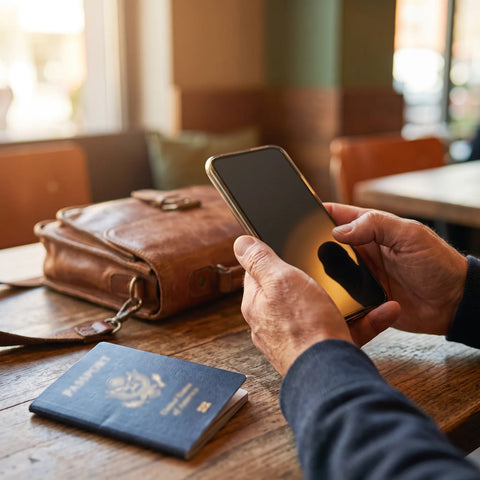
In short: The Hong Kong eSIM gives you internet as soon as you land at Chek Lap Kok, with 5G coverage throughout the city—island, Kowloon, and even inside the MTR—supported by local networks. For a 3-4 day getaway, 5-7 GB is more than enough, and you keep your Spanish number for calls while browsing with the local plan.
Landing in Hong Kong and leaving the terminal already connected, without searching for stores or waiting in lines: that's what an eSIM for Hong Kong gives you. In such a vertical and fast-paced city, having data from minute one is key to getting around on the MTR, hailing a taxi, or translating a menu in Mong Kok. In this guide, you'll see the actual coverage, local operators, how much data to bring, and how to connect as soon as you step foot in the airport.
Do I need an eSIM in Hong Kong?
Yes, if you want to get around easily. Hong Kong has public Wi-Fi in many places, but relying on it ties you to cafes and shopping malls. With an eSIM, you always have data: real-time maps, transport apps, menu translation, and taxis with a tap, from the minute you land.
An eSIM helps you avoid roaming, which can be very expensive with many Spanish operators outside the EU — here's the real difference between eSIM and roaming — and saves you from queuing to buy a physical SIM at the airport. You install it before leaving home, it activates in 1 minute, and you keep your Spanish number for calls while browsing with the local plan. In a city where the MTR and map apps are your compass, being always connected makes the difference between enjoying your trip and getting lost. If you're combining your trip with other Asian destinations like Seoul or Busan, check out the eSIM guide for South Korea.

Coverage and operators in the city
Hong Kong is one of the cities with the best mobile coverage in the world. 4G and 5G reach almost all of Hong Kong Island, Kowloon, and the New Territories, and even work inside the MTR, which is uncommon in many metros globally.
The main operators are CSL, 3 (Three), China Mobile Hong Kong, and SmarTone, and a good eSIM relies on their networks to give you stable signal throughout the urban territory. You'll see solid coverage in tourist areas like Central, Tsim Sha Tsui, Causeway Bay, or the Peak, and also in the more local neighborhoods of Kowloon. In dense interiors like large shopping malls or skyscrapers, the signal remains good thanks to the city's infrastructure. With reliable data, you won't have to depend on hotel Wi-Fi to chat with your group on WhatsApp or make video calls home. If you're still debating between a physical and a digital card, here's the comparison international chip vs. eSIM.
Useful tip: Hong Kong's MTR has mobile coverage inside the tunnels, so you can continue checking maps or messaging while crossing the city underground.
Where the signal can be a bit weaker is on the outlying islands: in Lantau, outside the core of Tung Chung and Disneyland, there are hiking trails towards the Big Buddha with irregular coverage, and in Cheung Chau or Lamma, the network is good in the village but weakens on the more secluded beaches and coves. If you plan a day trip to these islands, download the offline map before boarding the ferry: the ferry's signal itself is usually fine, the problem appears on land, away from the pier.
Connecting from the airport
Hong Kong International Airport, in Chek Lap Kok, is about 35 km from the city center. As soon as you land, you'll want data to buy an Airport Express ticket, hail a taxi, or check how to get to your hotel, and that's where a pre-installed eSIM wins the game.
The trick is simple: install the eSIM at home with Wi-Fi and activate data right upon landing, without looking for counters or cards. As soon as you turn on your mobile after the flight, the eSIM connects to the local network and you have internet to get your bearings. This avoids the classic rush of leaving the terminal without a connection in a huge, unfamiliar city. If you're coming from a trip that combines Hong Kong with mainland China, things change a bit: we'll look at that in the section below.

How much data to bring
Hong Kong invites you to use your mobile: maps for the labyrinth of streets, skyline photos, transport, translation, and social networks. An average user consumes between 1 and 1.5 GB per day; if you make a lot of video calls or upload videos, it goes up to 2 GB or more. For a 4-5 day getaway, 5 to 10 GB is usually more than enough.
| Trip duration | Average usage | Recommended data |
|---|---|---|
| Short trip (3-4 days) | 1-1.5 GB/day | 5-7 GB |
| Full week | 1-1.5 GB/day | 10-15 GB |
| Intensive use (video, social media) | 2+ GB/day | Larger GB or unlimited plan |
If you run out, the advantage of an eSIM is that you can top up on the go without changing cards. To stretch your GBs without getting stranded halfway through your trip, check out these tips for saving data with your eSIM while traveling.
Hong Kong and mainland China
There's an important nuance here. Hong Kong is a special administrative region with open internet: Google, WhatsApp, Instagram, and the apps you use daily work normally. In mainland China, however, many of these apps are blocked by the Great Firewall.
If your trip combines Hong Kong with Shenzhen, Canton, or other Chinese cities, you'll need a plan that covers both territories and often routes traffic outside of China to bypass the blockade; in that case, consult a specific plan designed for China in advance. If you're only staying in Hong Kong, you won't have any restrictions and your apps will work as usual. You can view the plans and coverage for the Hong Kong eSIM for your trip.
Tips for staying connected on the go
Hong Kong is best enjoyed if you master a couple of tricks with your connection. The city is vertical, dense, and fast-paced, so your mobile is your best ally for not wasting time.
- Download the offline map of the island and Kowloon in case you enter an area with weaker signal.
- Use transport apps for the MTR, trams (the famous "ding ding"), and the Star Ferry.
- Activate camera translation for Cantonese menus in the most authentic local eateries.
- Share your real-time location with your group in crowded areas like night markets.
With data always available, you can improvise: change plans on the fly, find the best dim sum in the neighborhood, or head up to the Peak just as the sky clears. That flexibility is what makes a good data plan so noticeable in a city like this.
How to install and activate the eSIM
The process is straightforward: you buy online, receive the QR by email, scan it from your phone's settings, and in 1 minute the eSIM is installed. Activate data only upon landing in Hong Kong, so that the validity period begins at the exact right moment.
Before you leave, confirm that your mobile is eSIM-compatible —most iPhones from XS onwards and modern Androids are— and review the step-by-step guide on how to install an eSIM. Install it at home with Wi-Fi and at your leisure, keep your Spanish SIM for calls, and reserve the eSIM for data. That way, you'll leave Chek Lap Kok with your internet sorted and your mind set on exploring the city.
Myths and what almost no one tells you about eSIM in Hong Kong
There are recurring misconceptions that pop up trip after trip. The first: thinking that the Octopus card (the city's transport and payment card) replaces data connectivity. This is not the case: the Octopus card is for the MTR, trams, ferries, or paying in convenience stores, but it doesn't give you a single megabyte of internet. They are two independent things, and you need both.
Another common myth is believing that you need to leave your Spanish operator's roaming activated for the eSIM to work. It's the other way around: if you leave your physical SIM's data roaming on, your phone might jump to that network as soon as the eSIM signal fluctuates for an instant, and that's when surprise charges come in. Disable data roaming on your Spanish line as soon as you land and only leave the eSIM's data active; to understand the difference well, here's the explanation of what data roaming is.
In shopping centers like IFC Mall or Elements, with multiple concrete floors and basements connected to the MTR, GPS sometimes loses accuracy and places you a floor above or below reality: trust the metro exit numbers more than the blue dot on the map. And if you travel during typhoon season —between May and October, with July and August among the most active months—, data connection is the fastest way to check the current warning signal and know if transport is still operational, so don't deactivate it even if the sky is clear in the morning.
A final honest recommendation: if you're only transiting through Chek Lap Kok airport without going into the city, you don't need to activate the eSIM yet —the free Wi-Fi in the terminal is usually enough for those hours— and thus you make better use of the plan's validity for when you're actually exploring Hong Kong. And if you're going to do any banking transactions using public Wi-Fi in a shopping center or hotel, it's better to use your own connection: here's why in the guide on privacy and VPN when traveling.
Frequently asked questions
Do WhatsApp and Google work in Hong Kong?
Yes. Hong Kong has open internet, so WhatsApp, Google, Instagram, and the apps you use daily work normally. The Great Firewall blockade only affects mainland China, not Hong Kong. If you combine both destinations, you'll need a plan designed to bypass that blockade in the Chinese part.
Is there coverage inside the MTR?
Yes, and it's one of its advantages. Hong Kong's metro offers mobile coverage inside the tunnels, which is uncommon globally. You'll be able to continue checking maps, transport, or messaging while crossing the city underground, without losing communication between stations.
How much data do I need for a getaway to Hong Kong?
For 3-4 days of average use, 5-7 GB is usually enough: maps, transport, photos, and messaging. If you watch a lot of video or make video calls, opt for a larger GB or unlimited plan. With an eSIM, you can top up on the go if you run out.
Can I use the same eSIM in Hong Kong and mainland China?
You need a plan that covers both territories and ideally routes traffic outside of China, because many apps are blocked in mainland China. For Hong Kong alone, there are no restrictions. Check a specific plan if your route includes cities like Shenzhen or Canton.
Do I lose my Spanish number when using an eSIM in Hong Kong?
No. The eSIM is used only for data, while your Spanish SIM remains active for calls and SMS with your usual number. This is the recommended setup: you browse with the local Hong Kong plan and remain reachable on your usual number.
Do I need to disable roaming from my Spanish operator in Hong Kong?
Yes, it's highly recommended. Leave your physical SIM's data roaming turned off and only use the eSIM for browsing; this prevents your phone from switching to your Spanish operator's network and incurring unexpected roaming charges. Calls and SMS with your number will still work as usual.
Does the Octopus card also provide internet connection?
No. The Octopus card is for paying public transport and purchases in convenience stores; it does not include mobile data. You need an eSIM (or a local SIM) to have internet; they are two distinct tools that complement each other during your trip.
Conclusion
Hong Kong is a city to experience while connected: MTR, maps, translation, and taxis at your fingertips from the moment you land. With an eSIM, you'll have data from Chek Lap Kok, solid coverage throughout the city (including the metro), and your Spanish number intact for calls. Prepare your Hong Kong eSIM with PuraSIM and leave the terminal already connected to explore the skyline without losing a second.