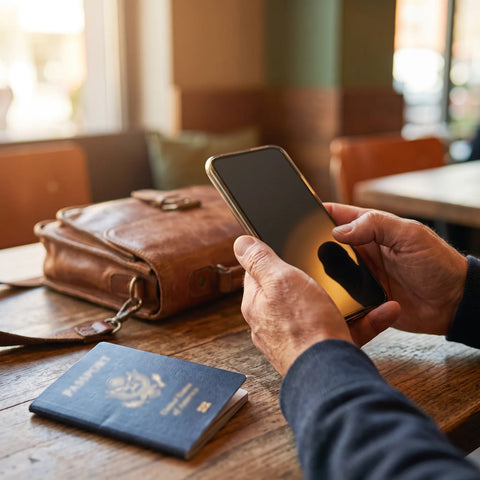
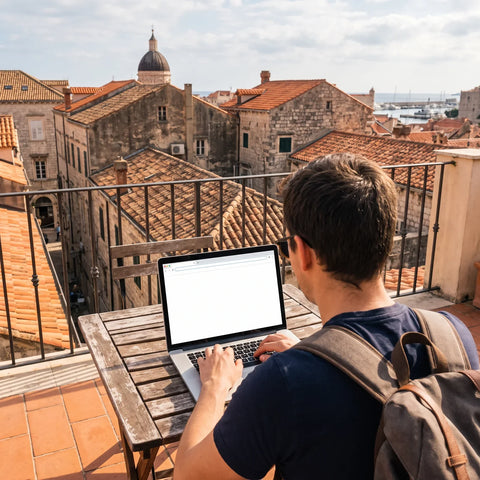
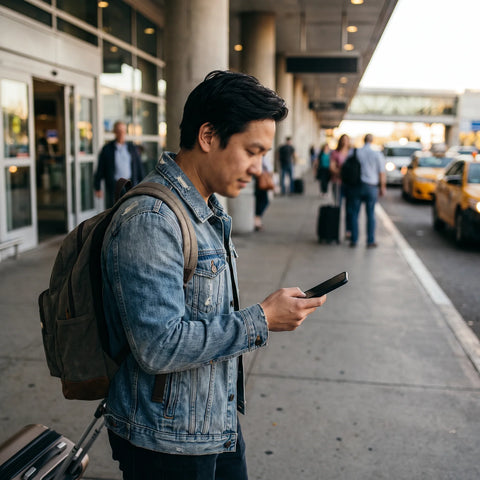
In short: an eSIM for backpackers is not a single card that works all over the world, but rather a strategy: buy data by region or country as your trip progresses, activate it as soon as you land, and combine it with hostel Wi-Fi. With PuraSIM, you can have local internet from minute one in each destination, without expensive roaming and without searching for a physical SIM card store with your backpack on.
If you're planning a long trip – South America from end to end, Southeast Asia on a shoestring budget, an Interrail across Europe, or a multi-month round-the-world journey – connectivity stops being a detail and becomes travel logistics. It's not the same to sort out an eSIM for a weekend in Lisbon as it is for eight countries in four months. This guide is about that: how to organize your mobile data when your itinerary changes countries every few weeks.
What an eSIM for backpackers is (and isn't)
An eSIM is a virtual chip installed on your phone via software, with no physical tray or card to lose. For a single-destination trip, the logic is simple: you buy the plan for that country, activate it upon arrival, and you're good to go. For a backpacking trip with multiple countries, the logic changes: you need to buy and activate a different plan each time you cross a relevant border, unless there's a regional plan that covers that block of countries.
This is important because many people look for "an eSIM that works for the entire round-the-world trip," and that single eSIM, in the literal sense, doesn't exist: each local operator or each regional plan covers a specific geographical area. What you can do is have several eSIMs installed on the same phone (most modern smartphones support multiple profiles, although only one or two active at a time) and activate the appropriate one depending on which country you are in.
How to set up connectivity for a long backpacking trip
The typical mistake is to leave everything until the last minute and buy the eSIM at the departure airport, in a hurry and without comparing. It works better if you treat it as just another part of itinerary planning, on the same level as domestic flights or travel insurance.
Before leaving home
- Outline your itinerary by country or region blocks (e.g., "Peru-Bolivia-Chile" as one block, "Southeast Asia" as another).
- For each block, decide whether a regional plan is worthwhile or if you will buy country-by-country as you go, depending on how much time you spend in each.
- Install at least the first eSIM for your trip in advance by scanning the QR code you receive via email; set it up but leave it inactive.
- Confirm that your phone supports eSIM and, if it's a physical dual SIM + eSIM, decide which line you'll use for calls/SMS from your Spanish number and which for data.
- Download offline maps for the first cities on your route. On backpacking routes with rural stages (Altiplano, jungle, multi-day treks), an offline map is not optional, it's the only one you'll have.
In each new country
- Before landing (or getting off the bus, if crossing a land border), activate the corresponding eSIM for that country or region as your data line.
- Check that data roaming is enabled within the settings for that specific eSIM.
- Test the connection by opening any website before moving from the entry point, so you can detect any problems while you still have backup Wi-Fi nearby.
- If it doesn't connect, manually select the network in mobile data settings instead of leaving it on automatic: in border areas, it's common for the phone to try to connect to the network of the neighboring country.
You repeat this second block every time you change countries. With practice, by the third or fourth border, you'll be doing it on the bus without thinking. You can see how the installation is done step-by-step, with screenshots, in our eSIM installation guide.
Which eSIM to buy depending on your route segment
Not all regions are handled the same way. This is where you really notice whether you've planned well or if you'll be renewing data every three days:
| Route segment | How it's usually best resolved | What to watch out for |
|---|---|---|
| South America (Peru, Bolivia, Chile, Argentina...) | Country-specific plan if each stage lasts weeks; useful if your route goes through Peru on the way to Machu Picchu or through Colombia between Medellín, Bogotá, and Cartagena | In the Altiplano and trekking areas, any operator's coverage drops; don't count on 100% uptime |
| Southeast Asia (Thailand, Vietnam, Indonesia...) | Country-specific plan; things change quickly and frequent land borders are common on classic backpacking routes | Islands and diving areas usually have worse signal than capitals |
| Europe (Interrail, Erasmus, city-hopping) | If you are a resident in Spain and travel within the EU, your own tariff usually covers you for roaming; for trips outside the EU (UK, non-EU Balkans), a specific plan is advisable | Don't buy an unnecessary eSIM if your Spanish operator already covers that area at no extra cost |
| Oceania (Australia, New Zealand) | Specific regional plan; distances between cities are large and traditional roaming is usually expensive | Outside coastal areas and touristy interiors, coverage becomes spotty |
You can compare the plan for Chile or for Europe depending on the segment you need. And if your route mixes backpacking with a work or study stop in the United States, the eSIM for the United States plan solves that part without relying on a local operator.
How long does data last if you're changing countries every few weeks?
This is where the most doubts arise on long trips. The validity of most plans begins counting from the first data usage, not from when you install the eSIM or activate it offline. This means you can install the profile for your next country in advance, without any days being used, and activate it on the same day you land or cross the border.
This significantly changes how you plan your GB: don't buy a 30-day plan for a country where you'll only be for 10 days, because unused data doesn't transfer to the next destination. It's better to calculate by actual stay blocks and allow for transit days, where you tend to use more data than usual (buying tickets, finding last-minute accommodation, solving unforeseen issues).
If you run out of data in the middle of a country, you can buy a top-up or a new plan from the client area; it applies in minutes and you don't have to reinstall anything.
Apps that real backpackers use with active data
No need for the usual long list. These are the ones that make a real difference on the road:
- Maps.me or Google Maps offline: download the map of each new city as soon as you arrive, using Wi-Fi, before moving. On rural or trekking routes, it's your only safety net if you run out of data.
- Google Translate with camera: essential in countries where the alphabet isn't Latin; offline mode works if you download the language pack before you need it.
- WhatsApp: for coordinating with other backpackers you meet along the way and for reassuring family without spending on international calls.
- Local transport apps: in many cities, these work better than negotiating with taxi drivers on the street, although in very rural areas they simply don't exist and you'll revert to the traditional method.
- Your bank: check before you leave if your app requires SMS verification from your Spanish number; if your voice line loses coverage in some country, that verification might fail exactly when you need it most.
On how to stretch that data for several days or weeks, we have a specific guide with tricks to save eSIM data on a trip that complements what you see here well.
What almost no one tells you before you hit the road
This is what you learn from scares, not from reading brochures:
- Not all dual eSIM smartphones work the same way. Some models allow two eSIMs to be active at the same time, others only one active even if you have several installed. Check this for your specific model before buying plans for the whole trip, because if you can only have one active, you need to deactivate the previous one before activating the new one.
- Crossing a land border is not like landing at an airport. There isn't that clear "I've arrived, activate the eSIM" moment. On overland routes (Bolivia-Chile, Thailand-Cambodia), it's advisable to activate the new profile a little before reaching the border post, when you still have coverage from the previous country, to check that everything is configured correctly.
- SMS verification can leave you stranded. Many apps and hostel Wi-Fi networks ask for a code via SMS to a local number. If you only have data and not a voice/SMS line from the country, you won't be able to receive that code. Always carry an alternative: email as a verification method, or an authentication app.
- Hostel Wi-Fi is, in general, the weak link. Shared among dozens of people, it gets saturated at night when everyone is making video calls at once. Don't count on it for anything urgent; that's what your data is for.
- A phone locked by the original operator can cause problems with eSIM. If your mobile is "unlocked" only for the Spanish operator that sold it to you, check before leaving that it supports third-party eSIM profiles without restrictions.
- Altitude and jungle are unforgiving. In Andean trekking sections above 4,000 meters or in deep jungle, no operator—local or eSIM—has decent coverage. It's antenna physics, not a card problem. Accept it and prepare with offline maps and, if the trek is serious, consider a separate satellite device.
WiFi vs. data: how to distribute them on a long trip
With months of travel ahead, spending eSIM data on anything you can do with Wi-Fi is throwing away money on unnecessary top-ups. Distribute it this way:
Leave for hostel or cafe Wi-Fi:
- Uploading photos and videos to the cloud
- Operating system and app updates
- Downloading maps and offline content for the next leg
- Long video calls
Reserve your mobile data for:
- Real-time navigation on the street
- Messaging and daily coordination
- Buying last-minute transport tickets
- Any urgent task when there's no Wi-Fi nearby (which happens more often than you think on a backpacking trip)
When you DON'T need to buy a new eSIM
Here we need to be honest, because it's not always worth it: if you live in Spain and your route includes a short segment through another European Union country, your own national tariff probably already covers you for roaming at no extra cost, according to your operator's "Roam like at Home" conditions. Buying an additional eSIM there would be spending twice for the same thing. Check with your operator before adding a plan you don't need.
Nor is it necessary if you're only spending a couple of days in transit at an airport with good Wi-Fi before continuing your journey, or if your accommodation and all your plans for those 48 hours are covered by a fixed connection. Where it clearly pays off is on long segments, outside the EU, or in countries where your Spanish operator's roaming costs skyrocket as soon as you leave Europe.
Frequently asked questions about eSIM for backpackers
Can I have several eSIMs from different countries installed on my phone at the same time?
Yes, most modern smartphones allow you to store several installed eSIM profiles, although the number of simultaneously active profiles depends on the model (some only allow one active, others two). You can install the next country's eSIM before you need it and activate it when it's time, without it consuming validity until the first data use.
What happens if my route changes on the fly and I don't buy the correct country plan in advance?
Nothing serious happens: you can buy the plan for the new destination from your mobile at the moment you decide to change, as long as you have some connection (hostel Wi-Fi or terminal Wi-Fi) to complete the purchase and install the QR.
Do I need a different eSIM for each country, or are there plans that cover several countries at once?
It depends on the region: in some geographical blocks, there are plans that cover several neighboring countries with the same profile, while in other cases it is more worthwhile to buy by country depending on how long you spend in each. Compare it segment by segment instead of assuming that a single plan will work for your entire round-the-world trip.
Does eSIM work equally well in rural areas as in capitals?
Not always. Coverage depends on the antennas of the local operator that each plan works with, and in mountain, jungle, or desert areas, the signal of any operator—eSIM or physical—is weaker or nonexistent. For such sections, an offline map is not an extra, it is the basis.
Can I use the eSIM as a hotspot to share data with another backpacker or with my laptop?
Yes, you can activate the personal hotspot and share your connection with other devices. Keep in mind that a hotspot consumes data faster, so if you're going to share it with more people throughout the trip, calculate more GB than you would use alone.
Is it safer to use my mobile data than hostel Wi-Fi for things like online banking?
Yes, generally. Shared hostel Wi-Fi is an open network with dozens of strangers on it, which facilitates data interception. Your mobile data connection via eSIM is a more isolated channel. For banking or payments, always prioritize mobile data over public Wi-Fi, wherever you are.
When does the plan's validity start counting if I install it before arriving in the country?
In most plans, validity starts counting from the first actual use of data, not from installation or from activating the eSIM offline. You can set it up in advance without fear of losing days from your plan.
Prepare the eSIM for your next country before you move and land connected at every stage of your route.
View eSIM plans →