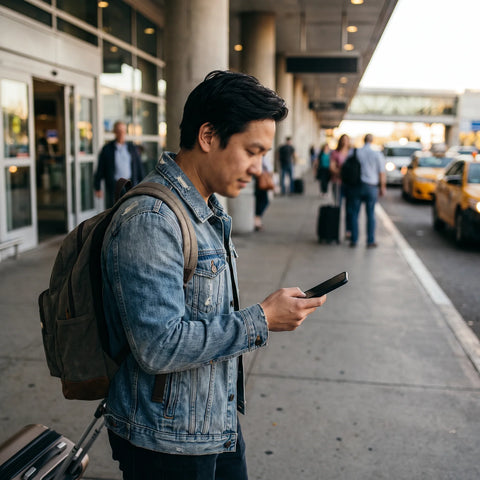
In summary: an eSIM for African safari trips gives you data coverage in Nairobi, Cape Town, Arusha, and other hotspots, but inside the parks (Masai Mara, Serengeti, Kruger, Okavango), the signal depends on the local operator and is usually intermittent or non-existent. Activate it before you leave and estimate a small number of GBs: there's almost no network in the park.

A safari is not an urban trip. You spend hours on dirt tracks, among acacias and herds of zebras, far from the nearest cell tower. And yet, before and after each day of driving, you usually return to a lodge, a camp, or a transit city where you do want data: to upload the leopard photo, confirm the next day's reservation, or simply write home. This is where an eSIM for African safari trips comes in: it doesn't promise coverage in the middle of the savannah, but it does solve your needs in the areas where you'll really need it.
This guide focuses specifically on the logic of a safari — Kenya, Tanzania, South Africa, and Botswana as the four classic destinations — and not on general coverage for Africa as a continent. If your route goes beyond a safari (Morocco, Egypt, extended urban South Africa, several countries), you might be more interested in the PuraSIM Africa eSIM, designed for broad coverage across the entire continent.
How coverage actually works on a safari
The first idea to let go of is that a safari has "coverage" in the sense we understand it in a European city. It has stretches with coverage and stretches without, and these usually alternate several times a day. Mobile networks in sub-Saharan Africa have been deployed following population density: main roads, cities, market towns. National parks, by definition, are protected areas with little to no human infrastructure — so antennas are scarce or simply non-existent within park limits.
What you will find with relative reliability:
- Entry cities: Nairobi, Arusha, Cape Town, Johannesburg, Maun. Solid 4G coverage, sometimes 5G in South Africa.
- Main roads between parks: intermittent coverage, with stretches of several kilometers without signal.
- Park gates and centers: there is usually at least one nearby antenna, even if the signal is weak.
- High-end lodges: private WiFi, often via satellite, independent of the operator's network.
- Inside the park, game drive areas: very limited or non-existent coverage. This is normal, not a flaw in your eSIM.
If you've been comparing prices for eSIM vs. roaming, the difference on a safari is less dramatic than in a European capital, simply because there's less network to utilize. Still, in city and main road sections, your Spanish operator's roaming can exceed several euros a day in data, while a local or regional eSIM is usually considerably cheaper for the same consumption — it's worth checking the details before deciding.
Coverage by park: what you'll find on the ground
Masai Mara (Kenya)
This is probably the park with the best relative coverage among the four major safari destinations. Safaricom has antennas near the main camp and several access tracks, so there's usually a signal, albeit weak, around the "Mara Triangle" and near Talek. In the more interior areas of the park, towards the south, the signal easily disappears.
Serengeti and Ngorongoro (Tanzania)
Arusha, the usual starting point, has very good urban coverage. Within the Serengeti, coverage is much scarcer than in the Masai Mara: Tanzanian operators have deployed less infrastructure in the park. Airtel Tanzania usually has a bit more reach than other operators in this specific area, so if you have the option to choose a network, it's the best performing one.
Kruger and surroundings (South Africa)
South Africa has, by far, the most developed mobile infrastructure of the four countries. Vodacom and MTN cover the Kruger's entry gates (Skukuza, Numbi) and a good portion of the park's internal camps, which are better equipped than those in Kenya or Tanzania. Still, in the adjacent private areas (Sabi Sands, Timbavati), coverage becomes irregular again.
Okavango Delta and Chobe (Botswana)
This is the destination with the least coverage of the four. The Okavango Delta is largely explored by mokoro (traditional canoe) or light aircraft, and many camps are deliberately isolated. Here, connectivity, if it exists, usually comes from the lodge's own satellite WiFi and not from the mobile network. This is the scenario where it's best to assume you'll be disconnected for much of the day.
| Operator | Country | Coverage outside cities | eSIM compatible |
|---|---|---|---|
| Safaricom | Kenya | Good at park gates, weak inside | Yes |
| Airtel Africa | Kenya / Tanzania | Adequate near the Serengeti | Yes |
| Vodacom | South Africa | Good, includes parts of Kruger | Yes |
| MTN | South Africa / others | Good in urban and access areas | Yes |
Qualitative indicative assessment by operator and area. Actual coverage may vary depending on the lodge, season, and terrain conditions — do not treat it as a guarantee.
How many GB do you need for a safari?
This is the most common miscalculation: people buy the same data plan they would use in a city and end up with half of it unused. On a typical 7- to 14-day safari, much of the time is spent without useful coverage, so actual data consumption is much lower than on an equivalent urban trip.
| Safari duration | Approximate GB | Usage profile |
|---|---|---|
| 5–7 days | 5–8 GB | One country, city + park |
| 10–14 days | 8–15 GB | Kenya or Tanzania, several parks |
| 15–21 days | 15–20 GB | Double destination (e.g., Kenya + Tanzania) |
If you're also extending your trip to South African cities with more remote work days, high-resolution photo uploads, or video calls, then bump it up a notch. And if your itinerary includes stretches with a lot of downtime on the road or internal flights, don't bump it up: you simply won't consume data during that time.
When and how to activate your eSIM before your safari
The recommendation is always the same, safari or not: install the eSIM profile from home, using WiFi, before you leave. On a safari trip, this makes even more sense, because the first contact with the network is usually the arrival airport — Jomo Kenyatta in Nairobi, Kilimanjaro in Tanzania, OR Tambo in Johannesburg — and you want to have Maps, WhatsApp, and your tour operator's voucher ready as soon as you land, not wasting ten minutes looking for WiFi in the terminal.
- Purchase the eSIM at purasim.com before traveling.
- Install the profile (QR or direct installation) using your home WiFi.
- Keep the line deactivated until the day of your flight.
- Upon landing, activate data from Settings → Mobile Data → select the eSIM line.
- Save offline maps of the parks you'll visit, just in case: on a safari, an offline map is your real safety net.
If you've never installed an eSIM, it's a good idea to review the step-by-step process beforehand — we explain it in detail in how to install an eSIM, and it takes no more than five minutes.
eSIM, roaming, or local SIM: what's best for a safari?
In safari destinations, where you'll spend a lot of time without network, the decision isn't as simple as "the cheapest." You also have to consider how much time you want to spend managing your connection in a country where you probably won't have much leeway for procedures — between early morning game drives, internal flights, and transfers, the last priority is waiting in line at a phone store.
| Option | Approximate cost | Management | Recommended for safari |
|---|---|---|---|
| Roaming from Spanish operator | Can exceed several euros/day for data | No management, but surprise bill | Only if you'll barely use data |
| Local physical SIM | Local price, variable by operator | Requires physical store and passport | Complicated if traveling directly from airport to park |
| PuraSIM eSIM | Check current price at purasim.com | 100% digital, activation before departure | Yes, especially for itineraries with little leeway |
If you want to better understand why traditional roaming is still so expensive outside the European Union, we have a complete explanation in what is data roaming. And if you're deciding between buying a physical SIM at the airport or sorting it out with an eSIM before you leave, the comparison of international chip vs. eSIM will help you decide based on your specific situation.
Common mistakes and what almost no one tells you
After seeing safari itineraries again and again, there are recurring patterns. These are the ones that really make a difference:
Buying too many GB "just in case"
This is the most common and most expensive mistake. On a safari, the bottleneck isn't GB, it's the lack of network. Oversizing your plan only makes you pay more for data you'll never be able to consume inside the park.
Not telling your guide that you need coverage at a specific moment
Safari guides know the terrain better than any coverage map. If you need to make an important call or confirm a flight, tell them — many know exactly where on the track there's a signal and can stop the vehicle there for a couple of minutes.
Trusting lodge WiFi without checking beforehand
Not all "WiFi available" listed in your reservation means the same thing. Some lodges have satellite WiFi only in common areas, not in tents or cabins. Explicitly ask if there's WiFi in your specific accommodation before assuming you'll be able to work from bed.
Forgetting airplane mode with data on in the safari vehicle
Constantly searching for a signal in areas without coverage drains the battery at top speed — just when you need it most for photography. In stretches where you know there won't be a network, activate airplane mode and save battery for when you return to a point with a signal.
Not downloading offline maps before leaving the city
This is the least costly precaution and provides the most peace of mind. Download the park area on Google Maps or Maps.me with WiFi before leaving Nairobi, Arusha, or Johannesburg. That way, even if your eSIM has no signal in that section, you still know where you are.
Thinking that "regional Africa eSIM" covers all countries equally
Not all regional coverage is uniform: some plans perform better in South Africa than in Kenya, or vice versa, depending on roaming agreements with each local operator. If your safari combines several countries, it's worth checking which networks the plan actually includes before buying, not just the number of countries listed in the name.
If your route continues beyond the safari
Many travelers combine a safari with a stopover in another part of Africa or link several destinations on the continent. If your itinerary includes Indian Ocean countries like Comoros, or if your route extends towards the Middle East, you might be interested in the Middle East and Africa eSIM, with broader regional coverage than a single-country plan.
One final practical recommendation: on long journeys with limited GBs available, applying some tricks to save data with your eSIM — disabling automatic app updates, lowering photo upload quality, limiting streaming — greatly extends the plan, especially on city days when consumption is highest.
Conclusion
An eSIM for African safari trips won't give you coverage in the middle of the Serengeti, and no serious provider should promise you that. What it does give you is reliable connection in the areas where you truly need it: airports, entry cities, main roads, and many lodges. Activate it before you leave, calculate a small amount of GBs, and accept that the rest of the time, the best data plan is to look out the window.
Frequently asked questions
Is there mobile coverage inside national safari parks?
It depends on the park and the specific area. Near entry gates and main camps, there's usually some signal; deeper inside, especially in more remote game drive areas, coverage often disappears. This is the norm, not an exception.
Which eSIM works best on a safari in Kenya and Tanzania?
A plan that includes Safaricom in Kenya and Airtel Africa in Tanzania usually provides the best combined result, as these networks have the most presence near the access points of the Masai Mara and Serengeti, respectively.
Do I need a lot of GB for a two-week safari?
No. 8–15 GB is usually enough for a 10-14 day safari, because much of the time is spent without useful coverage. Buying a plan designed for intensive urban use is usually an unnecessary expense.
Can I activate the eSIM upon arrival in Nairobi instead of before I leave?
You can, but you lose the main advantage: arriving connected from the airport. Installing the profile from home with WiFi and activating it as soon as you land avoids relying on airport WiFi and allows you to use Maps and WhatsApp from the first minute.
Do safari lodges have their own WiFi?
High-end ones usually have WiFi, often via satellite, independent of the mobile operator's network. Simpler camps or those in very remote areas, like the interior of the Okavango Delta, may not have any connection. It's advisable to ask when making your reservation.
Is an eSIM worth it compared to roaming from my Spanish operator on a safari?
In cities and on main roads, yes: roaming outside the European Union can exceed several euros a day for data, while a local or regional eSIM for the same area is usually considerably more economical for equivalent consumption.
What if my safari includes South Africa and Botswana on the same trip?
It's advisable to check if the plan you choose includes both networks with good coverage, as South Africa has more developed infrastructure than Botswana. If the itinerary is very international, a regional Africa eSIM usually fits better than a single-country plan.