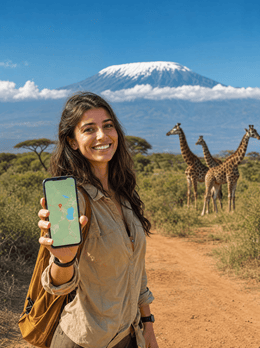
Every time someone writes to me before a safari, the same question comes up: how to get internet in Tanzania without overpaying or being stranded halfway through the trip. And it's understandable, because Tanzania blends two very different worlds: the tourist coast of Zanzibar, with good signal, and the wild interior of the Serengeti or Kilimanjaro, where your phone goes silent for hours. In this guide, I'll tell you, without jargon, all the options to get connected, where there's actual coverage, and how much data you'll need depending on your trip.
What it's like to connect to the internet in Tanzania
In Tanzania, you'll almost always connect via 4G mobile network. There are four ways: your carrier's roaming (very expensive), hotel and lodge Wi-Fi (unreliable), a local Tanzanian SIM (cheap, but requires biometric registration), and an eSIM that you activate before you fly. For most people, an eSIM is the most convenient.
The first thing to understand is that in Tanzania, fixed internet barely exists outside of offices and some hotels: almost the entire country connects via mobile. The good news is that mobile coverage has improved significantly in the last decade, and today you'll find 4G in all major cities and a good part of the coast. The bad news is that Tanzania is vast and very diverse: as soon as you move away from inhabited areas and enter national parks, the signal becomes intermittent or disappears.
For travelers, this means there's no single magic solution. In Zanzibar, Dar es Salaam, or Arusha, you'll be well connected with almost any option; on a safari, however, no card guarantees stable data, because they all rely on the same local antennas. That's why the key is not just which method you choose, but to adjust your expectations to each area of the country and have downloaded maps for sections without coverage.
Your options: roaming, Wi-Fi, local SIM, and eSIM
Before going into detail, here's a quick overview of the four real ways to connect. Each has its moment: I'd only save roaming for a specific emergency, accommodation Wi-Fi serves as a backup, a local SIM is unbeatable in price if you don't mind the paperwork, and an eSIM is the balance I recommend to most of my readers.
| Option | Approx. cost | Coverage | Ease of use | Ideal for |
|---|---|---|---|---|
| Roaming | Very high (several €/MB) | That of the local allied network | Zero configuration | Very specific emergencies |
| Hotel/lodge Wi-Fi | Included or variable | Only at the accommodation | Easy but slow | Email at night |
| Local SIM | Low | Excellent in the country | Registration with passport and fingerprint | Long stays |
| eSIM | Low-medium | Local Tanzanian networks | Activates before flying | Most travelers |
As you can see, the difference is not so much in coverage (they all use the same Tanzanian networks) as in price and the hassle of setting them up. Roaming wins in convenience and loses by a landslide in the bill. A local SIM wins in price and loses time in paperwork. The eSIM sits in the middle: cheap, no queues, and ready before you land. In the following sections, I'll break down each one so you can choose wisely.

International roaming: the most expensive option
Roaming means leaving your home carrier active and using it as is in Tanzania. It's the most convenient way—you don't configure anything—but also the one that causes the most headaches, because being outside the European Union, the regulated tariffs you enjoy within it don't apply. Here, many operators charge several euros per megabyte, so an afternoon looking at maps, uploading photos, or answering WhatsApp messages can turn into a three-figure bill before you know it.
I've seen travelers return with surcharges of hundreds of euros just for forgetting to leave their data on at the airport. That's why, if you really want to use roaming, the least you can do is call your company beforehand and contract a specific package for Africa or Tanzania; some have daily data packages that cushion the blow, although they are still expensive compared to local options.
My honest advice: reserve roaming for a real emergency and keep mobile data off by default while you look for another solution. If you want to see the numbers calmly, I explain it in detail in my comparison of eSIM vs. roaming and in the guide on how much international roaming costs, where I break down why it almost never pays off outside Europe.
Hotel and lodge Wi-Fi: when it's useful
Almost all hotels in Zanzibar, accommodations in Dar es Salaam, and many safari lodges offer Wi-Fi for guests. It's free and works well for basic needs: sending an email, making a short video call from the reception, or uploading photos at night. The problem is that it's rarely reliable on the go, and you'll be out all day, driving between parks or on the beach.
In inland lodges, Wi-Fi is usually limited to the common area (dining room, bar, or reception) and is shared among all guests via satellite, so the speed drops significantly in the late afternoon/evening, which is when everyone connects at once. It's fine for sending an "I'm okay" message; for remote work or watching a series, forget about it.
My recommendation is to treat accommodation Wi-Fi as an extra, never as your main connection. It can get you out of a bind and save you data, but you'll only rely on it for a few hours a day and in a fixed location. If you were looking for the convenience of a portable router as an alternative, I explain why it usually doesn't pay off in my comparison of eSIM vs. pocket Wi-Fi.
The local Tanzanian SIM and biometric registration
Buying a Tanzanian SIM is the cheapest option if you're staying for many days. The four main operators are Vodacom (the one with the widest general coverage), Yas (formerly Tigo, the fastest in the city), Airtel (the best in the northern parks), and Halotel (strong in Zanzibar and with low prices). The card costs less than $1 and a generous data bundle is around $7-12.
| Operator | Approx. share | Best for | Notes |
|---|---|---|---|
| Vodacom | ~32% | General coverage and safaris in the center-south | The country's most extensive network |
| Yas (formerly Tigo) | ~28% | Cities like Dar es Salaam and Arusha | The fastest 4G |
| Airtel | ~22% | Northern parks (Serengeti, Ngorongoro) | Better rural reach in Arusha |
| Halotel | ~16% | Zanzibar and budget travel | Decent 4G on the island |
The annoying part is the mandatory registration: in Tanzania, every card must be activated in your name by presenting your passport and, additionally, by providing your biometric fingerprints at the store. It's a legal process, not a whim of the seller, and it can take some queuing time at the airport or an official store. If you don't mind the paperwork and are looking for the lowest cost, go for it; if you prefer to avoid it, compare it first in my guide to eSIM vs. local SIM.
The eSIM: the option I recommend
An eSIM is a digital card that you install on your phone by scanning a QR code, without a physical part or changing your existing SIM. You buy it and have it ready before leaving home, and when you land in Dar es Salaam or Zanzibar, it connects automatically to the local Tanzanian networks. No queues, no biometric registration, no store: no losing the first afternoon of your trip sorting out your phone.
I recommend it to most travelers for three clear reasons. First, convenience: you keep your home number to receive bank SMS and use the eSIM's data for everything else. Second, cost control: you contract the gigabytes you need at a fixed price, with no surprises on your bill. And third, the peace of mind of arriving already connected to order a taxi, open a map, or notify that you've landed.
The only requirement is to have a compatible phone (almost all iPhones from the XS onwards and most recent Androids are). If you've never used one, I explain it step-by-step in what an eSIM is and how it works, and if you already know your destination, my eSIM guide for Tanzania goes into detail about plans and activation.

Coverage in Zanzibar, Dar es Salaam, and Arusha
Let's start with the good news: in tourist and urban areas, you'll be well connected. In Dar es Salaam, the large coastal city, and in Arusha, the gateway to northern safaris, there's solid 4G with almost any operator, sufficient for video calls, maps, and occasional work without complaints.
On the coast of Zanzibar, coverage is also good, especially in Stone Town and on the northern and eastern beaches where hotels are concentrated. Halotel stands out for its 4G on the island, although Vodacom and Airtel also work well. You might lose signal for a while in some isolated bungalow or on a boat trip, but in general, Zanzibar is the easiest part of the trip to stay online.
The difference between operators here is minimal, so don't obsess: any eSIM that uses the main Tanzanian networks will give you good service in these areas. The scenario changes completely when you leave the asphalt and venture into the parks, which is exactly what we'll see next. My advice is to take advantage of these points with good signal to download maps, tickets, and everything you'll need when coverage fails.
Coverage on safari: Serengeti and Ngorongoro
Here I have to be honest: in the middle of a safari, connectivity is unreliable and you shouldn't count on it. In the Serengeti, there's some signal near the main gate and in some central areas—Vodacom usually holds up best—but large expanses of the park are simply out of coverage. In the heart of the Serengeti, surrounded by wildlife, it's normal to go hours without a single bar.
In the Ngorongoro Conservation Area, something similar happens: inside the crater, the signal is very weak or nonexistent, and it improves slightly on the upper rim, where most of the lodges are located. For the northern parks, Airtel has a reputation for reaching rural areas somewhat better, while Vodacom dominates in the center and south of the country. Even so, no operator guarantees continuous data among animals.
Traveler's Tip: In the Serengeti, don't rely on your phone. Download offline maps, inform your loved ones that you'll be unreachable for a few hours, and enjoy the silence. Disconnecting is also part of the safari, and your guide will have a radio or satellite phone for any unforeseen circumstances.
With an eSIM or a local SIM, you'll have coverage in the sections where it exists, which is exactly the same as what any card offers: they all rely on the same antennas. The important thing is to plan your downloads before entering the park.
Coverage on Kilimanjaro
If your plan is to conquer the roof of Africa, connectivity works in sections and decreases as you ascend. In Moshi and Marangu, the base towns at the foot of the mountain, there is reliable 4G to prepare the route, notify your loved ones, and make final arrangements. From there, each altitude stage complicates the signal.
In practice, coverage begins to fail above Horombo Huts (around 3,720 m) and disappears during the final push to the summit. That is, you might have some data points in the lower camps—sometimes a bar surprises you in the middle of nowhere—but Kilimanjaro's summit and the final stretches are dead zones. Don't count on live-streaming your arrival at Uhuru Peak.
My recommendation for those climbing is clear: download the route profile, save emergency contacts offline, and only use data in camps where there's a signal to send a "I'm alive" message. Reputable agencies have guides who carry their own communication devices, so safety doesn't depend on your phone. An eSIM is good for your days in Moshi and for returning to civilization, but on the mountain, assume you'll be mostly disconnected.
How much data you need for your trip
The million-dollar question: how many gigabytes to buy. It depends on your profile, but as a reference, an average traveler consumes between 500 MB and 1 GB per day doing normal things (WhatsApp, maps, social media, some photos). For a week in Zanzibar plus safari, a plan of 7 to 10 GB more than covers most people, especially if you take advantage of hotel Wi-Fi at night.
| Traveler profile | Daily usage | For 10 days |
|---|---|---|
| Basic (maps, WhatsApp, messages) | 300-500 MB | 3-5 GB |
| Medium (social media, photos, some video) | 700 MB-1 GB | 7-10 GB |
| Intensive (videos, constantly active maps, tethering) | 1.5-2 GB | 15-20 GB |
Keep one detail in mind: on safari and Kilimanjaro, you'll barely use any data, because there won't be coverage to use it. Your actual consumption will be concentrated in cities and Zanzibar, so there's no need to go overboard contracting a giant plan. If you run short, you can always top up; and if you're on a tight budget, activate data only when you truly need it and rely on Wi-Fi. With an 8-10 GB plan, most of my readers finish their trip with plenty of megabytes to spare.
Frequently asked questions
Is there coverage in the Serengeti and Kilimanjaro?
Sometimes. In the Serengeti, there's some signal near the main gate and central areas, but much of the park is out of coverage. On Kilimanjaro, you have 4G in Moshi and lower camps, but above 3,720 m and on the summit, the signal disappears.
Do I need to register the local SIM with a passport and fingerprint?
Yes. In Tanzania, it is mandatory to register each card in your name by presenting your passport and providing your biometric fingerprints at the store. It's a legal process that can involve queues. An eSIM saves you this step, as it activates online before your trip without in-person registration.
Which is the best operator for a northern safari?
For northern parks, like Serengeti and Ngorongoro, Airtel generally has better rural reach, while Vodacom dominates in the center and south of the country. Even so, no operator guarantees continuous data within the parks: they all use the same antennas, and there are large dead zones.
Does my home carrier's roaming work in Tanzania?
Yes, it works, but it's expensive. Being outside the European Union, regulated tariffs do not apply, and many companies charge several euros per megabyte. Only use it for emergencies, with data turned off by default, or purchase a specific Africa bundle before you leave.
How many gigabytes of data should I contract?
An average traveler uses between 500 MB and 1 GB per day. For one or two weeks between Zanzibar and safari, a 7 to 10 GB plan is more than enough, because in the parks and mountains, there's barely any coverage to consume data. You can always top up if you run short.
Does an eSIM work throughout Tanzania the same way as a local SIM?
Yes. An eSIM relies on the same Tanzanian networks as a physical card, so you'll have coverage exactly where a local operator does. The advantage is that you install it before you travel, without queues or registration, while keeping your home number for SMS.
Is there good Wi-Fi in hotels and lodges?
In Zanzibar and cities, hotel Wi-Fi usually works well for basic needs. In safari lodges, it's limited to common areas and uses satellite, so it slows down significantly at night. It serves as a backup, never as your main connection for the trip.
Can I use the eSIM in Zanzibar too?
Yes, and it will work best there. Zanzibar has good 4G coverage in Stone Town and the tourist beaches, so your eSIM will work seamlessly for maps, photos, and video calls. You might only lose signal for a while in some very isolated accommodations or on boat excursions.
Conclusion
In summary: in Tanzania, you move between good coverage in Zanzibar and cities, and large dead zones in the Serengeti, Ngorongoro, and the summit of Kilimanjaro. Roaming is convenient but extremely expensive, hotel Wi-Fi is a backup, a local SIM is cheap but requires passport and fingerprint registration, and an eSIM is the perfect balance: you arrive connected from the moment you land, without queues and with controlled spending. Adjust your data to an 8-10 GB plan, download maps before entering the parks, and enjoy your trip. If you want to have everything ready before flying, check out PuraSIM's eSIM for Tanzania and don't worry about the connection.