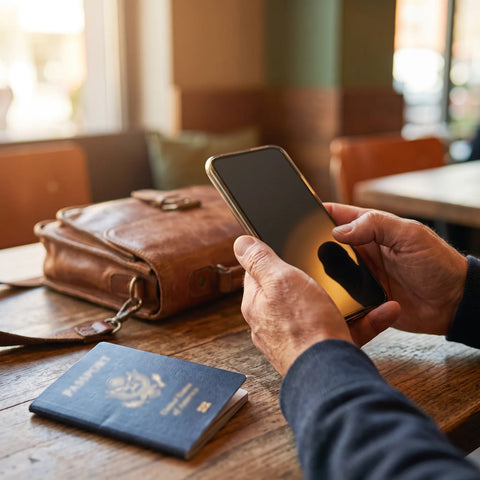
If you're planning a trip to the land of the northern lights, understanding internet in Greenland is one of those things you need to get right before you leave home, because the rules here aren't what you imagine. Although Greenland is part of the Kingdom of Denmark, your Spanish plan doesn't cover you for free like in the European Union, there's only one operator, and connection is basically limited to coastal towns. In this guide, I'll tell you, without hype, what really works and what doesn't, so you can choose with the right information and no surprises on your bill.
Your options for connecting
In Greenland, you have four options: your plan's roaming (expensive, because the country is outside the EU), hotel and ship Wi-Fi, a local Tusass SIM, and a data eSIM. The eSIM is usually the most convenient, but remember: no solution here covers the interior ice.
There's no single answer, and that's the first thing to accept. The best option depends on how you travel: someone spending four days in Nuuk doesn't need the same thing as someone embarking on a ten-day expedition cruise along the east coast. The second thing to internalize is that in Greenland, connectivity has a very low physical ceiling outside inhabited areas, so the choice matters less than you think compared to a factor you don't control: whether there's an antenna nearby or not. With those two ideas in mind, this table gives you the general picture to start deciding before delving into the details of each alternative in the following sections.
| Option | Coverage | Estimated Cost | Ideal for |
|---|---|---|---|
| Roaming (Spanish plan) | Tusass network, no price cap | Can be very expensive per MB | Emergencies and very short stays |
| Wi-Fi (hotel or ship) | Only in the building or on board | Free or included | Uploading photos and messaging at the end of the day |
| Local SIM (Tusass) | The country's only network | From €20-40 for a few GB | Long stays and unlocked mobile |
| Data eSIM | Tusass network (their partner) | From €10-20 for a few GB | Convenience and immediate activation |
Roaming in Greenland: the Danish surprise
Here's the nuance that catches almost everyone off guard. One thinks: "Greenland is Danish, and Denmark is in the EU, so I'll have my roaming included like in Copenhagen." Well, no. Greenland left the European Community in 1985 and, although it remains part of the Kingdom of Denmark, it is outside the European Union and the EEA. This means that the Roam Like At Home regulation, which makes your data work for free across Europe, does not apply here.
Practical consequence? Roaming rates in Greenland are not regulated or capped, and can be extremely high: we're talking about per-megabyte prices that can skyrocket your bill in a day if you're not careful with maps or videos. In fact, calls between Greenland and Denmark itself are counted as international. Before traveling, check your operator's customer area to see exactly what zone Greenland is in and at what price; it's almost always in the most expensive group of countries. I've compiled a comparison of eSIM vs. roaming, and if you want to be shocked by real numbers, see how much international roaming costs. Quick conclusion: leaving your phone on open roaming here is the worst possible idea.

Hotel, ship, and expedition Wi-Fi
Wi-Fi in Greenland is more important than in almost any other destination, because it's often your only stable connection. Hotels in Nuuk, Ilulissat, or Kangerlussuaq offer Wi-Fi for guests, and cafes and visitor centers usually also have a network. It's useful for the usual things: uploading daily photos, making a video call at night, or downloading maps and podcasts for the next day's excursion.
The important detail comes if you're traveling on an expedition cruise, which is how many people experience Greenland. On board, you'll depend on the ship's Wi-Fi, almost always via satellite, and that means two things: it's usually slow and often paid for separately in blocks or by data. On voyages along the east coast or in remote areas, you can go hours or days without any land connection, and the ship's satellite is all there is. So, it's good to manage expectations: Greenlandic Wi-Fi is fine for essentials, but don't count on streaming or being always available. If you're debating between using Wi-Fi, a portable router, or another option, my guide on eSIM vs. pocket Wi-Fi can help. My advice: take advantage of every network you find for heavy use and don't rely on it for GPS.
Tusass local SIM: the only operator
In Greenland, there is only one telecommunications operator: Tusass, the public company (formerly known as TELE-POST or TELE Greenland) that manages the mobile network, internet, submarine cable, and even mail. There is no competition, so the network is the same no matter what you contract; what changes is how you access it. For tourists, Tusass has a prepaid plan called Hello Greenland with data, calls, and SMS and a Greenlandic number, available in both physical card and digital format.
You can buy the physical SIM at Tusass stores in Nuuk, Sisimiut, and Ilulissat, and they will usually ask for your passport to register it, which is common in many countries. Roughly, tourist packages start around €20-40 depending on the gigabytes, although prices change, and it's best to check them on your travel day. The downside: you need an unlocked phone, physically change the card and keep yours safe without losing it, and handle the process upon arrival. For a direct comparison with the digital alternative, see my guide on eSIM vs. local SIM. If you're staying for weeks or need a local number for calls, a Tusass SIM makes sense; for a short visit, it's more cumbersome.
eSIM for Greenland: how it works and its nuances
An eSIM is a digital card already integrated into most modern mobile phones. Instead of looking for a store upon landing, you buy the plan online, receive a QR code, scan it, and you're connected within minutes, with your Spanish number intact to receive bank SMS. If the concept sounds strange, start with my explanation of what an eSIM is and come back later.
Now for the honest part, which is particularly relevant here. Since there is only one network in Greenland, any data eSIM that works in the country will do so, absolutely, on the Tusass network. This has a good side and a caveat. The good side: you save yourself the hassle of changing cards, registering anything with your passport, and looking for a store, and you pay a known fixed price upfront. The caveat: the eSIM will give you coverage exactly where Tusass does, that is, in coastal towns, and not on the interior ice or between settlements. No eSIM can magically create antennas that don't exist. That said, for a traveler's actual use—who spends most of their time in inhabited areas or on board—it's the most convenient option and the one that best balances price and zero complications upon arrival.
Real coverage by zone: towns yes, ice no
This is the section you'll want to remember most, because in Greenland, coverage is a map of signal islands surrounded by nothing. The Tusass network reaches the main coastal towns well—Nuuk, Ilulissat, Sisimiut, Qaqortoq, Aasiaat, Maniitsoq, or the airport hub of Kangerlussuaq—with 4G covering around 92% of the population. The problem is that this population lives concentrated in very few spots.
Outside these areas, the story changes completely. The interior ice cap has no coverage, and neither do areas between settlements: there are no roads connecting them or antennas along the way. Historically, Greenland connected via satellite; today, Tusass combines a submarine cable linking the island with Iceland and Canada, fiber and 4G deployments in the inhabited strip, and next-generation satellite to bring internet to remote settlements in the east and north. Even so, the wilderness remains, for mobile purposes, a dead zone. Here's an approximate summary by zone:
| Zone | Mobile Coverage | Notes |
|---|---|---|
| Nuuk, Ilulissat, Sisimiut | Good (4G) | The largest settlements, no problem |
| Other coastal towns | Acceptable | Depends on the size of the settlement |
| Kangerlussuaq (airport) | Available in the core area | Entry point for many flights |
| Between settlements | None | No antennas along the way |
| Interior ice cap | None | Total dead zone |

Northern lights, Ilulissat, and expedition cruises
Greenland is visited for very specific reasons, and each plan has its own connectivity reality. If you're going for the northern lights, good news: they're visible from towns and their surroundings, so many nights you'll have coverage to check the forecast and share photos. If your goal is the Ilulissat Icefjord, a UNESCO World Heritage Site known for its giant icebergs, you'll be in one of the country's best-connected areas, with data available in the town, though not always during a walk among the icebergs.
Things change with pure nature activities. On a dog sledding excursion, a hiking trip inland, or an expedition cruise along uninhabited areas, assume you'll be disconnected much of the time and on board you'll depend on the ship's satellite. This isn't a fault: it's part of the experience of being in one of the most remote places on the planet. My recommendation is to download offline maps, let people at home know there will be silences, and enjoy the real disconnection. No data solution changes this, so plan where you'll have signal and where you won't before you leave.
Travel tip: Before boarding or going on an excursion, download offline maps of the area, save your tour operator's phone numbers, and notify your family about the hours you'll be without coverage. In Greenland, being prepared is worth more than any data plan.
When each option pays off
With all of the above on the table, the decision simplifies considerably based on your profile. The first thing I almost always rule out is leaving your phone on open roaming: since the country is outside the EU, it's the most expensive option and the one that causes the most headaches on the next month's bill. From there, choose based on how long you're staying and what kind of phone you have.
- Short visit or cruise (2-7 days): A data eSIM is the most convenient. You activate it from home, land connected in the towns, and don't touch anything else.
- Long stay or work (weeks): A local Tusass SIM with a Greenlandic number pays off, especially if you need to call local services.
- Traveler from outside the EU (UK, Latin American, or US line): Forget your country's roaming and use a local data package; the price difference is huge.
- Just social media and email: Hotel and ship Wi-Fi might be enough if you like to disconnect and don't mind waiting until night.
The rule I use: for most tourist trips to Greenland, an eSIM with a few gigabytes covers what you actually use—messaging, maps in town, and uploading photos—without overpaying or dealing with hassle upon arrival. The rest are specific cases.
How much data do I really need?
The good news is that in Greenland you'll use less data than you imagine, precisely because you'll spend many hours without coverage. Your consumption will be concentrated in towns and on the ship or hotel Wi-Fi, so a modest package is usually more than enough. Maps, which you'll use most, consume little: Google Maps uses around 50-100 MB per hour, and if you download them offline via Wi-Fi, almost nothing. What really spikes usage is video and tethering. For a typical one-week trip, these are my recommendations:
| Profile | Typical Use | Data for 7 Days |
|---|---|---|
| Light | WhatsApp, maps in town, and some social media | 1-3 GB |
| Medium | Daily browsing, constant photos and messaging | 3-5 GB |
| Intense | Video, uploading content, and tethering | 5-10 GB |
For most, a 3-5 GB package is the sweet spot: it covers messaging, maps, and a few daily photos without running short. Since much of the trip will be without signal, you might even end up using less. A trick that greatly extends your gigabytes: download music, shows, maps, and podcasts via Wi-Fi at the hotel before heading out, and save mobile data for essentials. And don't buy too much thinking about the interior, because there won't be an antenna there to use it.
Frequently asked questions
Do I have EU roaming in Greenland because it's Danish?
No. Although Greenland belongs to the Kingdom of Denmark, it left the European Community in 1985 and is outside the EU and EEA, so Roam Like At Home does not apply. Roaming rates are not capped and can be very expensive.
Is there coverage outside of towns?
Almost never. The Tusass network reaches coastal settlements like Nuuk or Ilulissat, but between settlements and on the interior ice cap, there is no signal of any kind. No data solution covers the wilderness.
How many operators are there in Greenland?
Only one: Tusass (formerly TELE-POST/TELE Greenland), the public company that manages mobile, internet, the submarine cable, and mail. There is no competition, so the network is the same regardless of the plan you contract.
How many GB do I need for a week?
For normal use, between 3 and 5 GB is the most balanced amount, and it's easy to use less because you'll spend a lot of time without coverage. For very light use, 1-3 GB is enough; you only need more if you're going to upload video or tether.
Does internet work on an expedition cruise?
On board, you'll depend on the ship's Wi-Fi, almost always via satellite: it tends to be slow and often costs extra. In remote areas, it might be your only connection. When the ship docks in a town, you'll regain Tusass mobile coverage.
Do I need a passport for a local SIM?
Yes. To register a Tusass SIM, you'll typically need your passport, which is common in many countries. With a data eSIM, you avoid this process because you buy and activate it online without visiting a store.
Can I use WhatsApp and make calls with a data eSIM?
WhatsApp, Telegram, and video calls work without issue because they use data. For regular phone calls, you keep your Spanish line active in parallel, so you receive SMS and usual calls while browsing with your data package.
Conclusion
Sorting out internet in Greenland is simple if you accept three truths: your Spanish plan doesn't cover you for free because the country is outside the EU, there's only one operator (Tusass), and coverage is in towns, not on the ice. With that clear, open roaming is out due to cost, hotel and ship Wi-Fi helps but isn't enough, a local SIM is worth it for long stays, and a digital data package is the most convenient for a tourist visit. And above all: outside inhabited areas, there's no signal for anyone, so travel with downloaded maps.
If you want to fine-tune your choice for this destination, I've left my specific eSIM guide for Greenland, and once you've made up your mind, you can get everything ready from home with PuraSIM's Greenland eSIM and land already connected in the towns. Have a good trip to the Arctic.