If you're looking for internet in Burkina Faso, it's most likely not for a vacation: you're there for work — an NGO, a cooperation project, a mining mission — or visiting family. And in that context, staying connected isn't a convenience, it's part of the trip's security plan. I'll tell you how the network really works, which operators are available, how much data costs, and why, before buying anything, you should read the official travel recommendations from the Ministry of Foreign Affairs.
Internet connection in Burkina Faso
In Burkina Faso, you connect with mobile data: there are three networks —Orange, Moov Africa, and Telecel Faso— with decent 4G in Ouagadougou and Bobo-Dioulasso and little else outside those areas. An eSIM provides data upon landing without passport registration; a local SIM is cheaper if you're staying for weeks.
Burkina Faso is a landlocked country, and that dictates all its connectivity: international fiber reaches it overland from submarine cables touching Ivory Coast, Ghana, Togo, and Senegal. When something breaks on that terrestrial route, the entire country feels the latency. This isn't theory: it's why a video call from Ouagadougou can be perfect on a Tuesday and crawl on a Thursday.
Domestic access is overwhelmingly mobile. ADSL and fiber to the home exist, but are mostly for offices, embassies, hotels, and little else. Practically everyone, including cooperation delegations, relies on mobile data and 4G routers with SIMs. That's why your connectivity plan here is, in practice, a mobile data plan, not Wi-Fi.
4G LTE coverage reaches around 65% of the population, a figure that sounds better than it is: the population is highly concentrated, so that percentage translates to the two major cities and main corridors. In much of the territory, you'll still drop to 3G or directly to 2G, which is only good for text WhatsApp and little else. 5G is not a realistic scenario for travelers: if you're promised it, be suspicious.
The four options for getting connected, compared
You have four paths, and it's important to choose carefully, because in Burkina Faso, the cost of being cut off is higher than on a normal trip. Here are the options, with the pros and cons of each:
| Option | How to activate | Estimated cost | When it pays off |
|---|---|---|---|
| Your Spanish plan (roaming) | Automatic, if your operator has it open | Very high: "rest of the world" zone | Short stopovers or punctual emergencies |
| Hotel or office Wi-Fi | Password at reception | Usually included | Static work at night, uploading large files |
| Local SIM | Official store + passport | 250–1,000 XOF for SIM + top-ups | Long stays, need a local number |
| Travel eSIM | QR from Spain, active upon landing | Fixed rate in euros | Short missions, need data immediately without paperwork |
The quick read: your domestic Spanish plan is the worst economic idea, Wi-Fi is a complement, not a solution, and between a local SIM and an eSIM, the decision depends on how long you're staying and whether you need a Burkinabé number to call suppliers, drivers, or local counterparts. If you're debating between these two, I have a detailed analysis in eSIM vs. Local SIM.
A note about pocket Wi-Fi routers: in Burkina Faso, renting them to foreign tourists is not common or practical, and carrying an extra device with its charger on a sensitive trip rarely pays off. If you're considering renting one, first check the comparison between eSIM and pocket Wi-Fi, because most of the time, your mobile sharing its connection does the same job with half the bulk.

Your Spanish plan: outside the European Union
Let's get this out of the way: Burkina Faso is not in the European Union or the European Economic Area. "Roam Like at Home" — those gigabytes you use equally in Lisbon and Malaga — does not apply here. Not by any stretch. Burkina Faso falls into the most expensive zone in the catalog of almost all Spanish operators, usually called "Zone 3," "International," or simply "Rest of the World."
What does that mean in terms of money? Without a contracted bundle, megabytes are billed at prices ranging from several cents to several euros depending on the operator and plan. With those figures, an afternoon of maps, email, and a couple of WhatsApp videos can result in a three-digit bill. And some Spanish operators don't even offer specific daily bundles for Burkina Faso, so you're stuck with the bare rate.
There's an important nuance for business trips: many NGOs and companies have corporate lines with negotiated international packages. If this is your case, ask your administrative manager before you take off and get written confirmation of which zone it covers and with how much data. Don't assume that "the company plan covers everything."
If you want the headline numbers and how operator zones compare, I have them broken down in how much international roaming costs, and the direct comparison against the alternative is in eSIM vs. roaming.
Practical rule for West Africa: if your Spanish operator hasn't confirmed in writing a fixed-price bundle for Burkina Faso, turn off mobile data as soon as you land and connect via another method. It's the difference between spending twenty euros and two hundred.
Local SIM: Orange, Moov Africa, and Telecel Faso
The Burkinabé market is shared by three operators. Orange Burkina Faso is the largest and has the widest 4G footprint; it's the default choice if you're going to be in Ouagadougou or moving along the main corridors. Moov Africa (formerly Onatel, part of the Maroc Telecom group) is the historical incumbent, with good presence and often aggressive rates. Telecel Faso is the third, smaller, and with more irregular coverage outside the cities.
| Operator | Profile | Prepaid SIM | Data (estimated) |
|---|---|---|---|
| Orange Burkina Faso | Best 4G and widest national coverage | From 250 XOF (~€0.40) | Bundles from 500 XOF; ~5 GB/30 days for 8,000–10,000 XOF (€12–15) |
| Moov Africa | Incumbent, strong in cities | From 250–500 XOF | Frequent promotions for night and weekly data |
| Telecel Faso | Third operator, uneven coverage | From 250 XOF (~€0.40) | Cheap bundles, but weaker network outside the city |
Prices are indicative and change frequently: promotions in West Africa are renewed almost every month. Remember that the CFA franc (XOF) has a fixed parity with the euro: €1 = 655.957 XOF, so mental conversion is easy (1,000 XOF ≈ €1.50).
The procedure is what surprises newcomers most: SIM registration is mandatory and done with a passport at an official store or with an authorized distributor. It usually takes five to fifteen minutes, and at some points, they also take a photo or biometric data. Buy from an official store, not a street vendor: if the line isn't properly registered in your name, they can deactivate it within a few days, and you'll be left with nothing.
eSIM: data from the moment you land
An eSIM is a card that is already inside your mobile phone and is activated with a QR code, without physical plastic or visiting stores. If you've never used one, I explain how it works in what is an eSIM. For a trip to Burkina Faso, it has three advantages that weigh much more heavily than for a normal tourist destination.
The first is zero processing time. You land at Ouagadougou airport, activate it, and have data before clearing customs. In a country where you're advised not to wander around looking for stores or stand still in the street with your mobile phone in hand, sorting out connectivity from your airplane seat is a safety advantage, not just a convenience.
The second is that you keep your Spanish number active in the other slot. You still receive bank SMS messages, two-factor authentication for work, and calls from home, while data runs on the local line. For those traveling with an organization and needing to be reachable on their usual number, this is non-negotiable.
The third is the fixed price in euros, paid before departure and with no billing surprises. No topping up in CFA francs, no USSD codes in French, no balance that vanishes. The specific conditions, coverage, and which network you connect to are in the eSIM guide for Burkina Faso.
The downside, plainly stated: you don't get a local Burkinabé number. If your work involves calling drivers, hotels, suppliers, or local authorities by voice, you'll also want a local SIM. Many business travelers carry both: eSIM for data and a cheap local line just for calls.
Real coverage: Ouagadougou, Bobo-Dioulasso, and the rest of the country
Let's be honest here. In Ouagadougou, the connection is reasonable: stable 4G in the city center, in the Ouaga 2000 area, in administrative districts, and towards the airport. Video calls hold up, instant email, photo uploads without drama. In Bobo-Dioulasso, the second city and economic capital of the west, things also work well in the center, though with less antenna density and more fluctuations during peak hours.
Outside these two cities, lower your expectations. The main paved roads — the Ouagadougou–Bobo highway, or the stretch towards Banfora — maintain signal for almost the entire journey, but alternating between 4G, 3G, and dead zones. In provincial capitals, there's coverage, usually 3G. In rural areas, the Sahel, and the east of the country, the network is scarce, intermittent, or non-existent, and in some areas, telecommunications infrastructure has been directly damaged in recent years.
- Ouagadougou city center and Ouaga 2000: Solid 4G, suitable for video calls.
- Bobo-Dioulasso city center: Acceptable 4G, with drops to 3G.
- Banfora and surroundings (Karfiguéla waterfalls): Signal in the town, very weak in the natural environment.
- Intercity roads: Patchy coverage, with long gaps.
- Sahel, east, and north: Assume no network.
If your itinerary goes outside the two major cities, download offline maps, save emergency contacts on paper, and agree with your organization on a fixed "check-in" time window so as not to cause alarms when you disappear from the network for hours.

Mobile internet outages and restrictions
This is the point that almost no connectivity guide mentions, and which is essential in Burkina Faso. The country has experienced mobile internet outages and restrictions during periods of political instability, and this is documented by independent observatories.
Verified cases include the interruption of mobile internet in November 2021 during protests, and several interruptions in January 2022 coinciding with the coup d'état, with an approximate 15-hour outage followed by specific restrictions on WhatsApp and Facebook. In some of these episodes, the government later confirmed the measure, citing "national security reasons," and there were days when the general connection was restored but Facebook remained blocked.
The operational lesson is simple: in Burkina Faso, no connectivity solution — neither local SIM, nor eSIM, nor your Spanish plan — protects you from an outage decreed by the authorities. If the mobile network goes down nationwide, it goes down for everyone. No one selling you a card can promise otherwise, and anyone who does is deceiving you.
What you can do:
- Have two lines from different networks if your mission justifies it: sometimes one network is restored before another.
- Keep your hotel or office Wi-Fi as an alternative: fixed connections don't always go down at the same time as mobile ones.
- Download maps, documents, and contacts in advance.
- If your organization has a satellite phone, learn how to use it before you leave, not during a crisis.
And a word of caution: inform yourself about the local legal framework regarding encryption or circumvention tools before installing anything, because what is trivial in Spain may not be in certain contexts.
First of all: what the Foreign Ministry says
I cannot write a connectivity guide for Burkina Faso without stating this first: always consult the Travel Recommendations of the Ministry of Foreign Affairs at exteriores.gob.es before buying a ticket. Large areas of the country are advised against, and the situation changes. What you read here about antennas and gigabytes does not replace that consultation, and no data card turns an advised-against trip into a safe trip.
The context, without dramatizing or sugarcoating: major Western governments maintain the highest level of warnings for Burkina Faso, such as "do not travel," due to terrorism, kidnapping, and crime, and explicitly advise against travel outside Ouagadougou. The risk of kidnapping of Westerners is considered high in much of the territory, with particular severity in the Sahel and eastern regions.
For this reason, conventional tourism in Burkina Faso is practically non-existent today. Those who travel do so for work — cooperation, NGOs, mining sector, institutions — or due to family ties, and usually with protocols, specific insurance, and local logistical support.
Register with the Ministry of Foreign Affairs' Travelers Registry before you leave. It's free, takes two minutes, and lets the consulate know you're in the country. In a destination with these warnings, it's the first thing you should do, long before worrying about gigabytes.
Also check the coverage of your travel insurance: many policies explicitly exclude countries with official "do not travel" warnings, which can leave you without medical assistance or repatriation precisely where it's most needed. Serious organizations take out specific high-risk policies; if you are traveling independently, check the fine print.
FESPACO, Bobo-Dioulasso, and crafts: where there's network and where there isn't
There is one exception to the absence of international visitors: FESPACO, the Pan-African Film and Television Festival of Ouagadougou, the largest film festival in Africa. It is held every two years, in late February or early March, and during those days the capital fills with filmmakers, press, and delegations from across the continent. Hotels sell out months in advance and — this is important — the central mobile network becomes saturated: many people uploading video from the same four blocks.
If you're going to FESPACO, the practical advice is not to rely on 4G to send heavy material during peak hours. Upload large files in the early morning or from your accommodation's Wi-Fi, and have a second operator on hand in case yours gets congested.
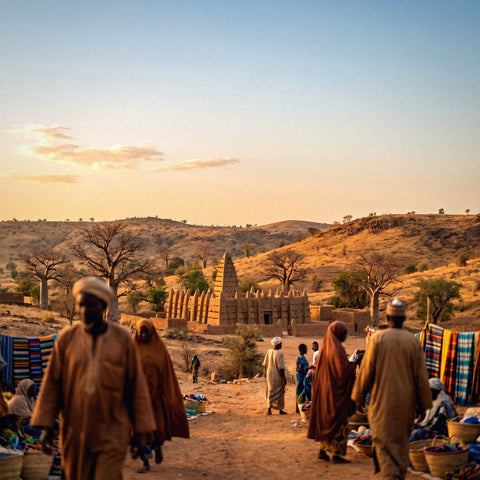
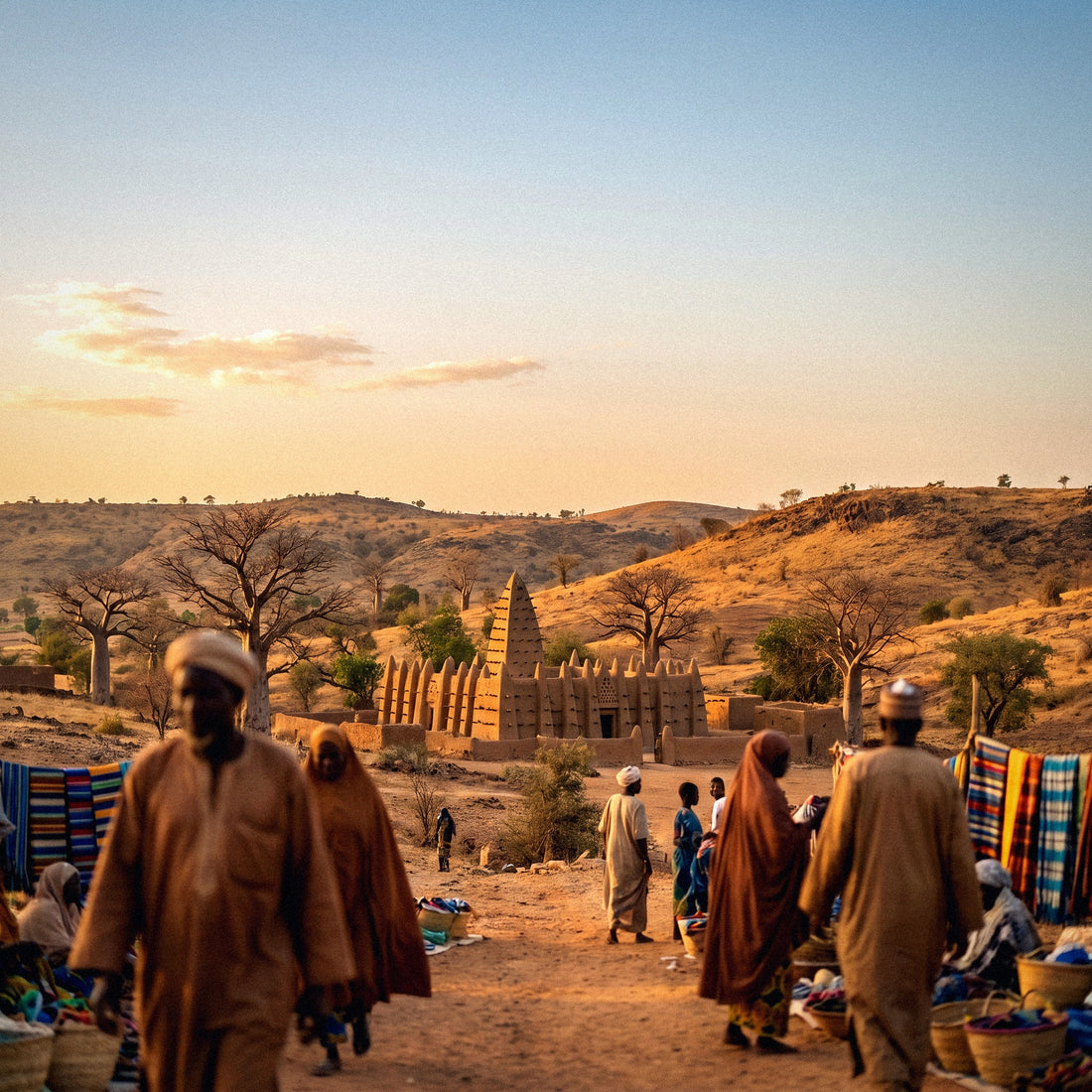
Outside the capital, what's worth seeing is in the west. Bobo-Dioulasso has the famous Great Mosque of Adobe, in Sudanese-Sahelian style, with its buttresses and protruding wooden beams; the old quarter of Kibidwé surrounds it and the signal there is better than in the city's commercial center. Near Banfora are the Karfiguéla waterfalls, with their stepped waters among sugarcane fields: a spectacular setting and patchy coverage, so assume you'll be disconnected.
And then there's what the country does better than anyone: lost-wax bronze casting from artisan workshops and faso dan fani textiles, hand-woven cotton that is almost a national symbol. The markets and villages artisanaux of Ouagadougou and Bobo have enough coverage to pay by mobile or look up references while bargaining.
How much data you need based on your profile
Calculating extra gigabytes is a waste of money; running out of data in Burkina Faso is worse. These are the figures I use to plan a work trip, assuming that much of the heavy usage will be done via office or hotel Wi-Fi:
| Profile | Typical Use | Daily Data | For 14 Days |
|---|---|---|---|
| Minimal Contact | WhatsApp text, email, occasional maps | ~300 MB | 4–5 GB |
| Cooperation Mission | Email with attachments, field photos, browsing | ~700 MB | 10 GB |
| Actual Remote Work | Daily video calls, cloud, sharing connection | 1.5–2 GB | 20–30 GB |
| Press / FESPACO | Uploading high-resolution video and photos | 3 GB or more | 40 GB+ |
Three settings that make a difference in consumption. First: disable automatic video playback on WhatsApp, Instagram, and X; in a country with a lot of 3G, automatic video will eat up your data without you noticing. Second: set photo backups to "Wi-Fi only" before leaving home, or your phone will try to upload the entire gallery via the mobile network. Third: download maps of Ouagadougou, Bobo-Dioulasso, and your routes on Google Maps or Maps.me while still in your home country.
If you're going to share your connection with a laptop or teammates, double your row's estimate. Data sharing is by far the biggest consumer, and on a work trip, you almost always end up acting as a hotspot for someone.
Frequently asked questions
Does my home country's plan work in Burkina Faso?
Technically yes, but at "rest of the world" prices, because Burkina Faso is not in the EU or EEA. "Roam Like at Home" does not apply, so your home gigabytes don't travel with you. Check with your operator for the exact price per megabyte and if there's any bundle for West Africa before you leave.
Do I need a passport to buy a local SIM?
Yes, SIM registration is mandatory in Burkina Faso and requires an ID; for a foreigner, a passport. It's processed on the spot, in five to fifteen minutes, at an official Orange, Moov Africa, or Telecel Faso store. Avoid informal stalls: a poorly registered line will be deactivated within a few days.
Which operator has the best coverage?
Orange Burkina Faso has the widest 4G network and is the most recommended if you're traveling outside the capital's center. Moov Africa works well in urban areas and often has aggressive promotions. Telecel Faso is cheaper but its coverage is the most inconsistent in rural areas.
Is there 5G in Burkina Faso?
Don't count on it: the realistic benchmark is 4G in Ouagadougou and Bobo-Dioulasso, and 3G or 2G in the rest of the country. 4G LTE covers about 65% of the population, a figure inflated by urban concentration. Outside the two major cities, plan your work assuming 3G.
Can the internet be cut off while I'm there?
Yes, it has happened: there were documented mobile internet outages in November 2021 and several episodes in January 2022, in addition to occasional blocks of WhatsApp and Facebook. No card or eSIM can prevent a shutdown decreed by the authorities. Have fixed Wi-Fi as an alternative and all critical information downloaded locally.
Can I pay with euros or do I need CFA francs?
You need CFA francs (XOF) for almost everything, including data top-ups; the exchange rate is fixed, 1 € = 655.957 XOF. Top-ups can be bought at kiosks and shops everywhere with scratch cards or via mobile. An eSIM bought from your home country avoids this process because you pay for it in euros in advance.
Is it a good idea to travel to Burkina Faso right now?
Consult your Ministry of Foreign Affairs' Travel Advisories: large areas of the country are not recommended due to terrorism, kidnapping, and crime. Conventional tourism is virtually non-existent today. If you are traveling for work or family, do so with a security protocol, valid insurance for destinations with warnings, and consular registration.
Will there be coverage at Karfiguéla waterfalls or FESPACO?
At Karfiguéla and its natural surroundings, coverage is minimal; at FESPACO, there is a network, but it's saturated due to the concentration of attendees. For the waterfalls, download maps before leaving Banfora. During the festival, send heavy material in the early morning or from your accommodation's Wi-Fi instead of using mobile data.
Conclusion
Let me summarize the important points. Burkina Faso is outside the EU, so your home country's plan won't work and will be very expensive. There are three operators—Orange, Moov Africa, and Telecel Faso—the local SIM costs from 250 XOF but requires passport registration, and coverage is decent in Ouagadougou and Bobo-Dioulasso and weak elsewhere. There have been mobile internet cuts and restrictions during periods of instability, and no card can fix that.
And most importantly, before considering gigabytes: check your Ministry of Foreign Affairs' Travel Advisories. Large areas of the country are not recommended, and this is not a typical tourist destination.
If your trip is still on and you want to arrive with your data already sorted, without looking for stores or handing over your passport as soon as you land, prepare your eSIM for Burkina Faso before leaving your home country. A QR code, a fixed price in euros, and your home number intact for calls from home.