Searching for internet in Iraq is nothing like searching for it in Rome or Bali. Almost no one travels here for holidays: journalists, NGO staff, energy sector technicians, diaspora Iraqis visiting family, Shia pilgrims on their way to Najaf and Karbala, and a growing trickle of travelers to Iraqi Kurdistan. I'll tell you how to really get connected, with prices in dinars, real operator names, and the pitfalls almost no one mentions before you land.
Connectivity in Iraq
To get connected in Iraq, the practical approach is to purchase an eSIM before you leave: it works upon landing, with no queues or passport registration. A local SIM is cheaper if you stay for weeks; Spanish roaming is expensive because Iraq is not in the EU; and hotel Wi-Fi is slow.
Iraq has a much more decent mobile network than people imagine, and a much worse fixed network. The country rebuilt itself by bypassing cables: 4G/4.5G is the normal way for almost everyone, including offices and businesses, to connect, and it works well in Baghdad, Basra, Mosul, Najaf, Karbala, Erbil, and Sulaymaniyah. Commercial 5G only exists in very initial deployments: don't count on it or factor it into your plans.
What really changes the game are three factors you won't find in a normal tourist destination. The first is political: Iraq intentionally shuts down the internet nationwide on certain dates. The second is geographical: Iraqi Kurdistan operates with its own visa, its own dominant providers, and a different sense of stability. And the third is demographic: during the Arbaeen pilgrimage, the central network receives more people at once than the entire population of many European countries.
Add to that the fact that many travelers here work, not tour: they send reports, upload heavy photos, make video calls with headquarters or family. Connectivity is not a luxury; it's a tool. If you want basic context before continuing, you can find a complete explanation of what an eSIM is and how to activate it. Here, we'll go straight to what matters on the ground.
The four options for getting connected, compared
Before going into detail, here's the big picture. These are the four ways to get data in Iraq and what you can expect from each in practice, not just in the brochure.
| Option | Estimated Cost | Advantage | Disadvantage |
|---|---|---|---|
| Roaming with your Spanish operator | Most expensive tariff zone; sometimes not even available | Zero hassle | Unpleasant bills; Iraq outside EU bundles |
| Hotel or office Wi-Fi | Included | Free and no mobile data needed | Slow, shared, goes down with power cuts; nothing outside the premises |
| Local SIM (Zain, Asiacell, Korek) | 5,000–15,000 IQD for the card + bundle | Unbeatable price per GB for long stays | Passport registration, official store, time-consuming |
| Travel eSIM | Purchased beforehand, in euros | Active upon landing, no paperwork or language barrier | Requires compatible mobile device |
Translated: if you're staying for two weeks or less, an eSIM saves you the most inconvenient part of the trip, which is arriving in a country with security checks, no coverage, and not knowing whom to ask. If you're going for a three-month mission, you'll end up with an Iraqi SIM in your pocket anyway, and probably with two different numbers. And if your plan is to rely on hotel Wi-Fi, be prepared: in Iraq, power cuts are part of daily life and the generator doesn't always power the router.
Roaming is the option to discard first, and not to sell anything: the numbers just don't add up. We'll see that now.

Roaming with your Spanish operator: Iraq is not the EU
This needs to be stated clearly because many people assume their data plan travels with them. Iraq does not belong to the European Union or the European Economic Area, so "Roam Like at Home" does not apply in any way. Your contract gigabytes stay at home, and you enter pure international rates.
In practice, Iraq usually falls into the highest tariff zone of Spanish operators, where megabytes are charged per unit, not in bundles. And there's a worse nuance: not all Spanish virtual operators have data agreements with all Iraqi networks, so you might end up with voice and SMS but no data, or directly no service. Before flying, check in your customer area which zone Iraq is in, if a daily bundle is available, and what you're charged per MB outside of it. If the operator doesn't publish the price for Iraq, you already have your answer.
My operational advice: deactivate data roaming before landing and don't touch it again. There's an extra risk that almost no one considers, accidental connection to neighboring networks. In northern Kurdistan, near the Turkish border, and in the east, near the Iranian one, your mobile might switch to a foreign network without warning you. That means two different bills on the same day.
If you want a full breakdown of why it's so expensive, you can find it in eSIM vs. roaming. Here, I'll stick to the practical conclusion: in Iraq, roaming off.
Hotel, cafe, and office Wi-Fi
Iraqi Wi-Fi deserves an honest paragraph. In high-end hotels in Baghdad, Basra, and especially Erbil, Wi-Fi works: it's good for email, messaging, and a video call if not too many people are connected. In mid-range hotels, guesthouses in Najaf or Karbala, and mountain accommodations in Kurdistan, the experience drops significantly. And everywhere there's a common enemy: electricity cuts. Iraq experiences daily power outages, especially in summer, and although almost all buildings have generators, those generators prioritize air conditioning and elevators, not the router.
Cafes in Erbil and Sulaymaniyah do have good Wi-Fi and are reasonable places to work for a while. In contrast, many official facilities, airports, and checkpoints have closed or outright unusable networks. And there's a security reality to keep in mind: open, shared hotel networks are not the best place to access corporate email, internal NGO systems, or sensitive work material. If you're traveling for work, use a corporate VPN and your own data.
Pocket Wi-Fi, which is a decent alternative in other destinations, makes little sense here: you have to pick it up and return it, it's another gadget to declare at checkpoints, and it relies on the same mobile network as your phone. I break it down in eSIM vs. pocket Wi-Fi. In summary: Wi-Fi is a supplement, never your main plan.
Local SIM: Zain Iraq, Asiacell, and Korek
Iraq has three national mobile operators, and it's useful to know them by name because people use them as geographical references. Zain Iraq is the largest, with a strong presence in Baghdad, the center, and the south. Asiacell was founded in Sulaymaniyah and is very strong in the north, although it covers the entire country. Korek Telecom also has Kurdish roots and national presence. In Kurdistan, Newroz Telecom is also present, very prominent in fixed lines, fiber, and wireless internet in Erbil, Duhok, and Sulaymaniyah.
| Concept | Estimated Price in IQD | Approximate Equivalent |
|---|---|---|
| Prepaid SIM card | 5,000 – 15,000 IQD | approx. 3 – 10 € |
| 1 GB (short validity) | from 5,000 IQD | approx. 3 € |
| Daily package (Zain) | from 2,500 IQD | less than 2 € |
| 5 GB / 30 days | around 15,000 IQD | approx. 10 € |
| 10 GB / 30 days | around 25,000 IQD | approx. 16 € |
| 30 GB / 30 days | around 50,000 IQD | approx. 32 € |
Two notes about money. First: the Iraqi Dinar (IQD) has an official exchange rate and a street rate, and they don't match; the dollar circulates normally, so many prices will be quoted in greenbacks. Second: the prices above are indicative and change often, so check what you see in the store.
The process: mandatory registration with passport at an official store, with data collection and, depending on the location, fingerprinting. This can be done at the airport kiosks in Baghdad and Erbil, but you'll pay more. The complete comparison can be found in eSIM vs. local SIM; here I'll just say it's cheap but slow.
Why I recommend eSIM in Iraq
In a beach destination, eSIM is about convenience. In Iraq, it's something else: it's about not having to solve a logistical problem on the day you have the least leeway. You land with the chip already active, with data from minute one, and you can announce your arrival, open a map, contact your fixer, your driver, or your local contact without depending on the airport shop being open or someone speaking English at 3 AM.
The first hour in Iraq is the most complicated: passport control, visa on arrival, currency exchange, and a parking lot full of identical cars. Arriving already connected removes the only problem you could have solved from home.
There are more specific reasons for this destination. One is registration: a travel eSIM doesn't require you to link your personal data to an Iraqi line, which is important for people traveling for sensitive work. Another is the number: you keep your Spanish number active to receive SMS from the bank or company while data goes through the eSIM. And another is the flexibility for those traveling the Erbil–Baghdad–Najaf–Basra route without wanting to change cards.
What I won't sell you: if you're going for a six-month mission on the ground, you'll end up with a local line, because you'll need an Iraqi number for banking, transport, and paperwork. The eSIM covers travel, not residency. You can find the country's specific options and coverage in the eSIM guide for Iraq, with the networks each plan connects to.

National internet blackouts during exams
This is the fact that surprises everyone, and it's real: Iraq shuts down the internet nationwide during national school exams to prevent questions from being leaked or copied. It's not a rumor or a technical fault. It's ordered by the Ministry of Communications at the request of the Ministry of Education, and announced with only a few days' notice.
The numbers illustrate the scale of the issue. In 2025, the first national outage was on May 20th, coinciding with the start of exams, and was repeated every exam day during a dawn period, typically from 6:00 to 8:00 local time. Between late May and mid-September 2025, 51 outages were recorded, of which 35 were national and 16 regional: almost one outage every two days. In August 2025, due to criticism, the time slot was shortened from two hours to an hour and a half.
What's important for you: it's not an operator problem, it's a country-wide shutdown. Neither local SIMs, nor eSIMs, nor hotel Wi-Fi are spared, because the shutdown is applied upstream. If you're traveling between May and September, assume it might happen and plan accordingly: downloaded offline maps, boarding passes saved on your phone, and notify your people that you might be unreachable during that morning slot. Iraq has also resorted to network shutdowns during protests, so it's wise to have a plan B that doesn't rely on the internet.
Iraqi Kurdistan: Erbil and Sulaymaniyah operate almost separately
If you're reading this, it's quite likely your real destination is Iraqi Kurdistan, the autonomous region in the north. And it's important to understand that, for practical purposes, it functions almost like a separate country: it has its own Regional Government (KRG), its own international airports in Erbil and Sulaymaniyah, its own checkpoints, and a much more stable security climate than the rest of the territory.
The point that causes the most problems is the visa. The KRG issues its own entry permit, valid for the Kurdistan Region. That permit does not automatically qualify you to move around federal Iraq: to go down to Baghdad, Najaf, or Basra, you usually need the federal Iraqi visa. This is a classic mistake, and it's paid for with a canceled trip at a checkpoint. Verify this with the embassy before buying tickets, because the rules have changed several times in recent years.
In telecommunications, something similar happens: the three national operators provide service, but the commercial weight changes. Asiacell and Korek have a strong presence in the north, and Newroz Telecom dominates in fixed lines and fiber. Mobile coverage in Erbil, Duhok, and Sulaymaniyah is good; in the mountain valleys towards Rawanduz, Amedi, or Barzan, it drops easily. The Citadel of Erbil, a World Heritage Site since 2014, has perfect signal; the surrounding trekking does not. Expect areas of total silence on the road.
Arbaeen: when the network gets saturated in Najaf and Karbala
If you are traveling for religious reasons, this directly affects you. The Shia pilgrimage to the shrines of Najaf and Karbala is constant throughout the year, but once a year it becomes the largest movement of people on the planet: Arbaeen, forty days after Ashura. In 2025, the Karbala shrine authority reported over 22 million pilgrims, and the Najaf authorities reported 17 million entries into the province. It falls about eleven days earlier each year, so check the exact date for the year you are traveling.
What that does to the network is exactly what you'd imagine. Between August 7 and 15, 2025 alone, over 277 million calls (272 million national and 4.4 million international) and 47 million SMS were recorded. Authorities deploy free internet stations along the walking route between Najaf and Karbala: in 2025, 30 new ones were added, bringing the total to 233 points on the pilgrimage routes.
Even so, be prepared for the worst on those days: data that won't load, calls that don't go through, impossible video calls, and drained batteries. Specific tips: a large power bank, a physical meeting point agreed upon with your group in case there's no signal, text messages instead of audio, and downloaded maps. Also keep in mind that exam-related outages may overlap with these dates.
Coverage by area, heritage sites, and official warnings
I'll start with the important stuff, straight to the point: Iraq is not a normal tourist destination, and there are formally discouraged areas. Before you plan anything, consult the official travel advisories for Iraq from your Ministry of Foreign Affairs, and review them again a few days before you leave, because they change. No connectivity guide replaces that warning, and we're not going to pretend otherwise here. Also check that your travel insurance covers the country, as many explicitly exclude it.
That said, here's the coverage where people usually go:
- Baghdad: good 4G signal, with drops and saturation during peak hours and near official facilities.
- Erbil, Sulaymaniyah, and Duhok: the best experience in the country, both mobile and fixed.
- Najaf, Karbala, and the route between them: decent except during pilgrimage peaks.
- Basra and the oil-rich south: reasonable industrial coverage in the city, spotty outside.
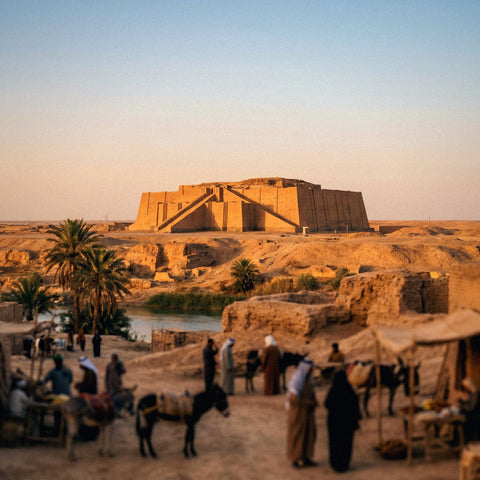
- Babylon, a World Heritage Site since 2019, and Ur, within the southern Ahwar inscribed in 2016: acceptable signal within the site, weak on the journey.
- Southern marshes and western desert: wide areas with no usable data. Don't rely on your phone there.
If you're traveling by road between provinces, expect checkpoints where documentation is requested and sometimes phones are checked. Carry your documents in both paper and digital format: this is the most useful advice in this entire guide.
How many gigabytes you need depending on your purpose
There's no universal number, because the consumption of a journalist uploading video has nothing to do with that of a pilgrim sending audio messages. This is the table I use to calculate, and it includes a margin.
| Travel Profile | Typical Duration | Recommended Data | Why |
|---|---|---|---|
| Pilgrimage to Najaf and Karbala | 7–10 days | 5–10 GB | Messaging, photos, calls home; saturation peaks |
| Trip to Kurdistan (Erbil, Sulaymaniyah) | 7–14 days | 10–15 GB | Maps, translation, some remote work |
| Business and Energy (Basra, Baghdad) | 5–10 days | 15–20 GB | Heavy email, video calls, corporate VPN |
| Press and NGO | 2–4 weeks | 30 GB or more | Uploading material, live broadcasts, tethering |
| Diaspora visiting family | 2–4 weeks | 20–30 GB | Long video calls and daily use |
Three adjustments that significantly change consumption. First, tethering: if you're the only one in the group with data, multiply by two or three. Second, video calls, which consume between 0.5 and 1.5 GB per hour depending on quality. And third, uploading material: a RAW photo report or a 4K video can drain any data plan in an afternoon, so if you work with heavy files, plan for the worst day, not the average.
If you want to see the contrast with what the same would cost in international roaming, you can find it calculated in how much international roaming costs. Warning: the difference is from two digits to three.
Frequently asked questions
Does a travel eSIM work in Iraq?
Yes. Travel eSIMs connect to Iraqi 4G networks and work in Baghdad, Basra, Najaf, Karbala, Erbil, and Sulaymaniyah. The only thing you need to check first is that your phone is eSIM compatible and unlocked. Installation is done at home, with Wi-Fi, and it activates automatically upon landing. It's the easiest thing to sort out before you leave.
Do I need my passport to buy an Iraqi local SIM?
Yes, registration is mandatory and done with a passport at an official Zain, Asiacell, or Korek store. They will take your details and, in some places, your fingerprint. Do not buy already activated cards from street vendors: they are usually registered in someone else's name and can be deactivated at any time, in addition to the legal problem this entails.
How much does a prepaid SIM cost in Iraq?
The card usually costs between 5,000 and 15,000 Iraqi Dinars, about 3 to 10 euros, and you have to add the data plan to that. As a reference, around 15,000 IQD for 5 GB per month and about 25,000 IQD for 10 GB, with Zain offering daily packages from 2,500 IQD. Prices fluctuate, so consider these as guidance.
Is it true that Iraq cuts off internet during school exams?
Yes, it is real and documented: Iraq has implemented scheduled national internet blackouts on every exam day to prevent leaks. In 2025, they started on May 20, from 6:00 to 8:00 local time, and between late May and mid-September, 51 outages were recorded, 35 of them national. It affects all operators equally.
Will the same line work in Kurdistan and the rest of Iraq?
Yes, in terms of coverage: operators are national, and an eSIM or an Iraqi SIM works in both parts. What is not interchangeable is the visa: the permit issued by the Kurdistan Regional Government does not automatically entitle you to travel to federal Iraq. Confirm this with the embassy before booking any internal flights.
What happens with coverage during Arba'een?
It gets very, very saturated. With over 20 million people concentrated between Najaf and Karbala, networks are pushed to their limit: between August 7 and 15, 2025, over 277 million calls were recorded. There are free internet stations installed by authorities along the route, but expect outages. Bring a power bank and an agreed physical meeting point.
How much does Spanish roaming cost in Iraq?
Expensive: Iraq is not part of the EU, so your national plan does not apply and you enter the highest tariff zone. Some Spanish virtual operators do not even have data agreements with all Iraqi networks. Check your tariff zone before flying and disable data roaming upon landing, especially near the Turkish and Iranian borders.
Is it safe to travel to Iraq?
It depends heavily on the area, and parts of the country are formally advised against. Always consult the official travel recommendations from the Ministry of Foreign Affairs, European Union and Cooperation before booking and again before departing. Also, check that your travel insurance covers Iraq, as many policies exclude it. This guide focuses on connectivity and does not substitute those warnings.
Conclusion
Iraq is a destination where connection is not a luxury: it's your way to coordinate, to let people know you're okay, and to work. Here's a summary of the essentials. Spanish roaming is out of the question because Iraq is not in the EU. Hotel Wi-Fi is a supplement that goes out with the power. A local Zain, Asiacell, or Korek SIM is the cheapest per gigabyte if you're staying for weeks, but requires passport registration at an official store. And an eSIM is what I would take for a trip of a few days or weeks, because it connects you upon landing without any hassle.
Add to the equation the three peculiarities of the country: scheduled national blackouts during exams, Kurdistan with its own visa and pace, and the brutal network saturation during Arba'een. And above all, review the official recommendations of the Ministry of Foreign Affairs before you travel.
If you already have dates, get the easy part sorted: purchase your eSIM for Iraq before you leave and land with data from the first minute. It's one less problem on a trip that already brings plenty.