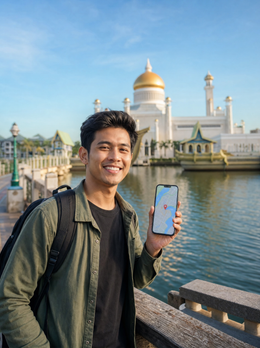
Brunei is one of those destinations that hardly anyone plans for: you end up there as a Royal Brunei layover on the way to Australia, or as a two- or three-day stop within a trip through Borneo. And precisely for this reason, many people land in Bandar Seri Begawan without having looked into the connectivity issue at all. This guide is about internet in Brunei, plain and simple: what operators are really available, how much a local SIM costs in Brunei dollars, where your mobile loses signal, and why your Spanish operator's roaming here could give you a three-figure shock on your bill.
How does the internet work in Brunei?
In Brunei, you connect with a data eSIM activated before flying, with a local imagine or Progresif SIM (about BND 15 for 3-4 GB and seven days, with passport), or with the hotel Wi-Fi. Spanish roaming is not included in your plan: Brunei is outside the EU.
Brunei has a peculiarity that you won't see in almost any other country, which greatly simplifies the decision: there is only one physical network. After the sector's restructuring, the infrastructure of towers, fiber, and spectrum passed into the hands of Unified National Networks (UNN), a publicly owned wholesale company. Commercial operators —imagine (the brand that replaced DST) and Progresif— do not have their own network: they resell UNN's capacity.
Translated to what matters to you: whichever brand you choose, the coverage is exactly the same. There isn't one operator "that works better on the coast" and another "that works better inland," as is the case in Indonesia or the Philippines. Only the price, the bundles, and the face of the attendant serving you change. That's good news, because it eliminates the most tedious part of researching a new destination.
The technology is at a good level. There is 4G/LTE in practically all inhabited parts of the country and 5G deployed in Bandar Seri Begawan and the urban areas of Brunei-Muara. It's a tiny country, with about 450,000 inhabitants concentrated in a small coastal strip, so covering the useful territory is much easier than in an archipelago. In the capital, I've seen reported mobile speeds of between 20 and 60 Mbps regularly, more than enough for maps, video calls, and uploading mosque photos instantly.
Spanish roaming in Brunei: outside the EU and expensive
Here's the most important warning in this entire guide, and I want it to be clear first: Brunei is NOT in the European Union or the European Economic Area. The "Roam Like at Home" —using your data from Spain just like at home— does not apply. Not even a little bit. It's not a doubtful case like Andorra or the Balkans: Brunei is in Southeast Asia and falls into the most expensive zone for all Spanish operators.
Movistar, Orange, and Vodafone classify it within their Zone 3 / "Rest of the World". The default data rate there can reach €12.10 per megabyte. Not per gigabyte: per megabyte. If you do the math, a single gigabyte of browsing would cost you over €12,000, such an absurd figure that you wouldn't even reach it, because European regulations require data to be cut when consumption exceeds €50 plus VAT, about €60. And that cut comes after consuming just five megabytes: opening Google Maps twice.
The €60 security cap is almost six times the cost of a local SIM with data for the whole week. That's the entire conversation about roaming in Brunei.
Some Spanish operators sell daily "world" bundles for between €10 and €20 per day with rather limited data volumes. If your trip is five days, that's €50-100. Before you leave, check your customer area to see which zone Brunei is in and what bundle you have available: I explain it with numbers in how much international roaming costs, and you'll save yourself an uncomfortable call to customer service upon your return.
Hotel and cafe Wi-Fi: better than you'd expect
Brunei is a rich country, and its fixed network reflects that. Fiber penetration is high, and hotels in Bandar Seri Begawan —from the Empire to the three-star hotels in the center— usually provide decent and free Wi-Fi. For a two- or three-day stop, good connectivity for sleeping is not a problem.
The detail no one tells you is that in Brunei, you'll spend more time in your hotel than you think. There are no bars, no nightlife, and many restaurants close early. Evenings are quiet, spent reading or planning the next day, and for that, the accommodation's Wi-Fi works perfectly. So, Wi-Fi covers a real part of the trip well.
The problem is the other part: outside. In Bandar Seri Begawan, there are shopping malls (The Mall in Gadong, Times Square) and chain cafes with Wi-Fi for customers, but there isn't an open municipal network you can use while walking around. And that's where you need it most: to order a taxi or a Dart (the local ride-hailing app), to cross the river to Kampong Ayer negotiating with the boatman, to find out if the Jame' Asr mosque is open to visitors that day, or to translate a menu.
And then there's security. Open networks at airports and shopping malls are shared networks: if you're going to check your bank or card, do it with mobile data. I elaborate on this in the comparison between eSIM and pocket Wi-Fi, where I also explain why renting a portable router in such a small country isn't worth it: you pay the deposit, carry the device and its battery, and there's only one pick-up point.
Local SIM: imagine, Progresif, and real prices
If you prefer to buy a card upon arrival, in Brunei you have two brands, and both sell specific tourist packages. Prices are in Brunei dollars (BND), a currency pegged at par with the Singapore dollar: in fact, Singapore dollars circulate as cash in Brunei and are accepted without issue. One BND is roughly €0.65-0.70, so the easy mental conversion is "two-thirds of a euro."
| Option | Price | Data | Validity | Extras |
|---|---|---|---|---|
| Progresif Tourist SIM | 15 BND (~€10) | 4 GB | 7 days | ~30 min local calls; +2 GB for 10 BND |
| imagine (ex DST) Tourist SIM | 15 BND (~€10) | 3 GB | 7 days | 3 BND credit for calls and SMS |
| imagine "Wish" prepaid | 8 BND (~€5.50) | 2 GB | 30 days | 5 BND credit, 20 min and 20 local SMS |
| Standard prepaid SIM | from 10 BND (~€6.50) | recharge separately | — | Data bundles from ~5 BND |
Prices are indicative and subject to change; confirm them at the counter. To purchase, you need a physical passport: line registration is mandatory and done by the attendant on the spot. There's an annual state fee of 25 BND per line which, according to common practice, is not passed on to tourist SIMs. You'll find counters for both brands in arrivals at Bandar Seri Begawan Airport (BWN) and their own stores in The Mall in Gadong and in the city center. The drawback is the usual: queue, form, passport photo, and using a clip to open the SIM tray. I compare the complete process in eSIM versus local SIM.
Travel eSIM: why I recommend it
An eSIM is the same SIM card as always, but recorded by software on a chip that your mobile already has soldered inside. There's no plastic, no tray, no clip. You scan a QR or press a button, and the profile is installed. If you're not sure how it works, I explain it from scratch in what an eSIM is.
For Brunei, it has three specific, not generic, advantages. The first is the schedule. Many Royal Brunei flights land at BWN in the early morning, and airport counters are not always open at those hours. In addition, Brunei's official weekend is Friday and Sunday, and on Friday afternoons, businesses close during prayer time. If you arrive on a Friday morning, you might find yourself at the hotel without a connection until Saturday.
The second is that you keep your Spanish number active. Your phone supports two profiles at once: your usual line for receiving bank SMS and the data eSIM for browsing. No need to store the original nano-SIM in an envelope and pray not to lose it.
The third is the most practical for this trip: you arrive already connected. You get off the plane, activate your phone, and have maps before getting into a taxi. You install the eSIM from home, using your living room Wi-Fi. And if your route continues to Kota Kinabalu or Kuching, you change profiles without having to go to a store again. Here's my specific guide to eSIM for Brunei with exact installation steps and mobile settings.
The four options, face-to-face
Put all together, here's the decision map for a short trip to Brunei. I've tried to be fair to all four, including those I don't sell.
| Option | Approximate cost (5 days) | Coverage | Procedures | For whom |
|---|---|---|---|---|
| Spanish Roaming | €60 until cut-off, or €50-100 in daily bundles | Total (UNN network) | None | Short layover without leaving the airport |
| Hotel Wi-Fi | €0 | Only at accommodation | None | For those who truly disconnect and don't leave the city |
| Local SIM | 15 BND (~€10) for 3-4 GB | Total (UNN network) | Passport, registration, queue | Long stays or those needing a local number for calls |
| Travel eSIM | From about €5-10 depending on GB | Total (UNN network) | None, activated from home | Most people: layovers, short trips, and Borneo routes |
Notice a nuance that slips into the coverage column: the three mobile data options provide exactly the same coverage, because all of them use the UNN network. In Brunei, you don't buy coverage; you buy price and convenience. This makes the comparison cleaner than in almost any other destination.
My honest recommendation: if you're coming from Spain for three or four days, eSIM. If you'll be there for three weeks for work and need a Bruneian number for people to call you, a Progresif local SIM, which gives one more gigabyte for the same price. And if your layover is six hours without leaving BWN, airport Wi-Fi and nothing else. You can find the breakdown of numbers versus roaming in eSIM vs. roaming, where I compare bill to bill with real cases.
Coverage area by area: from Kampong Ayer to Ulu Temburong
Brunei measures about 5,700 km², less than the province of Cuenca, and almost all the population lives in a coastal strip. This means coverage is good in 90% of what you will visit. But there are real exceptions, and I'll tell you about them even if it doesn't suit me.
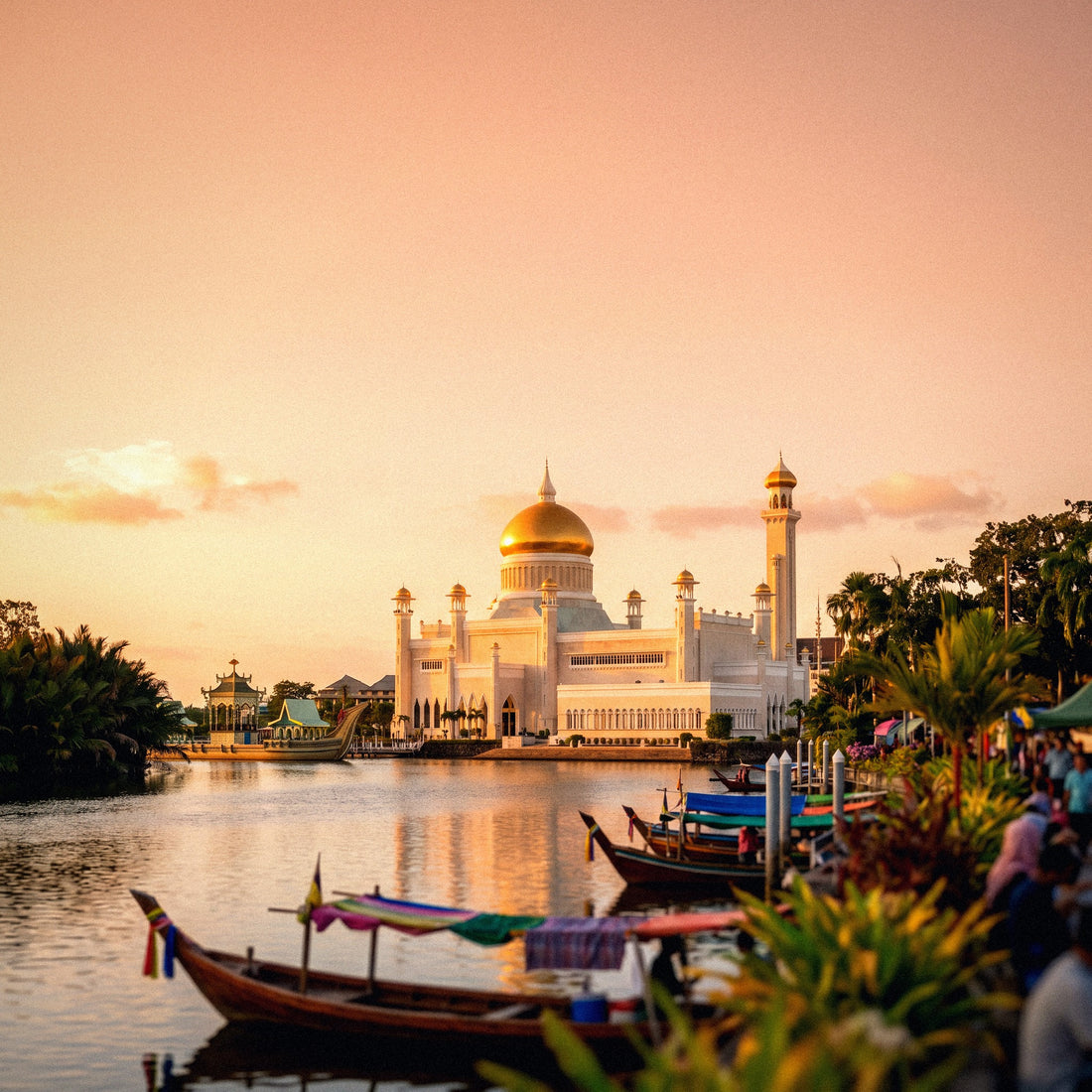
- Bandar Seri Begawan and Gadong: Strong 4G and 5G in much of the urban area. Here you'll find the Omar Ali Saifuddien and Jame' Asr Hassanil Bolkiah mosques, and at both, you'll have plenty of signal for maps and photos.
- Kampong Ayer: The water village, with thousands of people living on stilts on the Brunei River, is literally across from the city center. Normal coverage: you can call a water taxi back from the boardwalk without a problem.
- Muara, Jerudong, and the coast: Well covered; this is the most populated area of the country.
- Sultan Haji Omar Ali Saifuddien Bridge: The 30 km viaduct over the bay to Temburong has almost continuous coverage.
- Bangar (Temburong): The town has decent signal. It's your last reliable stop.
- Ulu Temburong: This is where it ends. Primary jungle, access only by temuai (longboat) upriver. Inside the park and on the tree canopy walk, there is no signal from any operator. Accommodations in the area rely on limited Wi-Fi or satellite links.
The practical consequence: download offline maps from Google Maps or Maps.me before getting on the boat in Bangar, and let people at home know you'll be out of contact for a few hours. A national park not having coverage isn't a flaw; it's part of why it's worth going.
How many GB do you need for Brunei?
Brunei is rarely a two-week destination. Typically, it's a long layover, a weekend, or three days fitted into a Borneo itinerary. With that in mind, here are the data volumes that make sense to contract.
| Travel Profile | Duration | Recommended Data | What it covers |
|---|---|---|---|
| Long layover in BWN | 6-12 h | 1 GB | Maps, messaging, a couple of short video calls |
| Short stop in the capital | 2-3 days | 3 GB | Daily navigation, photos to the cloud, transport apps |
| Full Brunei with Temburong | 4-6 days | 5 GB | Above plus uploading videos and some work from the hotel |
| Borneo itinerary (with Malaysia) | 10-15 days | 10-20 GB regional | A single profile for Brunei, Sabah, and Sarawak |
| Business trip | 2-4 weeks | 20 GB or more | Tethering to laptop, daily meetings |
A couple of tricks to make your data last. Video calls consume the most: half an hour on WhatsApp easily takes between 150 and 300 MB. If you're going to talk at length with home, do it from the hotel. Second: WhatsApp and internet calls work normally in Brunei; they are not blocked as in some Gulf countries, so you don't need a VPN to talk to Spain.
And third: activate photo backup only with Wi-Fi. It's the silent leak that eats up everyone's data, especially on a trip where you'll be taking many photos of two spectacular mosques. With that, 3 GB is more than enough for a long weekend.
Layover in BWN and border with Malaysia: two known traps
The Bandar Seri Begawan Airport (BWN) is small and very manageable: you can cross it in ten minutes. There's free Wi-Fi in the terminal and imagine and Progresif counters in arrivals, though their hours are designed for daytime flights. Royal Brunei operates its hub here, with connections to London, Dubai, Melbourne, and half of Southeast Asia, and several of those flights land in the early morning. If yours is one of them, arriving with your line already ready saves you from starting your trip waiting for a counter to open.
The second trap is more subtle and costs real money: accidental roaming with Malaysia. Brunei is completely surrounded by the Malaysian state of Sarawak, and at various points — the Kuala Lurah area, around Limbang, the Temburong district — your mobile phone can connect to a Malaysian antenna (Maxis, Celcom, Digi) without you realizing it. If that happens with your active Spanish line, you enter international roaming; and if it happens with an eSIM purchased only for Brunei, you will lose data until you return to the correct network.
The solution takes thirty seconds: in Settings > Mobile Data > Network Selection, disable automatic selection and manually set the Bruneian operator. And if your route includes Sabah or Sarawak, directly contract a regional Southeast Asian profile that covers both countries. Before 2020 this was even worse: to get to Temburong you had to cross Malaysian territory with four passport stamps. Today the bridge avoids it, but the signal still does not respect the borders drawn on the map.
Local rules you should know before landing
Brunei is a conservative Muslim sultanate and its daily life is governed by rules quite different from those of a tourist destination in Southeast Asia. I am not saying this to judge anyone, but because it completely changes what you can expect from the trip, and because almost everything can be resolved by informing yourself beforehand.
- Prohibition: the sale of alcohol has been prohibited since 1991. There are no bars or wine lists, not even in hotels. Customs regulations allow non-Muslim visitors of legal age to bring in a limited amount for private consumption, declaring it upon arrival. Confirm the current limits before flying.
- Friday: the official weekend is Friday and Sunday. On Friday at midday, shops and offices close during prayer; opening hours are not what your app tells you.
- Mosques: the Omar Ali Saifuddien and the Jame' Asr admit non-Muslim visitors at specific times, which are reduced on Thursdays and Fridays and during prayers. You enter barefoot, in clothes that cover your arms and legs, and they usually lend you a robe.
- Dress and behavior: discretion in clothing and with displays of affection in public. Nothing dramatic, but it is noticeable if you do not respect it.
- Ramadan: eating, drinking, or smoking in public during daylight hours is restricted. Restaurants mainly operate as takeout and hotels continue to serve their guests.
Brunei also applies an Islamic-based penal code. For a respectful traveler, the trip runs smoothly — it is an extraordinarily safe and peaceful country — but before going, it is worth reading the official fact sheet from the Spanish Ministry of Foreign Affairs. Having mobile data from minute one helps right here: checking a schedule, translating a sign, or checking a rule without depending on someone to explain it to you on the street.
Frequently asked questions
The most common questions I receive about getting connected in the sultanate, answered directly and without commercial jargon.
Does EU roaming work in Brunei?
No. Brunei does not belong to the European Union or the EEA, so "Roam Like at Home" does not apply at all. Your Spanish operator classifies it in the most expensive zone (Zone 3 or "Rest of the World"), with rates that can reach €12.10 per megabyte. Data will be cut off when you reach €50 plus VAT.
How much does a local SIM for tourists cost in Brunei?
Around BND 15, about €10. Progresif offers a tourist pack of 4 GB for 7 days with local minutes included, and imagine offers one of 3 GB for 7 days with some credit. There is also imagine's "Wish" prepaid plan for BND 8 with 2 GB and 30 days validity. Prices change: confirm them in-store.
Do I need my passport to buy a SIM in Brunei?
Yes, it is mandatory and without exception. The registration of prepaid lines is regulated and done by the sales assistant at the time of sale, with your physical passport present. You can buy it at the arrival counters at BWN airport or at imagine and Progresif stores in the capital, with the corresponding queue and form.
Which operator has the best coverage in Brunei?
All the same, literally. The physical network of towers and spectrum belongs to Unified National Networks (UNN), a unique wholesale entity, and both imagine and Progresif resell that same capacity. There is no operator with a better signal than another: choose by price, by included gigabytes, or by which counter is open when you land.
Is there coverage in Ulu Temburong National Park?
Inside the park, no. Bangar, the village from which the boat departs, does have a signal. But once you go up the river towards the primary forest and on the canopy walkway, you lose coverage from all operators. Download offline maps before boarding and notify home.
Can WhatsApp be used and video calls made in Brunei?
Yes, normally. Brunei does not block WhatsApp, Telegram, or VoIP calls, unlike some Gulf countries. You do not need a VPN to talk to Spain. Keep in mind data consumption: half an hour of video call uses between 150 and 300 MB, so if you are going to talk for a long time, it is better from the hotel Wi-Fi.
Can the same card be used for Brunei and Malaysia?
Only if you contract a regional Southeast Asian profile. A SIM or profile purchased only for Brunei does not work in Sabah or Sarawak. As the country is surrounded by Malaysia, near the border your mobile phone may connect to Malaysian antennas: manually set the Bruneian operator in the network settings to avoid surprises.
What currency do I use and can I pay with Singapore dollars?
The Brunei dollar (BND), and yes, the Singapore dollar is accepted. Both currencies are linked at par by agreement between the two countries, so Singapore banknotes circulate as cash in Brunei. One BND is equivalent to about €0.65-0.70. Phone stores accept card, but carry some cash just in case.
Conclusion
Brunei is an easy destination to resolve technologically and surprising in everything else. There is a single national network operated by UNN, so coverage is the same with any brand: good in Bandar Seri Begawan, Kampong Ayer, and throughout the coastal strip, and null in the interior of Ulu Temburong, where you are precisely going to disconnect. The only thing to avoid is leaving Spanish roaming on, because at €12.10 per MB, the bill arrives before the photos.
A local SIM is cheap and honest — BND 15 for 3 or 4 GB — but it requires a passport, queuing, and the counter to be open, and in a country where commerce closes on Fridays and many flights land at dawn, that doesn't always work in your favor. Therefore, for a layover or a three-day stop, arriving with your line already activated causes the least friction.
If you want to get off the plane at BWN with maps working and your Spanish number intact, check out PuraSIM's eSIM for Brunei: you install it from home in a couple of minutes and forget about it until you return. Have a good trip to the sultanate, and don't miss the sunset over the Omar Ali Saifuddien.