Gambia is one of those destinations discovered due to its climate: seven degrees in Madrid, twenty-eight in Kololi, and a direct flight of about six hours. But when you land, you realize that internet in Gambia doesn't work like in the Canary Islands or Morocco: there's no European tariff to save you here, coverage is good in the coastal strip and drops as soon as you head upriver, and the country is so surrounded by Senegal that your phone changes networks without warning. In this guide, I'll tell you what's available, with real prices in dalasis, operator names, and the four options you have for connecting, including the one I use.
Internet connection in Gambia in 2026
In Gambia, you have four paths: roaming with your Spanish operator (very expensive, European tariffs don't apply here), hotel Wi-Fi (unreliable due to power cuts), a local SIM from Africell or QCell (cheap, but requires registration and passport), or an eSIM that you activate before leaving home and works upon landing.
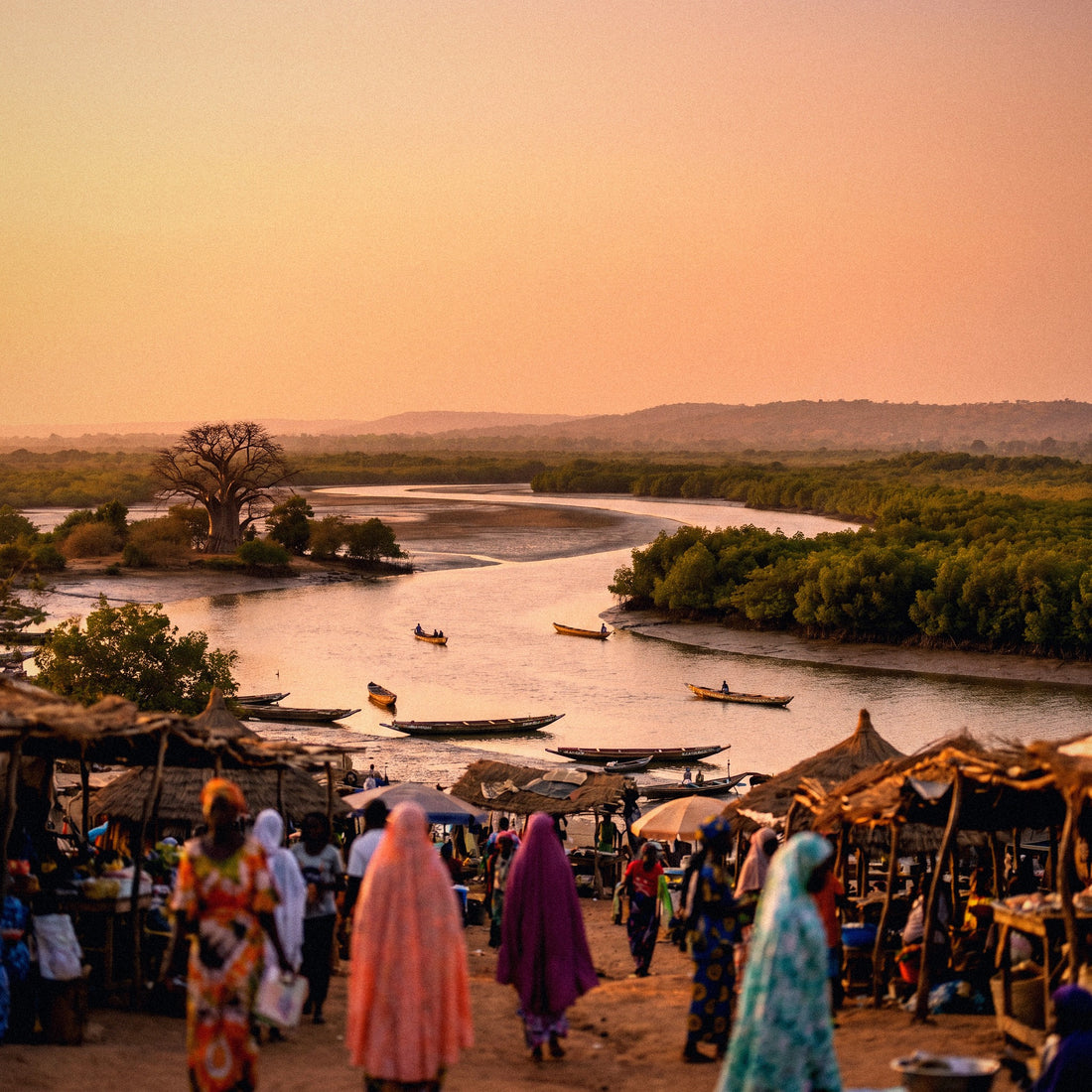
Gambia is the smallest mainland country in Africa: a narrow strip on both sides of the Gambia River, just over 11,000 km², entirely surrounded by Senegal except for its Atlantic mouth. This geography explains almost everything in terms of telecommunications. The population and business are concentrated in the metropolitan area of Serrekunda, Banjul, and the tourist coast, and that's where operators have invested their money. The rest of the country is a very long ribbon following the river, with low density and scattered towers.
There are four licenses in the market, although in practice the competition is between two. Africell is the dominant operator, with around 57% of users, the best 2G and 3G footprint in the country, and commercial 4G since 2018. QCell was the first to launch 4G/LTE in 2017, is reputed to be the fastest and provide the best experience in the coastal area, but its network is smaller and doesn't always fall back to 2G when you leave the urban area. Gamcel, the state-owned operator, and Comium are in a much weaker position and are not a choice I would recommend to a tourist.
The other piece of the puzzle is electricity. Power outages are part of Gambian routine, and a tower without power and without a generator is a silent tower. That's why it's advisable not to rely on a single connection.
Real coverage: tourist coast vs. upriver
The practical truth is simple: on the coastal strip, you'll be fine, and as soon as you move away, things degrade quickly. Kololi, Kotu, Bakau, Bijilo, Senegambia, Brusubi, Serrekunda, and Banjul have decent 4G with Africell and QCell. There you can make video calls, upload photos, and work without drama, with the caveat that during peak hours, Africell's network gets congested and speeds drop significantly: many people sharing limited capacity.
Upriver, the landscape changes. On the southern road axis towards Soma and Farafenni, you still find reasonable signal in large towns, but between them, there are long stretches of 2G or nothing. In Janjanbureh (formerly Georgetown) and Basse Santa Su, there is coverage, although often slow 3G with drops. And in the places where many people travel to Gambia (the river lodges and bird reserves), you have to assume you'll be disconnected.
- Tendaba Camp and Kiang West: intermittent signal, better 2G than useful data.
- Bao Bolong Reserve and mangroves: practically no data by boat.
- River Gambia National Park (chimpanzee islands): no reliable coverage.
- Abuko Nature Reserve: good, it's a stone's throw from Serrekunda.
- Makasutu and Brufut: acceptable coverage, with blind spots within the forest.
No card, neither local nor international, fixes this: if there's no tower, there's no internet. What you can do is choose the network with the best rural footprint, which is still Africell, and download what you need before leaving the coast.
Roaming with your Spanish operator: Gambia is outside the EU
Here comes the important warning. Gambia does not belong to the European Union or the European Economic Area, so the famous "Roam Like at Home" does not apply at all. Your gigabytes from your Spanish tariff do not travel with you. Movistar, Vodafone, Orange, and the brands that operate on their networks classify Gambia in their Zone 3 or equivalent, the most expensive in their catalog, and the default rates there are from another era.
The numbers are truly frightening. In Zone 3, Movistar can charge up to €12.10 for each MB consumed if you don't contract anything. One MB. That means opening Instagram a couple of times can cost you more than your return flight. Specific bundles alleviate the blow but are still expensive: Orange's Everywhere tariff is around €7 for 100 MB and Vodafone's Viaje Mundo is around €15 for 2 GB, and not all these options include Gambia in all plans. Before assuming anything, check your company's app and search for the country by name.
If you want the details of how these bills are calculated and why the figures are so absurd, I broke it down in this comparison between eSIM and roaming. My honest summary for Gambia: roaming only makes sense if you're going for two days, don't plan to use data, and want to be able to receive an emergency call. For everything else, it's the most expensive way to be worse connected, because you're also using the same local towers but paying twenty times more.
Hotel and resort Wi-Fi: what to really expect
Almost all hotels in the Senegambia, Kololi, and Kotu area advertise free Wi-Fi, and almost all of them have it. The question isn't whether it exists, but whether it's useful. In practice, you'll find three fairly common patterns: good signal at reception and the pool bar, weak or no signal in the room (especially in bungalows and secluded ground floors), and drops when the power goes out and the generator takes time to start or only powers the essentials.
The rule I use in Gambia: hotel Wi-Fi is for calling at night and uploading photos at leisure; for anything needed outside the premises, use your own data. Relying solely on resort Wi-Fi is like traveling with a single plug: it only works where it is.
There's a second, less obvious problem. The bandwidth of many accommodations is shared and limited, so at nine in the evening, with half the hotel connected, a video call will drop. And there's a third: security. These are open networks, without individual passwords, where it's not advisable to access your bank without a VPN.
Many people consider a pocket router as an alternative, but in Gambia, I find it of little use: you have to rent or buy it, charge it every day, carry it around, and it still depends on the local network. I compared the two ideas in depth in eSIM vs. pocket Wi-Fi, and for a beach trip with excursions, the extra device rarely pays off.
Local SIM: Africell, QCell, Gamcel, and Comium
A local SIM is the truly cheap option and, if you're staying a month or more, it makes perfect sense. You can buy it at Banjul International Airport, in official stores in Serrekunda and Senegambia, and at a thousand small kiosks with the operator's awning. The card costs between 50 and 100 dalasis (less than €1.50) and often Africell and QCell give it away for free if you buy a data bundle.
The process is mandatory: you must register the SIM with your passport. They'll photocopy it at the counter, fill out a form, and in about ten minutes, your line will be active. It's not complicated, but it takes time and usually involves queuing, especially if you land with a full charter.
| Bundle | Africell | QCell | Approx. equivalent |
|---|---|---|---|
| SIM Card | Free or up to D100 | Free or up to D100 | €0–1.30 |
| 1 GB | D250 (60 days) | Inquire at store | ~€3 |
| 5 GB | D770 (60 days) | D775 (30 days) | ~€9.50 |
| 10 GB | D1,300 | D1,310 | ~€16 |
| 25 GB | D1,790 | Inquire at store | ~€22 |
Equivalencies are at an approximate exchange rate of €1 ≈ 80 dalasis: check the daily rate, as the dalasi fluctuates. Bundles are purchased by dialing *120# on Africell or from their app. I would rule out Gamcel and Comium due to network and service. If you're wondering between a physical and a digital card, I compare them calmly in eSIM vs. local SIM.
eSIM: the option with no paperwork or queues
An eSIM is exactly the same as a SIM card, only instead of a piece of plastic, it's a profile downloaded to your mobile. You buy it from home, scan a QR code, and when the plane touches down in Banjul, your phone automatically connects to the Gambian network. No photocopied passport, no queue at the counter, no searching for who sells bundles on a Sunday afternoon. If you've never used one, in this guide, I explain what it is and how to install it step by step.
For Gambia, I see three specific advantages. The first is that you keep your Spanish number active on your physical SIM or a second profile, so you continue to receive bank SMS while browsing with local data. The second is that you can have it ready before you leave, which matters more than it seems when you land at night and the taxi to Kololi needs to be negotiated with your phone in hand. The third is cost control: you pay a fixed bundle in euros, and there are no surprise bills.
The honest drawback: per gigabyte, it's usually a bit more expensive than a local SIM, especially when compared to Africell's large bundles. And you need a compatible mobile, although practically all mid-range and high-end phones from recent years are. If you want details on coverage, networks, and specific plans for this destination, I have them compiled in the Gambia eSIM guide, with the operation on local networks explained with names and details.
The four options, face to face
Putting everything in a table makes it much clearer which option suits which trip. I've rounded the costs for a typical one-week coastal getaway, with normal use of maps, messaging, some social media, and a few photos uploaded.
| Option | Approximate cost (1 week) | Coverage and speed | Process | When it pays off |
|---|---|---|---|---|
| Spanish roaming | From €15 to three-digit figures | The same local network, no advantage | None | 1–2 day trips without using data |
| Hotel Wi-Fi | €0 | Unreliable; drops with power cuts | None | Nighttime complement, never the sole plan |
| Local SIM | D770–D1,300 (€9–16) | Best data/price ratio | Passport, form, and queue | Long stays and tight budget |
| eSIM | Fixed bundle in euros | Same networks, active upon landing | A QR from home | 1–3 week tourism and business trips |
My take: if you're going for three months of volunteering in Basse, buy an Africell SIM and forget about it. If you're going for ten days to a hotel in Kotu with an excursion to Janjanbureh and a trip to the birds of Tanji, an eSIM saves you the hassle and keeps your Spanish number active, which on a short trip is worth more than the three-euro difference. And roaming without a contracted bundle is, simply, the option to actively avoid: it activates itself if you don't disable it.
How many gigabytes you need according to your trip
Calculating too much data is wasting money, and calculating too little means running out on the last day. In Gambia, there's a factor that works in your favor: you'll spend quite a few hours without useful coverage, on a boat or dirt track, so actual consumption is usually lower than on a European city break. These are the figures I work with.
| Travel profile | Duration | Recommended data | Why |
|---|---|---|---|
| Beach and resort, light use | 7 days | 3 GB | Maps, WhatsApp, and some social media; the rest via Wi-Fi |
| Coast plus excursions | 10–14 days | 5–8 GB | Daily navigation and photo uploads outside the hotel |
| River safari and birds | 10 days | 5 GB | Many hours without signal; prior download is more important |
| Family sharing with hotspot | 2 weeks | 10–15 GB | Two or three devices using the same line |
| Remote work or long stay | 1 month | 20–25 GB | Video calls and cloud; it's good to have a backup plan |
A couple of nuances. Video calls are by far the biggest consumer: half an hour of video uses almost 500 MB, so if your plan is to talk home every night, increase the estimate or save those calls for hotel Wi-Fi. And lower the automatic photo upload quality to the cloud, which is the silent gigabyte thief number one on any trip.
Beware of network jumping with Senegal
This is the detail that ruins the budget for most people in Gambia, and almost no one mentions it. The country is a very narrow strip: in some places, there are less than thirty kilometers between the northern and southern borders. This means that in much of the territory, your mobile sees, in addition to Gambian towers, Senegalese towers from Orange, Free, or Expresso across the border. And phones choose the strongest signal, not the one from the correct country.
The result is an involuntary connection to a foreign network that your Gambian plan doesn't cover. With a local SIM or eSIM, this usually means running out of data until you reconnect to the Gambian network. With a Spanish line without a bundle, however, it translates into billing at Zone 3 prices without you having touched anything. I dedicated specific numbers to this type of scare in how much international roaming costs.
How I avoid it, and it's a matter of thirty seconds of settings:
- Disable automatic network selection and manually set the Gambian operator (Africell or QCell) in the mobile network settings.
- Turn off data roaming for the Spanish line from minute one, even before taking off.
- If you cross into Senegal on an excursion to Casamance or Saly, assume that you need a plan that covers both countries or you'll be without data that day.
- Check the network name in the status bar when you are near the border: if it says something different from what you expect, you know what's happening.
Tips to avoid being stranded without coverage
Gambia rewards those who prepare. Since there are entire areas without signal and frequent power cuts, a little foresight prevents almost all problems. These are the things I always do before leaving the coast for the interior.
- Download the offline map of the entire country in Google Maps or Organic Maps. It doesn't take up much space and works with GPS without data.
- Save to your phone the hotel voucher, travel insurance, guide's number, and written accommodation address. As PDFs, not screenshots, so they don't depend on the cloud.
- Carry an external battery pack of at least 10,000 mAh. With the power going out and towers failing, your phone constantly searches for a signal and drains at an incredible rate.
- Exchange dalasis on the coast: upstream there are few ATMs, and many don't accept foreign cards, so don't count on paying via app.
- Inform home that you'll be without coverage for several days if you go to the chimpanzee islands. This saves scares and calls to the embassy.
A note on birdwatching excursions, which is the other big reason to come here: the best spots (Tanji, Kartong, Bao Bolong, Kiang West) are precisely where the network is worst. If you use identification apps like Merlin, download the West African sound pack before leaving the hotel, because you won't be able to download it in the mangrove. And a common sense recommendation: on Gambia River boats, keep your phone in a waterproof case, as brackish water and splashes are unforgiving.
Frequently Asked Questions
The most common questions I receive about connectivity in this destination, answered concisely and directly.
Does my Spanish data plan work in Gambia without extra charges?
No. Gambia is outside the EU and EEA, so "Roam Like at Home" does not apply. Your national gigabytes cannot be used there, and without a contracted bundle, the default rate can be up to €12.10 per MB in zone 3.
Where can I buy a SIM card upon arrival at Banjul airport?
At the Africell and QCell counters in the arrivals terminal. You need your passport, they will photocopy it, and in about ten minutes your line will be active. The card costs between D50 and D100 and is sometimes given away free with a bundle.
Which operator has the best coverage in Gambia?
Africell, with around 57% of users and the best footprint outside the coast. QCell is usually faster in the tourist area but covers less territory. Gamcel and Comium are far behind and I do not recommend them for a traveler.
Is 4G available throughout Gambia?
No: 4G is solid on the tourist coast and in large cities, and scarce upstream. QCell launched LTE in 2017 and Africell in 2018, but investment has been concentrated in the Banjul and Serrekunda area. Inland, expect slow 3G or 2G.
How much does 5 GB of data cost with a local operator?
Around 770 dalasis with Africell and 775 with QCell, which is about €9.50. Africell's bundle usually lasts 60 days and QCell's 30 days. The 10 GB bundle is around D1,300 and there is a 25 GB bundle for D1,790.
Why does my phone connect to a Senegalese network?
Because the country is a very narrow strip surrounded by Senegal, and your phone picks up neighboring towers. Manually set the Gambian network in your settings and turn off data roaming on your Spanish line to avoid unexpected charges.
Can I work from Gambia with video calls?
Yes, as long as you stay in the coastal strip. In Kololi, Kotu, Senegambia, or Bijilo, 4G handles meetings without problems outside of peak hours. Plan for about 20–25 GB per month and have a second line or hotel Wi-Fi as backup for power outages.
Do I need a visa and special registration to use my phone?
SIM registration with a passport is mandatory for local cards, period. There are no additional telecommunications procedures for entering with your own phone. If you use a digital line purchased from Spain, you avoid registration entirely.
Conclusion
To sum up what's important: Gambia is outside the European Union, so your Spanish data plan doesn't travel with you, and default roaming is absurd, potentially reaching €12.10 per MB. Coverage is good in Kololi, Kotu, Bakau, Serrekunda, and Banjul, and weak or nonexistent as you go upriver, especially in river reserves and mangroves. Hotel Wi-Fi works intermittently and goes down with the power. Local SIMs from Africell and QCell are very cheap (about €9.50 for 5 GB) but require a passport, form, and queuing. And your phone will connect to Senegalese networks if you don't manually fix the network.
My recommendation for a one or two-week winter sun trip is the most boring and the one that causes the fewest problems: arrive with your line already sorted, leave the airport with data, and dedicate your time to the birds and the river instead of filling out forms. If you want that peace of mind, here is the Gambia eSIM with activation before leaving home and a fixed price in euros.