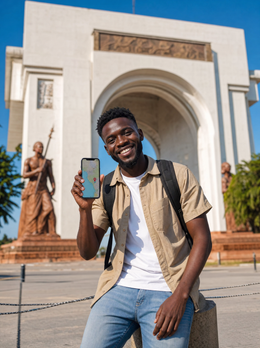
In short: The eSIM for Gambia gives you 4G internet as soon as you land in Banjul, without expensive roaming or queues for a local SIM. You activate it from home with Wi-Fi, turn it on when you set foot on Gambian soil, and browse the tourist coast of Kololi, Kotu, and Bakau while keeping your Spanish number for calls and texts.
Known as "the smile of Africa," Gambia is the continent's smallest country and one of the most beloved sun and nature destinations for Spanish travelers, many on all-inclusive packages on the Atlantic coast. To move freely between beaches, markets, and river excursions, an eSIM for Gambia gives you internet as soon as you land, without having to look for local cards or pay your operator's roaming fees. Here's information on coverage, operators, how much data to bring, and how to activate it in a minute.
Is an eSIM worth it in Gambia?
Yes. An eSIM for Gambia gives you mobile data as soon as you land in Banjul, without queues or physical cards, and for much less than traditional roaming. You buy the plan before leaving home, activate it upon arrival, and browse for maps, messaging, and excursion bookings.
Many travelers arrive in Gambia with a hotel package on the coast (Kololi, Kotu, Bakau) and find that the resort's Wi-Fi is slow or only reaches the lobby. With an eSIM, you have your own internet in your room, on the beach, and on excursions, without depending on the accommodation's connection. Also, as this is a destination where many make their first visit to West Africa, having reliable data helps you navigate, haggle with confidence, and coordinate transfers. If this is your first trip with this system and you're still not sure how it works, you might be interested in our explanation of what a virtual eSIM is before buying the plan.

Operators and coverage in Banjul and on the coast
The Gambian mobile market is shared by several operators such as Africell, QCell, Gamcel, and Comium. Africell and QCell usually offer the best 4G coverage in the urban area of the capital and in the tourist strip of the coast, which is where most travelers are concentrated.
The PuraSim eSIM connects to local networks, so you get the best available signal without doing anything. In the metropolitan area of Banjul, Serrekunda, and the beaches of Kololi, Kotu, and Bakau, the 4G connection is good and sufficient for video calls, maps, and social media. Inland, following the Gambia River eastward or in nature reserves, coverage becomes more irregular. A practical note: if you're going on a river excursion or birdwatching (Gambia is a paradise for birdwatching, especially in the Tanji reserve and going upriver towards Georgetown/Janjanbureh), download maps and information before leaving the coastal area. Our guide with tips for saving mobile data while traveling helps you stretch your plan if you're going to spend several hours without good coverage.
How many GB to bring for your trip
The data you need depends on the number of days and your usage. A week on the beach with maps and social media is covered by a moderate plan; if you're going to make video calls or upload many videos, calculate more. This table gives you an idea:
| Trip type | Days | Estimated data |
|---|---|---|
| Short getaway | 3-4 | 2-3 GB |
| Week of beach and excursions | 7 | 4-6 GB |
| Long trip with Senegal | 12-15 | 8-12 GB |
Tip: video and video calls consume the most data. If your usage is mostly maps, WhatsApp, and some social media, a beach trip is more than covered with a few GB per day.
If you run out, you can recharge or buy another plan without losing your Spanish number. And if you're wondering whether to bring a spare physical card or rely solely on the eSIM, take a look at our comparison of international chip vs. eSIM before deciding.

How to activate the eSIM in 1 minute
Activating the Gambia eSIM is quick and you can do it before leaving home. The process is as follows:
- Purchase the Gambia plan and receive the QR code instantly by email.
- With Wi-Fi at home, go to Settings > Mobile Data > Add eSIM and scan the QR code.
- Label the line as "Gambia" and keep your Spanish SIM for calls and texts.
- Upon landing in Banjul, activate the eSIM data, and you'll be online.
The entire setup takes about 1 minute, and you don't need to be an expert. If this is your first eSIM, follow our guide on how to install an eSIM. Before purchasing, check in Settings that your device supports eSIM (almost all recent mid-range to high-end phones do); the "Add eSIM" menu itself will confirm it in seconds. Install it at home, but don't activate it until you set foot in Gambia.
Gambia with your phone: beach, river, and Senegal
Gambia is a narrow country that follows the course of its river, almost entirely surrounded by Senegal. Its capital, Banjul, is small and quiet, and tourist life is concentrated on the Atlantic coast, with long beaches, resorts, and a lively entertainment area in Senegambia.
Beyond the beach, the attraction lies in excursions: pirogue trips on the river, reserves like Abuko, the historically significant Kunta Kinteh Island, and birdwatching days that attract naturalists from all over Europe. Many travelers take advantage of the proximity to cross into Senegal and visit Casamance or the Saloum Delta, and "trip to Senegal and Gambia" is a very sought-after combination. If that's your route, keep in mind that the Gambia eSIM is designed for that country: when crossing the border at Amdalai/Karang, it's advisable to also have a data plan for the neighboring country, just as you would with any single-destination eSIM. With reliable data on your phone, you can book excursions on the fly, negotiate prices with information in markets like Albert Market or Serrekunda, and navigate without getting lost.
eSIM vs. roaming and local SIM
For Gambia, eSIM is the most convenient and economical option. Roaming with your Spanish operator can cost several euros a day, and buying a local SIM means finding an official store, showing your passport, and registering the card, which takes time away from your first few days of travel.
The eSIM solves everything before you leave: you pay a fixed rate, keep your Spanish number to receive bank SMS, and browse with local data from minute one. If you want a good comparison, read eSIM vs. roaming, and if the concept of roaming still sounds confusing, check out what data roaming is to understand why roaming outside the EU can get so expensive so easily. In a destination where many travel on package tours and want to start enjoying themselves from the very beginning, arriving with the plan already installed is the most practical option.
Myths and what almost no one tells you about eSIM in Gambia
Before buying the plan, it's worth debunking a few ideas circulating among travelers that often lead to more frustration than the lack of coverage itself.
"With the all-inclusive Wi-Fi, I have enough"
This is the most widespread myth. In resorts in Kololi and Kotu, the Wi-Fi in common areas is usually acceptable, but in many rooms, it cuts out in the middle of the night or is so slow that it won't even load WhatsApp. With your own eSIM, you have data in your room, on the beach, and on excursions, without depending on whether the hotel's router decides to crash just when you need to confirm a flight.
"All operators provide the same coverage"
This is not true. Africell and QCell work best in Serrekunda, Bakau, and the coastal road, but as soon as you move away—upriver towards Georgetown/Janjanbureh or on Kunta Kinteh Island—the signal drops and sometimes disappears for long stretches. It's not a fault of your eSIM: it's the country's infrastructure itself. Download an offline map before getting on the pirogue.
"Crossing into Senegal is as simple as crossing a street"
The Amdalai/Karang border crossing does not always have good coverage while the phone switches from the Gambian to the Senegalese network; it's normal to be without data for a few minutes right at the checkpoint. Have your documentation and reservations downloaded in advance; don't rely on your phone for that specific stretch.
"The bigger the plan, the better: just in case"
This is where it really pays to be specific: if your trip is a short stopover at Banjul airport en route to another country, or you're on a closed package where you barely leave the resort beyond the pool and buffet, you probably don't need to buy anything; the hotel's Wi-Fi and a few occasional minutes of roaming data will be more than enough. Spending on a large plan "just in case" when your travel plan is minimal makes no sense, and saying the opposite would be selling you something you don't need.
"Sand, heat, or humidity can damage the eSIM"
The eSIM is a digital profile recorded on the phone's chip, not a physical card that can get wet or lost in the sand of Kololi. What does suffer from extreme heat is the phone's battery, so avoid leaving it in direct sunlight for too long and carry an external battery: occasional power outages in some areas outside the capital mean that charging your phone is not always immediate.
"I need public Wi-Fi to save data, and that's it"
Connecting to open Wi-Fi in a bar or hotel reception to save megabytes is tempting, but these shared networks are among the least secure for entering bank passwords or reservations. If you're going to use them anyway, check our guide on eSIM, VPN, and privacy when traveling; often, it's more cost-effective to use your own mobile data for important things and leave public Wi-Fi only for things that don't compromise anything.
"All destinations in the area work the same way"
Each African country has its own operator ecosystem and its own coverage, and it's important not to assume that what works in Gambia will be replicated in the next destination. If your route takes you further into the continent, take a look at how, for example, the eSIM for Comoros, another African island destination with its own network reality, is planned.
Frequently asked questions
Is there good eSIM coverage in Gambia?
In the area of Banjul, Serrekunda, and the tourist beaches of Kololi, Kotu, and Bakau, 4G coverage is good and sufficient for video calls and social media. Inland, following the river eastward, the signal becomes more irregular, so it's advisable to download maps before leaving the coast.
How many GB do I need for a week on the beach in Gambia?
For a week with maps, messaging, and some social media, between 4 and 6 GB is usually enough. If you make frequent video calls or upload many videos, calculate more. You can always recharge without losing your Spanish number if you run out during your trip.
Can I use the same eSIM in Gambia and Senegal?
The Gambia eSIM is designed for that country. As many travelers combine Gambia with Senegal, it's ideal to also add the Senegal plan to have optimal coverage when crossing the border. This way, you can browse without changing physical cards at any point along the route.
Do I need to register the eSIM with my passport in Gambia?
No. Unlike a local physical SIM, which requires presenting documentation and registering at the destination, the eSIM is purchased online before traveling and activates itself. You save queues and paperwork just when you want to start enjoying the beach.
When should I activate the Gambia eSIM?
Install it at home with Wi-Fi before traveling, but do not activate the data until you land in Banjul, so that the plan starts counting at the destination. The installation takes about a minute, so you'll have internet as soon as you get off the plane.
Does the eSIM work on any iPhone or Android?
Almost all mid-range to high-end smartphones launched in recent years support eSIM, both iPhone and Android. Before purchasing, check in Settings > Mobile Data if the "Add eSIM" option appears; if your device doesn't have it, the eSIM is simply not an option for that phone.
How much does roaming cost in Gambia if I don't have an eSIM?
It depends on your Spanish operator and its rates outside the European Union, but roaming in destinations like Gambia usually skyrockets without you noticing until you see the bill. If you decide not to use an eSIM, consult the current price of roaming data directly with your company before leaving home.
Conclusion
An eSIM for Gambia gives you reliable internet in Banjul and the tourist coast from the first minute, without expensive roaming or relying on slow resort Wi-Fi. It installs in a minute, you keep your Spanish number, and you browse with local data throughout your trip, ready even to cross into Senegal. Choose your data plan for Gambia and arrive connected to the smile of Africa without surprises on your bill.