You have your flight to Gambia and only one silly but important doubt remains: how many GB to put on your eSIM so you don't run out or pay too much. I won't repeat the comparison of ways to connect here—that's in the internet guide—I'll go straight to the number. A one or two-week beach package uses significantly less data than people think, especially if your hotel in Kololi or Kotu has Wi-Fi.
The quick answer, in a number
For 10 days on the beach in Gambia, using hotel Wi-Fi a bit, most people will be fine with 3 GB. If you upload photos and videos daily, avoid Wi-Fi, or share with family, count on 5-7 GB. For a long month, 8-10 GB will be more than enough.
I give you the figure at the beginning on purpose, because the rest of the article only serves to refine it for your case. Gambia is, for most Europeans, a winter sun destination: one or two weeks at a coastal resort, with mornings on the beach and an occasional excursion. This profile consumes little data: maps for getting around, WhatsApp for family, a bit of social media at night, and not much else. Heavy video—non-stop series, reels, long video calls—is the only thing that significantly increases data usage, and almost all of that can be saved for when you're connected to your accommodation's Wi-Fi.
If you're coming from another destination and don't know how your mobile usage translates into gigabytes, first check out the general guide on how much data you need for travel: it explains the method for any country. Here, I'll adapt it for Gambia, which has a couple of peculiarities that do affect the number and are good to be aware of before buying a package.
Why Gambia changes the calculation
There are destinations where your phone is your only window to the world and others where you barely touch it. Gambia is more like the latter, and that works in your favor. In the tourist coast—Kololi, Kotu, the Senegambia area, Bakau, Serrekunda, and Banjul—there's decent 4G with local operators (Africell usually provides the best coverage, followed by QCell and Gamcel). For maps, messaging, and social media, you'll be well-covered without spending a fortune.
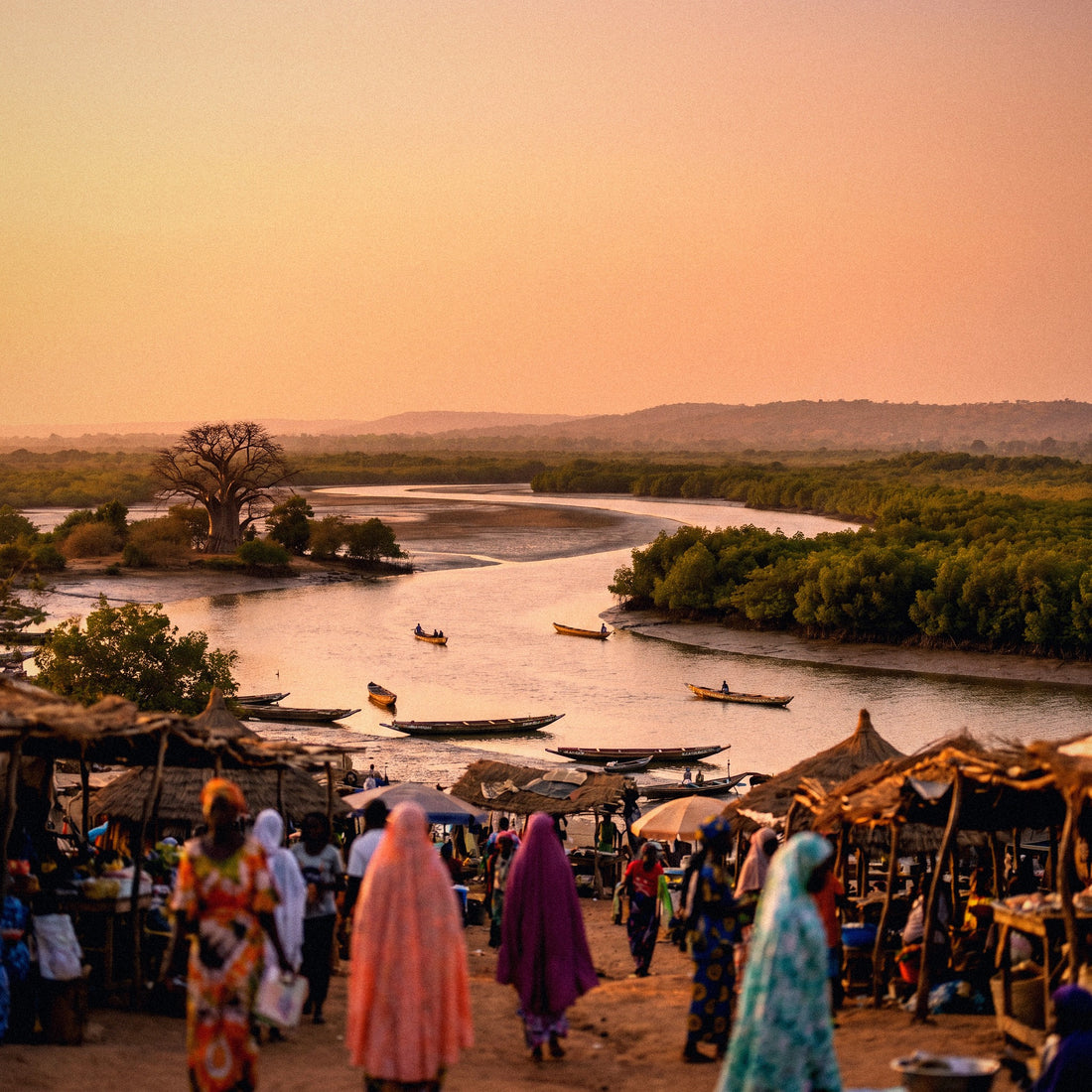
The important nuance is the geography. Gambia is a long, very narrow country, just a strip on both sides of the Gambia River, surrounded by Senegal on all sides except the river's mouth. This means that as soon as you move away from the coastal strip, coverage drops sharply: upriver, on river safaris and inland birdwatching, you'll get weak 3G or just voice service. The good news is you won't use data there even if you wanted to; the bad news is don't expect to upload that crocodile video live.
Add to that the fact that local data is cheap and almost all beach hotels offer Wi-Fi, and the result is that you don't need a huge data package in Gambia. If you want details on operators, speeds, and coverage by area, you can find them in the Gambia internet guide.
A warning about crossing into Senegal
This is the peculiarity that causes the most trouble and almost no one tells you about before you go. Because Gambia is a very narrow strip of land within Senegal, your phone is constantly near the border. In two very common situations in this destination—an excursion on the Gambia River and a crossing into Senegal (to Fathala, Casamance, or Dakar)—your phone will switch networks and countries without warning and connect to a Senegalese antenna, even if you are still physically in Gambia.
If your data plan is only for Gambia, the moment your phone picks up a Senegalese antenna, you will lose data—or be charged separately—even if you haven't actually crossed any border.
Two ways to protect yourself. One: if you know you're going to take a river cruise or a cross-border excursion, get a plan that covers both Senegal and Gambia (a regional West Africa eSIM), not just a single-country one. Two: if your plan is only for Gambia, go into your phone's network settings, turn off automatic operator selection, and manually set a Gambian operator while you are near the border. Be aware that the free roaming agreements between Senegal and Gambia starting in 2026 are for local SIMs of residents, not for a tourist eSIM. To choose the right type of plan, look at the eSIM options for Gambia and check if they also cover the neighboring country. This detail is worth more than an extra gigabyte.
How much each activity really consumes
Before deciding on your figure, it helps to see what data is being used for. The usual surprise is how little data is consumed by what you use most (maps, WhatsApp) and how much by what you think you use little (a bit of reels before bed). These are approximate real figures per activity:
| Activity | Approximate Consumption |
|---|---|
| WhatsApp (messages and voice notes) | 5-15 MB per day |
| WhatsApp, voice call | ~60 MB per hour |
| WhatsApp, video call | 300-500 MB per hour |
| Google Maps navigating | 5-10 MB per hour |
| Uploading a photo to social media or cloud | 2-5 MB per photo |
| Instagram / TikTok / social media | 600-900 MB per hour |
| Music streaming (Spotify) | 50-70 MB per hour |
| Video (YouTube, Netflix) normal quality | 500 MB-1 GB per hour |
Notice the jump between video and everything else: just one hour of reels or a series consumes more than a whole week of maps and messaging combined. That's why the honest recommendation for Gambia always revolves around video. If you're curious about the detailed figures, I break them down in the data usage statistics by activity.
How many GB according to your profile and days
Here's the core of the article. Find the row that best matches you and cross-reference it with the number of days you're staying. The table assumes a normal beach trip where you do use hotel Wi-Fi for heavy tasks (backups, series, updates). If you plan to completely ignore Wi-Fi and rely solely on data, move up one tier.
| Profile | 5 days | 10 days | 15 days | 30 days |
|---|---|---|---|---|
| Maps and WhatsApp (basic use) | 1 GB | 2 GB | 3 GB | 5 GB |
| Daily photos and social media | 3 GB | 5 GB | 7 GB | 12 GB |
| Digital nomad / remote work | 5 GB | 10 GB | 15 GB | 25 GB |
| Family sharing (2-4 mobiles) | 5 GB | 8 GB | 12 GB | 20 GB |
Two specific adjustments for Gambia. First: if you're spending days on a safari upriver, subtract rather than add, because there's hardly any coverage there and you won't use data—though serious remote work inland is not viable, you've been warned. Second: if your trip includes a river cruise or crossings into Senegal, what you need isn't more volume but rather a plan that covers the neighboring country, as I mentioned earlier. For a classic beach resort trip of one to two weeks, most people will fall into the first or second row and won't exceed 5 GB.
How to know your own consumption before you go
Don't just rely on my tables: your phone already knows how much you use. The most honest and reliable trick is to check your actual usage from the last month and extrapolate it to your travel days. On an iPhone, go to Settings, Mobile Data, and scroll down to see the total for the period; on Android, go to Settings, Network & internet, SIM, or Data usage. Many phones keep data for months, so reset it at the beginning of a month to get a clean picture.
With that number, do a simple rule of three: if you use 6 GB at home in 30 days, that's 0.2 GB per day, about 2 GB in ten days. Now adjust it for your trip. When traveling, you tend to use more maps and less video, because you're out and about, not on the couch, so for Gambia, I would keep the result about the same or slightly higher, not double.
If the world of eSIMs sounds like Greek to you and you don't even know how to install or top one up, start with the basics in what an eSIM is and how it works, then come back here with a clear figure. Buying by volume without knowing your pace is the easiest way to overpay.
Coastal hotel Wi-Fi
Gambia's Wi-Fi deserves a separate paragraph because it dictates whether you need 3 GB or 7 GB. In hotels and restaurants along the tourist coast—Kololi, Kotu, Senegambia—Wi-Fi is available in almost all, but the quality is so-so: it's fine for WhatsApp, email, and checking the weather, and not much else. Downloading a series or making a long video call can be an exercise in patience, and in many places, it gets saturated at night when everyone connects at once.
The strategy that works is to divide and conquer. Leave all heavy and non-urgent tasks for Wi-Fi—photo backups to the cloud, app updates, a chapter or two if it holds up—and use mobile data for what you need immediately on the street: maps, a taxi, finding a restaurant, sending a photo. This way, your data package lasts twice as long.
Upriver, things change: inland camps and lodges sometimes have slow and expensive satellite Wi-Fi, or none at all. If you're going on a river safari, assume you'll be disconnected for much of the day and download whatever you need beforehand. It's not a problem, it's part of the charm, but it's good to know.
Tips to stretch your data
If you want a small package to last your entire trip, four adjustments are more than enough. None complicate your life and all add up:
- Offline maps. Download the coastal area and your excursion routes in Google Maps before leaving the hotel. Navigating with downloaded maps uses almost no data and also works where there's no coverage, which in Gambia is half the country.
- Lower video quality. Set YouTube and Instagram to standard quality and disable automatic video playback in your feed. That alone can cut social media consumption in half.
- Backups only over Wi-Fi. Go into your photos and cloud settings and ensure they only upload when connected to Wi-Fi. This is the silent data drain that consumes the most gigabytes without you realizing it.
- Data saver mode. Activate it in your phone's settings and within each app; it stops background updates and synchronizations.
With all this, a normal beach traveler can nearly halve their actual data usage without giving up anything important. You can find the complete list, with screenshots, in the guide on tips to save data on your travels.
What happens if you run out
Let's address the question that's really bothering you: what if I'm too optimistic and run out of data halfway through my trip? Calm answer: nothing happens. With an eSIM, topping up is a matter of a minute from your phone, and on the coast, you have plenty of coverage to do it. Running out is a two-tap screen problem; overbuying is money you won't get back.
That's why my honest advice is to buy a suitable amount and top up if needed, not to overbuy "just in case." If you're torn between two sizes, go for the smaller one: almost no one uses up what they buy, especially in a destination with so much Wi-Fi and beach as Gambia. Here are the signs that you're running low and should top up before getting stressed:
| Sign | What to do |
|---|---|
| You've used half the package and are halfway through your trip | All good, keep going as is |
| You're halfway through your trip and already at 70-80% | Activate data saver and rely more on Wi-Fi |
| You get a low data warning | Top up with a small package, it takes a minute |
| You run out completely | Connect to the hotel Wi-Fi and top up from there |
The golden rule: it's better to buy a small amount and top up once than to carry gigabytes that will expire unused.
Frequently asked questions
Is 3 GB enough for a week at the beach?
For seven days at the beach with maps, WhatsApp, and a bit of social media, yes, 3 GB is ample. You would only run short if you watched a lot of video on data or made long video calls without using hotel Wi-Fi. In that case, jump to 5 GB.
Why does my phone say "Senegal" if I'm in Gambia?
Because Gambia is a very narrow strip surrounded by Senegal, and near the border, your phone connects to a Senegalese antenna. If your plan is only for Gambia, you'll lose data there. Manually set a Gambian operator or use a plan that covers both countries.
Can I rely on hotel Wi-Fi to barely use any data?
Yes for heavy tasks, no for daily use on the go. Coastal Wi-Fi works well for WhatsApp, email, and photo backups, but it gets saturated at night and you don't carry it with you. Save mobile data for maps and taxis.
How much data does a safari on the Gambia River consume?
Very little, because there's hardly any coverage upriver. You'll get weak 3G or just voice, so don't expect to upload video or do live streams. Download maps and anything you want to have before leaving the coast.
What do I do if I run out of data halfway through my trip?
Top up from your phone in a minute, without changing anything. With an eSIM, you can add a new package instantly; if you've run out completely, connect to the hotel Wi-Fi and top up from there. That's why it's wise to buy a suitable amount.
Do I need more GB if I'm going to make video calls home?
Yes: a video call consumes between 300 and 500 MB per hour, much more than everything else combined. If you're going to video call daily, do it over hotel Wi-Fi or add a couple of gigabytes to your package.
Should I buy data before flying or at Banjul airport?
Better before flying, with the eSIM already installed and ready to activate upon landing. You arrive connected without having to look for a store or stand in line, and you avoid the hassle of setting up a local SIM in a language you don't master.
Conclusion
In summary, without jargon: for a one to two-week beach trip in Gambia, most people will be fine with 3 GB, and with 5-7 GB, you'll be comfortable even if you upload photos daily or share with your partner. Only heavy video and video calls truly move the needle, and almost all of that can be saved for hotel Wi-Fi. Buy a suitable amount, rely on Wi-Fi for heavy usage, and top up if you run short: it's more cost-effective than carrying gigabytes that will expire.
And don't forget the detail that makes a difference in this destination: if you're taking a river cruise or crossing into Senegal, choose a plan that covers the neighboring country so your phone doesn't leave you stranded when it switches networks. Choose your data wisely and don't worry about the rest of the trip with a Gambia eSIM ready before you take off.