Searching for internet in Mali today is not the same as looking for it for a holiday. Mali has been off the tourist circuit for years, and those who travel there now usually do so for work: NGO personnel, international missions, people from the mining sector, civil servants, and members of the diaspora returning to see family. That's why this guide gets straight to the point and starts with what really matters before connectivity: security. Afterwards, I'll tell you about the actual network situation, how much Orange Mali, Moov Africa Malitel, and Telecel data costs, what happens with electricity and Wi-Fi, and which of the four ways to connect is best depending on your purpose.
First things first: what the Foreign Ministry says about traveling to Mali
In Bamako, you can connect without a problem: 4G network from Orange Mali or Moov Africa Malitel, unreliable Wi-Fi due to power outages, and mobile data as a backup. The most convenient option is an eSIM activated before flying; a local SIM requires a passport and in-store registration.
Now for the uncomfortable part. The Spanish Ministry of Foreign Affairs advises against travel to Mali and maintains the most severe warning: no tourism, and travel is strongly discouraged to the north and center of the country, as well as to border areas with Algeria, Niger, Burkina Faso, Mauritania, and Ivory Coast. The warning mentions a risk of attacks, the presence of armed groups, and kidnappings throughout the territory, including the capital itself, and recommends that Spanish residents consider temporary departure.
I'm not going to sell you a trip that authorities advise against. I am writing this for those who have already decided to go for work or family reasons, which is virtually everyone who lands at Bamako-Sénou airport today. If that's your case, three things before looking at rates:
- Consult the Foreign Ministry's travel recommendations sheet on the day of departure: it changes and is updated.
- Register with the Ministry's Traveler Registry. It takes two minutes and lets the consulate know you're there.
- Check your insurance: many policies exclude countries with an official negative recommendation. If you are going for work, get written confirmation from your organization.
And if you are traveling within the country, the official recommendation is clear: by plane, not by road. Roads in the center and north are riddled with improvised explosive devices, assaults, and kidnappings. This also affects connectivity, because the network is where effective territorial control exists.
How the internet works in Mali: operators and network
Mali has three licensed mobile operators and a fairly concentrated market. The regulator is the AMRTP (Autorité Malienne de Régulation des Télécommunications, des TIC et des Postes), which monitors coverage obligations and has publicly drawn attention to the third operator for not complying with them in recent years.
Orange Mali is the clear leader, with the most extensive network and the best deployed 4G. It is used by almost everyone, including international teams. Moov Africa Malitel is the former Malitel, heir to SOTELMA and a subsidiary of the Maroc Telecom group since its privatization; it competes on price and has a good presence in Bamako and regional capitals. Telecel (from the Planor Afrique group, formerly Alpha Telecom) arrived late—it launched commercially in 2018 after years of delays—and is the smallest: it mainly operates 2G and 3G, with a presence in Bamako, Sikasso, Kayes, and Ségou, and has received criticism from the regulator for its quality in peripheral areas.
The dominant technology in the country is still 3G, with 4G concentrated in urban centers. 5G is not even on the table in this market. The country's international connection is another bottleneck: Mali is landlocked and depends on submarine cables from neighboring countries, so a problem in Senegal or Ivory Coast is felt here. The telephone prefix is +223, and the official customer service language is French, with Bambara as the actual vehicular language.

Actual coverage: Bamako, regional capitals, inland, and desert
I'll be direct because this is where most people get disappointed. Coverage in Mali works well in Bamako and degrades quickly as you move away.
In Bamako, you have usable 4G in the neighborhoods where people who work here move: ACI 2000, Hippodrome, Badalabougou, Hamdallaye, the administrative center. Video calls, WhatsApp, email with heavy attachments, and normal browsing work well most of the day. During peak hours, the network gets saturated, and speeds drop, especially if you are near an event or a very dense area.
In the regional capitals—Sikasso, Ségou, Kayes, Koutiala, Mopti—there is coverage, and often 4G in the urban area, but it is more irregular: it alternates with 3G and stretches of only 2G in the outer neighborhoods. Between cities, the signal comes and goes along the road and large towns.
In the rural interior, the center, and the north, the reality is different. There are large areas without service, towers that have been out of service for a long time, and areas where the connection simply does not exist. In the Malian Sahara (Timbuktu, Gao, Kidal, Taoudenni), I assume you will be without data outside urban centers, and even within them, you cannot count on stable service. Anyone working in those regions uses a satellite phone, not a local SIM, and that is managed by the organization, not you.
Practical rule: if your work plan depends on being reachable outside Bamako and regional capitals, the solution is not a data card, but satellite equipment and an organizational communication protocol.
The four ways to connect, compared
On paper, you have four options, and in Mali, the differences between them are greater than in a normal tourist destination, because the mandatory registration, power outages, and the time you might lose in a store weigh heavily here.
| Option | Estimated cost | Advantage | Disadvantage |
|---|---|---|---|
| Roaming with your Spanish operator | Very high outside bundle; check rate per MB | You do nothing, it works upon landing | Mali is outside the EU: surprise bill almost guaranteed |
| Wi-Fi at hotel, base, or office | Included | Free and sufficient for email | Depends on the generator; goes down with power outages |
| Local SIM (Orange, Moov, Telecel) | From 1,000 FCFA (~1.5 €) for 2.5 GB | Lowest price per GB in the country | Passport, in-person registration, new number, need to top up |
| Travel eSIM | Fixed plan purchased before departure | Activates upon landing, no paperwork or queues | Requires compatible phone and download with Wi-Fi |
My honest summary: if you're on a two-week mission, an eSIM saves you the most annoying part of the first day, which is leaving the airport looking for a store with your passport in hand. If you're staying three months or more, or if you're going to make a lot of calls to Malian numbers, it eventually pays off to also have a local line with its local number. Many colleagues do exactly that: international data from the first minute and, at their leisure, a local line for daily use. I elaborate on this in this comparison between eSIM and local SIM.
Roaming with your Spanish operator: Mali is not the EU
Let's be clear to avoid unpleasant surprises: Mali does not belong to the European Union or the European Economic Area, so "Roam Like at Home"—the rule that lets you use your gigabytes in France or Portugal without paying extra—does not apply here. It also doesn't fall under the "Europe and Zone 1" bundles that many Spanish plans sell as international.
Mali usually falls into the most expensive zones in Spanish operators' catalogs, along with much of West Africa. There, data is billed per megabyte and at prices that hurt: a WhatsApp video, a map loading in the background, or an automatic backup can cost you more than the bus ticket from the airport itself. And calls and SMS are separate.
Some companies offer daily global roaming bundles with a data cap, and if your company pays the bill, it might be a convenient solution. But check two things first: that Mali is explicitly on the list of covered countries (often it isn't) and what happens when you run out of data. I have a breakdown of what each zone costs in this international roaming price guide, and a direct comparison with the alternative in eSIM vs. roaming.
If for some reason you decide to use your Spanish line, at least do this: activate the spending limit offered by your operator, disable background data, and turn off automatic photo backups. And check the consumption warning by SMS: in destinations outside the EU, it doesn't always arrive on time.
Hotel, base, and office Wi-Fi: electricity is the bottleneck
In Bamako, almost all mid-range and high-end hotels, NGO guesthouses, and offices have Wi-Fi. On paper, problem solved. In practice, there's a factor we don't consider in Europe: electricity.
Mali has been going through a severe energy crisis for years. The public company EDM-SA implements scheduled and unscheduled power cuts that, in many neighborhoods of the capital, amount to hours per day, and the situation has worsened with fuel supply problems affecting the country. What does this mean for your connection? The hotel router turns off, the operator's antenna runs on battery or generator until it dies, and Wi-Fi that worked fine at ten in the morning might be dead by four in the afternoon.
How people who work here cope with it:
- Ask about the generator when booking, not the Wi-Fi. The useful question is, "Is the router on the generator circuit?"
- Do heavy work in the morning: uploading reports, video calls, synchronizations.
- Carry a large external battery and charge everything when there's power, including your laptop.
- Have mobile data as a permanent backup plan: when Wi-Fi goes down, the mobile network usually lasts a bit longer.
- Download offline maps and the documents you'll need that day.
And the usual: on shared hotel Wi-Fi, if you handle sensitive data—and in cooperation, sensitive data is handled—use your organization's VPN. It's not paranoia; it's basic hygiene.

Local SIM: Orange, Moov Africa Malitel and Telecel
Buying a Malian SIM is cheap and perfectly feasible, but it's an in-person process. The law requires registration with a passport: you are identified, your details are recorded, and the line is activated. It usually takes 10-20 minutes at an official store, and it's best to bring your physical passport, not a photocopy. There are operator sales points at Bamako-Sénou airport and dedicated stores throughout the capital. Street vendors sell pre-registered SIMs under someone else's name: avoid this; it's a sure problem if you need to make a claim.
Approximate data prices in mid-2026 (the CFA franc is pegged to the euro at 655.957 XOF, so the conversion doesn't change):
| Operator | Data plan | Price | Equivalent |
|---|---|---|---|
| Orange Mali | Day pass, 80 MB | 100-150 FCFA | ~0.15-0.23 € |
| Orange Mali | Week pass, from | 500 FCFA | ~0.76 € |
| Orange Mali | 2.5 GB | 1,000 FCFA | ~1.52 € |
| Orange Mali | 12 GB / 30 days | 5,000 FCFA | ~7.60 € |
| Orange Mali | 30 GB / 30 days | 10,000 FCFA | ~15.25 € |
| Orange Mali | 45 GB / 30 days | 15,000 FCFA | ~22.90 € |
| Moov Africa Malitel | 16 GB / 30 days | 4,500 FCFA | ~6.90 € |
| Telecel | 2G/3G data pass | Check in store | — |
Orange also sells night passes (between 250 and 2,000 FCFA, from 600 MB to 8 GB, valid from 11:00 PM to 7:00 AM) which are very cost-effective if your heavy work involves uploading files in the early hours. Top-ups can be done with vouchers at any kiosk or via Orange Money, which is almost as important as the data network here. My advice: stick with the operator used by your team on the ground, because they already know which antenna works in each neighborhood.
eSIM: why it suits missions, business, and diaspora
An eSIM is a card that doesn't physically exist: it's downloaded to your phone as a profile and activated when you enter the country. If you've never used one, here's an explanation of what an eSIM is and how it works. In Mali, it solves three specific problems that are not theoretical.
The first is the first day. You land, leave the terminal, and need to contact whoever is picking you up. With the eSIM already installed from home, you have data before going through customs; with a local SIM, you depend on whether the counter is open and whether there's a queue. In an airport where it's not advisable to wander around, that's worth a lot.
The second is keeping your Spanish number. The eSIM runs parallel to your usual line, so you continue to receive SMS from your bank, two-factor verification codes, and calls from home. Changing physical cards and losing access to online banking in the middle of a mission is a huge hassle.
The third is cost control. You buy a closed plan, you know what you've paid, and there's no surprise bill upon return. For those traveling on behalf of an organization, this also simplifies expense justification. I've compiled the specific options for the country in the Mali eSIM guide.
Two honest caveats: you need a compatible mobile (iPhone XS or later, Pixel 3 or later, recent high-end and mid-range Samsung, Xiaomi, Motorola) and unlocked by the operator. And, most importantly, a digital card does not create coverage where there isn't any: in the north and the desert, it won't save you, because it relies on the same Malian antennas as everything else.
How much data you need according to your profile
In Mali, it's advisable to estimate on the high side, not because you'll "use a lot," but because when Wi-Fi goes down with the power, you'll be using mobile data many more hours than anticipated. Here's my estimation by actual traveler profile to the country:
| Profile | Typical Use | Recommended Data |
|---|---|---|
| Short NGO mission (7-10 days) | Email, WhatsApp, reports, some video calls | 10-15 GB |
| Long deployment (1-3 months) | Daily remote work, meetings, cloud | 30 GB/month or rechargeable local SIM |
| Business trip (mining, gold, import) | Heavy email use, calls, screen sharing | 15-20 GB per long week |
| Diaspora visiting family | Video calls to Europe, photos, social media | 20-30 GB per month |
| Very short technical stay (2-3 days) | Messaging and maps only | 3-5 GB |
Quick reference for calculating your usage: one hour of video call in standard quality consumes around 0.5-1 GB; one hour of HD video, about 1.5-2 GB; WhatsApp text and voice, less than 100 MB per day; browsing and email, about 200-300 MB daily. If you plan to make long video calls to Spain, that alone could double your consumption.
A note for the business profile, which in Mali heavily revolves around gold—the country is one of the continent's major producers, with operations concentrated mainly in the Kayes region and in the south: if your work involves going to a mining site, ask beforehand about the communication system there. Many operations have their own satellite link because they cannot depend on the public network, and your data card might simply be decorative there.
Timbuktu, Djenné, Dogon Country, and the Niger River: The Mali That Cannot Be Visited Today
It must be stated clearly, because there are guides who still write about Mali as if it were 2010. The heritage that made this country famous is not normally accessible today.
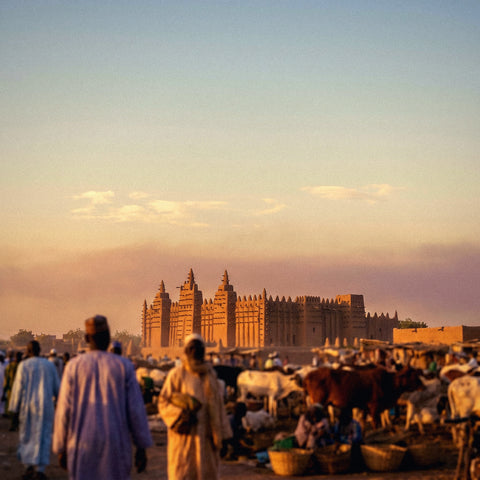
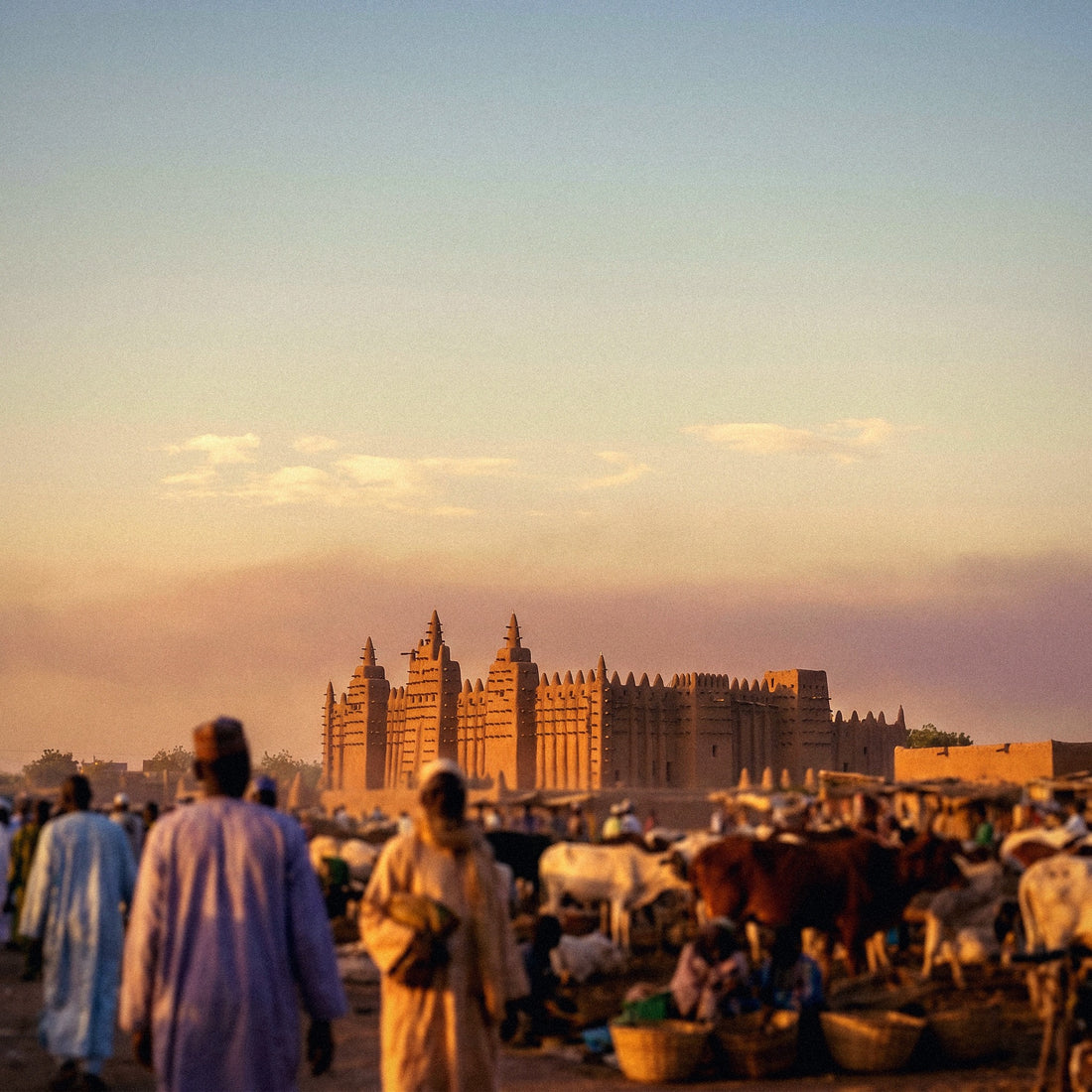
Timbuktu, the city of mud mosques and manuscripts, is in the north, in an area completely unadvised by the Foreign Ministry, with road access out of the question. The Great Mosque of Djenné, the largest mud-brick building in the world and one of Africa's iconic images, is in the Mopti region, right in the center of the country, the area most affected by the conflict in recent years. Dogon Country, with its villages clinging to the Bandiagara escarpment, was West Africa's great trekking destination and is now a territory of military operations. The Niger River, which was the main route for pinasses between Mopti, Timbuktu, and Gao, has seen attacks on passenger boats. Several of these sites are on UNESCO's World Heritage in Danger list, and it's not a symbolic label.
What remains alive and travels on its own is Malian music. Ali Farka Touré, Toumani Diabaté and his kora, Salif Keita, Amadou & Mariam, Tinariwen, Oumou Sangaré: few countries of any size have given so much. The legendary Festival au Désert in Essakane has not been held in its original location since 2012, but Bamako still has a vibrant scene, clubs, and recording studios. If you're in the capital and have a free night and your organization's security clearance, it's the most Malian thing you'll be able to do.
Frequently Asked Questions
Can I travel to Mali as a tourist?
It is not recommended: The Foreign Ministry advises against travel to Mali and considers the north, center, and border areas to be completely unadvised. Conventional tourism has been practically halted for over a decade. Those who travel today do so for cooperation, international missions, business, or family visits, and always with security protocols. Check the updated official information before buying any tickets.
Does my Spanish mobile work in Mali?
Yes, technically it works, but on roaming at expensive rates: Mali is outside the EU and "Roam Like at Home" does not apply. Malian GSM, 3G, and 4G bands are compatible with European mobiles, so connectivity is not the problem; the problem is the bill. Check your operator's per-megabyte rate and activate the spending limit before you leave.
Which operator has the best coverage in Mali?
Orange Mali, without question: it has the most extensive network and the best 4G in the country. Moov Africa Malitel works well in Bamako and regional capitals and competes on price per gigabyte. Telecel is the third, much smaller, with a predominantly 2G/3G network and limited presence in Bamako, Sikasso, Kayes, and Ségou.
Do I need my passport to buy a SIM in Mali?
Yes, passport registration is mandatory by law and is done at the time of purchase. Bring the physical document, not a copy, and buy from an official store or authorized operator point: the process takes between 10 and 20 minutes. Avoid pre-activated cards sold on the street, as they are registered in a third party's name.
How much does mobile data cost in Mali?
Very little in European terms: about 1,000 FCFA (~€1.5) for 2.5 GB and around 10,000 FCFA (~€15) for 30 GB per month with Orange. Moov Africa Malitel offers 16 GB for 4,500 FCFA (~€6.9). The CFA franc is pegged to the euro at 655.957 XOF, so equivalences do not fluctuate. Exact prices change, confirm them on the operator's website.
Is there coverage in Timbuktu and the desert?
Very limited or non-existent: outside Bamako and regional capitals, you cannot count on mobile data. In the Saharan north, there are entire areas without service and non-functional towers. Those who work in these regions do so with satellite equipment and their organization's communication protocols, never relying on a commercial data card.
Why does the Wi-Fi in Bamako go out so often?
Due to electricity cuts: Mali is experiencing an energy crisis with blackouts that in many neighborhoods last for hours each day. When the power goes out, the hotel's router shuts down and mobile antennas run on batteries or generators until they are depleted. That's why it's advisable to book at places with a generator connected to the router, do heavy work in the morning, and carry an external battery.
Is an eSIM useful if I go with an NGO to a rural area?
It's useful for Bamako and for travel through regional capitals, but it doesn't replace satellite equipment in the interior. A digital card uses exactly the same Malian antennas as any other line: if there's no network, there's no connection. Use it as an urban and transit tool, and leave communication on the ground to your organization's protocol.
Conclusion
To summarize the key points. Mali is a destination unadvised by the Foreign Ministry, with the north and center completely restricted, and this guide is intended for those who travel there for work or family reasons. In Bamako, you can connect well with Orange Mali or Moov Africa Malitel; in regional capitals, it's somewhat irregular; and in the interior and desert, there's nothing to count on. Hotel Wi-Fi exists but depends on a generator, so you absolutely need mobile data as a backup. A local SIM is very cheap—2.5 GB for 1,000 FCFA, about €1.5—but requires a passport and in-person registration, and your Spanish line on roaming is the fast track to an unpleasant bill.
If you want to land already connected, without queues and without losing your Spanish number, sort it out from home with a PuraSIM eSIM for Mali: you install it before flying and it activates automatically upon arrival. And if you were considering a portable router for your team, first check out this comparison between eSIM and pocket Wi-Fi, because in a country with power outages, an extra device to charge is not always a good idea. Have a good trip and, above all, be cautious.