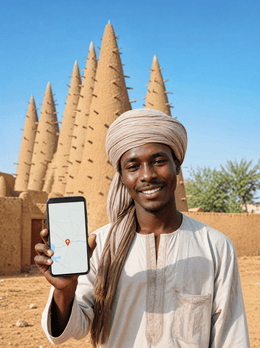
If you're looking for information about internet in Chad, it's highly likely you're not going on vacation. You go to Chad with an NGO, with an international mission, with an oil company, or with a Sahara expedition prepared for months. And in all four cases, connectivity stops being a convenience and becomes pure logistics. I'll tell you without embellishment: this is one of the countries with one of the most fragile connections on the planet, with expensive data relative to people's income, and with vast areas where a mobile phone simply doesn't work. Before continuing, a warning that I will repeat several times: always consult the official recommendations of the Spanish Ministry of Foreign Affairs before traveling around the country.
What the internet in Chad is really like
In Chad, you connect with a data eSIM over the Airtel Tchad or Moov Africa Tchad networks, which cover N'Djamena and provincial capitals with 4G. Outside the cities, coverage disappears: in Ennedi, Ounianga, or Zakouma, the only reliable link is a satellite phone.
Let's look at the numbers, because they explain everything else. Chad closed 2025 with an internet penetration of around 13% of the population, one of the lowest in the world, while the global average is around 72%. In other words: barely thirteen out of every hundred Chadians regularly use the internet. 4G coverage reaches just over half the country in terms of population—the most cited estimates speak of 51%—and that percentage is concentrated in a handful of cities. There is no 5G network deployed.
The second part of the problem is the price. In absolute terms, a gigabyte in Chad costs around $4 on average, with plans ranging from about $2 to nearly $40 per GB depending on the bundle you buy. It's not the most expensive in the world in dollars, but it is very expensive relative to income: it is estimated that a Chadian user dedicates around 21% of their income to mobile telephony, compared to a global average of 4.7%. This explains why most people buy tiny 200 MB bundles for 24 hours instead of monthly plans.
Translated to your trip: the network exists, it works reasonably well where it exists, and it disappears as soon as you leave the paved roads. Plan accordingly.
Before coverage: what the Foreign Ministry says
This comes first because it's more important than any tariff. The Spanish Ministry of Foreign Affairs maintains specific and restrictive recommendations for Chad, and it's advisable to read them in full and updated before buying your ticket. The points that are repeated year after year:
- Border areas: It is recommended to completely avoid a band of at least 30 km along the borders with Libya, Sudan, Central African Republic, Niger, Nigeria, and Cameroon.
- Lake Chad Region: Remains under a state of emergency due to the terrorist threat from Boko Haram, and navigation on the lake is prohibited. It is not a tourist destination, no matter how much it appears on maps.
- Saharan North (Tibesti, Borkou, Ennedi): Sensitive area, with the presence of armed groups and mines in some areas. Tours to Ennedi are done with authorized operators, circulation permits, and, depending on the area, escort.
- Travel on foot: Discouraged throughout the territory.
Additionally, to enter you need a visa and a yellow fever vaccination certificate. And a common-sense recommendation: register with the Ministry's Traveler Registry before you leave, so the Embassy knows where you are.
If you are traveling with an NGO, an oil company, or an international mission, your communications plan is not decided by you: it is decided by your organization's security department. This guide serves to help you understand the terrain and cover your personal needs, not to bypass their protocols.
Nothing you read here replaces the official country information. Consult it the day before you fly: things change quickly in Chad.

Your four options for connecting
As with any destination, you have four paths, and none of them are perfect. The difference is that in Chad, the distances between them are much greater than in Europe, and there is a fifth element—satellite—which in other countries is a luxury and here is a working tool.
| Option | Cost | Where it works | Who it makes sense for |
|---|---|---|---|
| Spanish Roaming | By far the most expensive option; outside the EU bundle | Where there is Airtel or Moov network | Stays of 24-48 h with the company paying |
| Hotel or base Wi-Fi | Included, or with a password | Hotels in N'Djamena, NGO bases, some camps | Email and messaging at night, nothing heavy |
| Local SIM | From 400-500 FCFA (€0.60-0.76) for 200 MB/24 h | National coverage of your operator | Long missions, if you have time for registration |
| Data eSIM | Fixed bundle purchased before flying | On the same local networks | Almost everyone: activate on the plane and you're good to go |
My summary: if you're staying less than a month, an eSIM saves you the most cumbersome part of the trip, which isn't the price, it's the paperwork. If you settle in N'Djamena for six months, you'll end up with a local Chadian line anyway, even if just for calls. And if you go to the desert, none of the four options will save you: that's what satellite is for. If you want the full details of each path, I have a complete comparison in the eSIM guide for Chad.
Roaming with your Spanish operator
There's no ambiguity here: Chad does not belong to the European Union or the European Economic Area, so "Roam Like at Home"—that included roaming you use in France or Italy—does not apply. Your Spanish tariff does not travel with you. And Chad is not just any destination in operator tables: it usually falls into the most expensive zone of all, where megabytes are billed at dizzying prices, and in some cases, it's not even included in the international travel bundles sold daily.
The classic result is a three-figure bill for doing practically nothing: a few photos uploaded by accident, automatic mobile updates, and two short video calls. Before you fly, go to your operator's client area, find Chad in their country list, and see exactly what zone they assign it and what bundle they offer. If it doesn't appear, assume the worst.
What I do recommend, and this is free: activate the roaming consumption limit that your operator is obliged to offer you, and deactivate roaming data in your phone settings as soon as you land. You can decide what to turn on later.
That said, there is one case where roaming pays off: a 36-hour layover in N'Djamena with the company covering the bill and zero desire to manage anything. For everything else, any alternative is better. If you want to see the numbers compared calmly, I break them down in how much international roaming costs and in eSIM vs. roaming.
Hotel, base, and camp Wi-Fi
Wi-Fi exists in Chad, but it's important to temper expectations. In N'Djamena, international hotels and accommodations working with organizations and companies offer connection in rooms or at least in the lobby. It works for email, WhatsApp, and basic browsing. As soon as you try a video call in the evening, when everyone is connected, it consistently crashes.
Outside the capital, the situation changes completely. Accommodations in Moundou, Abéché, or Sarh have very irregular connections, often a simple 4G router shared by the entire building. At NGO bases and oil company camps, there is usually VSAT (fixed satellite internet), but it's a corporate network: you only get access if given credentials, and with the restrictions set by the organization. Don't count on it for personal use.
Two more things. First: power outages are frequent outside the capital, and without electricity, there's no router. Bring a power bank and, if you'll be there for weeks, a small solar panel. Second: any open Wi-Fi in a lobby is a network you don't control, so use a VPN if you're going to access corporate email or banking. In short, Wi-Fi in Chad is a supplement, never your main plan. If you were thinking about a portable router, in eSIM vs. pocket Wi-Fi I explain why it almost never pays to carry such a device in destinations like this.
Local SIM: Airtel Tchad and Moov Africa Tchad
The two actual mobile operators in the country are Airtel Tchad and Moov Africa Tchad. Together they share virtually the entire market, and their coverage is very similar: good in N'Djamena, acceptable in provincial capitals and along the southern axis, and practically nonexistent in the Saharan north. Airtel has a reputation for being slightly better in the capital; Moov competes by lowering prices.
| Operator | Bundle | Price | Approx. Equivalent |
|---|---|---|---|
| Airtel Tchad | 200 MB / 24 h | 500 FCFA | ≈ €0.76 |
| Airtel Tchad | 1 GB | 1,500 FCFA | ≈ €2.29 |
| Moov Africa Tchad | 200 MB / 24 h | 400 FCFA | ≈ €0.61 |
| Moov Africa Tchad | 1 GB / 24 h | 1,000 FCFA | ≈ €1.52 |
The currency is the Central African CFA franc (XAF), with a fixed parity against the euro: €1 = 655.957 FCFA. That's an advantage, because the exchange rate won't surprise you. Note the important detail in the table: almost all cheap bundles expire within 24 hours. This is the local consumption model, designed for daily top-ups of small amounts, and it fits poorly with a traveler who wants to forget about it.
The other obstacle is registration. Buying a SIM in Chad requires identifying yourself with your passport at an official point of sale, filling out the form, and waiting for the line to activate. Nothing impossible, but it can take half a morning between the store, the queue, and topping up. Always buy them at an official store, never from a street vendor: unregistered lines are deactivated. More nuances in eSIM vs. local SIM.

The eSIM: why I recommend it
An eSIM is a SIM card that is already soldered inside your mobile phone and is activated by downloading a profile. There's no plastic, no store, no queue. You buy the bundle before leaving Spain, install it with Wi-Fi at home or at the airport, and upon landing in N'Djamena, you activate it and have data. If you've never used one, I explain how it works step-by-step in what an eSIM is.
In Chad, this has three specific advantages. First, you avoid the passport registration process, which is no small feat in a country where paperwork is slow. Second, you keep your Spanish number active on the other line to receive SMS from your bank, NGO, or airline, something you can't do with a local SIM if your phone only has one slot. Third, the bundle is fixed: you know what you've paid before getting on the plane, with no surprises upon return.
Now, for the honest part. An eSIM in Chad connects to the same networks as a local SIM: if Airtel and Moov don't reach a place, the eSIM won't either. It doesn't do magic. And data eSIMs usually don't give you a Chadian number for local voice calls, which matters if you need to coordinate with drivers, fixers, or field staff who rely on calls. In that case, the efficient approach is to combine: an eSIM for your data from minute one, and, if the mission is extended, a local line for voice when you have free time in the capital.
N'Djamena, Moundou, and the oil-producing areas
N'Djamena is where connectivity truly works. In the city center, the administrative district, the embassy area, and around the airport, you'll have decent 4G most of the time. There's saturation during peak hours and occasional outages linked to power supply, but you can work. This is the place where it's advisable to download offline maps, sync everything, and send heavy files before heading anywhere else.
Outside the capital, the network follows the southern axis, which is where most of the population lives and where economic activity is concentrated: Moundou, Sarh, Doba, Kélo, Bongor. In these cities, there is reasonable mobile coverage, with 4G in the core areas and 3G or 2G in the surroundings. The Doba oil basin, due to the activity it concentrates, is better served than the rural average, although much of that connectivity is corporate and not public.
To the east, Abéché maintains coverage as a regional capital and humanitarian logistics hub, as do Mongo and Ati in the center. But as soon as you move away from the main tracks, the coverage map ends long before the road does. You can travel a hundred kilometers between two points with signal without seeing a single bar.
Practical advice: treat each city as a "digital charging station." Arrive, sync, send your report, notify your people when you'll be back online, and then leave assuming complete silence until the next one.
Ennedi, Ounianga, and Zakouma: the realm of satellite
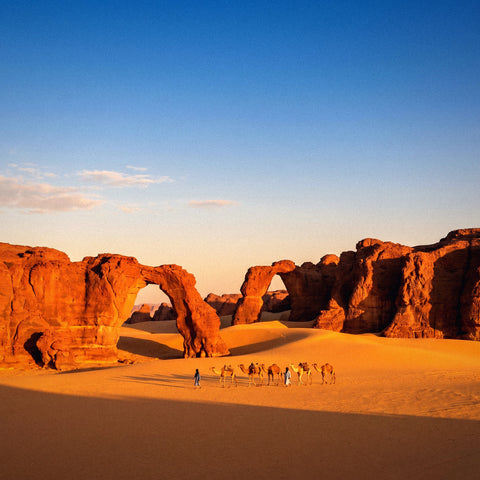
Here's the heart of this article, and I'll be very clear. The Lakes of Ounianga—eighteen lakes in the heart of the Sahara, a UNESCO World Heritage site since 2012—and the Ennedi Massif—sandstone arches, gorges, rock paintings, and the Nile crocodiles of Guelta d'Archei, also a World Heritage site since 2016—are among the most spectacular landscapes that exist. And they have no mobile coverage whatsoever. None. Expeditions that reach there last for weeks, are organized in convoys of 4x4s with fuel, water, and spare parts, and spend entire days without encountering an antenna.
In that context, a satellite phone stops being a luxury and becomes a safety essential. An Iridium or Thuraya terminal, or a Garmin inReach-type communicator with an active subscription and SOS button, is the only thing that works in Ennedi, Ounianga, Tibesti, and Borkou. Your eSIM and local SIM are useless there. Check before you go: in several Sahel countries, satellite equipment requires prior declaration or authorization, so have your expedition operator confirm the paperwork.
Zakouma National Park, in the southeast, is another story. It is one of Africa's great conservation success stories: its elephant population plummeted from over 4,000 in the early 2000s to about 450 in 2010 due to poaching, and since African Parks took over management, poaching has been almost completely halted and the herd has grown again. Today it receives scarce, high-end safari tourism, with a lodge and seasonal camp during the dry season. There is camp Wi-Fi in common areas when the generator and link cooperate, but inside the park, you will not have mobile data.
| Travel Profile | Recommended Data | Essential Equipment |
|---|---|---|
| Short mission in N'Djamena (3-5 days) | 3-5 GB | eSIM + power bank |
| Humanitarian staff, 1-month base | 15-20 GB | eSIM + local voice line |
| Oil rotation (Doba and south) | 10-15 GB | eSIM + field VSAT access |
| Safari in Zakouma (1 week) | 5 GB | eSIM + offline maps and books |
| Ennedi / Ounianga Expedition | 5 GB (cities only) | Satellite phone + SOS beacon + solar |
Frequently Asked Questions
Does my eSIM work in the Ennedi Massif or at the Lakes of Ounianga?
No. There is no mobile network in these areas, neither Airtel nor Moov, so no eSIM or local SIM can connect. It is exclusive territory for satellite phones or communicators with an SOS beacon. Your eSIM will work again when you return to a city with an antenna.
Is Chad included in the European Union's free roaming?
Absolutely not. Chad is not part of the EU, EEA, or an outermost region, so "Roam Like at Home" does not apply, and your Spanish tariff does not travel with you. It usually falls into the most expensive tariff zone for operators, if included at all. Disable data roaming upon landing.
How much does 1 GB of data cost in Chad?
Between 1,000 and 1,500 FCFA (about €1.50-2.30) for local Moov Africa and Airtel bundles, though many expire within 24 hours. The country average is around $4 per GB. Cheap for a European, very expensive for a Chadian: telecommunications account for more than 20% of the average income.
Do I need a passport to buy a local SIM?
Yes. Line registration is mandatory in Chad: you must identify yourself with your passport at an official Airtel or Moov point of sale and fill out the form before the line is activated. Never buy SIMs from street vendors; those lines end up disconnected.
Is there 5G in Chad?
There is no commercial 5G network deployed. The best you'll find is 4G in N'Djamena and major provincial capitals, with 3G and 2G in other covered areas. 4G coverage reaches approximately half the population, heavily concentrated in the southern urban corridor.
Which areas does the Ministry of Foreign Affairs advise against in Chad?
The border strips and the Lake Chad region, at a minimum. The Ministry of Foreign Affairs recommends avoiding a band of at least 30 km along Libya, Sudan, Central African Republic, Niger, Nigeria, and Cameroon, points out the state of emergency in the Lake Chad region, and advises against travel on foot. Consult the updated official fact sheet before traveling.
Is there Wi-Fi in Zakouma National Park?
Only camp Wi-Fi, and it's limited. The lodge and seasonal camp usually offer satellite connection in common areas, subject to generator and schedules. Inside the park, on safari routes, there is no mobile data. Download maps, guides, and music before entering.
Is it worth renting a satellite phone?
If you're going to the desert, yes, and it's not optional. For Ennedi, Ounianga, Tibesti, or Borkou, it's the only link that works and is part of the safety equipment, along with the SOS beacon. Confirm paperwork with your expedition operator: satellite equipment may require prior authorization.
Conclusion
Chad is not a destination where you can improvise with connectivity. In summary: in N'Djamena and the southern corridor, you'll have reasonable 4G from Airtel Tchad or Moov Africa Tchad; local bundles are cheap in euros but expire within 24 hours and require passport registration; Spanish roaming is the most expensive option because Chad is outside the EU; and in the Ennedi, the Lakes of Ounianga, or inside Zakouma, there is no mobile network that works, only a satellite phone. And above all, review the official recommendations from the Ministry of Foreign Affairs and respect the advised-against areas: borders, Lake Chad, and the northern Sahara.
For the part you can control—data in the city—the simplest way is to arrive connected from the first minute with the PuraSIM eSIM for Chad: install it before you fly, activate it upon landing, and forget about queues, forms, and surprise bills. Have a good trip, and come back to tell me about it.