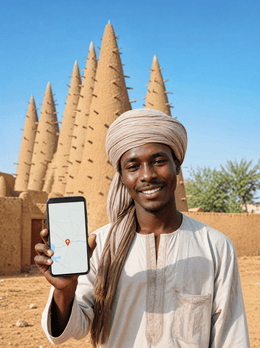
In short: an eSIM for Chad gives you mobile internet as soon as you land in N'Djamena, without expensive roaming or a local physical SIM. 4G coverage is concentrated in the capital and main cities; in the Sahel and inland, it drops to 3G/2G or disappears. It activates in one minute from Spain.
Chad is not a mass tourism destination or a weekend getaway. People go for work, cooperation, research, or a true adventurous spirit, and precisely for this reason, it's a good idea to sort out your connection before you get on the plane. With an eSIM for Chad, you'll have mobile data from the moment you step foot in N'Djamena airport, without having to search for a local SIM kiosk with your passport in hand or activating roaming that could send your bill skyrocketing without warning. In this guide, we review the country's actual coverage, which operators are behind the network, how many GB you should carry, and how to get everything activated before you leave home.
What is an eSIM in Chad and how does it work?
An eSIM is a digital SIM card that is installed by software on your mobile, without a physical tray or plastic cutout. If you don't know about it yet, we explain it from scratch in the guide to what a virtual eSIM is. For Chad, it works the same as in any other destination: you buy and install it online before you travel, using your home Wi-Fi, and it is saved on your phone, ready for use.
Upon landing in N'Djamena (Yamena), you activate the data plan for that line, and your phone automatically connects to the available mobile network, just as a physical SIM bought there would. You don't need to change your number: your Spanish line continues to receive calls and SMS if you leave it active, and the eSIM only handles data. This is the same logic that avoids traditional roaming, the system by which your home operator charges you for using foreign networks; to fully understand this difference, the guide to what data roaming is explains it in detail.
It's important to arrive with realistic expectations. Chad is a Sahel country with a telecommunications infrastructure that is considerably more limited than Europe's, and no eSIM in the world can change that. What it does achieve is saving you from exorbitant roaming charges and the hassle of buying a local line. You can get your eSIM for Chad ready from Spain and take off with everything already configured.

Actual coverage: N'Djamena and the rest of the country
This is the question that really matters before booking your flight: what is the actual network coverage in Chad? The short answer is that it is clearly concentrated in a few points on the map. N'Djamena, the capital, is where the network is most developed, with functional 4G in a large part of the city for browsing, using maps, and making internet calls without issues. Secondary cities such as Moundou, Sarh, or Abéché also have reasonable coverage, usually 3G or limited 4G depending on the area.
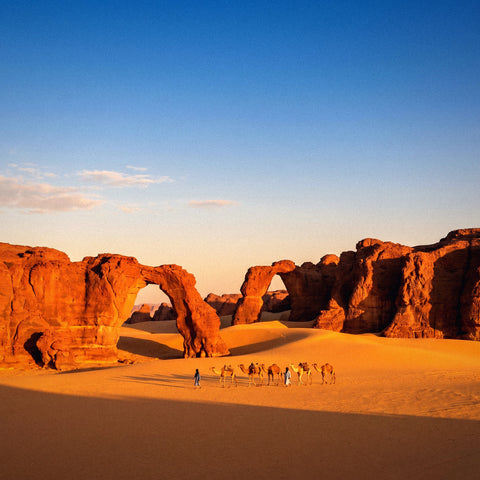
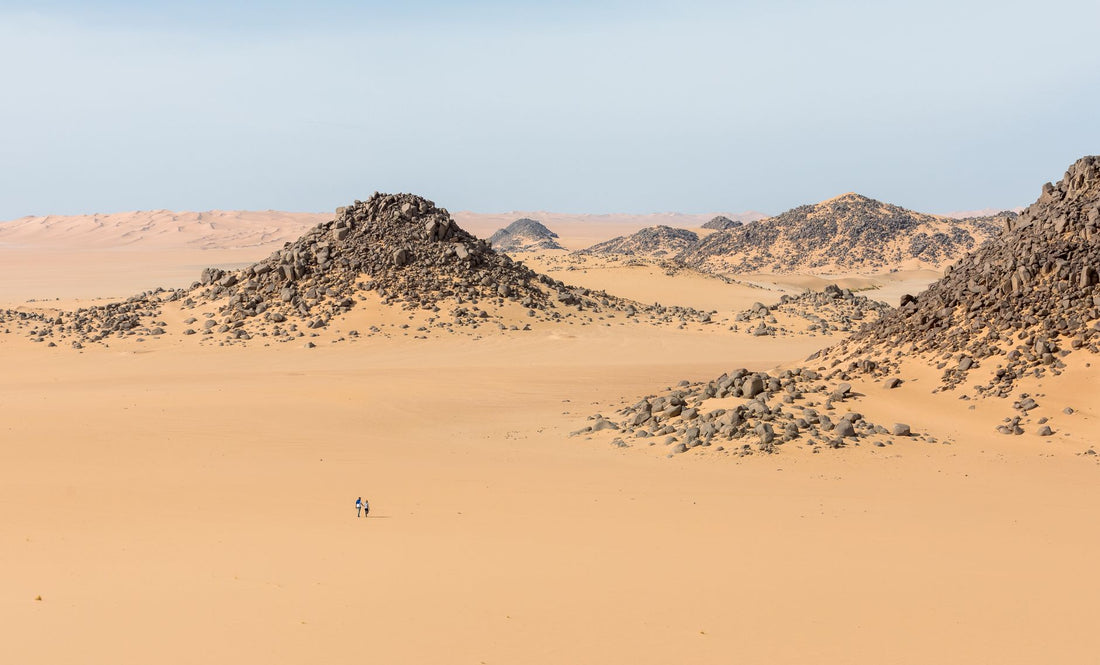
Outside these urban centers, network coverage in Chad drops significantly. In the desert interior, on routes to Lake Chad, and in much of the Sahel, it is common to find intermittent 2G or a complete absence of signal for long stretches. This is not a fault of the eSIM or the operator: it is the reality of a huge territory, with very low population density and unevenly distributed antennas.
In practical terms: in N'Djamena, you'll have more than enough to work and navigate with real-time maps. On a road trip to the south or to rural areas, however, you should expect stretches without data, sometimes for several hours. That's why the recommendation that makes a difference is to download offline maps and save important travel information before leaving the capital.
Useful tip: download your route on Google Maps or Maps.me using Wi-Fi at your N'Djamena hotel before heading inland. In the Sahel, coverage is intermittent, and offline maps can save you from trouble when the network simply doesn't reach.
If your itinerary combines Chad with neighboring countries such as Cameroon, Niger, or Nigeria, or if your African route also passes through the Indian Ocean, check out other destinations with similar network logic, such as the eSIM for Comoros guide, to get an idea of how coverage behaves in different parts of the continent.
Local operators in Chad
The Chadian mobile market is shared by a handful of operators, and any travel eSIM relies on their infrastructure to provide service. You don't choose which one to use: the system automatically selects the available network with the best signal at any given moment. Still, it's good to know who's who:
| Operator | Coverage Notes | Typical Technology |
|---|---|---|
| Airtel Chad | Extensive national presence, good coverage in N'Djamena and major cities | 4G / 3G |
| Moov Africa Tchad | From the Millicom group, solid and expanding urban coverage | 4G / 3G |
| Salam (Sotel Tchad) | Historic state operator, more limited network outside large urban centers | 3G / 2G |
With an eSIM, you avoid the inconvenient part of this setup: you don't have to decide which local operator to choose, go to a store to buy a card, or register with your passport, which is usually required for physical lines at your destination.

eSIM or physical SIM card: what's best for you in Chad
This is the question most people have before traveling to a destination like this: should I buy a SIM card in Chad upon arrival, or should I sort out my connection from home? Both options exist, but they don't carry the same weight in practice.
Buying a physical SIM card in Chad means finding a reliable point of sale as soon as you land, going through the passport registration required by local operators, and waiting for the line to activate, all while feeling tired from your flight. In return, it can be economical if you're staying for a long time and need a Chadian phone number for local matters.
An eSIM, on the other hand, you activate before leaving Spain, using your home Wi-Fi, and in N'Djamena, you just need to turn on the data for that line. There are no queues, no in-person registration, and you keep your Spanish number intact for SMS and calls if you need it. It's the logical option for short or medium stays and business trips. If you want a complete comparison between both options, check out the guide on international chip versus eSIM.
Chad, Tchad, Tsjaad: one country, several names
One detail worth clarifying: if you search for information about this destination in different languages, you'll see that the country's name changes depending on the language. In Spanish and English, it's Chad; in French, one of its official languages along with Arabic, it's written Tchad; in Dutch, it appears as Tsjaad; and in Arabic, it's written تشاد. It's the same country, the same capital, N'Djamena, and exactly the same mobile network, so if you've come this far searching in any of those variations, everything this guide explains applies to you just the same. This is useful if you're coordinating your trip with international colleagues who search for the destination under a different name than yours.
How much data do you need for your trip?
Chad is primarily a destination for work, cooperation, or adventure, not for uploading content to social media every five minutes. Still, it's wise to calculate your GBs carefully so you don't run out halfway through your stay. This indicative guide helps you choose a plan based on the number of days:
| Traveler Profile | Typical Use | Recommended Data |
|---|---|---|
| Essential (maps + messaging) | WhatsApp, maps, occasional email | 1 GB per week |
| Standard (normal travel) | Social media, some video, browsing | 3 GB per week |
| Intensive (work/streaming) | Video calls, photo uploads, cloud, remote work | 5 GB or more per week |
If your trip includes frequent video calls with home or the office, add more allowance: they consume more than it seems, especially if the signal is weak and the phone constantly readjusts quality. To fine-tune the calculation according to your consumption style, the guide on tips to save data abroad will help, with guidelines that work just as well in Chad as in any European city.
Regarding price: travel data plans are charged by GB volume and validity days, not by a fixed daily charge like traditional roaming. Always check the current price at the time of purchase, as these rates are updated quite frequently.
How to activate your eSIM in Chad step by step
It's best to get everything ready at home, with your Wi-Fi, so that you arrive in N'Djamena without having to rely on finding a network to set anything up. The process is quick and requires no technical knowledge:
- Purchase and install your eSIM for Chad from Spain, connected to your Wi-Fi. You'll receive the QR code or installation link by email in a matter of minutes.
- Scan the QR or install it with a tap from your phone's settings; if it's your first time using this system, we'll guide you through how to install an eSIM step by step.
- Upon landing in N'Djamena, activate the mobile data for the eSIM line and data roaming for that same line, which allows it to connect to the local Chadian network.
- Check the connection: open your browser or any app; you should have functioning internet in seconds.
A tip that is often overlooked: leave your physical Spanish SIM active only for SMS and calls if you need to receive bank codes or other verifications, and use the eSIM exclusively for data. This way, you won't miss those occasional messages while saving on roaming for everything else.
Tips for staying connected while traveling through the Sahel
Chad requires a bit more foresight than a European destination, and that has nothing to do with the eSIM but with the territory. With these guidelines, you'll be connected where it matters and prepared where there simply isn't a network:
- Download maps, reservations, tickets, and documents offline before leaving the capital for any route into the interior.
- Carry an external battery: a weak signal causes your mobile to consume more battery searching for a network, and there isn't always a place to charge on long journeys.
- Activate system data saving and deactivate automatic downloads to extend your contracted GB.
- Share your location with a trusted person while there is coverage, especially on rural or less traveled routes.
- Have your eSIM installed before flying: N'Djamena airport is not the ideal place to configure anything for the first time.
With your connection sorted out in advance, you'll have mental energy left for what really matters: the trip. If you're also concerned about your privacy on hotel or airport Wi-Fi, check out the guide on eSIM, VPN, and privacy abroad.
Myths and mistakes that almost no one tells you
Before closing your suitcase, it's worth debunking some common misconceptions about staying connected in a country like Chad, as they can lead to misguided expectations.
"If I have an eSIM, I'll have the same speed as in Spain." No, and it doesn't depend on the eSIM but on the country's infrastructure. Chad's network, even in N'Djamena, is not on par with a European city. You'll have enough data for essentials, but avoid planning tasks that require constant high bandwidth, like uploading high-quality video.
"With an eSIM, I don't need to inform anyone of my itinerary." It's the opposite: precisely because coverage drops out in parts of the interior, share your route with someone while you have a signal. Don't assume you'll be able to send updates at any time.
"All Chadian operators provide the same service." Not exactly, as shown in the operator table: some have better urban presence than others. The real advantage of a travel eSIM is that you don't choose manually; the system connects to the best available network in each area.
"If I activate the eSIM before flying, it starts using the plan immediately." It depends on how you configure it: installing the profile doesn't consume data on its own. What depletes the plan is activating data roaming for that line, so you can install it days in advance and only turn it on when you land.
Frequently Asked Questions
Is there good network coverage in all of Chad?
Not uniformly. N'Djamena and cities like Moundou, Sarh, or Abéché have functional 4G or 3G. In the desert interior and the Sahel, coverage drops to intermittent 2G or disappears for long stretches, typical of such a vast country with a low density of antennas.
Should I get a physical SIM card in Chad or an eSIM?
For short to medium stays, an eSIM is more practical: it saves you from finding a point of sale upon arrival and the in-person passport registration required for physical local SIMs. A local SIM only pays off if you're staying for a long time and need a Chadian number for specific purposes.
How many GB do I need for a week in Chad?
For essential use (maps, WhatsApp, email), 1 GB per week is usually enough. With social media and some video, it goes up to 3 GB; for frequent video calls or remote work, estimate 5 GB or more.
Do I need to register the eSIM with my passport in Chad?
No. When you buy it online, you don't go through the document registration that is sometimes required for physical SIMs at the destination. It's activated in your name from the website before you leave home and works as soon as you land.
Can I use the same Chad eSIM in neighboring countries like Cameroon or Niger?
The Chad eSIM is designed for Chad; it doesn't automatically cover neighboring countries. If your route crosses African borders, check how coverage works in other destinations on the continent (you have the example of Comoros above) to plan each leg with the correct line.
When should I activate the eSIM, before flying or upon arrival?
Install it at home with Wi-Fi before flying, but don't activate data roaming until you land in N'Djamena, so the plan starts counting at your destination.
Is esim Chad, esim Tchad, or esim Tsjaad the same thing?
Yes, it's the same country and the same eSIM. Chad in Spanish and English, Tchad in French (official language along with Arabic, تشاد), and Tsjaad in Dutch. The name changes depending on the language, but the capital, coverage, and operators are the same.
Conclusion
Traveling connected in Chad is possible if you have realistic expectations: functional 4G in N'Djamena and major cities, and offline preparation for the Sahel. An eSIM saves you from expensive roaming and the paperwork of a local SIM, and it activates in one minute from Spain. Arrive in the capital already browsing with your PuraSIM eSIM for Chad ready from this page.