Every time a reader writes to me before a safari in Southern Africa, the question is repeated word for word: how to get internet in Botswana without overpaying and without being cut off. And it's a very fair question, because Botswana is a huge country, with barely two and a half million inhabitants spread across a territory the size of France. There's decent 4G in cities and on main roads, and then there's the Okavango Delta, where your mobile simply ceases to exist. In this guide, I'll tell you about all the options and, most importantly, where there's actual signal.
What it's like to connect to the internet in Botswana
In Botswana, you connect via 4G mobile network with Mascom, Orange, or BTC. There are four ways: your operator's roaming (expensive), satellite Wi-Fi at lodges, a local SIM registered with a passport, or an eSIM activated before flying. In the parks, expect to be disconnected.
Botswana has very little fixed internet outside of offices and urban hotels: almost the entire country connects via mobile. The good news is that mobile coverage in inhabited areas works well, with reliable 4G in Gaborone, Francistown, Maun, and Kasane and along the main roads connecting these cities. The bad news is that this antenna map covers a very small fraction of the territory. Outside of it, there's sand, water, and very little infrastructure.
It's worth adding a surprising fact: Botswana still doesn't have commercial 5G deployed. It doesn't matter, because for what you need on a trip — maps, WhatsApp, a few photos — 4G is more than enough. The decisive factor is not technology, but geography. Here you don't choose between "good connection" and "bad connection," but between areas where your mobile works normally and areas where there isn't a single antenna for a hundred kilometers around. Planning your trip with that in mind will save you frustration and, incidentally, money.
Your options: roaming, Wi-Fi, local SIM, and eSIM
Before going into detail, here's a quick overview of the four real ways to connect in Botswana. Each has its moment: I'd only use roaming for an emergency, camp Wi-Fi serves as occasional support, a local SIM is the cheapest if you don't mind the hassle, and an eSIM is the balance I recommend for almost everyone.
| Option | Approx. Cost | Coverage | Ease | Ideal for |
|---|---|---|---|---|
| Roaming | Very high (several €/MB) | Local allied network | Zero configuration | Very specific emergencies |
| Lodge Wi-Fi | Included or paid | Only at the accommodation | Easy but slow | A message at night |
| Local SIM | Low (Pula) | Best in the country | Passport registration | Long stays |
| eSIM | Low-medium | Botswanan local networks | Activated before flying | Most travelers |
Note a nuance that almost no one explains: the difference between these options is not in coverage, because they all rely on the same Botswanan antennas. Where there's no tower, there's no data, no matter what card you have. What really changes is the price and convenience. Roaming wins in laziness and loses by a landslide on the bill. A local SIM wins on price and costs you a queue with your passport in hand. The digital option is in the middle: cheap, no paperwork, and ready before takeoff.

International roaming: the most expensive option
Roaming means leaving your Spanish card activated and using it as is when you land. It's the most convenient way, you don't configure anything, and it's also the one that causes the most headaches: Botswana is outside the European Union, so regulated tariffs do not apply as they do when you travel in Europe. Here, many Spanish operators charge several euros per megabyte, a price that turns an afternoon of maps and messages into a three-figure bill without you even realizing it.
I have seen cases of people who came back from a safari with surcharges of several hundred euros just for forgetting to leave their data on while waiting for a connection at the airport. And there's an aggravating factor specific to Botswana: in border areas near Namibia, Zimbabwe, or South Africa, your mobile can connect to an antenna in a neighboring country without warning you, so you pay tariffs for a different destination than you thought.
If you still want to go this route, call your company before you leave and ask if they have a specific bonus for Africa: some offer daily packages that soften the blow, although they are still expensive compared to local options. My honest advice is to save it for a real emergency, with data turned off by default. I'll give you the numbers calmly in my comparison of eSIM vs. roaming and in the guide on how much international roaming costs.
Lodge and camp Wi-Fi: satellite and patience
In Botswana, safari accommodation is almost by definition high-end, which might lead one to believe the connection will be too. Not always. Camps in the delta and private reserves don't have fiber or cable: they connect via satellite Wi-Fi, an expensive, limited, and shared link among all guests. Just because the camp costs a fortune per night doesn't mean you can make a work video call from your tent.
Typically, you'll find one of these three situations, and it's advisable to ask when booking:
- Wi-Fi only in the common area: dining room, bar, or reception. This is the most frequent case, and often it's a deliberate decision by the camp for people to disconnect.
- Wi-Fi in tents or suites: increasingly common, although the accommodation itself usually warns that it doesn't guarantee a constant connection.
- No Wi-Fi: mobile or classic-style camps that simply don't offer it.
The novelty is that low-orbit satellite internet has been operating legally in Botswana since 2024, and several camps have installed it, which has improved the experience. Even so, it's still a supporting connection: good for sending an "I'm okay" message, not for remote work. If you were considering a portable router as a backup plan, I explain why it's not worth it here in my comparison of eSIM vs. pocket Wi-Fi.
Local SIM: Mascom, Orange, and BTC
If you're going to spend several weeks in the country, a local SIM card is unbeatable in price. Botswana has three operators: Mascom (the largest and with the best national coverage), Orange Botswana, and BTC / be Mobile (the historic, state-owned one). You can find them at Gaborone airport, in shops in Maun and Kasane, and in supermarkets and petrol stations.
| Operator | Approx. data price | Best for | Notes |
|---|---|---|---|
| Mascom | 2 GB for about 50 BWP; 10 GB for about 200 BWP | National coverage and long routes | The country's most extensive network |
| Orange Botswana | 5 GB for about 100 BWP; 10 GB for about 220 BWP | Cities and Maun | Good large bundles |
| BTC (be Mobile) | Usually the cheapest per gigabyte | Tight budgets | Slightly less coverage outside cities |
The currency is the Botswanan Pula (BWP), and the card costs next to nothing, between 10 and 50 BWP depending on where you buy it. At the exchange rate, a 10 GB bundle is around 13-15 euros: very reasonable prices. The annoying part is the mandatory passport registration: the Botswanan regulator requires every card to be registered to an identified person, so you'll have to provide your details at the point of sale and wait for it to be activated. This is a process that eats up time on your first day. If you're torn between this option and a digital one, I compare them in eSIM vs. local SIM.
eSIM: the option I recommend
An eSIM is a digital card that you install on your mobile by scanning a QR code, without a physical piece and without taking out your Spanish card. You set it up before leaving home and, upon landing in Gaborone or Maun, it automatically connects to the local network with the best signal at that moment. No queues, no paperwork, and no losing the first afternoon of your trip looking for an open store.
In Botswana, this weighs more than in other destinations. Safari itineraries are very tightly linked: you land in Maun, sleep one night, and the next morning you're already on a small plane heading to the delta. There's no time to dedicate half a day to sorting out connectivity, and many travelers also arrive via Johannesburg with tight connections.
The three advantages my readers value most are clear: you keep your Spanish number for bank SMS, you control spending because you contract the gigabytes in advance at a fixed price, and you arrive connected to order a transfer or open the map. The only requirement is a compatible mobile, which almost all iPhones from the XS and most recent Androids meet. If you've never used one, start with what an eSIM is and how it works, and if you already have a clear destination, I'll go into plans and activation in my eSIM guide for Botswana.

Coverage in Maun, Kasane, and cities
Let's start with the good news. In Gaborone and Francistown, the connection is normal and ordinary: stable 4G, sufficient speed for video calls and occasional work, and coverage throughout the urban area. Nothing like the image of remote adventure one gets of Botswana.
Maun deserves a separate paragraph because it is the logistical base of the delta: almost all Okavango safaris start at its small airport, from which small planes depart for the camps. There you have reasonable 4G with Mascom and Orange, which is why I call it the last port of digital civilization. It's the place where you need to get everything done: maps downloaded, messages sent, reservations confirmed, and photos uploaded.
Kasane, the gateway to Chobe in the north, works just as well within the urban area, especially in the strip of hotels along the river and near the airport. And the main roads — the axis connecting Gaborone, Francistown, Nata, and Kasane — maintain reasonable signal for most of the journey, with some dead spots between villages. If you take a road trip, keep this in mind: coverage is by villages, not by kilometers, and between Nata and Maun there are long stretches where you won't see a single bar.
The Okavango Delta: embrace disconnection
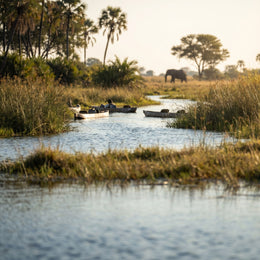
Here I have to be completely honest with you, because this is the part that breaks the most expectations. In the interior of the Okavango Delta, there is no mobile coverage. It's not that it's weak or intermittent: there are simply no antennas. The camps are on islands reached by small plane from Maun and then by 4x4 or mokoro, and all around there's only water, papyrus, and wildlife. You can spend three or four days without a single bar on your screen.
What you will have, with luck, is the camp's satellite link, with the limitations we've already seen: often only in the common area, shared, and slow during peak hours. Many accommodations present it as part of the experience and ask for discretion with mobile phones.
Traveler's tip: In the Okavango, don't try to stay connected; plan for disconnection. Download maps and documents while in Maun, notify people at home that you'll be unreachable for a few days, and leave the safari operator's contact information. All serious camps have radio or satellite phone, so your safety doesn't depend on your mobile.
Moremi, the eastern delta reserve, works the same way: some stray signal near certain access points and silence elsewhere. No card changes this: the problem is not your data plan, but that there's no infrastructure to pick up.
Chobe, Makgadikgadi, and the Kalahari
The rest of the country's major parks follow the same pattern, with nuances worth knowing before booking. In Chobe, famous for its enormous elephant herds, things are slightly better than in the delta: since the main gate is right next to Kasane, you might get some signal from the town's antennas in the river area and during the initial stretch of the river journey. As soon as you venture towards Savuti or Linyanti, however, you enter a horizon without antennas, and your mobile effectively goes dead.
The Makgadikgadi salt pans are another world. It's an immense, flat, empty salt plain, and there the signal appears and disappears capriciously: sometimes you pick up something on the Nata road and then nothing for hours. This is precisely the landscape where it's most important to have your itinerary downloaded, because getting lost in a salt pan without references is a serious problem.
The Central Kalahari is directly the most isolated area of the country. We're talking about a reserve the size of Belgium and Holland combined, with sand tracks and camps without mains electricity. Here there's no debate: there will be no data, period. In summary, the practical rule for Botswana is simple: there's internet where people live and not where animals live.
How much data you need and how to plan
The million-dollar question is how many gigabytes to buy, and in Botswana the answer is lower than people expect. The reason is obvious: during safari days, you'll hardly use any data, because there won't be coverage to use it. Your actual consumption is concentrated in Maun, Kasane, Gaborone, and during road transfers.
| Traveler Profile | Daily use in signal area | For 10 days in Botswana |
|---|---|---|
| Basic (maps, WhatsApp, email) | 300-500 MB | 2-4 GB |
| Medium (social media, photos, some video) | 700 MB-1 GB | 5-8 GB |
| Intensive (video, tethering, work) | 1.5-2 GB | 10-15 GB |
A plan of 5 to 8 GB is more than enough for most people on a one or two-week trip. If you combine Botswana with Victoria Falls or Namibia, make sure your plan also covers those countries. And more important than gigabytes is the routine before entering the bush; mine is this:
- Download offline maps of the entire itinerary, including park tracks, while you have 4G in Maun or Kasane.
- Save offline plane tickets, camp vouchers, and travel insurance, both on your phone and in print.
- Notify home with specific disconnection dates so no one gets alarmed.
- Write down the safari operator's phone number, who does have satellite communication, and leave it with your family.
- Carry a power bank: in several camps, electricity is solar and has limited hours.
Frequently asked questions
Is there coverage in the Okavango Delta?
Almost never. The interior of the delta has no mobile phone antennas, so you can spend several days without any signal. The only thing available is usually the camp's satellite Wi-Fi, often limited to the common area and with no guarantee of continuous operation.
Do I need my passport to buy a SIM in Botswana?
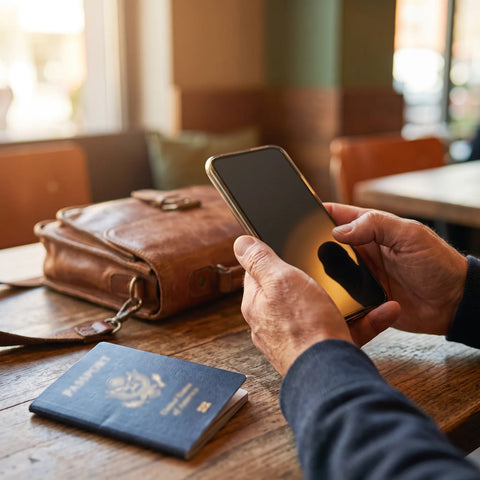
Yes. SIM card registration is mandatory by Botswanan regulatory norms, so you will need to identify yourself with your passport when purchasing it, whether in an official store, supermarket, or petrol station. An eSIM avoids this process because it is activated online before your trip.
Which operator has the best coverage in Botswana?
Mascom is the largest in the country and reaches the most rural areas, followed by Orange Botswana and BTC. However, none cover the interior of the parks: in the Okavango or the Kalahari, there is no network from any operator, so the difference only matters on the road.
Does my Spanish operator's roaming work in Botswana?
It works where there is coverage, but it's expensive. Botswana is outside the European Union, so regulated tariffs do not apply, and many companies charge several euros per megabyte. If you use it, keep data turned off by default or pre-contract a specific data plan for Africa.
Is there Wi-Fi in safari camps?
In many of them, yes, via satellite link, although it is usually limited to the common area and shared among guests. It is suitable for sending a short message or checking email, but don't count on it for video calls or remote work.
How many gigabytes do I need for ten days in Botswana?
Between 5 and 8 GB is more than enough for most people. Actual consumption is low because on safari days there's no coverage for data usage: your spending is concentrated in Maun, Kasane, and during road transfers. If you run short, you can extend your plan.
Is there 5G in Botswana?
There is no commercial 5G deployment in the country. The available network is 4G in cities and main roads, with 3G or 2G in some rural areas. For typical travel use—maps, messaging, photos, and browsing—Botswana's 4G is more than sufficient.
How do I call for help if I'm in the bush without signal?
Through the camp or your guide. Serious safari operators carry radio or satellite phones and have evacuation protocols with delta bush planes. Leave their contact information with your family before entering an area without coverage.
Conclusion
To sum up: Botswana is a country of two digital speeds. In Gaborone, Maun, Kasane, and on main roads, you'll have 4G without issues; in the Okavango Delta, Savuti, Makgadikgadi, and the Kalahari, there will be nothing, and no SIM card can fix that. Save roaming for emergencies, treat camp Wi-Fi as an extra, consider a local SIM if you have enough time for passport registration, and if you want the easiest option, arrive connected from the moment you land with a pre-activated 5-8 GB plan. Download maps in Maun, notify home, and enjoy those days without coverage, which in the Okavango are part of the journey. If you want to sort it out before flying, check out PuraSIM's eSIM for Botswana.