In short: the eSIM for Erasmus and exchange students provides mobile data from day one in the destination country, without expensive roaming or relying on Wi-Fi at home or university. It installs online in minutes, keeps your Spanish number in dual SIM mode, and costs a fraction of what traditional operator roaming would charge for the entire semester.
What is an eSIM and why do you need it for your Erasmus
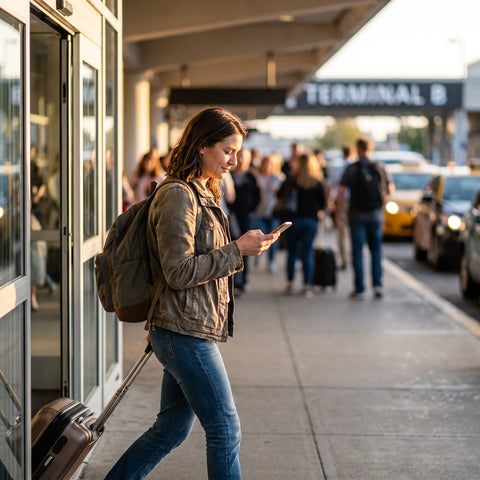
You arrive at the airport, leave the terminal, and immediately need three things: the map to get to your accommodation, the university's WhatsApp group, and Wi-Fi to let your family know you landed safely. Without data, those first few days of Erasmus become a desperate search for open Wi-Fi networks in cafes and stations. With an eSIM active before you even leave, that problem disappears.
An eSIM is essentially a digital SIM card that is installed by software instead of being physically inserted. There's no need to go to a store or queue at the airport: you scan a QR code from your phone and, in minutes, you have data coverage in your destination country. Most smartphones from recent years (iPhone from XS, Samsung's mid-to-high range, Google Pixel, Xiaomi, and others) are compatible, so it's a good idea to check before booking your flight to your Erasmus city.
For an Erasmus student, connectivity is not a luxury: it's the tool you use to enroll in courses, talk to your tutor, locate your residence on the first day, and stay in touch with your family while you adapt. Losing that connection precisely when you need it most adds unnecessary stress to an experience that already demands a lot of adaptation all at once.
How much traditional roaming costs versus an eSIM
Here's the real reason why more and more Erasmus students opt for an eSIM instead of activating roaming with their Spanish operator: the price. Roaming outside the European Union can skyrocket your bill in a matter of days, and although within the EU there's the "roam like at home" regulation that replicates your national tariff, that protection has limits and nuances that you should be aware of before assuming you're covered without restrictions.
The following table qualitatively summarizes how the main connectivity options compare for an Erasmus semester. We don't provide exact price figures because each operator, destination, and tariff varies, and roaming rates can change without notice: always consult your operator's current conditions before traveling.
| Option | Approximate Cost | Main Advantage | Disadvantage |
|---|---|---|---|
| Spanish operator roaming outside the EU | Can exceed several euros per day just for having your phone on | Zero setup, you keep your line as is | Real risk of a high bill at the end of the month |
| EU Roaming ("roam like at home") | Included in your tariff up to a data limit, according to contract | No need to do anything | The included data limit is usually insufficient for an entire semester |
| Local physical SIM in destination | Moderate price, variable by country | Local rates, sometimes with a local number included | Requires documentation, in-person processing, and you lose your number while using it alone |
| International data eSIM (like PuraSIM) | Price adjusted by data volume and plan duration | Installs before leaving Spain, no procedures at destination | Data only: for traditional calls and SMS, you need your Spanish line |
| Data eSIM + Spanish SIM in dual SIM | Sum of both costs, generally much lower than full roaming | Best of both worlds: cheap local data and your number always active | Requires a mobile compatible with dual SIM (physical + eSIM) |
The practical conclusion is simple: if your Erasmus lasts a semester or a full academic year, paying for roaming day by day is almost always more expensive than planning your connectivity in advance. And if your Spanish operator does not include free roaming in your destination — for example, if you are doing an exchange in South Korea or any country without roaming agreements with Spain — the eSIM goes from an option to a reasonable alternative compared to roaming that can be unfeasible.
How to configure your phone: dual SIM is key
The most common question Erasmus students ask us before leaving is always the same: "If I activate an eSIM, do I lose my Spanish number?" The answer is no. Almost all modern smartphones allow two lines to be active at once: your physical Spanish SIM stays in the tray, receiving calls and SMS with your usual number, while the eSIM manages data with a local tariff.
The installation process is practically identical in all cases and does not require technical knowledge:
- Purchase the eSIM before leaving Spain, with a stable Wi-Fi connection at home. This way, you avoid relying on airport Wi-Fi or data you don't yet have.
- Install the profile by scanning the QR code you receive by email, following the device's own instructions (on iPhone and Android, the process is integrated into the "Mobile Data" settings).
- Leave the eSIM deactivated until you land at your destination, unless you want to test it beforehand.
- Configure which line uses data and which uses calls in the phone settings: data via the eSIM, calls and SMS via your Spanish SIM.
- Briefly activate and deactivate airplane mode upon landing to force the phone to search for the local network via the eSIM.
If it's your first time installing an eSIM and you want to see the step-by-step process with screenshots, we have a specific guide on how to install an eSIM that covers the differences between iPhone and Android. And if you are still undecided between eSIM and traditional roaming for your specific case, it is also worth reading the comparison of eSIM versus roaming, because the best option is not always the same depending on the destination and the duration of the exchange.
When to activate the eSIM and how much data you need per month
A common mistake is to leave everything until the last minute and try to activate the eSIM at the destination airport, with luggage in tow and unreliable Wi-Fi. The ideal is to buy and install the profile several days in advance, even if you don't activate it until you arrive: this way, if any questions arise during installation, you have time to resolve them calmly from home.
Regarding consumption, there is no single valid figure for everyone, but you can get a reasonable idea based on your habits:
| Usage Profile | Typical Activities | Estimated Monthly Consumption |
|---|---|---|
| Light use | Maps, WhatsApp, email, occasional browsing | 5–10 GB |
| Medium use | Active social media, streaming music and podcasts, occasional video calls | 15–25 GB |
| Intensive use | Streaming series and videos, online classes, constant content uploads | 30 GB or more |
A trick almost no one mentions: in most student residences and apartments, you'll have Wi-Fi for heavy tasks (downloads, streaming at home, long video calls), so the eSIM doesn't have to cover all your consumption, only what you do outside the house and campus. This allows you to adjust your plan downwards without running out of data. If you also want to stretch every GB to the maximum while moving around the city, take a look at our guide to tricks to save data with the eSIM: small adjustments that make a big difference in a long semester.
Erasmus within the EU vs. exchanges outside Europe
Not all Erasmus experiences are the same when it comes to connectivity, and this is where many students encounter an unpleasant surprise.
If your Erasmus is within the European Union (France, Germany, Italy, Netherlands, Poland, Portugal…), your Spanish operator will probably include free roaming up to a data limit set by your tariff. This is a good base, but it rarely suffices for a full semester of intensive use: once you exceed it, the operator can charge per extra megabyte at an unfavorable price. The most reasonable approach is to use the included roaming as a cushion and supplement it with a data eSIM when consumption spikes, for example during exam periods with online classes or in the first few days of moving.
If your exchange program is outside the European Union — the United Kingdom after Brexit, Nordic countries outside the economic area, or destinations in Australia and New Zealand if your university has exchange agreements with that side of the world — European roaming regulations no longer protect you. In such cases, a local eSIM is no longer an option but simply the sensible way to get data without risking an out-of-control roaming bill.
It's also worth understanding the difference between classic roaming and data roaming managed with eSIM: we explain it in what is data roaming.
Apps every Erasmus student should have installed
With connectivity sorted, the next step is to make good use of it from day one. These are the applications that make life easiest on an exchange:
- Google Maps with the city map downloaded offline: reduces data consumption and provides a backup plan if you lose coverage on a trip.
- Splitwise or a similar app: essential for splitting apartment expenses, weekend trips, and outings with your Erasmus group.
- A banking app with no foreign transaction fees: prevents you from losing money on every purchase or cash withdrawal in local currency.
- Duolingo or similar: use public transport commutes to practice the local language.
- WhatsApp or Telegram: the usual channel for family and Erasmus social life at your destination.
- A translation app with a camera: useful for menus, signs, and paperwork in the local language during the first few weeks.
If your Erasmus includes weekend getaways to other countries—something very common among exchange students—it's wise to plan the connectivity for those trips in advance as well, just as you would for short holidays in Europe: check if your eSIM plan covers multiple countries or if you need to activate a new one for that specific getaway.
What almost no one tells you about eSIM for Erasmus
Beyond the obvious, there are a number of details that are only discovered once you've lived an Erasmus or talked to someone who has. Here are the most important ones to consider:
- You don't need to buy the entire semester at once. Many start with a short plan for the first few weeks and, once they know how much they actually consume (almost always less than they thought), they adjust the next plan up or down.
- University Wi-Fi isn't always as reliable as the faculty promises. Saturated networks during peak hours or credentials that take days to activate. Having your own data frees you from relying on that network for essentials.
- Save the QR code or installation profile in a separate email, not just in screenshots on your phone. If you have to reset your phone during the exchange, you'll be glad you did.
- Check your phone's compatibility before booking the plan, not after. Not all models support eSIM, and some Spanish operators block it by default until you unlock it.
- If you share an apartment, don't assume everyone will use the same solution. Each person has different needs depending on whether they study, work remotely, or make many video calls home.
- Also consider the privacy of your connection, especially if you access the virtual campus from public Wi-Fi networks in cafes or libraries. Combining your eSIM with a VPN is an extra layer of peace of mind that many overlook; we explain it in eSIM and VPN: how to use them together.
Our recommendation for your Erasmus
For the vast majority of Erasmus students, the winning combination is dual SIM: your Spanish line active for calls and SMS, and a data eSIM for browsing at prices adjusted for extended months of use. This formula avoids surprises on your bill, doesn't force you to change your number during the exchange, and gives you connectivity from the first minute at your destination, without queues or paperwork. If your Erasmus destination is in Europe, check out our eSIM for Europe plan, designed precisely for long stays on the continent; and if you return to Spain during a break in the course and need to stay connected without relying on inverse roaming, we also have eSIM for Spain.
At PuraSIM, we always summarize it the same way: land with internet, without roaming, without stress. And for an Erasmus, where you already have enough to worry about in the first few days, that peace of mind is worth more than it seems.
Frequently asked questions about eSIM for Erasmus
Can I continue to use my Spanish number during Erasmus?
Yes. If your mobile is dual SIM (physical Spanish SIM + data eSIM), you keep your usual number for calls and SMS while the eSIM handles mobile data at your destination. You do not lose your line at any time.
How many GB of data do I need per month for an Erasmus?
It depends on your habits, but as a reference: between 5 and 10 GB if your usage is light (maps, messaging, email), between 15 and 25 GB if you are active on social media and occasional streaming, and 30 GB or more if you watch a lot of video streaming outside of home Wi-Fi. As you will have Wi-Fi in the residence or apartment, the eSIM usually covers mostly usage outside the home.
Does the eSIM work on the university campus?
Yes, the eSIM works in any area with coverage from the local operator, including the campus. Many universities also offer their own Wi-Fi within buildings, but the eSIM solves the connection problem for commutes, common areas, and any spot without institutional Wi-Fi.
Can I make calls with the data eSIM?
A data eSIM like PuraSIM is designed for internet, not for traditional calls or SMS. To talk to Spain without additional cost, use applications like WhatsApp, FaceTime, or Google Meet via the eSIM's data; for conventional calls and SMS, keep your Spanish line active in the second slot of your mobile.
Do I need a different eSIM for each country if I travel during Erasmus?
Not always. If you are moving within the same region, a data plan with regional coverage can cover several countries with a single eSIM, which greatly simplifies the typical Erasmus weekend getaways. If you leave that region for an unincluded destination, you will need to activate a specific plan for that country.
What if my phone is not eSIM compatible?
If your device does not support eSIM, the alternative is a local physical SIM at your destination, although this involves in-person procedures and, typically, temporarily losing your Spanish number while you use it. Before traveling, check your phone settings or the manufacturer's website to see if your model is eSIM compatible: most mid-to-high-end smartphones from recent years are.
Is the eSIM reliable for something as important as enrolling or communicating with the university?
Yes, provided you choose a provider that uses recognized local mobile networks in the destination country, just as any physical SIM would. eSIM is not an experimental technology: it's the same type of connection as a traditional SIM, only it's installed digitally instead of physically.