In short: there is no exclusive Toronto eSIM: you use a Canada eSIM, which covers the city, Pearson Airport, and any excursions within the country. It’s installed before you fly, automatically activates upon landing, and saves you from expensive roaming outside the EU. Estimate between 3 and 8 GB depending on the length of your trip.
What is (and isn't) an eSIM for Toronto?
When someone searches for "eSIM for Toronto," they often imagine something hyper-local, as if the city had its own network separate from the rest of Canada. It doesn't. Toronto is in Ontario, so the plan you need is a Canadian national coverage eSIM: the same one you'd use in Vancouver, Ottawa, or Niagara. You buy it once, activate it when you land on Canadian soil, and your phone connects to local networks without touching anything else. This is the same criterion we apply for our Spain eSIM: one plan per country or zone, not a different product for each city.
This is different from an international physical SIM card, which you have to remove and insert into your phone and sometimes can't find at the terminal counter at your arrival time. The eSIM is a digital profile: you scan a QR code before leaving home, and it remains dormant until you land. It's also worth understanding what exactly you're avoiding by using it: if you don't know what data roaming is, that guide clarifies why your Spanish operator charges you extra outside the European Union and why a local eSIM bypasses that charge.

Leave Pearson (YYZ) already connected
Most flights arrive at Toronto Pearson Airport (YYZ), about 25 km from downtown. It's a large airport, with terminals that require a fair bit of walking, and the last thing you want after a long flight is to queue at a phone counter to buy a physical SIM card.
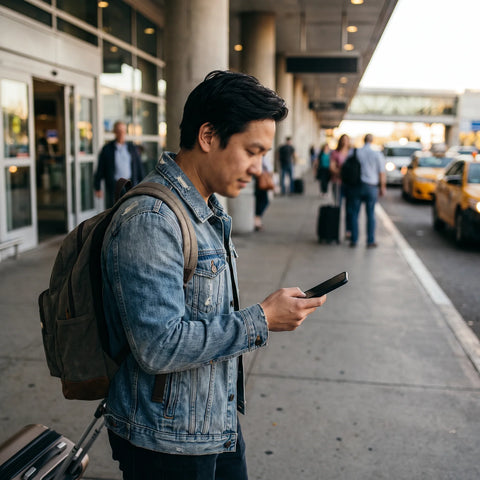
With the eSIM installed and programmed from home, your phone automatically connects to the Canadian network as soon as you land, while you make your way through the terminal to immigration and baggage claim. This comes in handy exactly when you need it most: to order the UP Express or a taxi to downtown, open your map, notify of your arrival, or check your hotel reservation without relying on airport Wi-Fi. Compared to roaming from your operator, which skyrockets in price outside the EU, the difference is noticeable as soon as you see your first day's bill. A practical detail: Pearson has free Wi-Fi in the terminals, so if for some reason the eSIM takes a few seconds to connect, you can calmly check the settings without using data, although it usually starts up without you doing anything.
Coverage downtown and on the TTC (subway)
Toronto has very good 4G/5G coverage throughout the urban area. Downtown, the CN Tower, the financial district, the University of Toronto, Kensington Market, the Distillery District, the Lake Ontario waterfront, and residential neighborhoods all have excellent signal for browsing, video calls, and uploading photos without interruptions.
Above ground: no surprises
On the street, on streetcars (the famous red streetcars), and on buses, you won't notice any difference between your home connection and the one here. The network holds up well even during rush hour on Yonge Street or around the Eaton Centre.
Underground: the TTC requires some foresight
The weak point is the subway (TTC), especially in older sections and stations of Line 1 and Line 2, where the tunnels cut off the signal almost completely. Newer stations on the northern extension have better coverage, but don't count on stable data while the train is running through tunnels. The solution is simple: download an offline city map and have your tickets or transit app loaded before going down to the platform, so you don't have to wait for anything to load just as the train is arriving.
Tip: If you use your phone as a GPS when driving around the city or to the outskirts, activate offline map download before you leave. Ontario highways (the 401, the QEW) are huge and have many lanes with successive exits; a pre-loaded map prevents you from missing a turn while the GPS tries to reconnect.

How many GB you need for your trip
For a city break involving maps, social media, and photos, a reasonable estimate is around 1 GB for every two days of normal use. If you make a lot of video calls, upload video stories, or use GPS all day in the car, increase that figure. This table provides a quick reference before choosing a plan.
| Trip Duration | Light Use (maps, chat, some social media) | Medium Use (active social media, occasional video/streaming) |
|---|---|---|
| 3-day getaway | 1 GB | 3 GB |
| 5 days | 2 GB | 5 GB |
| 1 week | 3 GB | 7-10 GB |
| 2 weeks touring Canada | 5-8 GB | 15 GB or more |
Hotel and many Toronto café Wi-Fi networks save you a lot: download series, maps, and guides at night at your leisure, and save your eSIM for when you're out and about. If you run short halfway through your trip, you can top up in a minute from your phone, without having to buy or install anything new. And if you want to fine-tune the calculation even more based on your travel style, there are specific tips in the guide on how to save data with an eSIM while traveling.
When you DON'T need to buy an eSIM
It's time to be honest, because it's not always necessary. If your layover in Pearson is only a few hours and you're not leaving the terminal, the free airport Wi-Fi is usually enough to check your phone, reply to messages, and find your next boarding gate: you don't need to activate mobile data for that.
It also won't pay off if your Spanish operator already includes Canada in an international roaming plan that you specifically contracted for the trip (they exist, although they are a minority and it's wise to check before leaving home). And if you're going to spend most of your time at an event, a wedding, or an office with stable Wi-Fi, without needing to move around with GPS or post in real time, you can rely on that network and save the eSIM for the day you do move around the city. The eSIM makes sense when you need reliable data outside a fixed network: upon arrival, when moving around, when getting a little lost on a new street. If your plan is to stay put, save your money.
Excursions: Niagara, Montreal, Ottawa and crossing to the USA
Toronto is an excellent base for a day or weekend trip: Niagara Falls is an hour and a half away by car, and Montreal or Ottawa are a few hours away by train or road. The advantage of having a national coverage eSIM is that it works for all of these without buying anything new: data on the 401 on the way to Niagara, on the train to Montreal, or at any intermediate stop.
There's a nuance almost no one considers: Niagara Falls has a Canadian side and an American side, and many people cross on foot or by car to see the view from Niagara Falls, New York. The moment you step onto US soil, you leave the coverage of your Canadian eSIM and need a different plan for that side, even if only for a few hours. If your route includes that crossing, take a look at the eSIM for the United States before leaving Toronto, so you don't run out of data just when you want to record the falls from the other side of the river. For other excursions within Canada, you don't need to touch anything: the same eSIM continues to work, just keep an eye on your GB if the journey is long and you're using your phone as a GPS the whole time.
Installation on iPhone and Android
The process is practically identical on both systems: you buy the eSIM, receive a QR code, scan it from your phone's mobile data settings, and it's installed. It's most convenient to do this at home, with a stable Wi-Fi connection, a few days before flying, and not activate it until you land in Canada, so that the plan's validity period starts when you actually need it. You have the complete step-by-step process, with screenshots for each system, in how to install an eSIM.
Upon landing at Pearson, your phone automatically connects to the local network if you left the eSIM activated or programmed to do so. Remember to turn off data and roaming for your Spanish line before taking off, to avoid any surprises on your bill when you return: your Spanish number remains available for calls and SMS while the eSIM handles data. If you plan to use hotel and café Wi-Fi frequently to save GB, it's also wise to consider the privacy of these open networks; this topic is explained without jargon in eSIM, VPN, and travel privacy, especially if you're checking your bank or making purchases from your phone.
Errors and myths that almost no one tells you about
There are ideas that are repeated trip after trip and that should be debunked before leaving home.
"I need to find a specific eSIM for Toronto." There's no such thing as a hyper-local plan: it's a Canada eSIM, period. Searching for something "city-only" makes you waste time comparing products that actually cover the same, or less.
"The subway has the same coverage along the entire line." Not true: it varies quite a bit depending on the age of the station and the tunnel section. Don't count on constant data underground anywhere in the city, even if the signal is excellent above ground.
"Leaving roaming activated just in case is fine." No, it's not: even if you have the eSIM installed, if you don't disable data for your Spanish line, the phone can switch between both networks without warning, and that complicates troubleshooting if something is slow. Disable it completely and only use the eSIM for data.
"Activate the eSIM as soon as I buy it, to have it ready." Better not: if you activate it in Spain, the plan's validity starts before you need it. Activate it when you land or, at most, the day before you fly.
"If I cross to see the falls from the American side, I'll still have data." As explained above, no: it's another country, another network, and your Canada eSIM doesn't cover that side of the river.
Frequently asked questions
Is there an eSIM just for Toronto?
No. Toronto is in Ontario, Canada, so you use a national eSIM that covers the city, Pearson Airport, and any excursions within Canada. It's more practical than looking for something exclusive to the city, which doesn't actually exist as a real product.
Does the eSIM work right after leaving Pearson Airport?
Yes, if you installed it at home before traveling. Your phone connects to the Canadian network as soon as you land, so you leave the terminal with data to order transportation, open your map, or notify of your arrival, without needing to find a counter or wait in line.
Is there coverage on the Toronto subway (TTC)?
Above ground and throughout the city, 4G/5G coverage is very good. In tunnels and older TTC stations, the signal may weaken or disappear, so download an offline map and have your transit app loaded just in case before heading to the platform.
How many GB do I need for a week in Toronto?
For normal use of maps, social media, chat, and photos, 3 to 5 GB for seven days is usually enough, especially if you use hotel Wi-Fi at night. If you make a lot of video calls or record a lot of video, estimate a bit more and top up in a minute if you run short.
Does the same eSIM work for going to Niagara Falls?
Yes, as long as you stay on the Canadian side. As it's a Canada eSIM, it covers Niagara, Montreal, Ottawa, and the rest of the country with the same plan. If you cross to the US side of the falls, you'll need a different plan for that part of your journey.
Can I still receive calls and SMS to my Spanish number with the eSIM active?
Yes. The eSIM only handles data; your Spanish line continues to work normally for calls and messages, provided you have deactivated data roaming for that line to avoid mixing both networks.
Do I need a specific phone to use an eSIM in Toronto?
You need an eSIM-compatible and unlocked phone (not exclusively tied to an operator that blocks additional profiles). Most mid-range and high-end phones from recent years are, but it's worth checking your settings before purchasing the plan.
Conclusion
Toronto doesn't require its own specific plan: with a Canada eSIM, you'll have internet in the city, at Pearson, and on excursions like Niagara, activated in minutes and without queues at any counter. Forget about expensive roaming outside the EU, understand that the American side of the falls is a different story, and leave the airport already connected, with your eSIM ready before takeoff.