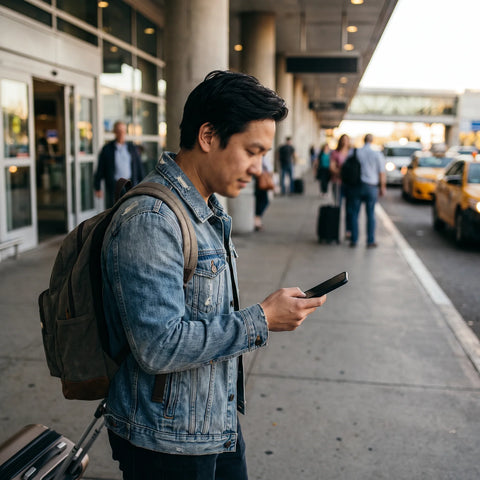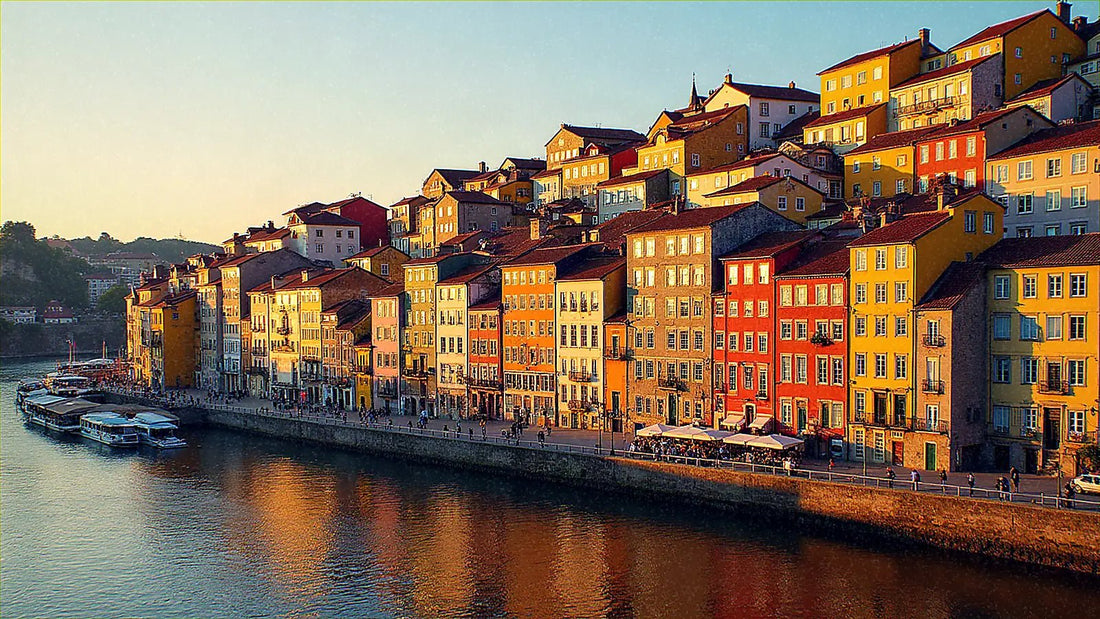
In short: for an eSIM for Porto, there's no city-specific plan. You buy an eSIM for Portugal or Europe, install it before leaving home, and activate it upon landing at Sá Carneiro. 3-5 GB covers a normal weekend (maps, WhatsApp, photos); if you add Braga, Guimarães, or the Douro Valley, it goes up to 8-10 GB.
What is an eSIM and why it's useful for Porto
Porto is perfect for a long weekend or a four-day getaway, and in both cases, you'll be constantly using your phone: the purple metro to the city center, Douro River cruise schedules, your wine cellar reservation in Vila Nova de Gaia, and navigating between the slopes of Ribeira. An eSIM for Porto activated before you leave gives you local data from the moment you step into the Sá Carneiro terminal, without searching for airport Wi-Fi or relying on the hotel's free coverage.
An eSIM is a digital card installed by scanning a QR code, without moving or removing anything from your phone's physical tray. You don't lose your Spanish number, you don't change cards, and you can leave it installed at home days before your trip, at your leisure, without relying on airport Wi-Fi to configure it at the last minute. If you're still not sure how it differs from a regular SIM, we explain what a virtual eSIM is without jargon and with real-world examples.

Porto doesn't have its own eSIM: it's for Portugal (or Europe)
There's no such thing as an "Porto-only" eSIM. A country eSIM works with the network throughout the territory, so the same digital card works in Porto, Lisbon, the Algarve, or when stopping for gas in a Douro village. If your route stays within Portugal, that's the logic you need: one plan, coverage throughout the country.
However, if your trip doesn't end in Portugal (for example, you enter through Porto and leave through Madrid, or combine it with Galicia by road), it's more worthwhile to consider an Europe eSIM: it covers several countries with the same plan, and you don't have to buy a new package every time you cross a border. This is the difference between managing a single eSIM for the entire itinerary or adding separate plans country by country, which also makes it harder to know how many GB you have left in each.
Useful tip: if your return trip passes through Spain and you'll need data there for a few more days, the Spain eSIM covers that leg without relying on your usual carrier to give you good roaming coverage.
Mobile coverage in the Porto area is dense: 4G network throughout the urban area and 5G in much of the city center and tourist spots. To understand why a data eSIM coexists perfectly with your calls and SMS roaming, the article on what data roaming is clarifies the difference between the two concepts, which many people confuse.
How many GB you need for your getaway to Porto
For a classic weekend (maps, WhatsApp, social media, some short videos, and uploading photos), 3 to 5 GB will be more than enough. If you stay for four or five days, do live streams, listen to music on the street, or share the connection with your partner via hotspot, aim for 8-10 GB to avoid running out on the last day, which is when consumption always spikes due to farewell photos.
| Duration | Usage profile | Estimated GB |
|---|---|---|
| Weekend (2-3 days) | Maps, chat, photos | 3 GB |
| Getaway (4-5 days) | Social media, some video, some video calls | 5-8 GB |
| Week or more, with excursions | Intensive use, streaming, shared hotspot | 10 GB or more |
A trick that saves a lot without you noticing it in your travel experience: download the offline map of Porto in Google Maps or Maps.me in advance. This way, you only consume data to update your location and not to download the entire street map every time you exit a metro tunnel. There are more tricks of this kind, designed to stretch your GB without rationing your phone, in how to save data with an eSIM on a trip.

Real coverage by neighborhoods: Ribeira, Aliados, Gaia, and Foz
The area where you'll spend the most time (Aliados, São Bento station, Ribeira, Don Luís I bridge, and the Vila Nova de Gaia wineries) has ample signal. You'll be able to navigate the hills, order a Bolt or Uber back to your accommodation late at night, and check schedules without interruptions.
You will notice a temporary drop in signal inside some Gaia wineries with thick stone walls, inside the Don Luís I bridge itself while crossing on the lower deck, and in some sections of the metro between stations (normal in any city with underground lines). It recovers in a matter of seconds upon exiting. If you go to Foz do Douro, where the promenade moves away from the center, coverage remains stable because it is still a densely urban area.
A tip that isn't so obvious: avoid connecting to the "free" Wi-Fi at tourist viewpoints in Ribeira without verifying the exact network name with the establishment; these are spots with many distracted tourists and trap networks that mimic the real name. With your own mobile data from the eSIM, you completely avoid that risk, especially if you're checking online banking or work email during your trip.
How to activate it before landing at Sá Carneiro
The trick to avoiding wasted time at the airport is to install the eSIM at home, using your Wi-Fi, and program it to connect to the Portuguese network upon arrival. This way, when you land at Francisco Sá Carneiro airport and disable airplane mode, you'll already have data to call for the metro (Line E, the purple one, which connects directly to the center) or a taxi without needing to look for Wi-Fi in the terminal.
The step-by-step process is: buy the plan, receive the QR by email, scan it from your mobile, and follow the on-screen instructions. The entire installation is done with your home internet connection; it's best to save data activation for when you land, so you don't use up any of the plan prematurely. If this is your first eSIM, the complete step-by-step guide is in how to install an eSIM, with screenshots for iPhone and Android.
Airport trick: activate the data plan with airplane mode still on and only turn it off when you exit the plane or the jet bridge. It connects to the local network in seconds, saving you from the roaming welcome screens that some operators still display even if you won't be using them.
If you're torn between an eSIM and a physical prepaid card bought at an airport kiosk, the main difference is time: with a physical card, you have to queue, sometimes show your passport, and wait for the line to activate, whereas the eSIM is ready before you even board the plane. The complete comparison, with the real pros and cons of each option, can be found in physical international chip vs. eSIM.
EU Roaming vs eSIM: when each is worth it
Portugal is in the European Union, so your Spanish tariff should include roaming "as if at home"... on paper. In practice, many economic tariffs limit data abroad or apply a small allowance, and if you exceed that allowance, the extra cost per GB skyrockets. It's advisable to check the specific conditions of your contract before assuming you're covered.
Here, we have to be honest: if your current plan includes ample EU roaming data and your trip is just a short weekend without any other stops, you might not need to buy anything. For a short getaway without excursions outside of Portugal, first check how much roaming data your Spanish line already includes; if it's enough, save the expense. Where the eSIM really makes a difference is on longer trips, on routes that combine several countries, or when your operator is known for overcharging when exceeding the allowance: there you pay a fixed price for specific GB and know exactly what you're getting, with no surprises on your next month's bill.
Activating the eSIM doesn't force you to give up anything from your main line: you keep your Spanish number for calls and SMS, and use the eSIM only for data. You can have both lines active at the same time without any conflict. The complete comparison between the two models, with their pros and cons depending on the type of trip, is in eSIM vs. roaming.
Day trips: Douro, Guimarães, Braga, and Aveiro
Many people combine Porto with a day trip, and here the country (or Europe) eSIM proves its usefulness: you don't buy anything extra or activate roaming; you simply stay connected wherever you go.
The Douro Valley is usually reached by train from São Bento station or on an organized excursion; in the terraced vineyard areas, the signal drops slightly due to the deep valley topography, but it remains usable for basic needs. Guimarães, considered the birthplace of Portugal, has a compact historic center with solid coverage. Braga, slightly larger, also presents no problems, even when climbing to the Bom Jesus do Monte sanctuary. Aveiro, the "Portuguese Venice," has good coverage in the central canal where the moliceiro boats are located, although on the nearby dune beaches (Costa Nova, with its striped houses), the signal weakens a bit as you move away from the urban core.
On any of these day trips, the only real precaution is to download the route map before leaving Porto, because on the road between towns, coverage goes from 5G to 4G or even 3G in specific sections, and you don't want to rely on loading an entire map at that moment.
Myths and what almost no one tells you
Myth 1: "I need a different eSIM if I'm going on excursions outside the city." False. Since it's a country or Europe eSIM, coverage follows you wherever you go within that area. You don't need to buy anything extra for leaving Porto for a day.
Myth 2: "If my Spanish plan includes roaming in the EU, there's no point in getting an eSIM." It depends. If your roaming data allowance is generous and your trip is short, it's true that it might not be worth spending on a separate plan. But many low-cost plans significantly cut data outside of Spain, and that's where you'll notice the difference as soon as you open a few maps and upload photos to social media.
Myth 3: "Hotel Wi-Fi is enough, I don't need mobile data." This is the most common trap for short getaways. Hotel Wi-Fi works for what you do inside your room, but as soon as you go out to find a restaurant, call a car back, or check the cruise schedule, you need your own data; relying on Wi-Fi from bars and viewpoints leaves you stranded precisely when you need it most, and moreover, these are networks that you shouldn't use for anything sensitive.
What almost no one tells you: Sá Carneiro airport has free Wi-Fi, but usually requires you to register with personal data or watch an ad before you can browse, which wastes minutes precisely when you want to call a taxi as soon as possible. With the eSIM already activated, you skip that entire step. Another little-known detail: on the upper deck of the Don Luís I bridge (the one with the panoramic view, next to the Serra do Pilar monastery), it's windier than it seems from below, so if you're going to record a video while crossing, hold your phone tight.
Frequently asked questions
Do I need a specific eSIM for Porto?
No. A city-specific eSIM does not exist as a separate product: you buy an eSIM for Portugal or, if your route crosses borders, an Europe eSIM, and it works the same in Porto as in the rest of the country. It's the same digital card and the same coverage, whether you stay in the city or go on excursions to Braga, Aveiro, or the Douro Valley.
How many GB do I need for a weekend in Porto?
For 2-3 days with maps, WhatsApp, social media, and uploading photos, about 3 GB is sufficient in most cases. If you're going to record video, stream on the street, or share your connection with another person via hotspot, go for 5-8 GB to avoid rationing data on the last day.
Will I have internet as soon as I land at the airport?
Yes, if you install and program the eSIM before leaving home. When you arrive at Sá Carneiro, you just need to turn off airplane mode: it connects to the Portuguese network in seconds, in time to order the purple metro or a taxi to the center without relying on the terminal's Wi-Fi.
Can I still use WhatsApp with my Spanish number?
Yes. The eSIM only provides data; your Spanish number remains active on your main line for calls and SMS. WhatsApp, Telegram, or any messaging app will work with your usual number, using the data provided by the eSIM, without you having to change anything in the app's settings.
Can I use the same eSIM if I continue my trip to Lisbon or Spain?
If you stay within Portugal, yes: the country eSIM covers the entire territory, so Porto and Lisbon are covered with the same plan. If your route crosses into Spain, it's more convenient to consider a Europe eSIM from the beginning, which avoids having to buy a new plan when changing countries.
What happens if I run out of GB halfway through my trip?
You can purchase an additional plan from the same app the moment you need it, without waiting to return home or relying on finding a physical store. That's why it's advisable to calculate your GB with a little margin from the start, especially if you're going on a day trip outside the city.
Does the eSIM work on any mobile?
On most recent models, yes, both high-end and mid-range iPhones and Android phones usually come with eSIM support. Before buying, it's a good idea to check your phone settings to confirm that your specific model supports it and is unlocked, to avoid surprises right before your flight.
Conclusion
Porto is a short and intense getaway: metro, hills, wineries, and a mobile phone you always need close at hand to avoid getting lost in the alleyways. With an eSIM for Portugal, or for Europe if your route crosses borders, you get data at a fixed price, solid coverage throughout the city, and connectivity from the moment you land, without touching your Spanish number. PuraSIM has plans for over 200 destinations and 24/7 support in all languages via email and WhatsApp, so if something goes wrong during installation, you have someone to ask before boarding the plane. Prepare your eSIM before your trip and land at Sá Carneiro already connected, ready to take the metro and cross the bridge to Gaia.