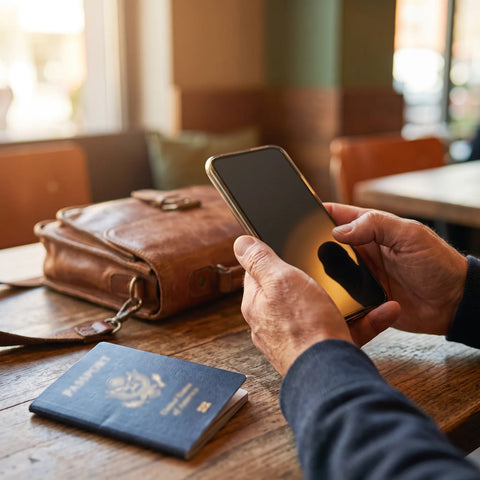
In short: an eSIM for Barcelona gives you internet as soon as you land at El Prat, with no roaming or searching for card shops. It only makes sense if you're coming from outside the European Union: 3-5 GB will cover a multi-day getaway, because actual data usage in the city is less than it seems thanks to Wi-Fi in hotels, museums, and restaurants.
Do I need an eSIM just for Barcelona?
It depends on where you're coming from, and this is where many people lose money without realizing it. If you're traveling from within the European Union, your plan already includes European roaming by law: activating an additional eSIM doesn't add anything, it's a duplicate expense. But if you're coming from outside—the United States, the United Kingdom, Latin America, Asia—your carrier probably charges roaming per megabyte or deactivates your data directly when you cross the border. That's where an eSIM changes the trip: you buy it before you leave home, it arrives by email or QR, and you land with internet without relying on airport Wi-Fi or a shop on La Rambla selling you a physical SIM at a clueless tourist price.
Barcelona is also, above all, a city for short getaways: a long weekend, two or three days combining the Sagrada Familia, the Gothic Quarter, and the beach. For this type of trip, a physical SIM with a contract or constantly topping up credit at a phone shop doesn't make sense: a data plan with just enough GB covers your whole trip, and since it doesn't affect your phone number, WhatsApp and internet calls work exactly the same as at home.

Coverage in the city center, metro, and El Prat
Barcelona has one of the strongest mobile coverages in Spain, and that's noticeable in a tourist's daily life. In Eixample, Ciutat Vella, Gràcia, and the beach areas of Poblenou and Barceloneta, there's plenty of 4G or 5G for maps, video, and sharing a connection with another phone in the group. El Prat airport also has good signal in general, though there's a nuance almost no one mentions: in the passport control area of Terminal 1, with so many walls and people, the signal can sometimes be delayed; it stabilizes once you reach the baggage claim. This is the perfect time to activate your eSIM: while waiting for your luggage, not while queuing at control.
TMB's metro deserves a special mention because it's a rarity in Europe: most stations and a good part of the tunnels have coverage. You can follow your route on the map or reply to a message while going down Passeig de Gràcia without losing connection, something that simply doesn't exist in London or Paris. Where you will notice occasional drops is in very narrow streets of the Gothic Quarter, with tall, closely packed buildings: the signal doesn't disappear, but it sometimes takes an extra second to load a map. If your getaway includes a trip to Montserrat or the Costa Brava, coverage remains strong throughout the province. And if you're wondering about the real difference between relying on your carrier's roaming or a local eSIM, it's worth reviewing the advantages of an eSIM over roaming.
Pro tip: If you land at night on a low-cost flight arriving at Terminal 2, the signal in the shuttle bus area to Terminal 1 is weaker than in the rest of the airport. Activate your eSIM as soon as you step onto solid ground; don't wait until you're already on the bus.
How many GB for a city getaway
A city getaway consumes much less data than people think, because a good part of the time you're on Wi-Fi: at the hotel, in the restaurant, at the museum. For a weekend in Barcelona with maps, social media, photos, and some video, 3 GB will be more than enough. For a full week, 5 GB is a comfortable margin, even if you share the connection with someone in your group.
| Trip duration | Recommended GB | Usage covered |
|---|---|---|
| 2-3 days (long weekend) | 3 GB | Maps, social media, photos, taxi apps |
| 4-5 days | 5 GB | Above + video, video calls, and occasional streaming |
| 1 week | 5-8 GB | Intensive use or sharing internet with another phone |
| Week with a festival or large event | 8 GB or more | Live social media, stories, burst photos |
The key is not to oversize the plan: it's rare for a city break to consume more than 1 GB per day if you use the accommodation's Wi-Fi for large downloads, such as uploading a whole video to social media or backing up photos. Mobile data usage is concentrated during street time: walking to the Sagrada Familia looking at the map, searching for a place to eat in El Born at the last minute, or checking the bus schedule to Montjuïc. A separate case is if your trip coincides with Primavera Sound or a large event at the Fòrum or Montjuïc: with tens of thousands of people connected simultaneously in the same venue, the network gets saturated, and even a generous plan might feel slow during peak concert hours, not due to lack of GB but due to antenna congestion. In that situation, no data trick will help; it's more helpful to activate airplane mode for a while and reconnect, or wait until you move away from the venue. To calculate with more margin according to your travel style, take a look at these tips to save data on a trip with an eSIM.

Barcelona eSIM vs. Spain eSIM
Technically, there's no such thing as an eSIM "just for Barcelona": eSIMs cover entire countries, so a Spanish plan works just as well in Barcelona as in Madrid, Seville, or Bilbao. Far from being a limitation, it's an advantage: with the same plan, you can take a combined getaway—Barcelona plus a jump to Zaragoza or Valencia—without changing anything on your phone.
Here it's worth offering some honest advice: if your trip is only to Barcelona and a couple more days in Spain, you don't need anything more than the national plan. But if your route crosses borders—Barcelona, then Nice or Milan on the same trip—buying a separate plan for Spain and another for France is usually more expensive and complicated than a single regional plan that covers all of Europe at once; in that case, look directly for an Europe eSIM plan instead of chaining country-by-country plans. And if you're coming from a country where your carrier already offers reasonable European roaming, before buying anything, compare what's more cost-effective: sometimes the eSIM clearly wins, other times your home plan already covers you, and buying something additional is throwing money away. To understand exactly what your carrier calls "data roaming" and why the cost sometimes skyrockets, this guide on what data roaming is explains it without technical jargon.
How to activate it upon landing
The process is the same no matter where you buy it for. You purchase the eSIM before leaving home, install it using your home or office Wi-Fi (it arrives as a QR or installation link), and leave it prepared but not activated. Upon landing in Barcelona, you activate the data for that specific profile, and within about a minute, you'll have internet working.
The detail almost everyone forgets: you need to select the eSIM as your data line and activate data roaming specifically for that profile, not for your physical line. Your home SIM can remain active for calls and SMS if you need it, but data will run through the eSIM. If it's your first time using one, it's best to do it calmly before your trip and not in the boarding queue; the step-by-step guide on how to install an eSIM explains it without rush. One more warning: don't try it with your phone in extreme battery saving mode right after landing; some models restrict profile download if the battery is very low, and you'll have to wait to charge it a bit before you can install it.
Tips for getting around the city
Barcelona is best enjoyed with your phone as a co-pilot: metro routes, Sagrada Familia entry times, reserved table in El Born. To maximize your data during your getaway:
- Download the Barcelona map offline before leaving the hotel; it's done in a couple of taps in Google Maps and will save you if the signal is slow in some Gothic Quarter alley.
- Use the official TMB app for the metro and bus: it consumes very little data and prevents you from running out of data just when you need it most.
- Take advantage of Wi-Fi in museums, hotels, and cafes to upload heavy photos or back up data; don't do it with mobile data in the middle of the street.
- Save Sagrada Familia or Park Güell tickets as a screenshot, not just in the app: in the access queue, so many people are connected simultaneously that it can sometimes be difficult to load the QR code at the right moment.
- If you use public Wi-Fi in a bar or at the airport for something sensitive, like online banking, it's wise to be careful: open networks are not the place for that. If you need to handle sensitive data away from home, this guide on eSIM, VPN, and travel privacy explains when it's worth adding that extra layer.
With these habits, even a small data plan will easily last for an intense city break, backpack on shoulder from one neighborhood to another.
Myths and common mistakes almost everyone makes
There are a handful of ideas that recur trip after trip and should be debunked before landing at El Prat:
"I'll buy a physical SIM at a kiosk near Plaça Catalunya as soon as I arrive." This is the most expensive and slowest option possible: you have to find the place, queue, sometimes pay in cash, and manually activate the card. With an eSIM, that step disappears entirely: it's installed from home and activates itself upon landing. The only real reason to prefer a physical SIM is if your phone is very old and doesn't support eSIM.
"If I have an eSIM, I no longer need hotel Wi-Fi." On the contrary: your accommodation's Wi-Fi is your best ally to stretch your data plan's GB. Use it for heavy tasks—videos, backups, downloads—and save the eSIM for getting around on the street.
"At Camp Nou or a big concert, everyone has good signal, so it doesn't matter." Not exactly: with tens of thousands of people in the same venue connected simultaneously, the network gets congested even if the area's coverage is excellent on a normal day. This isn't a problem with your eSIM or your carrier; it's due to saturated antenna physics. Be patient during these sporadic moments.
"A physical international chip is the same as an eSIM, only the format changes." They are similar in result but not in process: one requires a store, physical card exchange, and sometimes cutting the chip; the other is installed via Wi-Fi before leaving home. If you're interested in a complete comparison with examples, here's a detailed explanation of international chip vs. eSIM.
"For a weekend in Barcelona, I need a large plan, just in case." Here's an honest take: if you're going to spend most of your time in the city center, with Wi-Fi in your accommodation and at the places you visit, a 3 GB plan for two or three days is more than enough. Buying too much doesn't protect you from anything; it just costs you more money for data you won't use.
Frequently asked questions
Does a Spanish eSIM work for Barcelona?
Yes, and it's exactly what you need. eSIMs cover entire countries, not just cities, so a Spanish eSIM works in Barcelona just like in the rest of the country. With the same plan, you can travel to Madrid, Valencia, or any other Spanish city without changing anything.
Is there coverage in the Barcelona metro?
Yes. Unlike other major European cities, most stations and a good part of TMB's metro tunnels have mobile coverage, so you can follow your journey on the map or reply to a message without losing signal underground. The connection is stable for messaging and basic browsing.
Do I need an eSIM if I'm coming from another European Union country?
Not necessarily. If your plan includes European roaming, you'll browse in Barcelona with your usual plan and no extra cost. An eSIM makes sense primarily for travelers from outside the European Union, whose carriers do charge expensive roaming or deactivate data when crossing the border.
How many GB do I use on a weekend in Barcelona?
Less than it seems. With maps, social media, photos, and some video, a weekend typically uses around 2-3 GB if you take advantage of hotel Wi-Fi for large downloads. A 3 GB plan more than covers a two or three-day getaway.
Can I activate the eSIM at El Prat airport?
Yes. El Prat generally has good coverage, although it's advisable to wait until you're in the baggage claim area: at passport control, the signal can sometimes be delayed due to the crowd. Just remember to have installed it beforehand with Wi-Fi; the activation itself takes about a minute.
Does the eSIM work for calls and WhatsApp, or only for data?
Most travel eSIMs are data-only: they don't include their own phone number or traditional call minutes. But since they keep your original number active on your physical line, WhatsApp, internet calls, and verification SMS continue to work exactly as they do at home, with no additional cost.
What if I run out of GB halfway through my getaway?
It depends on the plan you've purchased, but generally, you can extend your data from the same app without having to install anything new or go through the setup process again. That's why it's advisable to estimate your plan with a reasonable margin instead of cutting it too close to the limit.
Conclusion
Barcelona is a convenient destination for traveling with an eSIM: excellent coverage even on the metro, a well-connected airport once you pass security, and a getaway that consumes less data than people expect if you take advantage of Wi-Fi in hotels and museums. For tourists from outside the European Union, it is simply the most direct way to get around without roaming or queuing at a kiosk. Prepare your trip with PuraSIM's Spain eSIM and land at El Prat already connected, with your map open before collecting your luggage.