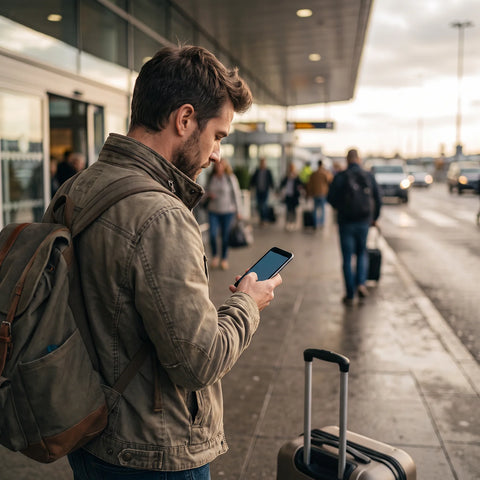
In short: for an eSIM in Cappadocia, you don't need a region-exclusive plan: PuraSim's eSIM for Turkey covers Göreme, Uçhisar, and the rest of the country through local networks. For a 14-day itinerary covering Istanbul, Cappadocia, Ephesus, and Antalya, 15-20 GB is usually sufficient to land with internet, without roaming, and without a physical SIM.
If you're planning a two-week trip to Turkey with Cappadocia as a highlight, the most common technical question isn't "which operator is better?" but something more specific: is there coverage in the valleys where you'll be hiking? Do I need a special plan for the hot air balloon area? Can I use the same eSIM in Istanbul and Göreme, or are they different networks? We'll answer all of this calmly, section by section.
The underlying idea is simple: you land with internet, no roaming, and no need to search for a mobile store on your first day. The eSIM is installed before you leave home and activates whenever you want, so the stress of "will I have coverage when I get off the plane?" disappears from your itinerary.

What exactly is an eSIM for Cappadocia (and why it's not "another product")?
Here's the first clarification, as it causes a lot of confusion: there is no eSIM that covers only Cappadocia. Turkey operates as a single local roaming market, so the same data profile you use at Istanbul Airport is what connects you in Göreme, Selçuk (near Ephesus), or Antalya. What changes from one area to another is not the plan, but the antenna infrastructure on the ground.
That said, it makes sense to specifically search for "eSIM Cappadocia" when what you're actually concerned about is: I'm going to spend two or three days in a region with volcanic terrain, deep valleys, and small towns; will I have the same connectivity as in a big city? The short answer is that in the tourist core (Göreme, Uçhisar, Ürgüp, Avanos) coverage is good; in the hiking valleys and more remote areas, it drops significantly. We'll elaborate on this in the next section.
If you're also traveling across the entire country and not just this region, you might be interested in our general guide to internet in Turkey, where we review country-wide connectivity without focusing on a specific itinerary.
The 2-week itinerary: from Istanbul to Cappadocia, Ephesus, and Antalya
A classic 14-day itinerary through Turkey usually breaks down like this: 3-4 days in Istanbul, 2-3 in Cappadocia, 1-2 in the Ephesus area (based in Selçuk or Kuşadası), and 3-4 on the Antalya coast, leaving the rest for travel and an extra destination like Pamukkale. Connectivity is not uniform throughout the journey, and it's worth knowing what to expect in each section before leaving home.
Istanbul: The first hours set the tone for the trip
Istanbul Airport (IST) has good 4G/5G coverage right from passport control, so if you activate your eSIM before leaving home, you can have it ready to use as soon as you get off the plane. The city, on both the European and Asian sides, has a stable network in tourist areas like Sultanahmet, Beyoğlu, or Kadıköy. A nuance that almost no one mentions: during peak hours in the midday and afternoon, in the most crowded spots (the queue for Hagia Sophia, the Grand Bazaar), the network can be slower not due to lack of coverage, but due to saturation of simultaneous users. If you need to upload a reservation or a ticket right then, be patient a few seconds longer than usual.
Cappadocia: Göreme, Uçhisar, the valleys, and the hot air balloon flight
This is the stop where the most questions arise about the eSIM. In Göreme, which is the base for most travelers, coverage is solid in the town center and most accommodations, including the famous cave hotels (whose own Wi-Fi, let's be honest, is often quite weak, so the eSIM ends up being your primary connection). Uçhisar and Ortahisar, being in elevated areas with direct line of sight to the antennas, often have even better signal than Göreme itself.
Where coverage drops significantly is within the hiking valleys: Rose Valley, Love Valley, Pigeon Valley, or Ihlara. These are routes between tall rock formations that block the signal, so don't count on real-time data to guide you while hiking. Practical recommendation: download the area map in offline mode before entering the valley.
Regarding the hot air balloon flight: booking and payment are usually managed via WhatsApp or email with the local operator, and often the final confirmation (pickup time, changes due to wind) arrives the night before or early that morning. This is a typical scenario where you really need data working, so it's advisable to have the eSIM active from the day before, not leave it for the morning of the flight. During the flight itself, it's common to put your phone in airplane mode: not due to lack of signal, but for safety and to save battery exactly when you want to take photos and videos.
Ephesus and the Aegean coast
Selçuk, the base for visiting the ruins of Ephesus, has normal urban coverage. Within the archaeological site itself, being an open and extensive area, the signal remains reasonably good, though it's advisable to have your entrance ticket downloaded in advance in case the signal drops at some point.
Antalya and the Mediterranean coast
The coastal strip of Antalya has 4G/5G coverage comparable to any established tourist destination in Europe. This is probably the section where you'll think least about connectivity, precisely because it works seamlessly.
Coverage by itinerary segment: what to expect at each stop
This table summarizes, as a guide, the typical connectivity experience in each area of the 14-day itinerary. It does not replace on-site verification, but it helps you plan when to download offline content.
| Itinerary Segment | Expected Coverage | Practical Recommendation |
|---|---|---|
| Istanbul (Sultanahmet, Beyoğlu, Kadıköy) | Stable 4G/5G | Activate your eSIM from the airport without worry |
| Göreme and Uçhisar (Cappadocia, urban area) | Good, sometimes better in high areas | Confirm balloon reservation the night before |
| Hiking valleys in Cappadocia | Weak or null in sections | Download the offline map before entering the valley |
| Selçuk / Ephesus archaeological site | Acceptable, open space | Save tickets offline just in case |
| Antalya and Mediterranean coast | Stable 4G/5G | Good section for video calls or remote work |
| Intercity bus or train journeys | Variable | Have offline content ready for long stretches |
How many GB do you need for 14 days in Turkey?
For a two-week trip that includes Istanbul, Cappadocia, Ephesus, and Antalya, our usual reference is 15-20 GB for 14 days. This range is designed for normal travel use: maps almost all day, messaging, social media, and some reservation lookups. If your plan is lighter (little map usage, Wi-Fi at accommodation) less might be enough; if you plan to work remotely or make daily video calls, upgrade your plan.
| Daily Usage Type | Approximate Consumption | What it includes |
|---|---|---|
| Basic | 300-500 MB/day | Occasional maps, messaging, quick searches |
| Moderate | 0.8-1.5 GB/day | Social media, photos, continuous GPS navigation |
| Intensive | 2-4 GB/day | Remote work, streaming, frequent video calls |
A detail often overlooked: in Cappadocia, if you're constantly using your phone camera for the hot air balloon flight and rock formations, that battery and storage consumption doesn't directly use mobile data, but automatic cloud synchronization does if you have it enabled. If you're tight on GB, check that photo backups are configured to happen only over Wi-Fi. If at any point you run short, you can top up data from the app or customer panel without having to buy a new eSIM or change plans; also check our guide on tricks to save data while traveling if you want to maximize your contracted plan.
You can check the available plans for the country on PuraSim's eSIM Turkey, or if your itinerary is shorter and only covers Istanbul and Cappadocia, consider a plan with fewer GB such as the basic eSIM Turkey.
How to activate your eSIM before flying to Cappadocia (step by step)
The process is the same throughout the country, so you only do it once for the entire trip:
- Purchase your plan on purasim.com for Turkey. You'll receive an email with the activation QR code.
- Install the eSIM: on iPhone, Settings → Cellular → Add Data Plan; on Android, Settings → Connections → SIM Manager.
- Scan the QR code (or enter the data manually if your device asks for it).
- Select the PuraSim eSIM as the default data line, so your phone doesn't try to use your usual carrier.
- Enable data roaming within the settings of that specific eSIM; without this step, it won't connect to local networks.
You can do all of this from home, days before flying, and leave the eSIM ready to connect as soon as it detects a Turkish network. If this is your first time installing an eSIM and you want the process explained with screenshots, we have a complete step-by-step installation guide.
Before buying, check that your phone is eSIM compatible. Most iPhones from XS, Samsung Galaxy from S20, and Google Pixel from 3 are. In Settings → General → About, your device's listing should mention "eSIM" among its options.

eSIM, physical SIM, or roaming: what's best for this trip
For a two-week trip with multiple stops, your home operator's roaming is usually the most inconvenient option: the cost skyrockets depending on your contracted rate, speed is often limited, and you don't know the actual expense until the bill. A local physical SIM is cheaper than roaming, but it means finding a store as soon as you land, queuing, sometimes showing your passport, and losing your usual number while using it.
The eSIM solves both problems at once: you keep your original number for calls and SMS (because the eSIM occupies an independent virtual slot) and you have local data from the moment you land, without going to any store. If you want a complete breakdown of this comparison, we've developed it in eSIM vs. roaming, including the case of the physical international chip.
Common mistakes (and what almost no one tells you) about eSIM in Cappadocia
The same stumbling blocks repeatedly occur among first-time eSIM travelers. Here they are, along with nuances often not explained in generic guides:
- Thinking you need a "Cappadocia eSIM" separate from a Turkey one. This is not the case: it's the same national network. Buying two different plans for the same country only doubles the cost.
- Relying on cave hotel Wi-Fi without checking it first. The charm of sleeping in a cave in Göreme comes at a price: Wi-Fi is often the weakest link in the accommodation. Assume your real connection will be the eSIM, not the hotel router.
- Entering a hiking valley without having downloaded the map. Rose Valley and Love Valley are beautiful, but they are also areas where the signal is lost fastest. An offline map is not optional there.
- Not checking the plan's activation date. Each operator manages this differently: some plans start counting validity from the first network connection, others from purchase. Review the specific terms of your plan before installing it too far in advance.
- Leaving the shared hotspot active "just in case." If you're traveling with others and sharing a connection with a laptop or tablet, consumption skyrockets much faster than it seems. Only activate it when you truly need it.
- Not checking mobile compatibility before buying. Two minutes in Settings → General → About will confirm if your device supports eSIM.
If you're also concerned about privacy when connecting to public Wi-Fi networks in cafes or at the airport, we've dedicated a separate section to it in eSIM, VPN, and travel privacy.

If your itinerary extends beyond Turkey
Some itineraries don't end in Antalya: some people connect to Greece or another European country. If this is your case, you don't need to buy a new eSIM for each country if the next destination is within the coverage of a multi-country plan like the eSIM Europe. Check the specific coverage before purchasing.
Frequently asked questions
Do I need to buy a specific eSIM for Cappadocia?
No. Turkey operates as a single local roaming market, so PuraSim's eSIM for Turkey connects you in Istanbul as well as Göreme, Uçhisar, or any other point in Cappadocia. There is no (and no need for) an exclusive plan for that region.
Is there coverage in the hiking valleys of Cappadocia?
This is the most inconsistent area of the itinerary. In the urban areas of Göreme and Uçhisar, the signal is usually good, but within valleys like Rose Valley or Love Valley, rock formations block the signal in several sections. Download the route map in offline mode before entering.
When should I activate the eSIM for my trip to Turkey?
You can install it on your phone before leaving home and activate it whenever you want: as soon as you land in Istanbul or just before entering Cappadocia. Review the terms of your specific plan to know if validity starts from purchase or from the first network connection.
Is my phone compatible with eSIM?
Most smartphones from 2018-2019 are: iPhone XS onwards, Samsung Galaxy S20 onwards, Google Pixel 3 onwards, and many more current models. Check in Settings → General → About, looking for the mention of "eSIM".
Can I keep my usual number while using the eSIM in Turkey?
Yes. The eSIM occupies a virtual slot independent of your physical SIM, so you can keep your regular line active for calls and SMS while using the PuraSim eSIM for data only.
What happens if I run out of data halfway through my trip?
You don't suddenly lose coverage. You can top up your data from the PuraSim app or customer panel in minutes, without having to buy a new eSIM or change your plan.
How many GB do I need if I only visit Istanbul and Cappadocia (without Ephesus or Antalya)?
If your trip is shorter, with fewer days and fewer segments, a plan with fewer GB than recommended for the full two weeks may be sufficient. Review the available options and adjust based on your daily mobile usage.
Activate your eSIM before you leave and arrive connected from Istanbul to Cappadocia.
View eSIM Turkey plans →