In short: In the eSIM vs. portable WiFi comparison, the eSIM wins for solo or couple travelers: it activates from your phone, there's no device to charge or lose, and the connection is direct. Portable WiFi (pocket WiFi) still makes sense for large groups or with devices without eSIM, such as a work laptop.
If you are about to book a trip and are debating between ordering an eSIM or renting a pocket router, the question is tricky: it's not a question of which technology is "better" in the abstract, but rather how many devices you need to connect and how much luggage you are willing to carry. Let's break it down, no frills.
What each option is and how it works
The travel eSIM
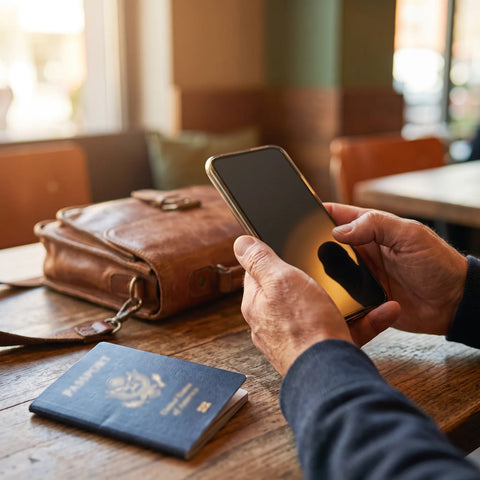
An eSIM is a digital SIM card already integrated into your mobile phone. Instead of waiting for an envelope with a physical card, you purchase a data plan, scan a QR code (or install it with a link from the provider's own app), and in a few minutes, you have active mobile data in your destination country. There's no slot to open, no SIM to lose at the bottom of your suitcase.
Portable WiFi (pocket WiFi)
It's a small router, about the size of a deck of cards, with its own battery, that creates its own WiFi network and shares it with the devices you connect: mobile, tablet, laptop, or camera if it has WiFi. The router has a SIM inside (physical or eSIM) that provides the internet connection; you simply connect to its network as you would to a coffee shop's WiFi.
The fundamental difference lies there: the eSIM puts internet directly into the device you already carry; the pocket WiFi adds an intermediate device that distributes that connection to several devices simultaneously.
| Aspect | Travel eSIM | Portable WiFi (pocket WiFi) |
|---|---|---|
| What you need | Only your eSIM-compatible mobile phone | The router + its charger |
| How it's activated | QR or app, in minutes, no shipping | Airport pickup, delivery, or prior shipping |
| Devices it connects | Yours directly; others via hotspot (drains phone battery) | Multiple devices simultaneously on its own battery |
| Extra weight | None | One more device, plus its charger |
| Risk of loss or forgetting | Practically zero, it's digital | Real: left on the hotel table, in a taxi |
| Battery life | Depends on your phone's battery | Own battery, but needs recharging daily |
| Connection | Direct to the country's mobile network | One extra hop: mobile → router → mobile network |
To properly install an eSIM even before leaving home, it's wise to calmly follow the steps the first time: we explain it with screenshots in how to install an eSIM step-by-step. If you have never used data outside your country, you also need to understand the real difference between eSIM and roaming with your usual operator, because they are distinct things and are often confused.
Price: what factors to compare (without figures you can't verify yourself)
We won't give you a table with fixed prices here, and there's a reason: eSIM prices change depending on the provider and date, and pocket WiFi rental prices vary by company, season, and pick-up country. Any figure you read today could be outdated in a few weeks. It's not useful to memorize a number, but rather to know what factors influence the price of each option to compare well at the time of booking.
- eSIM: you pay once for a data package (for example, for the entire stay) and that's it. The cost depends on the country, the data volume, and whether you need 5G speed. Always check the current price on the destination's product page before purchasing.
- Pocket WiFi: usually charged per rental day, plus a deposit or bond (which may be held on your card until you return the device) and, in some cases, the cost of shipping or airport pick-up.
- Your Spanish operator's roaming, for background comparison: within the European Union, it's usually included in your plan; outside the EU, the cost can easily skyrocket if you don't deactivate it or contract a specific add-on.
The calculation that truly matters is not "eSIM vs. portable WiFi" in the abstract, but "total cost of pocket WiFi for all travel days (rental + deposit + possible penalty)" versus "cost of the eSIM for the GBs you will actually use." If you travel alone, the second calculation almost always works out to be more economical because you don't overpay for capacity for multiple devices you won't use. If there are four of you sharing a single device, the equation changes.

Speed and daily performance
Given equal network coverage, eSIM usually feels a bit more agile because the connection is direct: your phone communicates with the operator's tower without going through an intermediate router. The pocket WiFi adds that extra hop, which in practice translates to a bit more latency, especially if you move a few meters away from the router (for example, leaving it charging in the room and stepping into the hallway).
That said, the real difference is almost always made by the country's network, not the technology you use to access it: if 4G coverage is weak in a rural area of Scotland, neither eSIM nor pocket WiFi will perform miracles. And in destinations with very good infrastructure, like South Korea, both options work solidly; you can see the actual coverage level in our eSIM guide for Seoul and Busan.
Practicality: what really happens when you travel
Specification tables don't tell the part that is most noticeable in actual travel. Some concrete examples:
- You go to the airplane bathroom or step out to take photos without your large bag: with eSIM, you remain connected because the internet lives on the phone in your pocket. With pocket WiFi, if the router stays in your partner's backpack, you'll be without coverage until you meet up again.
- You forget to charge the router one night: with eSIM, this doesn't exist; the battery is your phone's, which you already manage by habit. With pocket WiFi, if it starts the day at 15% and you haven't plugged it in, you begin your excursion day without internet.
- You leave the router at the hotel when checking out in a hurry: this happens more often than it seems. With most rentals, losing or not returning the device incurs an additional charge. eSIM, being digital, doesn't have this risk.
- You need to do banking or enter your work 2FA: connecting directly via mobile network with eSIM is generally more secure than doing so over a WiFi network from a router that has passed through several rental hands.
If you travel light and hate extra cables and chargers, this already tells you a lot. If, on the other hand, you're a family with two teenagers who want their tablet connected in the car, keep reading.
Groups and families: here the pocket WiFi regains points
A portable router can share its connection among several devices at once, which is really convenient if you are traveling in a group and all want to stay connected without relying on one of you activating your phone's hotspot (which, by the way, consumes phone battery at a significant rate).
The alternative with eSIM for a group is for each person to carry their own, which has an often overlooked advantage: if the group separates for a while (one stays shopping, another continues the route), each person maintains their connection independently, without depending on who has the router. For a small group that prefers to maintain individual autonomy, several eSIMs is usually the most practical option; for a family with small children and a single person responsible for connectivity, a shared router simplifies logistics.
If the trip is to Australia or New Zealand with the whole family, it is advisable to plan connectivity in advance because there are sections with irregular coverage outside the cities: we detail this in the eSIM guide for Australia and New Zealand.
When to choose each option (and when not to buy anything)
Choose eSIM if:
- You are traveling alone or as a couple and don't need to connect more than a couple of devices.
- Your mobile is eSIM compatible (most smartphones from recent years are, but it's worth checking before buying).
- You want the lightest option: nothing to carry, nothing to return, nothing to lose.
- You are going to do activities where carrying an extra device is a real hindrance: trekking, diving, festivals.
Consider pocket WiFi if:
- Three or more people are traveling and want to share a single connection.
- You are carrying a laptop or tablet without eSIM that you need to connect for work.
- You are going to a destination where pocket WiFi rental is very common and easy to pick up, like Japan or South Korea.
And when not to buy either: if you're spending a weekend in a European city with good hotel WiFi and plan to move around little, first consider if your own plan with EU roaming already covers you without spending anything extra. Buying an eSIM or renting a router for two days of urban tourism in Lisbon, when your Spanish operator already includes that data for being within the EU, is a waste of money. Reserve the eSIM for outside the EU, long trips, or when you need more data than your plan includes.

What almost no one tells you
Beyond the technical comparison, there are details that are only learned by traveling (or by carefully reading the fine print):
- Mobile hotspot isn't free on battery. If you decide to use your eSIM and share it via hotspot with your partner's laptop, your phone's battery will drain much faster than usual. If you're going to do this for several hours a day, bring a power bank; it's not optional.
- Not all "unlimited pocket WiFi" are truly unlimited. Many rentals have a speed or daily data limit beyond which the connection slows down significantly, even if the ad says "unlimited data." Read the fine print of the rental before assuming you'll have full speed all day.
- The router deposit may be held longer than you think. Some rental companies don't release the charge on your card until they verify that the device has been returned in good condition, which can take days after returning it. If you're tight on funds during your trip, keep this in mind.
- A phone with dual eSIM cannot always use both data lines at once. Some models allow you to have your home physical SIM on standby and the data eSIM active, but not all handle notifications and calls from the standby line well. Check your mobile data settings before leaving to ensure that traffic goes through the eSIM and not through roaming on your Spanish line unintentionally.
- Hotel WiFi is not a reliable backup plan. It's usually the slowest network of the three (eSIM, pocket WiFi, and establishment WiFi), especially in areas with many rooms connected at once in the evening. Don't count on it for important video calls.
How to decide in practice
If you have doubts, ask yourself these three questions in order:
- How many people and devices need to be connected at once? One or two: eSIM. Three or more, or there are laptops without eSIM involved: pocket WiFi or several combined eSIMs.
- How much extra weight and management are you willing to take on? If you prefer not to depend on charging, returning, or looking after an additional device, eSIM almost always wins.
- Is your destination already covered by your current plan? Within the EU, check your roaming before spending anything extra. Outside the EU, compare the total cost of both options with current prices at the time of booking, not with figures you saw months ago.
If you travel frequently and want to stretch the data you purchase, here are real (not generic) tricks for saving data with your eSIM during your trip, such as disabling automatic app updates and downloading offline maps before losing coverage in areas with weak signal.
And if you're concerned about privacy when connecting to shared networks (something that applies whether you use pocket WiFi or hotel WiFi), it's worth understanding what a VPN truly protects and what it doesn't when traveling: we explain it in eSIM, VPN, and privacy when you travel.
Conclusion
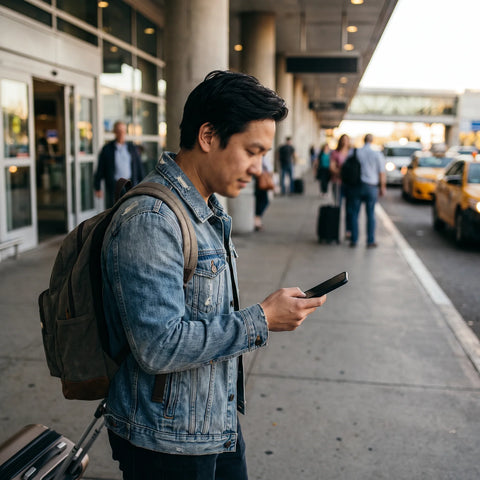
For most solo or couple travelers, eSIM is the simplest option: it activates from your phone, adds no weight or risk of loss, and the connection is usually more direct. Pocket WiFi holds its place when traveling in a large group, when you need to connect devices without eSIM, or in destinations where rental is well-established and easy to pick up. There is no single answer valid for all trips: the correct answer depends on how many devices you need to connect and how much luggage you want to carry, not which technology is "more modern." If you decide on eSIM, at PuraSIM you can check the coverage and current price for your destination before booking.
FAQ: eSIM vs portable WiFi
Which is better, eSIM or portable WiFi, for solo travel?
For solo travel, eSIM is almost always the most convenient option: there's no extra device to carry or accidentally leave behind at the hotel, and the connection goes directly to your phone without relying on a router's battery.
Can I use my eSIM as a hotspot to connect my laptop?
Yes, you can activate your phone's personal hotspot and connect your laptop via WiFi to your own eSIM. The difference from a pocket WiFi is that you consume your phone's battery, so if you're going to work for several hours straight, bring a portable charger.
Is rented pocket WiFi in Japan or Korea worth it compared to eSIM?
In destinations like Japan or South Korea, pocket WiFi rental is very well-established and easy to pick up and return at the airport, making it attractive for groups. If you're traveling solo, eSIM is usually still more practical as you don't have to manage device pickup or return.
Is it safe to connect to shared portable WiFi?
A pocket WiFi router creates its own private network for your group, which is safer than a public hotel or cafe WiFi. Even so, eSIM has the advantage that data travels directly over the mobile network, without passing through an intermediate device that you could lose or that someone else might have used before you.
What happens if I lose or break the rented pocket WiFi router?
Most rental contracts include a financial penalty for loss or damage to the device; review the exact terms and conditions before signing the rental, as they vary greatly from one company to another. With eSIM, there is no such risk because there is no physical device involved.
Do I need to buy an eSIM for each country if I'm touring multiple destinations?
It depends on the provider: some eSIMs cover only one country and others are regional, covering several at once. Before purchasing, check if your route fits better with a per-country eSIM or a regional one, and always review the exact coverage of the plan on the product page.
Can I bring my own pocket WiFi router instead of renting it every time?
Yes, it's an option for frequent travelers: you buy an unlocked router once and then insert local SIMs or eSIMs at each destination. It makes sense if you travel a lot, but it still involves managing different SIMs and carrying an additional device on each trip.